

Quick Answer: Damon Day — my podcast co-host and an independent debt coach — filmed a slow Tuesday night of Walmart Spark and restaurant-delivery work in which he passed on shop orders that paid at or under his own minimum and waited to see whether the pay would rise. Two of them did. He also shows the other side of that bet: another driver can grab the order, or the customer can cancel it. Every dollar figure here is what happened on one night, to one driver, in one market — not typical pay and not a promise. The part worth your time is the method and the arithmetic: miles, time and taxes come out before an offer is worth anything.
Debt is math wrapped in emotion, and an offer on a phone screen is the same thing. The number you see is not the number you keep.
I co-created The Penny Stupid Project with Damon in 2022 as a public experiment in side hustles. It is still The Penny Stupid Project on YouTube (@pennystupid), and the gig-work videos are the ones where Damon does the driving. I tell you I helped start it every time I feature a video, because you deserve to know where I stand before you weigh my opinion. Damon also runs his own debt-coaching practice at damonday.com, which is the first link in the channel’s own description. He is also my podcast co-host, and I receive no payment for featuring his videos or for recommending him.
His newest long video, posted October 8, 2026, is titled I Refused These Walmart Spark Orders Until the Pay Went Up. It runs a little over eight minutes. The setup is simple: a Tuesday night, a few apps open, and a rule he applies to himself about what a Walmart shop order has to pay before he will take it.
Each weekday I send one short email: one story that caught my attention, why it might matter to you, and one manageable thing you can do with it. A couple of minutes, and a dad joke.
In the latest issue (Nov 11): I let AI shop my insurance. I saved $2,000.
Free. I sell nothing. Unsubscribe any time.
What He Passed On, and What He Waited For
The night starts with an offer he treats as a joke: a package delivery listed at $28 for a trip of about 55 miles. He points out that the drive back is also 55 miles, so he is being asked to cover something like 110 miles for $28. He doesn’t take it, and he doesn’t need a spreadsheet to know why.
The more interesting moments are the Walmart shop orders. By his account, an eight-item shop with a 3.5-mile delivery was listed at $14.74, and his own minimum on a shop order is $20. He considers sitting in the parking lot until the pay climbs, then decides that waiting 20 or 30 minutes for a small order to reach a number is just spending an hour of his evening on it, unless he has something better to do with the time. So he went home and got something done instead. When he looked again, the same order had risen to $23 and nobody had taken it, so he went back and did it.
A second shop order, listed at $20, gets the same treatment, only this time he waits while he completes a restaurant delivery. The boost climbs in small steps while he watches. At one point it drops off the board and he isn’t sure it will come back. He takes it when it reaches $27.
A package offer he scoffed at, listed at about 55 miles
One Walmart shop offer, after he went home and checked again
A second shop offer, while he finished a restaurant delivery
These are offers and rounded estimates from one night’s footage, for one driver in one market. They are not typical pay, an average, or a projection, and the pay rising on an order is never guaranteed.
Why the Miles Come Out First
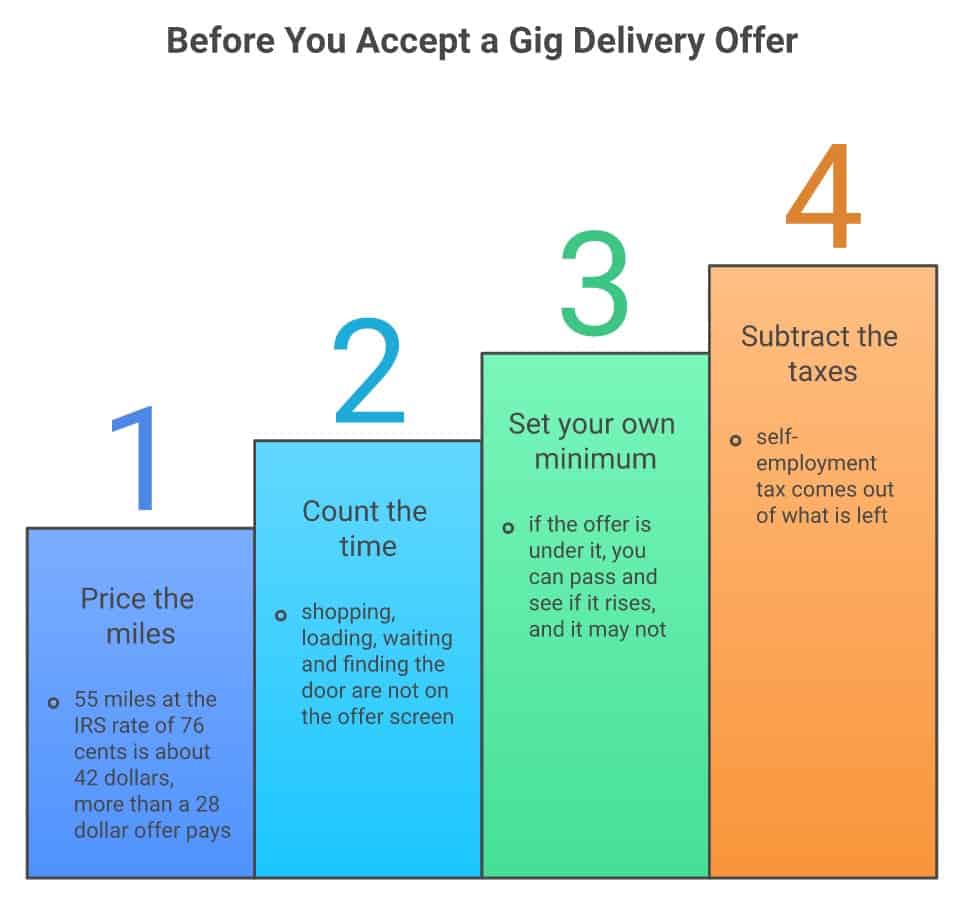
The IRS’s own standard business mileage rate is 76 cents a mile for July 1 through December 31, 2026. It is the number the IRS uses as a stand-in for what gas, tires, maintenance, insurance and depreciation cost per mile. It isn’t a measurement of anyone’s actual costs, but it is a fair yardstick for a driver who hasn’t tracked their own.
What a Few of Those Offers Look Like After the Miles
The 55-mile package offer. 55 miles × $0.76 is about $42. The $28 offer doesn’t cover the miles at the IRS rate, and that is before the drive back, before your time and before any tax.
The short restaurant delivery. He took a two-drop restaurant order listed at $10.75 for 4.6 miles because the route lined up with his drive home. At the IRS rate, 4.6 miles is about $3.50, so roughly a third of that offer is the miles. It passes his test because it was nearly on the way, which is the whole point: the miles you would have driven anyway cost you less than the miles you wouldn’t.
The night as a whole. He reports roughly $98 gross across three Walmart orders and two restaurant deliveries, and at his mileage check late in the video he is at about 34 miles (rounded estimates, per the video’s own description and footage). At 76 cents, 34 miles is about $26, which leaves roughly $72 before income tax, before self-employment tax and before anyone counts the hours. That is still not a wage. It is what is left to pay you for your time.
That 34-mile figure is the part of the video I’d want a new driver to notice. He makes the point that stacking nearby orders matters less for the dollars than for where the extra miles go: a mile you were going to drive anyway is not the same as a mile you drive only for the order. I’d add one caution, and I’m not a tax professional: whether any particular mile is a deductible business mile is a question for someone who is, not for me or a video.
Damon has since counted the miles back to where the next order might be on a shift from a loaner Tesla using Full Self-Driving (Supervised); I wrote up the math on that day across four apps.
The Gamble Inside Waiting
I like that the video doesn’t pretend the strategy always wins. The video’s own description says it plainly: waiting for a boost is a gamble. Another driver can take the order while you’re away, and a customer can cancel and reschedule for tomorrow, especially late at night. Two orders rose for him on this particular night. I’d treat that as the interesting part of one evening, not as a pattern you can count on.
No sense wasting a perfectly good mistake, and the one to avoid here is treating a minimum like a magic spell. A minimum is a decision you make in advance, while you’re calm, so you don’t have to make it in a parking lot while you’re tired. That is a good habit with money in general. But it only works if the minimum comes from arithmetic, not from hope. If the order is going to cost you more in miles, wear and time than it pays, waiting for it to rise is just a slower way to say no. And if you need cash for rent on Friday, waiting on a gamble may be the wrong gamble, which is why a floor has to be set against your own bills and not against someone else’s night.
What I Take From It for Anyone Behind on Bills
I hear some version of this all the time: should I pick up delivery work to catch up on debt? My answer is the one I give about every option on this site: it depends on your numbers, and most people never run them. Gig work can be real, fast cash when you need money now and don’t have savings. You can often start the same day. That immediacy is genuinely valuable if you’re closing a short-term gap.
Before you count it as ongoing income, especially income you’re relying on to dig out of debt, do three things. Count the miles first and subtract them at a realistic rate. Set aside money for self-employment tax as you earn, because the platforms withhold nothing from you. And track what you actually keep over a full week, not the best order you saw on one lucky evening. If the math shows gig work won’t get you out, that is useful information, not a failure on your part. Sometimes the faster, cleaner answer is a different tool entirely, like a hard look at whether bankruptcy fits. You are not your debt, and you don’t have to drive your way out of it if the numbers say otherwise.
Cleaned Auto-Transcript, Condensed
This is a cleaned and condensed rendering of YouTube’s auto-generated captions, with names and numbers corrected against the video’s own description and chapter list. It is not a record of his exact words. Auto-captions get names and numbers wrong, which is why none of it is in quotation marks. Watch the video above for what he actually says.
0:00 – The 55-mile offer. He opens on a package offer listed at $28 for about 55 miles, jokes about being asked to drive 110 miles round trip for it, and moves on.
0:16 – A slow Tuesday. It is a quiet night. He checks Walmart, sees little, and takes a curbside pickup to get started.
0:34 – Why he went home. He is about 39 minutes into the night when a small shop order shows up below his minimum. He explains that waiting in the lot for it to climb would waste the time, so he goes home, makes a video and checks again later.
1:28 – The same shop is now $23. It rose and nobody took it. He accepts, does a quick shop, and heads to a short delivery.
2:05 – The apartment complex. A lighthearted aside about always walking to the wrong side of a building to find the door, and how those extra minutes add up.
2:28 – The return miles matter. He returns to the point that the drive back counts, and uses the package offer as the example.
3:03 – Why he took the smaller restaurant order. It is a two-drop order close to home, so the route fits what he was going to drive anyway.
4:00 – Another shop worth waiting on. He sees a second Walmart shop priced at his minimum, decides whether to take it now or let it sit, and chooses to let it sit.
5:05 – A restaurant delivery while the pay rises. He takes an order whose drop-off is near the store he is waiting on, so about half the miles are ones he would drive anyway, and watches the shop’s pay climb in steps.
6:12 – Take it, or risk losing it. The order drops off the board for a moment. He talks through the risk that someone else takes it or the customer cancels, then accepts at $27.
6:54 – The last shop and the night’s numbers. He finishes the Walmart delivery and tallies the evening, with the gross and the miles in rounded estimates.
7:52 – Where do those miles leave you? He wraps up on the point that how many extra miles you add matters more than the headline pay on any one order. He also makes an hourly claim about his pace that evening, which I’m deliberately not repeating: a gross hourly figure ignores the very things (miles, wear, fuel or charging, taxes) that decide whether a night of this is worth doing.
More From the Side Hustle Archive
I’ve been writing about this project since it started in 2022. A few pieces that pair well with this video:
- Damon Day Thought a $55 Walmart Order Was Worth It. Here’s the Math. — the previous video, and the same subtraction on a different order
- Quick Cash for Bills: Myth vs Reality — the honest version of the I-need-money-fast question
- Side Hustles: When They Help and When They Hurt — the honest boundaries of what a side hustle can fix
- Side Hustle Success: What It Means and What to Do — the mindset piece behind the math
- Making More Money From Home With Online Arbitrage and Amazon — my own side of the original 2022 experiment
- Damon Day Switched His Walmart Spark Zone — why one good order doesn’t prove anything
- Damon Day Asked for an Order Going His Way and DoorDash Delivered. Here’s the Math. — a later video, where he waits on a different kind of offer and the order he asked for shows up
- Damon Day Tried a 10-Stop Walmart Spark Delivery. Here’s the Math After Miles and Tips. — a later video, where bundled tips and incentives did most of the work once the miles were counted
Key Takeaway
Damon Day passed on shop orders that fell below his own minimum, and two of them rose while he did something else. That worked on one night; the video itself says it is a gamble. The useful part isn’t the pay going up. It is the subtraction: at the IRS’s 76-cent standard mileage rate, a 55-mile offer’s miles alone cost more than a $28 offer pays, and that is before your time and your taxes. The figures are what happened to one driver in one market on one night, not a promise, and not a plan.
This is what I’m telling friends like you over coffee. But remember, you do you. Take it as input and make the call that fits your own life.
If you know someone counting on gig work to dig out of debt, send them this before they treat an offer on a screen as real money. Share this with a friend who is thinking about delivery work, because watching someone turn down an order is worth more than any lecture about budgeting.
Common Questions
Who is Damon Day, and what is The Penny Stupid Project?
Damon Day is my podcast co-host and an independent debt coach, and his own site is damonday.com, listed first in the channel’s description. The Penny Stupid Project is a public side-hustle experiment I co-created with Damon in 2022. It lives on YouTube as The Penny Stupid Project, and I tell you I helped start it every time I feature a video so you know where I stand. You can read why I recommend Damon in Why Do You Recommend Damon Day as a Debt Advisor? I receive no payment for featuring his videos or for recommending him.
Is it smart to turn down a low Walmart Spark offer and wait for the pay to go up?
It can be, but there’s no guarantee. In this video two shop orders rose while he waited, and the video’s own description calls waiting for a boost a gamble: another driver can take the order, or the customer can cancel. Waiting only makes sense if you have something better to do with the time and you don’t need that money right now.
What does a delivery offer really pay after miles?
Less than the screen says. The IRS standard business mileage rate is 76 cents a mile for July 1 through December 31, 2026, so a 55-mile trip is about $42 of mileage cost at that yardstick, more than a $28 offer pays. The rate is a stand-in, not your actual costs, and it doesn’t count your time or your self-employment tax.
Are the dollar figures in the video typical Walmart Spark pay?
No. They are one driver’s offers and rounded estimates from one Tuesday night in one market, and he calls the night slow. Pay varies by city, time of day, the orders that happen to appear, and whether other drivers grab them first. Don’t treat any figure as an average or a guarantee for you.
Can gig work get me out of debt?
It can help close a short-term gap, and some people use it that way. Whether it can get you all the way out depends on what you keep after miles, wear and taxes compared with what you owe. If the math says it won’t, other options exist, and I lay all of them out in the debt options comparison, including bankruptcy, which I rate highest across credit, collections, speed and retirement.
Dealing With Debt? Understanding your options is the first step. See how all your debt relief options compare — including ones most sites won’t tell you about. The Find Your Path quiz gives a recommendation based on your actual numbers, and the Scam-O-Meter checks any company’s complaint history before you sign. Federal Reserve Bank of New York research shows bankruptcy filers recover faster than those who don’t file.



