

Quick Answer: A man who says he lives in the Northern District of Illinois filed a proposed class action against American Debt Protection, Corp. on October 7, 2026, in the U.S. District Court for the Northern District of Illinois (case 1:26-cv-12326). His complaint alleges the company made an unsolicited pre-recorded telemarketing call to his cell phone on May 15, 2026, without his consent, in violation of the Telephone Consumer Protection Act. These are allegations in a court filing. No court has made any finding, and the docket entries I reviewed show no response from the company yet.
Expert Context: I ran a credit counseling organization, so I know what a debt relief pitch sounds like from the inside and which questions are worth asking before you pay anyone. This case is a reason to ask those questions. It is not a verdict on anyone.
An Illinois man says a pre-recorded voicemail offering a “hardship personal loan” reached his cell phone without his permission. Whatever the court ends up deciding, the message the complaint quotes is a useful way to practice reading an unsolicited offer carefully.
What the Complaint Alleges
Everything in this section comes from the complaint itself (PDF). The paragraph numbers in parentheses point to its numbered paragraphs. They are allegations, not findings.
Each weekday I send one short email: one story that caught my attention, why it might matter to you, and one manageable thing you can do with it. A couple of minutes, and a dad joke.
In the latest issue (Nov 6): Owed money on an Amazon return? Check by Dec. 1
Free. I sell nothing. Unsubscribe any time.
According to the complaint, the plaintiff alleges that American Debt Protection, Corp. “made unsolicited pre-recorded telemarketing calls to his cellular telephone number” as well as those of proposed class members (¶ 2). It describes the company as a California corporation that makes telemarketing calls into that district (¶ 8). The one call it describes in detail is alleged to have happened on May 15, 2026, and it uses the phrase “at least one pre-recorded telemarketing call to the Plaintiff” (¶ 19).
The complaint quotes the message it says was left: “You’ve been pre-selected for a hardship personal loan up to $42,200. Payments are around $467 a month. What most people do with this is consolidate everything.” It also quotes the line “This pre-selection is active through today at 5 PM only” (¶ 20).
The plaintiff alleges he never consented to telemarketing calls from the company (¶ 16), never requested information from it (¶ 17), and never asked it for “document preparation and consulting services” (¶ 18). The complaint says the call was pre-recorded because “the voice sounded like a robot,” there were delays while the message played, and the message had no personalization (¶ 21).
It asks the court to let the case proceed as a class action for people in the United States who, from four years before the filing through class certification, were called on a cell phone with “the same or a substantially similar artificial or prerecorded voice message” (¶ 24). It pleads one count under the Telephone Consumer Protection Act, alleging the calls were made “without the prior express written consent” of the plaintiff and the class (¶ 37). It says each member is entitled to “a minimum of $500 in damages, and up to $1,500 in damages, for each violation” (¶ 38), and it asks for class certification and damages as allowed by law.
Where the Case Stands
It was filed October 7, 2026, and has been assigned to Judge Andrea R. Wood, with Magistrate Judge Heather K. McShain designated. The docket entries on my case post so far are procedural: an attorney appearance, a clerk’s notice about consenting to a magistrate judge, a civil cover sheet, and a summons filing the clerk marked unprocessed because of a paperwork error. None of that is a finding about anyone. I am reporting from the complaint, so American Debt Protection’s side is not here. If the company responds in court, the response will appear on the docket. My full case post has the filing’s allegations word for word.
I also have an earlier research guide, Is American Debt Protection Legit in 2026? Here’s How to Find Out. The complaint gives no address for the defendant, so I am not saying the company in that guide is the one named in this case.
What I Would Check Before Paying Any Debt Relief Company
I am not telling you what happened on that call. A court will sort that out. But unsolicited offers about debt are everywhere, and the message quoted in this complaint makes a handy practice sheet. Here is what I would do before paying anyone who contacts me first.
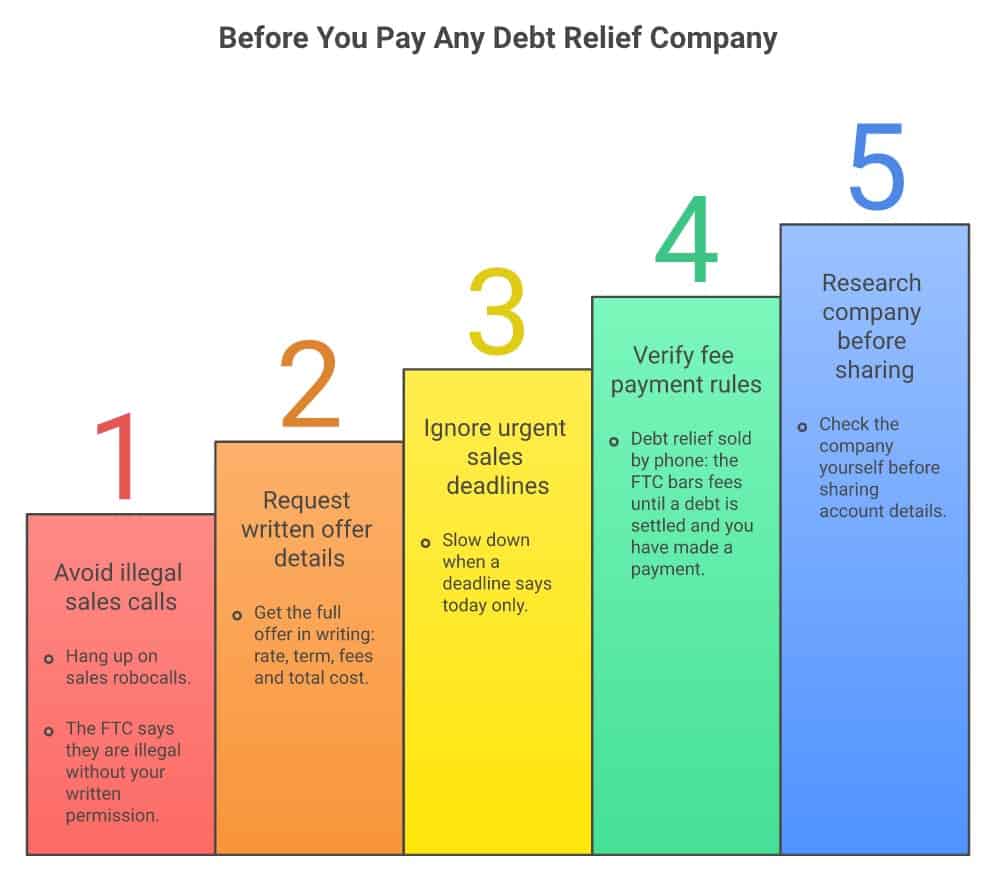
- Treat a sales robocall as a reason to hang up, not to call back. The FTC says a robocall trying to sell you something is illegal unless the company got written permission, directly from you, to call you that way. It also says pressing numbers to speak to someone will probably only lead to more robocalls, and that caller ID is easy to fake. You can report unwanted calls at DoNotCall.gov. I covered the FTC’s Do Not Call Registry report on debt-related calls in this earlier post.
- Ask for the full offer in writing: rate, term, fees and total cost. The message as the complaint quotes it gives a loan amount and a monthly payment, and no interest rate, length or fees. Do the arithmetic yourself. If a payment really is about $467 a month, $42,200 divided by $467 is roughly 90 months, about seven and a half years, before a single dollar of interest. A consolidation loan is a new loan, not debt relief, and it only comes out ahead if its total cost, interest plus fees over the full term, is lower than what you pay now and the payment does not come out of your retirement savings. I walk through that math in a separate post.
- Let a same-day deadline slow you down. If an offer only works when I decide before I can read the terms, I decline it. A deadline tells me about the sales process. It tells me nothing about my numbers.
- If someone sells debt relief by phone, know the FTC fee rule. The FTC’s guidance says such a company can’t collect any money until it has settled or otherwise resolved at least one of your debts, and must wait until you have made at least one payment on the debt. I wrote about it in They Said I Have to Pay the Debt Settlement Company Before They Do Anything.
- Look the company up before you hand over any account details. Run any contract through the Contract Decoder, check the company with the Scam-O-Meter, and read what I have already written about the name.
Keep the full menu in view too. If the real problem is that the debt is bigger than the budget can carry, a new loan just moves it. Debt is math wrapped in emotion, and a message with a same-day deadline makes the emotion louder. You are not your debt, and asking questions before you pay anyone is not being difficult. It is being careful. If you want to see how the options compare on the numbers, start with all your debt relief options.
This is what I’m telling friends like you over coffee. But remember, you do you. Take my advice as input, not instruction, because you are the only one who knows your whole situation.
If you know someone who keeps getting calls about their debt, share this with them. Knowing the questions to ask is half the battle.
Frequently Asked Questions
What does the lawsuit against American Debt Protection allege?
The complaint, filed October 7, 2026, alleges that American Debt Protection, Corp. made an unsolicited pre-recorded telemarketing call to the plaintiff’s cell phone on May 15, 2026, without his prior express written consent, and that other people were called with the same or a substantially similar message. It pleads one count under the Telephone Consumer Protection Act and asks to proceed as a class action. These are allegations only.
Has American Debt Protection been found liable?
No. A complaint is one side’s allegations. The docket entries I reviewed are procedural, no court has made any finding, and the company’s response is not part of the filing.
What does the Telephone Consumer Protection Act say about pre-recorded calls?
The complaint says the law prohibits using a pre-recorded message to call a wireless number without an emergency or the called party’s prior express written consent (¶ 11). The FTC puts it in plain terms: a robocall trying to sell you something is illegal unless the company got written permission, directly from you, to call you that way. Whether this company’s calls broke the law is what the court has to decide.
What should I do if I get a pre-recorded sales call about my debt?
The FTC says to hang up, not press any numbers, and not trust caller ID. You can report the call at DoNotCall.gov. If an offer interests you anyway, find the company yourself, ask for the rate, term, fees and total cost in writing, and take your time reading it.
Can a debt relief company charge me before it settles any debt?
For debt relief sold over the phone, the FTC’s guidance says a company can’t collect any money until it has settled or otherwise resolved at least one of your debts, and must wait until you have made at least one payment on the debt. The FTC says the rule also covers many calls that customers place in response to ads. Check any company’s offer against that rule before you pay.
Before You Sign Anything: Run any debt relief contract through the free Contract Decoder to spot hidden fees and unfair terms. Check the company’s complaint history with the Scam-O-Meter.
Compare Your Real Options: Most debt relief companies won’t tell you about all your options — especially the ones they can’t profit from. Credit counseling has a 21-27% completion rate. Settlement resolves about 1% of enrolled debts fully. Chapter 7 bankruptcy generally ends in a discharge for individual filers in more than 99% of cases, excluding cases dismissed or converted (U.S. Courts) — and protects your retirement. Take the Find Your Path quiz for a recommendation based on your actual numbers.



