

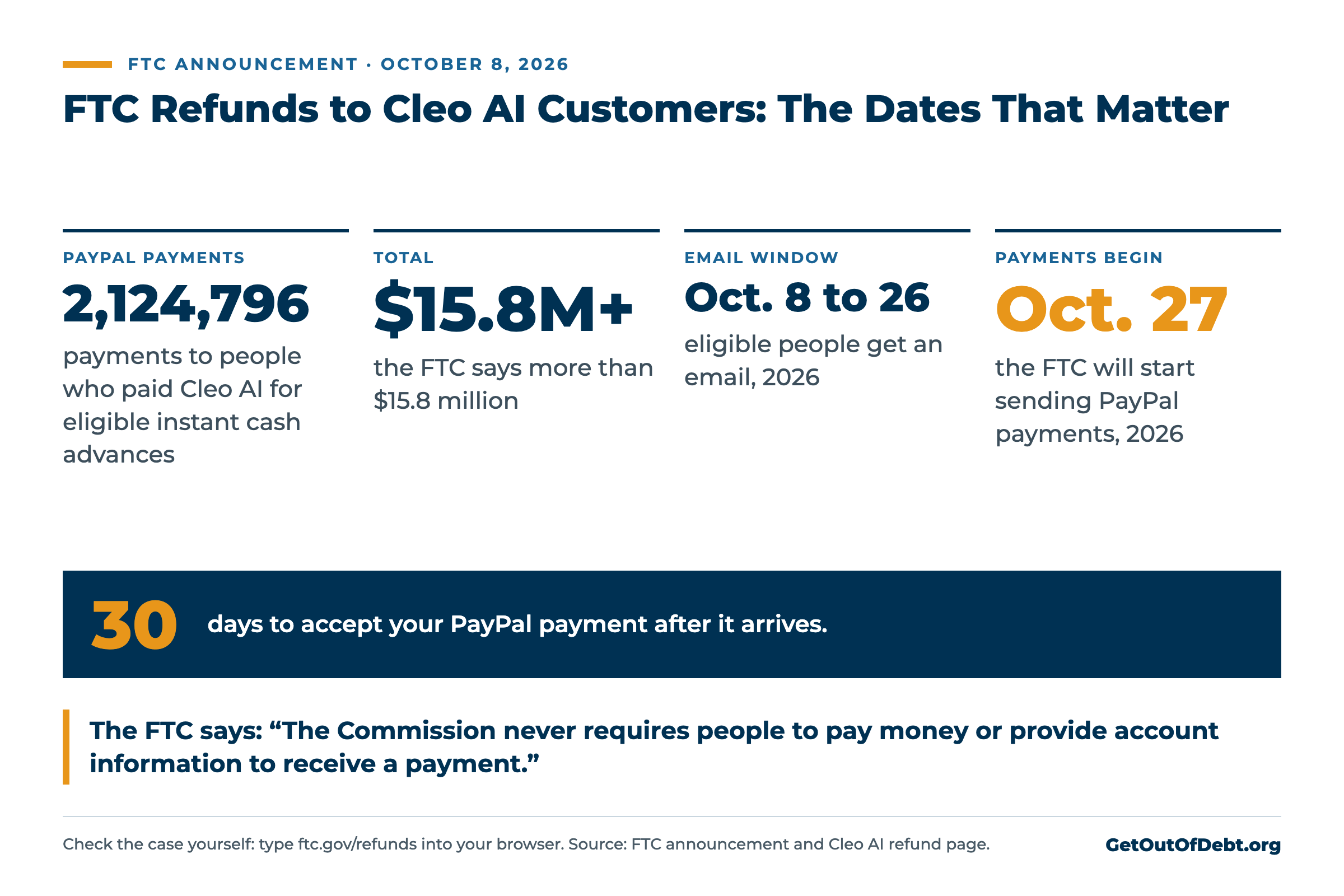
Quick Answer: An email or PayPal payment from the FTC about Cleo AI can be real, and a fake can look the same, so before you click anything, type ftc.gov/refunds into your browser and open the Cleo AI case. On October 8, 2026, the FTC announced it will send 2,124,796 PayPal payments totaling more than $15.8 million to people who paid Cleo AI for eligible instant cash advances. The FTC says eligible people get an email between October 8 and October 26, 2026, and you should accept yours within 30 days of getting the PayPal payment, which the FTC says it will begin sending on October 27, 2026. The FTC says it never requires you to pay money or give account information to get a payment.
Expert Context: I have covered FTC refund programs, and the fake versions that imitate them, on this site for years.
The FTC says a PayPal payment is headed to people who paid Cleo AI for eligible instant cash advances. A refund notice is exactly what a scammer would imitate, so here is what the FTC says is happening, how to check it yourself, and what to do if you used Cleo and nothing arrived.
What You Need to Know
According to the FTC’s October 8, 2026 announcement, the payments go to Cleo AI customers “who paid for eligible instant cash advances.” Its Cleo AI refund page says that if you are eligible, you will get an email from no-reply@consumersentinel.gov between October 8, 2026 and October 26, 2026, the FTC will start sending PayPal payments on October 27, 2026, and “If you get a PayPal payment, please accept it within 30 days.” My reading: the 30 days run from when the PayPal payment is sent to you, not from the day you notice it. Everything about Cleo here is the FTC’s account, not my own findings.
The FTC pages I read do not say what makes an instant cash advance “eligible,” so I cannot tell you whether yours qualifies. Only the FTC’s notice to you can.
Now the math the headline leaves out. The FTC says it is sending more than $15.8 million across 2,124,796 payments. By my arithmetic, not the FTC’s, that works out to about $7.40 per payment on average, and a bit more because the FTC says “more than” $15.8 million. The FTC gives no per-person amount and has not said how individual Cleo payments were calculated, so the amount in your own notice is the only number that counts. On average that is small, and it is still your money. Also, the FTC’s 2025 release said Cleo’s $17 million payment would be used to provide refunds. The new release says more than $15.8 million is going out. The FTC pages I read do not explain the difference, and I am not going to guess.
Why the FTC Is Sending It
The FTC’s refund page describes the case this way:
“Cash advance app Cleo AI promised instant or same-day cash advances. The FTC sued Cleo AI alleging that few customers ever got the promised amounts, and some customers waited multiple days for the promised fast money, even after paying an additional express fee. The FTC said that Cleo AI also made it difficult for customers to cancel their subscriptions.”
The FTC’s March 27, 2025 release said Cleo agreed to pay $17 million to settle the FTC’s allegations, and listed the allegations in its complaint. These three bullets are the FTC’s allegations, not my findings:
- The complaint charges that Cleo’s ads promised access to hundreds of dollars in cash advances, but almost no one received anything close to the advertised amounts.
- Cleo’s ads promised same-day or instant advances, but subscribers had to pay an additional fee for that service, and even after paying it, they could have to wait until the next day for their money.
- Cleo made it difficult to cancel subscriptions. Consumers said they were charged monthly fees despite repeated requests to cancel, and were told they could not cancel until outstanding cash advances were paid.
Those are the FTC’s allegations. The FTC pages I read do not include a statement from Cleo, and I am not adding any accusation of my own. Cleo agreed to pay to settle the FTC’s allegations, and a settlement is not a court finding that they were true. The FTC’s case page has the complaint and the stipulated order if you want to read them yourself.
What To Do With Yours
- The email: the FTC says it comes from no-reply@consumersentinel.gov between October 8 and October 26, 2026. A sender address can be faked, so I treat it as one clue, not proof. Do not click a link in it. Do the lookup below instead.
- The PayPal payment: the FTC says it begins sending them on October 27, 2026. Accept yours within 30 days of when the PayPal payment arrives. The FTC pages I read do not say what happens after 30 days, so I would not test it. The FTC’s general refund FAQ says PayPal then sends its own email telling recipients about the refund. It also says you only need to provide your name and email address to create a PayPal account — give those only at PayPal.com after typing the address yourself, never in reply to an email or on a page a link opened.
- Questions: call the refund administrator, Rust Consulting, at 1-877-788-4958, the number on the FTC’s Cleo AI refund page.
- Taxes: the FTC’s general FAQ says to ask a tax advisor if you have questions, and says it generally does not issue 1099s to refund recipients unless it is required to report a payment to the IRS.
Check It Before You Click
This is what the headline skips. The FTC’s release says: “The Commission never requires people to pay money or provide account information to receive a payment.” Its refund page adds: “No, the FTC never asks you to pay to get a refund.” And it says that if someone calls “demanding money, making threats, or telling you to transfer money, or promising you a prize, it’s a scam.”
Here is how I would check it, step by step:
- Look the case up yourself. Type ftc.gov/refunds into your browser. The FTC’s FAQ says a case with payments is listed there with the name of the company issuing payments and a phone number for questions. Do not trust a number or link in a message, and do not just trust this post either. Check the FTC’s own page.
- Do not click links in emails that seem to be from the FTC or PayPal. The FAQ says it is safer to go to the website by typing the URL into your browser, ftc.gov/refunds or PayPal.com. My suggestion, not an FTC instruction: from October 27 on, type PayPal.com into your browser yourself and sign in. I would expect a real payment to appear as money sent to you, never as an invoice or a request for you to pay. The FTC pages I read do not say which email address the payment goes to or how long the rollout takes, so if nothing appears, that does not mean you were left out and it does not mean the program is fake — call the refund administrator at the number on the FTC page.
- Expect no fee. The FAQ says: “Never pay money or give sensitive financial information to get a refund payment from the FTC.” Report anyone who asks at ReportFraud.ftc.gov.
- Watch the calendar. The FTC says PayPal payments begin October 27, 2026. That is its schedule, so my read is to be extra careful with anything claiming to be a Cleo payment before then.
If You Used Cleo and Got Nothing
Do not panic yet. The FTC says eligible people get an email through October 26, 2026, so the emails may still be on their way. Here is what I would do:
- Look through the email account tied to your Cleo account, spam folder included. That is my suggestion, not an FTC instruction.
- Wait until October 26. That is the last day of the FTC’s email window.
- Then, if nothing shows, or if your Cleo account used an email address you can no longer get into, call Rust Consulting at 1-877-788-4958. The FTC’s refund page names the refund administrator as the place for other questions.
- Understand what the FTC does and does not say. It says payments go to people who “paid Cleo AI for eligible instant cash advances.” It does not say whether someone who paid only for a subscription is included, and it does not say they are excluded. The release’s opening line says the money is going to “consumers impacted by” Cleo’s “deceptive claims about the amounts and timing of available cash advances” and its “hard-to-cancel subscriptions”, but its sentence on who gets paid refers only to people who paid for eligible instant cash advances. Ask the administrator. The Cleo pages mention no claim form. The general FAQ says most FTC cases do not require you to file one, and that if the FTC needs claims it will post the details at ftc.gov/refunds.
- The FTC says it does not require you to give up your rights — which is not the same as saying you have a claim against anyone. The FAQ says the FTC does not require you to give up any rights under federal or state law to get your refund.
Things to Consider if You Live Paycheck to Paycheck
The FTC alleges that Cleo’s ads promised hundreds of dollars and almost no one got close, that instant delivery cost an extra fee and could still take until the next day, and that canceling was hard. That is the FTC’s account of one company. Here is how I would use it. Before you use any cash advance app, get answers to these in writing or in a screenshot:
- What is the most I will actually get on day one, not the biggest number in the ad?
- What will I pay to get it fast, and how fast is fast?
- Is there a subscription, and how do I cancel it before I take an advance?
The FTC’s refund page points to two consumer guides: Payday Loans and Cash Advances Explained and its guide to getting in and out of free trials, auto-renewals, and negative option subscriptions. I also have my own posts on earned-wage-access apps and on finding emergency money when your credit is bad.
My Take
A surprise payment is nice, and it is also exactly what a scam looks like, so be happy and slow. Verify first, then accept it, because even a small payment is your money. If anything asks you to pay, stop. The only place I would enter anything is PayPal.com after typing the address myself, and PayPal may ask for more there than the FTC ever will. Debt is math wrapped in emotion, and a small payment will not change your math. But if a cash advance app has become part of how you get from one paycheck to the next, that is information worth acting on, and it says nothing bad about you. You are not your debt. For more, see how to tell a real settlement notice from a fake one, the free Scam-O-Meter tool, and my January 2026 roundup of FTC refunds. If your check is about Walmart money transfers instead, see how to check an FTC Walmart refund check before you cash it.
Frequently Asked Questions
Is my Cleo AI email or PayPal payment from the FTC real?
It can be. The FTC announced on October 8, 2026 that it is sending 2,124,796 PayPal payments to people who paid Cleo AI for eligible instant cash advances. Type ftc.gov/refunds into your browser, find the Cleo AI case, and match the phone number. The FTC says it never requires you to pay money or provide account information to receive a payment. Do not click links in emails that seem to be from the FTC or PayPal.
Who is getting a Cleo AI payment, and how much will it be?
According to the FTC, people who paid Cleo AI for eligible instant cash advances. The FTC gives no per-person amount. Dividing its totals gives about $7.40 per payment on average (a bit more, since the FTC says “more than” $15.8 million), which is my arithmetic and not an FTC figure, so your own notice is the only number that counts.
How long do I have to accept the PayPal payment?
The FTC’s words are “If you get a PayPal payment, please accept it within 30 days.” It says it will begin sending PayPal payments on October 27, 2026, and that eligible people get an email between October 8 and October 26, 2026.
I used Cleo and got no email. What do I do?
Check the email account tied to your Cleo account, including spam, and wait until the FTC’s email window closes on October 26, 2026. Then, if nothing shows, or if your Cleo account used an email address you can no longer get into, call the refund administrator, Rust Consulting, at 1-877-788-4958. The FTC pages do not say whether subscription-only customers are included, so ask.
If I accept the payment, can I still take legal action?
The FTC’s general refund FAQ says it does not require you to give up any rights you may have under federal or state law to get your refund — which is not the same as saying you have a claim against anyone.
This is what I’m telling friends like you over coffee. But remember, you do you, and only you can decide what is right for your situation. Take what I have said as input, not instruction.
Know someone who used Cleo, or who just got an email from the FTC and is unsure if it is real? Send them this before they click.
For more stories like this, sign up for my free weekday email, Your Money Actually.
Dealing With Debt? Understanding your options is the first step. See how all your debt relief options compare — including ones most sites won’t tell you about. The Find Your Path quiz gives a recommendation based on your actual numbers, and the Scam-O-Meter checks any company’s complaint history before you sign. Federal Reserve Bank of New York research shows bankruptcy filers recover faster than those who don’t file.



