

Quick Answer: As of the National Hurricane Center’s 1:00 PM CDT advisory on Thursday, October 8, 2026 (Intermediate Advisory 8A), hurricane, tropical storm and storm surge warnings are in effect along parts of the northern Gulf Coast, and the NHC says preparations in the warning area should be rushed to completion today. Evacuation orders and your local emergency officials come before anything in this post. For your money, the first thing to find is the hurricane deductible on your policy’s declarations page, because regulators say it can be a percentage of the home’s insured value instead of a flat dollar amount. Flood damage is a separate policy. Photograph your belongings, keep every receipt, and after the storm call your insurer first, then call your mortgage servicer and other lenders before a payment is due. FEMA: You can apply only after a major disaster declaration that includes Individual Assistance covers your county, and applying is not the same as being approved.
Safety first: If local officials have ordered an evacuation for your area, leave. The NHC’s own advisory says: “Promptly follow evacuation and other instructions from local officials.” Nothing in this post is worth delaying that for. It will all still be here when you are somewhere safe.
Expert Context: I am not a meteorologist, an insurance adjuster or an emergency manager, and I am not going to pretend to be one. For this post I read the National Hurricane Center’s advisory and the consumer pages published by the NAIC, state insurance departments, FEMA, Freddie Mac, the CFPB, the FTC and the IRS, and I put the money questions in the order I would ask them. Every number below comes from the National Hurricane Center, the National Association of Insurance Commissioners (NAIC), a state insurance department, FEMA, Freddie Mac, the CFPB, the FTC or the IRS, and I name or link the page next to each claim. Debt is math wrapped in emotion, and a hurricane adds a deadline to both.
A hurricane warning tells you about wind and water. It does not tell you the number that may matter most to your wallet: what you will owe out of your own pocket before your insurer pays anything on a hurricane claim. For many homeowners that number is a percentage of the home’s insured value, and it is on a piece of paper you may not have looked at in a year.
Each weekday I send one short email: one story that caught my attention, why it might matter to you, and one manageable thing you can do with it. A couple of minutes, and a dad joke.
In the latest issue (Nov 13): The shelf price isn't always what you pay
Free. I sell nothing. Unsubscribe any time.
What the National Hurricane Center Said at 1:00 PM CDT Thursday
This section is a snapshot, and it will go out of date. I am quoting the National Hurricane Center‘s Hurricane Isaias Intermediate Advisory Number 8A (AL092026), issued at 1:00 PM CDT on Thursday, October 8, 2026. Check nhc.noaa.gov and your local National Weather Service forecast office for the current advisory before you rely on any of it. The advisory itself says: “For storm information specific to your area, including possible inland watches and warnings, please monitor products issued by your local National Weather Service forecast office.”
If your area is not on this list, that does not mean you are clear, because warnings are extended and changed with each new advisory — check nhc.noaa.gov and your local officials for the current one.
The warnings and watches in effect in Advisory 8A, as the NHC lists them:
- Storm Surge Warning: Mouth of the Mississippi River to the Suwannee River
- Hurricane Warning: Ocean Springs, MS to the Bay/Gulf County Line, FL
- Tropical Storm Warning: Jefferson/Plaquemines Parish Line, LA to west of Ocean Springs, MS; and East of Bay/Gulf County Line to Aucilla River, FL
- Storm Surge Watch: Suwannee River to Yankeetown
The advisory’s headline says preparations to protect life and property from storm surge and damaging winds in the warning area should be rushed to completion today (the headline is in capital letters; I have lower-cased it). I am not forecasting where this storm goes or what it does. I am telling you what the NHC said at 1:00 PM CDT, and that the money steps below are easier to do today, while you are not in the middle of it.
Your Hurricane Deductible May Be a Percentage, Not a Flat Amount
The National Association of Insurance Commissioners (NAIC) says a hurricane, or named storm, deductible “can be expressed as a fixed dollar deductible or, more commonly, as a percentage of the home’s insured value.” The NAIC also says it “is applied separately from standard peril deductibles” and that “triggers vary from state to state, as well as from insurer to insurer.” Ask your agent what triggers it on your policy. A storm page published by Florida’s insurance consumer advocate says: “Most insurance policies have a hurricane deductible of 2 to 5 percent of a home’s insured value; some are a set amount such as $2,000. You can locate the hurricane deductible on your insurance policy’s declaration page.”
A Worked Example (An Example Only, Not Your Number)
Say a home is insured for $300,000. A 2% hurricane deductible would be $6,000. A 5% hurricane deductible would be $15,000. The Alabama Department of Insurance uses the same kind of example: a 5% named storm deductible on a $300,000 house means the policyholder is responsible for paying $15,000 out of pocket. Your percentage, your insured value and your dollar figure are on your own declarations page. Please look at them rather than trusting my example.
The sources do not all give the same range, which is one more reason not to guess. Alabama’s insurance department says percentages can range from 1% to 10% of the value of the insured home, and the NAIC says the percentage can run “from 1% to as high as 15%.” Alabama’s page also says the deductible can be per event, per season or per calendar year, so read your policy to see which kind you have, and that named storm deductibles are separate and may be a different amount than your normal homeowners deductible.
Why this matters for your money: the NAIC defines a deductible as “the amount of loss paid by the policyholder before any loss is paid by the insurer.” If a $6,000 hurricane deductible is sitting between you and the insurer’s check, you want to know whether you could cover it before the adjuster tells you. If you have been planning to send every spare dollar to a credit card this month, this is a reason to pause the extra payments, not the minimums; keep making at least the minimum payments while you can. I wrote about whether to use your emergency fund to pay off debt, and cash set aside for a number like this is exactly what that fund is for. If you want the three lines I told East Coast readers to check before the September nor’easter, they are in this post.
Flood Is a Separate Policy
FEMA’s flood insurance page says: “Most homeowners insurance does not cover flood damage. Flood insurance is a separate policy that can cover buildings, the contents in a building, or both.” The Mississippi Insurance Department’s hurricane checklist says the same thing in its own words: homeowners’ policies do not cover flood damage caused by rising water. The NHC says a storm surge warning means there is “a danger of life-threatening inundation, from rising water moving inland from the coastline” in the places the warning covers. Which parts of your damage a given policy pays for is a question for your policy and your insurer. I cannot answer it for you, and neither can the news. If the storm has already passed and water got in, here is what to check before you put flood repairs on a credit card.
The other catch is timing. FEMA says “there is typically a 30-day waiting period for an NFIP policy to go into effect,” with some exceptions, so a flood policy bought today will usually not cover this storm. Separately, and about homeowners coverage in general rather than flood policies, Mississippi’s Insurance Department says: “most all insurance companies will not accept new applications after a designated hurricane enters the Gulf of Mexico or the area located in the boundaries of 80 degrees West longitude by 20 degrees North latitude.” Other states and companies may handle this differently. That is why the flood question belongs on a calendar in the spring, not the week of a storm.
Before the Storm, If You Have Time
If local officials have told you to leave, take your policy declarations page if it is within reach and go. Do the rest of this section only if you have not been told to leave, or once you are somewhere safe; the written inventory can wait.
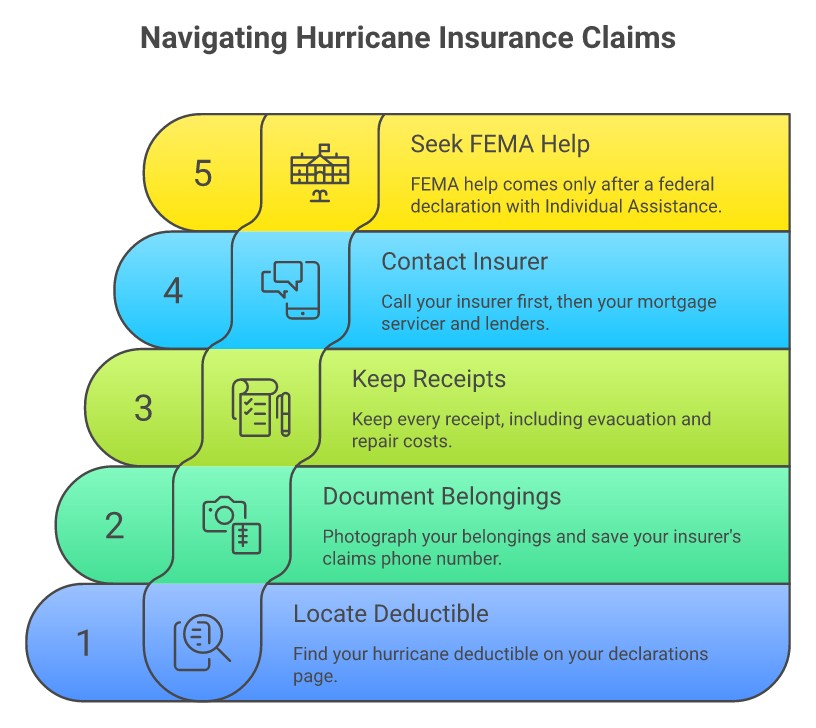
- Photograph or film your belongings, room by room. FEMA’s Ready.gov guide says you can take photos or videos to record your belongings, “but be sure to also write down descriptions, including year, make, and model numbers, where appropriate.”
- Find your declarations page and save a copy somewhere that does not depend on your phone’s battery. Ready.gov says to store paper copies “in a waterproof and fireproof box, safe, or bank deposit box” and to leave copies with trusted relatives or friends.
- Write down your policy number and your insurer’s claims phone number. Ready.gov: “Keep your policy number, your insurance professional/company phone number, and claim filing instructions in a secure, convenient location.” The Mississippi Insurance Department suggests a wallet card with your insurance company’s name, the location of your inventory records, and the phone numbers for reporting claims.
- If you evacuate, tell your agent how to reach you. The Mississippi Insurance Department says to contact your agent and leave a phone number and address.
- Keep every receipt. Mississippi’s regulator says to keep all receipts and take photos of the damage, before and after repair, to submit with your claim. Florida’s insurance consumer advocate says to keep receipts for additional living expenses and other out-of-pocket expenses that may be covered by your policy. Ask your insurer whether your policy pays “additional living expenses” for things like hotels and meals. I cannot tell you what yours will reimburse.
If you live in one of the warned states, your state insurance department has a page for this. Florida’s Insurance Consumer Helpline is 1-877-693-5236. The Louisiana Department of Insurance prints 1-800-259-5300 in its post-disaster guide. The Alabama Department of Insurance prints (800) 433-3966 in its natural disasters guide. Mississippi’s hurricane checklist points to its Request Assistance page. Check each department’s website for the current number.
After the Storm: Insurer First, Then the Bills
The CFPB opens its disaster guidance with this: “After a disaster, your priority is your own safety and meeting your day-to-day needs. Once you’re safe, focus on the bills you need to pay first.” My reading of that: if the storm leaves you unable to cover both, food, shelter and safety come before a credit card minimum, and the move then is to call the card company before the due date (Step 3), not to skip quietly, because a missed minimum can still bring late fees and a mark on your credit report. If you want a longer read on that, I wrote one years ago: Debt After a Natural Disaster: Survival Guide.
Step 1: Call your insurance company. The CFPB’s step one is to call your insurance company to file a claim. Take pictures or video of the damage if you can, and the CFPB says to do that “before and after you perform any repairs yourself.” The Mississippi Insurance Department says to keep track of the special reference number your insurer gives you for the claim. Ask what deductible applies to your claim, and check it against the figure on your declarations page.
Step 2: Call your mortgage servicer, if you own your home. The CFPB is plain: “After a disaster you still have to pay your mortgage. However, there are steps you can take to get help.” It tells you to contact your servicer, explain what happened, and ask three things: what options are available to help you temporarily reduce or suspend your payments, whether there are forbearance options, and whether they can waive late fees.
Here is the part nobody should promise you, including me. Forbearance is not forgiveness. The CFPB says it “does not erase or decrease the amount you owe on your mortgage” and that you have to repay missed or reduced payments. It tells you to keep asking questions until you understand how much you must pay and for how long payments are paused or reduced, how interest accrues during that time, and when and how you pay back the paused amounts. It also says some servicers require that forbearance or hardship help be requested within a specified time after a disaster, so ask what that deadline is.
Whether you get anything depends on who owns or guarantees your loan. The CFPB says that if your loan is not insured or sponsored by entities like Fannie Mae and Freddie Mac, “any disaster relief or assistance will be up to the owner or servicer of your loan,” and that federal rules “allow, but do not require” a servicer to offer help. If your mortgage is government insured or sponsored, the CFPB says it may have specific programs to assist you. Freddie Mac’s page says that if Freddie Mac owns your loan, you become eligible for its disaster relief options — eligible is not the same as approved — when your ability to pay your mortgage is affected because, among other reasons, your home is in a FEMA-declared disaster area eligible for individual assistance or your home has experienced an insured loss. It also says that to be eligible for its special disaster flexibilities, you must have been current with your mortgage payments, or not more than one payment behind, when the disaster occurred, and it has a Loan Look-Up Tool to find out whether it owns yours. If you get stuck, the CFPB says you can call (855) 411-CFPB (2372) to be connected with a HUD-approved housing counseling agency. And if the payment problem turns into something worse, I wrote what to do if you are facing foreclosure and if you get a notice of default.
Step 3: Call your car lender and credit card companies before the next payment is due. The CFPB’s advice for auto loans: call, explain, and ask “if they offer a hardship or forbearance program.” For credit cards and other lenders, it says some companies will waive interest and late fees, while others may allow you to stretch out or pause monthly payments, and to ask about “disaster hardship or forbearance programs.” None of that is guaranteed. Some will say yes and some will say no. Forbearance is not forgiveness on a car loan or a credit card either: ask what you will still owe, whether interest keeps running, and how the paused payments get repaid. I wrote about the credit card hardship program and how it works.
Step 4: Watch your credit report. The CFPB’s example: “if your creditor agreed to let you skip one month’s payment, make sure they didn’t report it as delinquent or a missed payment.” You can get your free reports at AnnualCreditReport.com.
FEMA: Applying Starts With a Federal Declaration That Includes Individual Assistance
I want to be very clear, because people in a storm’s path hear “FEMA” and assume money is coming. FEMA says: “You can apply for FEMA disaster assistance after the area in which you live has received a major disaster declaration designated for Individual Assistance.” It adds that statewide emergency declarations are often made by the Governor, but “to apply for FEMA Individual Assistance, a separate, Federal declaration must be made by the President.” It says to monitor local news or check DisasterAssistance.gov to confirm whether there is an open declaration in your area, and that if your county is not in the initial declaration, keep checking because it may be added later. You can apply only after a major disaster declaration that includes Individual Assistance covers your county, and applying is not the same as being approved. A governor’s emergency declaration is not enough, and a presidential emergency declaration is not the same thing as a major disaster declaration that includes Individual Assistance. Do not guess from a headline; check DisasterAssistance.gov for your county.
I do not know whether any declaration has been made for your county, and the NHC advisory does not tell you. Do not apply for anything that does not exist yet, and do not pay anyone who says it does. When a declaration that includes Individual Assistance covers your area:
- Apply at DisasterAssistance.gov, or call the FEMA Helpline at 1-800-621-3362. The site says the helpline runs 7 a.m. to 10 p.m. in your time zone, 7 days a week, and that hours may be longer during periods of high activity.
- Have your home, mailing and email addresses, phone number, Social Security number, and banking and insurance information ready. The site also says you will need an account on Login.gov to save your application, check your status and upload documents.
- The CFPB says FEMA provides assistance for various types of damage not covered by insurance, so file your insurance claim first and keep the paperwork. I cannot promise that covers an insurance deductible.
Whether or not there is a federal declaration, the CFPB says your state emergency management agency may have resources.
Scams Show Up After Storms
FEMA’s disaster fraud page says it plainly: “DHS, FEMA, SBA, and other federal agencies will never charge applicants for disaster assistance or help in filling out applications.” It adds that “FEMA never charges a fee for an inspection,” and the FTC’s disaster page says: “If someone wants money to help you qualify for FEMA funds, it’s a scam.”
On contractors, the FTC’s line is “If they want cash up front, walk away”; FEMA’s is “Don’t pay more than half the costs of repairs in advance.” Those two are not the same, and I would follow the stricter one: no cash up front. The FTC also says: “And if they won’t give you copies of their license, insurance, or a contract in writing, that’s a red flag.” It also says “never sign your insurance check over to a contractor,” and to pay by credit card or check, “never by wire transfer, gift card, payment app, cryptocurrency or in cash.” (I wrote about why a demand for gift cards is the tell in so many scams.)
For mortgage help, the CFPB warns that after a disaster, scammers may offer help negotiating or delaying your mortgage payments, and says: “never pay a company to negotiate with your servicer on your behalf.” Your options “should ALWAYS be discussed directly with your mortgage servicer.” Because the CFPB says you may be asked for sensitive information like your Social Security number after a disaster, you can also freeze your credit; the CFPB says a federal law lets you freeze and unfreeze your credit record for free at the three nationwide credit reporting companies. To report disaster fraud, the CFPB lists the Disaster Fraud Hotline at (866) 720-5721, and the FTC takes reports at ReportFraud.ftc.gov.
Taxes: Relief Follows a Declaration
The IRS says relief follows “an emergency measures declaration or a major disaster declaration offering Individual Assistance”; the rules can change, so check the IRS page for the current list before counting on any extra time. I am not going to guess at any date. When one is announced, search irs.gov for “Tax relief in disaster situations.” The IRS lists a Disaster Hotline at 866-562-5227.
Key Takeaways
- Evacuation orders and local emergency officials come first. The NHC’s 1:00 PM CDT Advisory 8A is a snapshot; check nhc.noaa.gov for the current one.
- Your hurricane deductible may be a percentage of your home’s insured value. Your own number is on your declarations page. $300,000 at 2% is $6,000, and at 5% is $15,000, as an example only.
- Flood is a separate policy, and a new National Flood Insurance Program policy typically has a 30-day waiting period.
- After the storm: insurer first, then mortgage servicer, car lender and credit cards before a payment is due. Forbearance is not forgiveness, and nobody can promise it to you.
- FEMA: You can apply only after a major disaster declaration that includes Individual Assistance covers your county, and applying is not the same as being approved. Federal agencies say they never charge you to apply.
The Bottom Line
If you are looking at a storm and an account balance at the same time, you are not doing anything wrong, and a storm is not a verdict on your finances. If you are not under an evacuation order, today find the one line on your declarations page that says what your hurricane deductible is, photograph your things, and keep your receipts. After, call your insurer first and your lenders before the payment is due, and never pay anyone to apply for FEMA help. If the storm leaves you with more debt than your income can handle, that is a math problem, not a character flaw.
Frequently Asked Questions
What is a hurricane deductible, and how is it different from my regular deductible?
The NAIC says a hurricane, or named storm, deductible “is applied separately from standard peril deductibles” and can be a fixed dollar amount or, more commonly, a percentage of the home’s insured value. Ask your agent what triggers it on your policy. Florida’s insurance consumer advocate says most Florida policies have one of 2 to 5 percent, and that you can find yours on the declarations page. As an example only, 2% of a $300,000 insured value is $6,000.
Does my homeowners policy cover flood damage from the storm?
FEMA says most homeowners insurance does not cover flood damage, and that flood insurance is a separate policy. FEMA also says there is typically a 30-day waiting period for a National Flood Insurance Program policy to go into effect. What your particular policy covers is a question for your policy and your insurer.
Can I get FEMA help right now?
You can apply only after a major disaster declaration that includes Individual Assistance covers your county, and applying is not the same as being approved. FEMA says a statewide emergency declaration by a Governor is not enough, and that you should watch local news or DisasterAssistance.gov to see whether a declaration covers you. If one does, you can apply at DisasterAssistance.gov or by calling 1-800-621-3362.
Will my mortgage servicer let me skip payments after the storm?
I cannot promise that, and neither can anyone else. The CFPB says to call your servicer and ask about reducing or suspending payments, forbearance and waiving late fees. It also says forbearance does not erase what you owe, and that for loans not insured or sponsored by entities like Fannie Mae and Freddie Mac, any relief is up to the owner or servicer of your loan. Ask how interest works and how you repay the paused amount.
How do I spot a hurricane recovery scam?
Anyone who wants a fee to help you qualify for FEMA money is running a scam, according to the FTC, and FEMA says federal agencies never charge to apply or to help fill out an application. The FTC says to walk away if a contractor wants cash up front, and that it is a red flag if they will not give you copies of their license, insurance or a contract in writing. The CFPB says never to pay a company to negotiate with your mortgage servicer for you.
This is what I would tell a friend over coffee. Take it as input, not instruction. You know your policy, your income and your state better than I do, and nobody, including me, gets to tell you what to do with your money. You do you.
Send this to someone on the coast who is not under an evacuation order yet. Sometimes the most useful thing you can pass along is a reminder to go look at one line on one piece of paper.
Dealing With Debt? Understanding your options is the first step. See how all your debt relief options compare — including ones most sites won’t tell you about. The Find Your Path quiz gives a recommendation based on your actual numbers, and the Scam-O-Meter checks any company’s complaint history before you sign. Federal Reserve Bank of New York research shows bankruptcy filers recover faster than those who don’t file.



