

Quick Answer: The Justice Department says fraud victims who sent a Western Union money transfer between January 1, 2004 and March 9, 2020 may be eligible for compensation in the third phase of its Western Union remission process, described in a release dated October 7, 2026. Remission is decided by the Justice Department and a payment is not guaranteed. The deadline is December 31, 2026, according to the official remission site, and filing is free: DOJ says neither it nor the administrator will ask you for any payment. File only through the official site DOJ lists, westernunionremissionphase3.com, or by mail to the P.O. Box that site gives. Type the address into the address bar at the top of your browser, not a search box, and check the spelling before you enter anything.
Expert Context: This site has covered Western Union refund programs, and the fake emails that imitate them, since 2018.
If you sent money to a scammer through Western Union, there is a window open right now to ask the Department of Justice for compensation from the forfeited funds, and DOJ calls it the “third and final phase.” It is free, it closes December 31, 2026, and anyone who contacts you out of the blue offering to file or recover this money for a fee is the next scam.
What the Department of Justice announced
According to the DOJ press release dated October 7, 2026, the Department “has begun the third phase of the remission compensation process to provide recovery for Western Union fraud victims.” Remission is the process DOJ uses to pay crime victims out of forfeited money. The release says: “Because additional forfeited funds remain available in this case, the Department of Justice has reopened the petition process to potential victims who did not previously submit a petition for remission.”
Claiming money you are owed is one good day. What you do over the following year is what actually changes your position.
In the latest issue (Nov 6): Owed money on an Amazon return? Check by Dec. 1
Each weekday I send one short email: one story that caught my attention, why it might matter to you, and one manageable thing you can do with it.
Free. I sell nothing. Unsubscribe any time.
Everything below about Western Union comes from the Justice Department’s release and the official remission site, not from me. DOJ says that in 2017 Western Union “entered into a deferred prosecution agreement (DPA) with the Department of Justice and agreed to forfeit $586 million,” and that under that agreement Western Union “acknowledged responsibility for its criminal conduct, which included violations of the Bank Secrecy Act and aiding and abetting wire fraud.” DOJ says Western Union “aided and abetted the scheme by failing to suspend or terminate complicit agents and by allowing them to continue to process fraud-induced monetary transactions.” The release also says Western Union “fulfilled its obligations under the DPA, and the court granted the motion to dismiss the criminal information against Western Union in 2020,” and that it resolved a parallel civil investigation with the Federal Trade Commission.
On the money so far, DOJ says it “previously distributed over $436.9 million to more than 180,000 victims.”
Who qualifies in this phase, and the deadline
DOJ’s release wording is: “Victims of fraud who sent a money transfer through Western Union between Jan. 1, 2004, and March 9, 2020, can file a petition for remission and receive compensation for their fraud losses.” The official remission site’s FAQ words it more carefully: “You may be eligible for a remission payment if you sent a money transfer through Western Union between January 1, 2004 and March 9, 2020, and were the victim of fraud.” Whether you are paid is not automatic: the FAQ says DOJ’s Money Laundering, Narcotics, and Forfeiture Section will compare the requests to Western Union’s records and decide whether to grant each petition.
The release adds: “The deadline to file a petition for remission is Dec. 31.” The Justice Department’s release prints “Dec. 31” and no year, and the official remission site gives the year: “The deadline to submit a Petition for Remission has now been extended to December 31, 2026. Petitions for Remission must be postmarked or submitted online on or before December 31, 2026.” For mailed petitions, the site says acceptance of those postmarked after that date “will be subject to the Justice Department’s discretion.”
The release describes three kinds of scam as examples aimed at seniors: the grandparent scam, lottery or sweepstakes scams, and romance scams. Those are examples DOJ gives, and the eligibility sentences above are the ones to go by, not a list of approved scam types. If you want a refresher on how those work, I have written about romance scams and lottery scams.
DOJ’s general remission FAQ says it decides eligibility by looking at whether you have shown: (1) a loss of a specific amount, (2) that the loss is the direct result of the criminal acts, (3) that you did not knowingly contribute to, participate in, benefit from, or act in a willfully blind manner toward the offense, (4) that you have not in fact been compensated for the loss, and (5) that you do not have other recourse reasonably available to obtain compensation. That list is from DOJ’s FAQ on compensating victims of forfeited assets, which covers remission generally rather than only this case, and it points readers to the official case website for additional eligibility information. Do not use that general list to rule yourself out. The case site’s own test is shorter: you sent a Western Union transfer between January 1, 2004 and March 9, 2020, and you were the victim of fraud. The Department decides, not you.
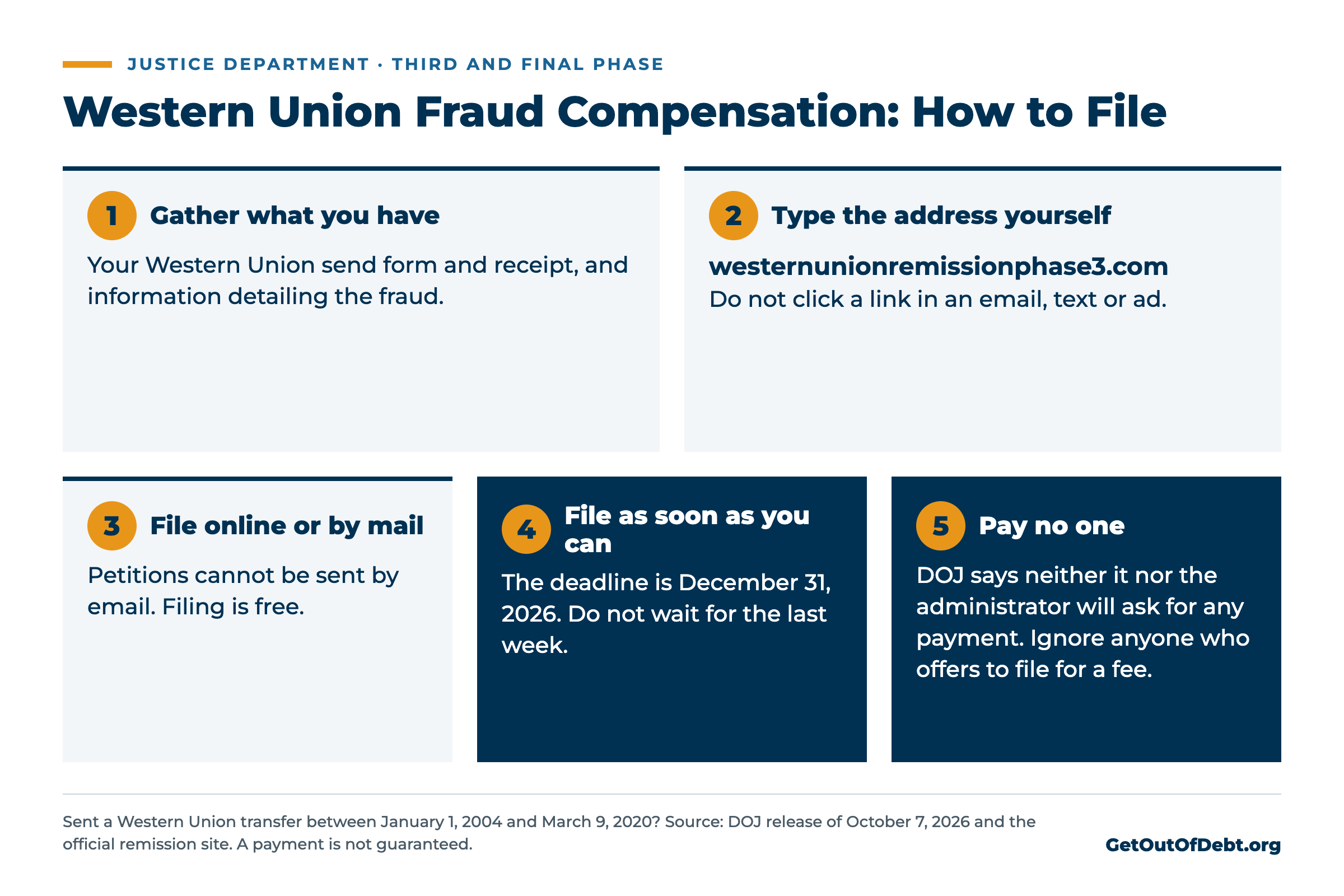
How to file without getting scammed a second time
Step 1, check your dates. Did the money go out through Western Union between January 1, 2004 and March 9, 2020? The official site says to submit a Petition for Remission form “along with any available supporting documentation.” The FAQ names “the Western Union money transfer send form and receipt and information detailing the fraud” as acceptable documentation, and says the Money Transfer Control Number, or MTCN, is a ten-digit number: for transfers started in person it is on the printed receipt, and for transfers started at WU.com or in the app it is on the email confirmation. Bank or card statements and messages with the scammer are my own suggestion of what to gather, not something the FAQ lists.
Step 2, go to the official site by typing the address yourself. The address is westernunionremissionphase3.com. Type it yourself; I am not linking it so that nobody learns to click a link for this. DOJ’s release names that site, and DOJ’s own Large Remission Matters page, last updated September 29, 2026, lists the same website. Type it, or use the phone number below, so no email, text or search ad can steer you somewhere else.
Step 3, file or call. The official FAQ says you can file online or mail a petition. If you did not get a pre-filled petition but believe you were a victim, it says “you may file a petition online or download and print a copy of a petition form and mail it in.” The mailing address in the FAQ is “United States V. The Western Union Company Phase 3, P.O. Box 301132, Los Angeles, CA 90030-1132.” Petitions cannot go by email: the FAQ says “petitions for remission and supporting documentation cannot be submitted via email.” It also says “Please do not send original documents,” and to keep a copy of your supporting documentation for your own records. For questions, the Justice Department’s release gives the number 1-833-419-4677, saying more information is on that site “or by calling 1-833-419-4677.” The administrator DOJ names is Verita Global LLC, formerly Gilardi & Co. LLC. Anything neither the release nor the FAQ answers is the question to put to that number. If you have no receipt left from an old transfer, the official FAQ’s answer is: “Please submit any documentation, such as customer receipts, to support your submission that you do have.” The FAQ also says many victims were mailed petitions with loss amounts already filled in; if one of those reached you, check it against the official P.O. Box and phone number before you send anything back.
Step 4, do not wait for the last week. The deadline is December 31, 2026. File as soon as you can instead of planning around late December. Assistant Attorney General A. Tysen Duva of DOJ’s Criminal Division called this the “third and final phase of the Western Union remission process.”
Step 5, pay nothing. The release says: “Neither the Remission Administrator nor the Department of Justice will ask for any payment to participate in this remission process.” The official FAQ answers the fee question the same way: “No. The Department of Justice does not charge fees for you to participate in the remission process.” And on whether you need a lawyer, its answer is: “No, you do not need an attorney to file a petition.”
One more thing you may see is the old date. The original deadline was August 19, 2026. On August 5, 2026 the official remission site announced the extension: “The deadline to submit a Petition for Remission has now been extended to December 31, 2026.” If you see August 19 anywhere, including lower down on the official site’s own home page, the administrator’s general case page or my own June post, it is the old date and it has been extended, so do not assume you are too late.
An out-of-the-blue offer to file or recover this money for a fee is the next scam
Suppose someone calls, emails or texts and says they can recover your Western Union money for a fee. That is what the FTC describes as a recovery scam, where “someone says they can help get your money back or recover the prize or item you never got. You just need to pay them first.” DOJ’s Large Remission Matters page says: “The Department and its Remission Administrators will never ask for payment to participate in or receive funds from the remission process. If you are asked to pay a fee from an unknown source it is a fraud.” The FTC says the same thing about refunds in general: “Government agencies and legitimate organizations will never ask for money to help you get a refund” (FTC, Refund and Recovery Scams).
The release also warns: “Please be cautious of any individual or organization claiming to represent the Remission Administrator or the federal government in this matter.” And it says that if you are a victim, “any communications will come directly from the Remission Administrator or from government representatives with whom you have already had contact.” So an unexpected caller who says they are with the program should make you suspicious. Hang up and call the number in the Justice Department’s release, 1-833-419-4677, yourself. If anyone hands you a contract promising to recover this money for a fee, do not sign it.
What happens after you file, and what nobody can promise
The release does not give a per-person amount or a payment date for this phase. It says victims “can file a petition for remission and receive compensation for their fraud losses,” and that is as specific as it gets. The official FAQ says: “The amount you receive will be based on the eligible amount you lost minus any refund you have already received.” It also says the payment is based only on the amount of the money transfer, so Western Union fees, incidental losses and transfers sent through other businesses are not recoverable; that is the FAQ’s point, in my paraphrase. On timing, the FAQ says “We cannot provide an estimated time” and points to the remission website for updates. DOJ’s general remission FAQ is more cautious. It says remission “is a discretionary decision made by the Attorney General” and that “In most cases, the funds available for remission do not fully compensate the victims.” Treat any per-person figure you see from anyone other than DOJ or the administrator as a guess.
Because this is a debt site, here is one more thing from the official FAQ. It explains why a Social Security number or ITIN is required: “If your petition is approved, it must be reviewed by the Treasury Offset Program to verify that you do not owe any money to the federal government or certain state debts. If you owe money, your payment will be used to pay your debt. If your payment is more than the amount you owe, you will receive the remainder.” Enter that number only on the official site, after checking the address letter by letter, or on the paper form you mail to the official P.O. Box. Do not give it to anyone who calls, emails or texts you, even if they say they are with the program. Hang up and call 1-833-419-4677 yourself.
If you already filed, are filing for an estate, or your transfer falls outside the dates
You filed in an earlier phase. The official FAQ says: “You may only file a petition for remission for newly discovered or additional transactions between January 1, 2004 and March 9, 2020 that were not previously submitted.” If your earlier petition was denied only because the transfers were outside the old time period, you do not need to resubmit. The FAQ says those petitioners “were sent new letters informing them that their petitions have been granted” on May 21, 2026, and that anyone who had not received a letter by June 8, 2026 should contact the administrator. If no letter came, the place to ask is the number in the Justice Department’s release, 1-833-419-4677. If you already filed in this phase earlier this year, you should not need to file again. If you have no confirmation that your petition was received, call 1-833-419-4677 and confirm it well before December 31, 2026.
The person who sent the money has died. The official FAQ answers the question about filing on behalf of an estate with “Yes.” and says: “please submit the petition in the name of the deceased and include verification of the death and documents showing that you represent the estate. Please do not send original documents.” On the Social Security number, the same FAQ says: “please submit the petition and SSN in the name and number of the deceased.”
Your transfer was before Jan. 1, 2004, or after March 9, 2020. The release covers transfers between those two dates and says nothing about any other period, so I cannot point you to a DOJ payout for them. The FTC’s page on what to do if you were scammed says: “Report a scammer to the FTC at ReportFraud.ftc.gov” (FTC). That page also tells people who sent money through a wire transfer company like Western Union to report it to the company immediately and ask for a refund, though I would not count on that for a transfer from years ago. Even if the money is not coming back, that is the FTC’s own channel for scam reports. And if a stranger then offers to recover it for a fee, you already know what that is.
You are carrying debt because of the transfer. That is a separate problem from the remission petition, and it has more than one answer. The Find Your Path quiz compares your real options using your own numbers.
DOJ’s release says fraudsters targeted consumers, including seniors, through multiple scams. Being scammed is not a character flaw, and shame keeps a lot of people from ever checking. Asking for compensation from the forfeited funds is not admitting anything except that someone took advantage of you. I wrote about this same program in June. That post carries the old August 19 date and talked as if a refund was waiting, so go by this page: the date is now December 31, 2026, and no payment is guaranteed.
The Bottom Line
If a scammer got your money through Western Union, you did not do something uniquely foolish, and you may not be out of options. DOJ says it has reopened the process for transfers made between Jan. 1, 2004, and March 9, 2020, the deadline is December 31, 2026 according to the official remission site, and neither DOJ nor the administrator will ask you to pay anything. Type westernunionremissionphase3.com yourself, or call the number in the Justice Department’s release, 1-833-419-4677, and anyone who contacts you out of the blue offering to file or recover this money for a fee is the next scam. Take the afternoon this week, because it is the one piece of this you control.
Frequently Asked Questions
Can I still get money back if I sent money to a scammer through Western Union?
Possibly. In a release dated October 7, 2026, the Justice Department described the third phase of its Western Union remission process, which has been taking petitions since earlier this year, and the official remission site says you may be eligible for a remission payment if you sent a money transfer through Western Union between January 1, 2004 and March 9, 2020, and were the victim of fraud. Remission is decided by the Justice Department, and DOJ’s general remission FAQ says it is discretionary and that in most cases the funds do not fully compensate victims, so no payment is guaranteed.
What is the deadline to file a Western Union remission petition?
The official remission site gives the deadline as December 31, 2026, and says petitions must be postmarked or submitted online on or before that date. The Justice Department’s October 7, 2026 release prints only “Dec. 31” and no year. If you see August 19 anywhere, including lower down on the official site’s own home page, the administrator’s general case page or my own June post, it is the old date and it has been extended, so do not assume you are too late.
Do I have to pay anyone to file?
No. The official FAQ says the Department of Justice does not charge fees for you to participate in the remission process, and that you do not need an attorney to file a petition. The Justice Department’s release says neither the Remission Administrator nor the Department of Justice will ask for any payment, and DOJ’s Large Remission Matters page says that if you are asked to pay a fee from an unknown source, it is a fraud. Anyone who contacts you out of the blue offering to file or recover this money for a fee is the next scam.
I filed in an earlier phase. Do I need to file again?
Only for new transactions. The official FAQ says you may only file a petition for remission for newly discovered or additional transactions between January 1, 2004 and March 9, 2020 that were not previously submitted. If your earlier petition was denied only because the transfers fell outside the old time period, the FAQ says you do not need to resubmit and that letters went out on May 21, 2026. If no letter came, call the number in the Justice Department’s release, 1-833-419-4677. If you already filed in this phase earlier this year, you should not need to file again. If you have no confirmation that your petition was received, call 1-833-419-4677 and confirm it well before December 31, 2026.
What if my transfer was outside the covered dates?
The release covers transfers between Jan. 1, 2004, and March 9, 2020, and does not address other dates. The FTC says to report a scammer at ReportFraud.ftc.gov. Anyone who contacts you out of the blue offering to recover that money for a fee is the next scam.
This is what I’m telling friends like you over coffee, and it is only my read of what DOJ published. But remember, you do you: only you know your situation, and only you can decide what is right for you. Take it as input, not instruction, and do not let anyone, me included, tell you what to do with your money.
Know someone who sent money to a scammer this way? Send this to them. The people most likely to qualify are often the ones too embarrassed to look. A message from someone who cares about them can be the only nudge that gets them to check before December 31, 2026.
Dealing With Debt? Understanding your options is the first step. See how all your debt relief options compare — including ones most sites won’t tell you about. The Find Your Path quiz gives a recommendation based on your actual numbers, and the Scam-O-Meter checks any company’s complaint history before you sign. Federal Reserve Bank of New York research shows bankruptcy filers recover faster than those who don’t file.



