

Last reviewed October 8, 2026 • By Steve Rhode, consumer debt expert since 1994 • Every study figure below comes from a paper linked on this page.
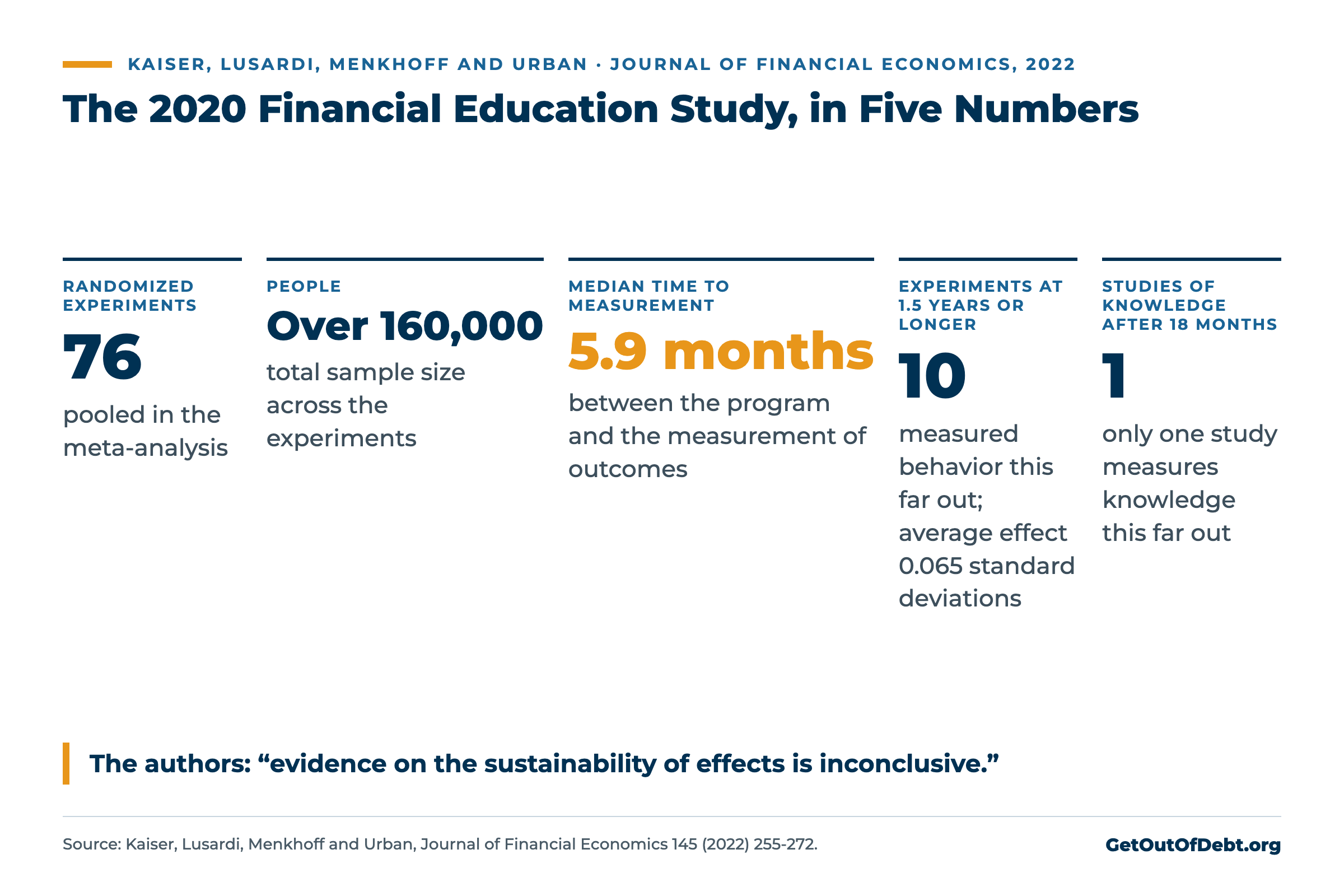
The verdict: True, but missing context. The study is real. Across 76 randomized experiments covering “over 160,000 individuals,” it found that financial education improves financial behavior on average. But the median time between the class and the measurement was 5.9 months, and the authors write that “evidence on the sustainability of effects is inconclusive.” A study that cannot say whether the effect lasts has not proven that a class sets you up to handle money for good. “Inconclusive” is the authors’ word, not mine.
Well, Actually…
Here’s the part that gets left off when someone says a huge study proved it. I read the paper, not a summary of it. In 2022 the Journal of Financial Economics published Kaiser, Lusardi, Menkhoff and Urban, which had first circulated as an NBER working paper in April 2020. That is the 2020 study; the figures on this page come from the 2022 journal version. The authors pooled the results of 76 randomized experiments with a total sample size of over 160,000 individuals, from interventions from 33 countries and six continents.
I’m not going to wave that away. In a randomized experiment, chance decides who gets the education and who doesn’t, which is a stronger design than comparing people who chose a class to people who didn’t. And the results were positive: financial education raised what people know (an average effect of 0.204 standard deviations) and what they do. The effect on behavior was smaller than the effect on knowledge, and the authors give a reason I find believable: it “may be easier to learn new concepts and facts than to change possibly entrenched behaviors.” Note also that “financial education” in this paper is not only a classroom. The paper breaks results out by classroom, online, counseling and “educative nudge” programs.
What does “0.204 standard deviations” mean in plain English? Picture 100 people standing in a line, sorted by how much they know about money. The person who knows the least is number 1 and the person who knows the most is number 100. A person who is exactly average stands at number 50, right in the middle. Now send that person to the class. Afterward, they would stand at about number 58. They moved up eight places, and 42 people in the line still know more than they do. A “standard deviation” is just a ruler for how spread out the line is, and 0.204 means the class moved people about one-fifth of one ruler length. The line of 100 is my own arithmetic, and it assumes the usual bell-curve spread – the paper gives the 0.204 and not the line.
What 0.1 standard deviations means, by my arithmetic. The paper reports effects in standard deviations, and its overall estimate for financial behavior is 0.1003 (95% confidence interval 0.071 to 0.129). If you assume the usual bell-curve spread, a gain of 0.1 moves a person from the middle of the pack (the 50th percentile) to about the 54th. A gain of 0.065 (the estimate at 1.5 years or longer, below) moves them to about the 53rd, and the knowledge gain of 0.204 moves them to about the 58th. That translation is mine, not the paper’s claim. The authors call the effects “economically meaningful in size” and argue that many of the programs are cost-effective. You can decide for yourself whether four places up the line is a lot. I call it modest.
Now the fine print, in the authors’ own words. “The median time between financial education treatment and measurement of outcomes is 25.8 weeks (5.9 months).” The programs were not long, either: the average estimate came from “a mean of 11.7 h of instruction,” with “the median associated with 7 h of instruction.” The paper also reports that 60.8% of the estimates come from programs in developing economies, and that 72.8% of the estimates are about adults (older than 25), 19.6% about youth (14 to 25) and 7.6% about children under 14. None of that makes the results wrong. It does mean most of this evidence is about adults, and most of it comes from developing economies, not from American teenagers in a classroom.
Here is how the effect on financial behavior looks by how long after the program it was measured, in standard deviations:
- Under six months: 0.099, from 34 experiments.
- Six to 18 months: 0.09, from 23 experiments.
- 1.5 years or longer: 0.065, from ten experiments (95% confidence interval 0.021 to 0.110).
The authors say of the drop: “These effects are reduced but are still not statistically different from the other estimates.” They also write: “In our set of studies measuring treatment effects on financial behaviors after 18 months, we find positive and significant effects, on average.” I want you to see that, because it is the evidence against my side of this argument. Knowledge is a different story. The authors found “significantly larger effects” on financial knowledge when it was measured within six months (0.23) than at six to 18 months (0.143), and “only one study measures treatment effects on financial knowledge after 18 months.”
Then comes the sentence that matters most, and it cuts both ways: “while the point estimates may be suggestive of some decay in treatment effects over time, our examinations do not find conclusive evidence, indicating that neither sustained and relatively large effects nor close to zero effects of financial education at longer time spans can be ruled out due to the limited number of studies that measure very long-run outcomes.” Read that twice. It does not say the effect vanishes. It does not say it lasts. It says the studies that could answer the question mostly do not exist yet. Their conclusion: “What we can say, however, is that we do not find evidence for dramatic decay up to six months after the intervention.” Up to six months. And on the data: “few studies can link their experiments to administrative data, so the usual caveats of having to rely on self-reported survey data also apply to these studies.”
Here is what I believe is underneath a lot of the push for these classes in schools: people hope a class will inoculate a kid so they are good with money through their lives. I understand the hope. I haven’t found a fact that shows a class does that, and this study, the one cited as proof that classes “work,” does not claim it. Half its measurements came within 5.9 months, and the authors call the evidence on whether effects last inconclusive.
A big 2020 study of 160,000 people proved financial literacy classes work.
The study is real and its average effect is positive. But the effect is modest by my arithmetic, the median measurement came 5.9 months after the program, only ten experiments measured behavior at 1.5 years or longer (their average was smaller but still positive, 0.065), and the authors call the evidence on lasting effects “inconclusive.” “Works” is supported for the short run. Whether it lasts is not established.
Kaiser, Lusardi, Menkhoff and Urban, Journal of Financial Economics 145 (2022) 255-272
Where the Fine Print Goes Missing
Here are three places that describe the study. One is a company blog, one is a listing for a 2022 brief credited to the same four authors, and one is a research center’s page presenting the paper. I saved a copy of each page on October 8, 2026, and searched the text for “month,” “week,” “long-term,” “lasting” and “decay.” On those copies, none of the five words appeared in the page text. That is a word search, not proof the pages never address timing. Keep the paper’s own sentence in mind as you read them: “Because the literature is characterized by very few longer-term impact assessments, evidence on the sustainability of effects is inconclusive.”
EVERFI’s blog, whose page data lists a publication date of March 25, 2026, introduces the sentence with the words “as Kaiser and colleagues found in their meta-analysis of 76 randomized experiments in 2023” and then writes:
“When high quality content is implemented in a strategic manner, it not only predicts knowledge gain, but also future fiscal behaviors.”
That sentence is EVERFI’s own summary; the page does not put it in quotation marks. I also searched the full text of the journal article for “predict,” “strategic” and “fiscal.” None of the three appears in the copy of the journal article I read.
The Jump$tart Clearinghouse listing for Financial Education Matters, a 2022 brief the listing credits to the same four authors with FINRA and NEFE, and says was provided by the FINRA Investor Education Foundation, says:
“Financial education positively impacts nearly all financial behaviors studied, including budgeting, saving, credit and insurance.”
I am comparing the listing’s sentence with the journal article, whose wording is narrower. It says its findings are “largest in magnitude for budgeting behavior and saving (and investing) behavior,” and that results on some behaviors “are less certain due to fewer studies including these outcomes (insurance and remittances) or to small average effects (credit behaviors).” The brief itself (FINRA Investor Education Foundation and NEFE, March 2022) does carry the caveat. It says: “We find no evidence to support or refute the decay of effects over time.” The listing’s summary does not.
The GFLEC meta-analysis page says:
“Financial education works and is cost-effective.”
The authors do argue the cost-effectiveness point, and I’ve told you so above. That headline line does not carry the sentence about when it was measured and whether it lasted.
The Earlier Study Said It Fades. The Later One Says Not So Fast.
You may have read the opposite claim, that the benefit is gone in about 20 months. It comes from an earlier meta-analysis, Fernandes, Lynch and Netemeyer in Management Science (August 2014). Its abstract says: “Like other education, financial education decays over time; even large interventions with many hours of instruction have negligible effects on behavior 20 months or more from the time of intervention.”
The 2022 authors looked at that finding and wrote that the evidence for it rests “on a sample of only 29 observations” and “should be viewed with caution in light of the large amount of uncertainty around this estimated effect.” In their own data the behavior effect at 1.5 years or longer is positive, 0.065. So the 2014 claim is not established either. Two papers disagree, and neither settles how long this lasts.
The benefit of a financial literacy class is gone within about 20 months.
The 2014 paper said so. The 2022 authors say that finding rests on “a sample of only 29 observations” and “should be viewed with caution.” Their own ten experiments at 1.5 years or longer averaged 0.065 standard deviations, with a confidence interval that does not include zero. The honest summary is small, mostly measured in the short term, and not settled beyond that.
Fernandes, Lynch and Netemeyer, Management Science, August 2014; Kaiser et al., 2022
One more finding from the 2014 authors, and I’ll keep it short because it is about a different kind of study. They report that the partial effects of financial literacy “diminish dramatically when one controls for psychological traits that have been omitted in prior research.” That is about the connection between what people score on financial-knowledge tests and how they behave. It is not about randomized classes.
The Best Evidence That Something Can Last
I promised you the other side, so here it is. The strongest evidence I found that a school program can leave a lasting mark is from Brazil. Bruhn, Garber, Koyama and Zia (a World Bank working paper, July 2022) report “a randomized controlled trial with 892 high schools in six Brazilian states” and followed “16,000 students for the next nine years” using administrative data. The program ran for 17 months across the last two high school years, and the authors describe its intensity as “much stronger than typical one-off financial education workshops.”
The short-term results were bad: “the treatment students used expensive credit and were behind on payments.” The long-term results reversed: “treatment students were less likely to borrow from expensive sources and to have loans with late payments than control students.” The sizes: students in the program were “1.4 percentage points less likely to have credit card debt and 0.9 percentage point less likely to use overdrafts, compared to 23 percent of control students with credit card debt and 11 percent of control students with overdrafts,” and they were less likely to have loans with repayment delays “by about 0.9 percentage point, compared to 15 percent of control students.” The authors add: “Both effects persist over time, that is, they are equally strong eight to nine years after the financial education program ended as they were five to seven years after the program.” And: “While some literature has hypothesized that the long-run effects of high-school education would be declining or zero as students forget what they have learned, we find lasting effects.”
That is a real result and I’m glad it exists. Three things to keep next to it. The effects are real, but they are about one percentage point. The authors found tax ID numbers for 44.27 percent of the treatment students and 46.02 percent of the control students, a small difference that “is statistically significant at the 10 percent level,” although they report that baseline characteristics were balanced across the two groups. That matters because the long-run results cover only the students who could be matched to records. And the same paper found treated students were more likely to own microenterprises, meaning very small businesses, and “less likely to be formally employed than control students,” so the picture is mixed.
The studies of what U.S. states required in high school, using credit records, point in more than one direction:
- Fades with age. A New York Fed staff report (Brown, Grigsby, van der Klaauw, Wen and Zafar, revised September 2015) found that math and financial literacy education “modestly decreases the incidence of adverse outcomes” such as delinquency and collections, and then: “All but the student debt effects tend to fade out with age.” For example, a financial literacy requirement “reduces the probability of having outstanding debt by 1.4 percentage points for 22 year olds, but the estimate is essentially zero for 27-year-olds.” In plain terms: slightly fewer 22-year-olds carried debt, and by 27 the estimated difference was essentially zero.
- Small, and only for one kind of course. A 2025 working paper (Collins and Urban, IZA Discussion Paper 18268), which follows people ages 22 through 34, found that “states requiring a full semester of coursework improve both credit scores and subjective measures of financial well-being, while states allowing more flexibility in implementing personal finance coursework into other classes do not.” The size: “roughly 2 points (0.3 percent relative to the mean)” on credit scores, and standalone-course students were “1.2 percentage points (or 3.9 percent as a marginal effect) less likely to have a subprime credit score.” IZA says its discussion papers “often represent preliminary work,” so I’m holding it loosely.
- Nothing found in older mandates. Cole, Paulson and Shastry (2016) studied mandates from 1957 to 1982 and people who were 35 to 54 in 2000, and found “traditional personal finance courses, which we find have no effect on financial outcomes.” Those are much older mandates than the ones Brown and colleagues studied, and Cole and his coauthors write that it is possible “the effects dissipate with age.”
What to Actually Do
- If you took a class and still ended up in money trouble, that is not a character flaw. A class is not a vaccine. In this study the average behavior result is what I’d call a modest nudge, not a shield. You are not your debt.
- Get help at the moment of the decision. The 2014 authors suggest “a real but narrower role for ‘just-in-time’ financial education tied to specific behaviors it intends to help.” That is their suggestion; their paper did not test it. It is how I would use it: before you sign for a loan, before you answer a collector, before you decide on bankruptcy. But never let a court deadline pass while you look for help. Ask Steve is free, and the Find Your Path quiz works from your actual numbers.
- If you’re a parent, I think a class is worth your kid’s time. Just don’t count on it to do the whole job.
- When someone hands you a study, ask four questions. How many months after the class did they measure? How many hours of teaching was it? (In this study the median estimate came from 7 hours of instruction; the Brazil program was spread across 17 months of school.) Who was measured: adults, teenagers or children? Was it records, or what people reported about themselves?
- Build systems, not willpower. I wrote about it in Budgets Are a Page of Lies — Build Systems Instead. And if the math has already broken, the 2-minute bankruptcy quiz can help you see whether bankruptcy is worth discussing with an attorney.
Steve’s Take
I ran a credit counseling and financial education nonprofit, Myvesta, so I’m not against teaching people about money. What I won’t do is tell you a class sets you up for life, because I haven’t found a fact that says so, and neither does the study everyone points to; the closest I found is the Brazil trial, at about one percentage point. Debt is math wrapped in emotion. A layoff, a medical bill or a divorce can break the math whatever anyone taught you in tenth grade. I filed bankruptcy in 1990, and I look at it this way: deal with it and look to the future rather than spend five years repairing the past. No sense wasting a perfectly good mistake. I think your money personality may play a much bigger role as a predictor of how you handle money than any class you took, and that is my opinion, not something these studies tested. You can find yours with my free Money Personality Quiz. If a class helped you, good. If it didn’t, you didn’t fail it.
Free Tool — Contract Decoder: Have a contract from a debt relief company? The free Contract Decoder analyzes it for red flags, hidden fees, and problematic terms — before you sign anything. Decode My Contract →
Frequently Asked Questions
Do financial literacy classes work?
On average, in the short run, yes. The 2022 meta-analysis of 76 randomized experiments found positive average effects on financial knowledge (0.204 standard deviations) and on financial behavior. Whether the effect lasts is still open: the authors write that “evidence on the sustainability of effects is inconclusive” (Journal of Financial Economics, 2022).
What did the 2020 study of 160,000 people actually find?
It pooled 76 randomized experiments with over 160,000 individuals and found that financial education improves what people know and what they do. By time after the program, the average behavior effect was 0.099 standard deviations under six months, 0.09 at six to 18 months, and 0.065 at 1.5 years or longer. The median time between the program and the measurement was 5.9 months.
How long do the effects of a financial literacy class last?
Nobody knows with confidence. The 2022 authors say there is “no evidence to support or refute the decay of financial education treatment effects six months or more after the intervention.” A Brazilian trial that followed 16,000 students for nine years found lasting effects of about one percentage point on expensive credit and late payments (World Bank, 2022), and a New York Fed study of U.S. requirements found that all but the student-debt effects tended to fade out with age (Staff Report 634).
Is it still worth taking a financial literacy class?
It can be. The study found that classes raise what people know, and it found positive average effects on behavior. I just wouldn’t count on a class to protect you from money trouble later. Use it as one tool, and get help at the moment of a big decision.
Should my kid’s school require a personal finance course?
That is a decision for you and your school board, and I can only give you the evidence. A 2025 discussion paper by Collins and Urban found that people ages 22 through 34 in states requiring a full semester of personal finance had credit scores about 2 points higher and fewer subprime scores, while states that let schools fold the content into other classes did not show that (IZA DP 18268); IZA says its discussion papers “often represent preliminary work,” a New York Fed staff report found modest benefits and that all but the student-debt effects tended to fade out with age, and a study of mandates from 1957 to 1982 found no effect.
I took a class and still got into debt. What does that say about me?
Nothing about your character. The study everyone cites found an average effect I’d call modest, and a class cannot protect you from a job loss, an illness or a bad stretch. Debt is what is left over when the math is broken, and I can help you look at what broke it. Ask Steve.
What is “just-in-time” financial education?
It is education tied to a specific decision at the moment you face it, instead of a course taken years earlier. The 2014 authors suggest “a real but narrower role for ‘just-in-time’ financial education tied to specific behaviors it intends to help” (Management Science, 2014).
This is one informed perspective from someone who has watched how this plays out since 1994 — not financial advice for your situation. Only you can decide what’s right for you and your family. Take this as input, not instruction, and make the call that serves your future.
The bottom line: The 2020 study is real and found an average benefit I’d call modest, but half its measurements came within 5.9 months and its own authors say whether the effect lasts is inconclusive. A class helps; it isn’t a vaccine. If someone you know still believes one class sets a kid up for life, send them this page.
Dealing With Debt? Understanding your options is the first step. See how all your debt relief options compare — including ones most sites won’t tell you about. The Find Your Path quiz gives a recommendation based on your actual numbers, and the Scam-O-Meter checks any company’s complaint history before you sign. Federal Reserve Bank of New York research shows bankruptcy filers recover faster than those who don’t file.



