

Quick Answer: Evacuation orders and local emergency officials come before anything in this post. On the money side, a homeowners or renters policy that pays for a hotel and meals (the insurance industry calls it “additional living expenses”) is tied to damage in many policies. The Texas Department of Insurance says that if you leave because of an evacuation and your home was not damaged, “your policy won’t cover additional living expenses.” Florida’s Department of Financial Services says most policies provide that coverage when a civil authority bars you from your home because of direct damage to neighboring homes by a covered threat. Your own policy wording decides it, so keep every receipt from today, call your insurer and ask, and do not assume FEMA money exists yet: when I checked FEMA’s public declarations data around 1:00 PM CDT on October 9, 2026, it listed no federal declaration for Isaias, and that can change within hours, so check DisasterAssistance.gov.
Safety first: If local officials have ordered you to leave, leave. The National Hurricane Center’s own advisory says: “Promptly follow evacuation and other instructions from local officials.” If a hotel is out of reach, ask your county emergency management office about open public shelters. Money questions come second, and every one of them will still be here when you are somewhere safe.
Expert Context: I am not a meteorologist, an insurance adjuster or an emergency manager. For this post I read the National Hurricane Center advisory, consumer pages from the National Association of Insurance Commissioners (NAIC) and the insurance departments of Texas and Florida, FEMA’s assistance pages and policy, the U.S. Department of Labor’s Disaster Unemployment Assistance materials, the CFPB, and the Georgia Attorney General’s price-gouging warning, and I name the page next to each claim. Debt is math wrapped in emotion, and a hotel bill on a credit card in the middle of a hurricane is both at once.
You are probably paying for the hotel, the gas and the restaurant meals with a credit card this week, and you are probably wondering whether anyone will pay you back. The honest answer is that it depends on a few sentences in your policy that I cannot see, on whether your home gets damaged, and on whether a federal declaration is ever made. What you control today is the paper trail.
Each weekday I send one short email: one story that caught my attention, why it might matter to you, and one manageable thing you can do with it. A couple of minutes, and a dad joke.
In the latest issue (Nov 6): Owed money on an Amazon return? Check by Dec. 1
Free. I sell nothing. Unsubscribe any time.
What the National Hurricane Center Said on Friday, October 9, 2026
This is a snapshot from 10:00 AM CDT on Friday, October 9, 2026, and storms change by the hour. If you are reading this after that evening’s expected landfall, the forecast below is already history, so use nhc.noaa.gov for where the storm is; the receipt and claim steps still apply. I am quoting the National Hurricane Center‘s Hurricane Isaias Advisory Number 12 (AL092026), issued at 10:00 AM CDT on Friday, October 9, 2026. At that time the center of Isaias was about 195 miles south of Pensacola, Florida, with maximum sustained winds of 120 mph, and the advisory called it a category 3 hurricane. It said that “on the forecast track, Isaias is expected to approach the U.S. northern Gulf Coast this afternoon and make landfall within the warning area this evening.” It listed a Hurricane Warning from Ocean Springs, MS to the Bay/Gulf County Line, FL and a Storm Surge Warning from the Mouth of the Mississippi River to the Suwannee River. That is not the full list of watches and warnings. An intermediate advisory (12A) at 1:00 PM CDT put the center about 145 miles south of Pensacola with the same 120 mph winds and the same landfall forecast. Check nhc.noaa.gov and your local National Weather Service office for the current advisory before relying on any of this; warnings get extended and changed.
I am not forecasting anything. I am telling you what the Hurricane Center said, because the rest of this post depends on one question the advisory cannot answer for you: whether your home, or your neighbors’ homes, end up damaged.
Does a Homeowners Policy Pay for an Evacuation Hotel?
Maybe, but the trigger is usually damage or a government order that follows damage, not the evacuation by itself. Three sources, three slightly different angles:
- The NAIC: “If you can’t stay in your home after a covered disaster, many homeowners policies will pay for additional living expenses (ALE).” It says ALE covers hotel bills and “reasonable restaurant meals (if you’re staying in a hotel room with no kitchen),” and that “it will only pay the difference between your previous living expenses and your new temporary expenses.” The NAIC also says: “Some policies have a dollar limit; some may also have a time limitation.” Another NAIC page lists the same coverage under the name “Loss of Use,” so your policy may use either label.
- The Texas Department of Insurance: homeowners and renters policies “may cover additional living expenses if you can’t stay in your home because it was damaged by an event that’s covered in your policy.” It then says: “If you left your house because of a power outage or evacuation – and your home wasn’t damaged – your policy won’t cover additional living expenses.”
- Florida’s Department of Financial Services: “Civil authorities, such as law enforcement agencies and emergency management services, sometimes issue mandatory evacuation orders that affect thousands of residents. Find out whether lodging and meals are covered if you must evacuate but no damage occurs to your property.” It adds that “most policies will provide additional living expense coverage when a civil authority prohibits the use of a residence due to direct damage to neighboring homes by a covered threat,” generally without a deductible and for up to two weeks.
Here is how I read those three together, and I want to be clear that this is my reading and not a promise about your policy. If you evacuated and your home turns out undamaged, the Texas Department of Insurance says a policy won’t cover additional living expenses, while Florida’s Department of Financial Services tells you to find out, and ties its civil authority coverage to damage to neighboring homes. Texas and Florida are examples of how two regulators describe common policy wording, not the rule for Alabama, Mississippi or any other state, so ask your own insurer and your own state’s insurance department. Whether the hotel gets reimbursed is never a reason to stay. If the storm damages your home so you cannot live in it, an additional living expenses benefit may apply. If the storm damages neighboring homes and authorities bar you from yours, a civil authority clause may apply, usually for a limited time. Which of those is in your policy, how long it lasts and what the dollar limit is are things only your policy and your insurer can tell you.
There is one more catch with storm surge. The Texas Department of Insurance says “most home policies don’t cover floods,” that National Flood Insurance Program policies “don’t pay for additional living expenses,” and that if your home policy includes flood coverage, “it probably will pay for additional living expenses.” I covered the flood question, and the percentage hurricane deductible that comes with damage claims, in yesterday’s post on the hurricane deductible. This post is about the other bill: where you sleep and eat while you are away. If water did get into your home, I wrote about what to check before you put flood repairs on a credit card.
Start the Paper Trail Today, Even If You Think Nothing Will Be Covered
Nobody knows today whether your policy will pay, or whether a federal program will open. Receipts you kept cost you nothing. Receipts you threw away cannot be recovered. The NAIC says: “Keep all receipts for any additional costs you have. The insurance company will need the receipts to reimburse you.” Florida’s Department of Financial Services says the same thing about additional living expenses: “Keep all receipts during this period.” And if you ever receive FEMA money, FEMA’s program page for individuals and households says to keep receipts for at least 3 years to show how you used it.
What I would keep, as a practical matter and not as a list any regulator gave me:
- The itemized hotel receipt (ask for it at checkout, not the card slip alone), with the dates you stayed.
- Gas receipts and a note of where you drove from and to.
- Restaurant and grocery receipts while you are away.
- Photos of the date and time on any evacuation order, text alert or road closure that tells you where you could not go.
- A note of who you talked to at your insurer, what day and time, and what they told you.
Because the NAIC says ALE “will only pay the difference” between your normal costs and your temporary ones, it also helps to know what you normally spend on food in a week. That way, if your policy does apply, you can show the difference rather than guessing at it. That last point is my inference from the NAIC’s wording, and your insurer will tell you how it calculates the difference.
Paying by card gives you a second record of the dates and amounts if a paper receipt gets wet or lost, which is a suggestion from me and not an insurance rule. Don’t run one card to its limit to keep things tidy, and don’t count on any reimbursement arriving before the bill does.
What FEMA Says, and What I Found Today
I checked FEMA’s public OpenFEMA declarations data around 1:00 PM CDT on October 9, 2026. It listed no emergency or major disaster declaration for Isaias, or for any Gulf Coast state, among the most recent declarations in the data (the newest dated October 7, 2026, for other places). That data can lag a declaration by hours, so check DisasterAssistance.gov, which says it lists “states where a disaster has been declared for Individual Assistance by FEMA.” Georgia’s attorney general says Governor Kemp’s State of Emergency took effect on October 8, 2026, but a governor’s declaration is not a federal one, and FEMA’s individual programs follow a federal one.
If a declaration that includes Individual Assistance is made for your county, FEMA’s housing assistance page (last updated July 29, 2026) describes these in its own words:
- Displacement Assistance: “Money you can use to stay in a hotel or motel, stay with family and friends, or for any other available housing options.”
- Lodging Expense Reimbursement: “Money to reimburse you for emergency lodging expenses such as hotel or motel if you are displaced from your home because of the disaster.”
- Serious Needs Assistance: “money to pay for emergency supplies like water, food, first aid, breast-feeding supplies, infant formula, diapers, personal hygiene items, or fuel for transportation,” as “a one-time payment of $770 per household,” available to “survivors who apply during the first 30 days after a disaster is declared.” That page was last updated May 7, 2025, and FEMA says “The award amount is adjusted annually,” so confirm the current amount at DisasterAssistance.gov.
Do not read those as a promise. FEMA’s page says eligibility requires that your “necessary expenses and serious needs are directly caused by a declared disaster,” and FEMA’s program page says “Your insurance or other assistance must not cover your disaster-related needs” and that “While FEMA assistance cannot replace insurance, it helps survivors begin recovery.” FEMA’s separate Transitional Sheltering Assistance policy (FP 104-21-0008), the program that provides hotel and motel stays for eligible survivors, says a registrant is no longer eligible to remain in it if they have “applicable insurance providing Additional Living Expense or Loss of Use coverage,” that a state has to request it, and that registrants must show their home is inaccessible or damaged because of the disaster. In plain terms: insurance pays first, and FEMA does not replace it and exists only after a federal declaration that covers your county. That is about who pays first, and it is not a reason to wait. If a declaration that includes Individual Assistance covers your county, register with FEMA even while your insurance claim is still open, because the windows can be short. Nobody can tell you in advance whether you will be approved, including me.
If Your Paycheck Stops: Disaster Unemployment Assistance
If you cannot get to work, or your workplace is closed because of the storm, there is a federal program called Disaster Unemployment Assistance (DUA). The Department of Labor says “DUA becomes available when the declaration is for ‘individual assistance including DUA.’” So, like the FEMA programs above, it does not exist until a presidential declaration says so. Labor’s fact sheet adds that regular state unemployment insurance comes first: if you are eligible for regular benefits, “they will receive those benefits instead of DUA.”
On timing, the same fact sheet says: “Applications for DUA must be filed within 30 days of the announcement of the availability of DUA in the state.” The rule itself is in the federal regulations at 20 CFR 625.8, which also says a late application can be accepted if you had good cause. Your state’s announcement will give the actual deadline, so file as soon as it is announced. And if you evacuated to another state, Labor says you can file by contacting the affected state, or the unemployment agency in the state where you are staying, for help. Labor also says you may need proof of your job, such as a tax return or bank statements, and gives you 21 calendar days after filing to supply it. If you think this could be you, keep your recent pay stubs or bank statements where you can find them. I wrote a longer guide to unemployment benefits by state if regular benefits are the question.
Gas, Hotels and Price Gouging
On October 9, 2026, Georgia Attorney General Chris Carr warned Georgians about price gouging and scams related to Isaias. His office says Georgia’s price gouging statute is in effect for goods and services tied to the state of emergency, including “motor fuel, diesel fuel and other petroleum products,” and that if you think you have been the victim of a scam or price gouging you can contact the Attorney General’s Consumer Protection Division at 404-651-8600 or 1-800-869-1123 (toll-free in Georgia). That is Georgia’s rule. Other states have their own laws and their own attorney general offices, so check yours, and keep a photo of the posted price when you pay. Before you book a rental from a listing you found online in a hurry, read what I wrote about rental listing scams after hurricanes.
What I Would Do Today, in Order
- Get to safety and follow local officials. Everything below can wait.
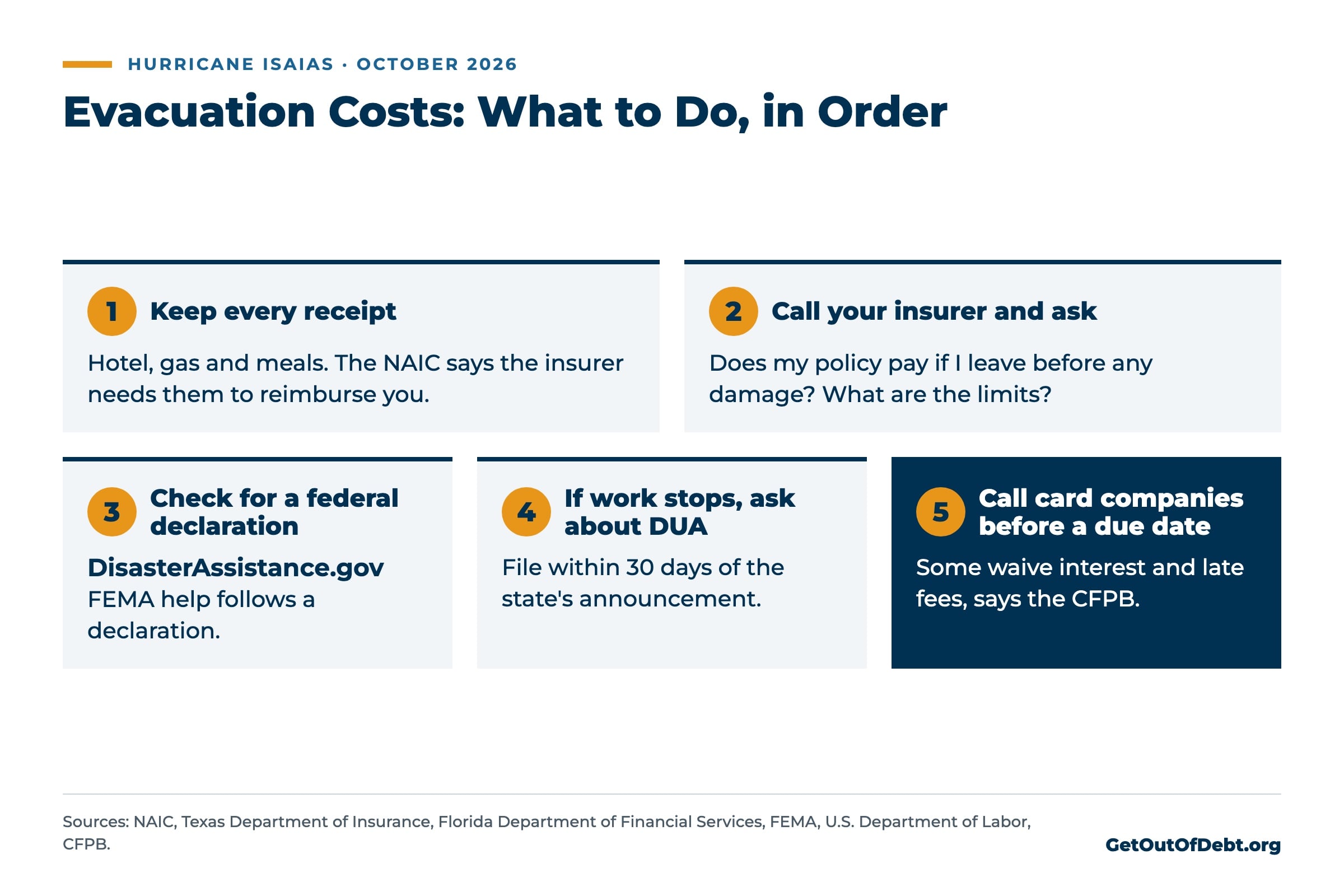
- Keep every receipt and take photos. Hotel, gas, meals, and the evacuation order or road closure that sent you away.
- Once you are somewhere safe, call your insurer and ask the exact question. “Does my policy pay additional living expenses or loss of use if I evacuate before my home is damaged? Does it include a civil authority clause? What are the dollar and time limits? Do I have flood coverage?” Write down the answers and who gave them, and ask for the answer in writing. If your home is damaged, report the claim as soon as you safely can and keep the claim number.
- Check DisasterAssistance.gov each day. If your county is listed for Individual Assistance, register with FEMA then, even if your insurance claim is still open. Counties can be added after the first declaration.
- If your work stops, ask your state unemployment agency about Disaster Unemployment Assistance, and keep your pay stubs or bank statements handy.
The Card Bill
The CFPB says: “After a disaster, your priority is your own safety and meeting your day-to-day needs. Once you’re safe, focus on the bills you need to pay first.” For credit cards, its advice is to contact your card companies “before your next payment is due if the disaster has affected your ability to make payments.” The CFPB says some companies “will waive interest and late fees; while others may allow you to stretch out or pause monthly payments,” and tells you to ask about “disaster hardship or forbearance programs.” Nothing there is guaranteed, and some will say no. If you do get a pause, ask what happens to interest and when the paused amount comes due. I explain how credit card hardship programs work and where they stop, and I have a longer list of the money problems that follow a natural disaster.
One more thing, because shame shows up in moments like this: putting a hotel and gas on a card to get your family out of the way of a hurricane is not a character flaw. It is a bill from an emergency. You are not your debt.
Key Takeaways
- Follow evacuation orders first. The National Hurricane Center’s Advisory 12, issued at 10:00 AM CDT on October 9, 2026, is a snapshot; check nhc.noaa.gov for the current one.
- The Texas Department of Insurance says a policy won’t cover additional living expenses if you left because of an evacuation and your home was not damaged. Florida’s Department of Financial Services says most policies pay when a civil authority bars use of your home because of direct damage to neighboring homes by a covered threat, generally for up to two weeks. Those are two states’ descriptions, and your own policy wording and your own state decide.
- Keep every receipt starting today. The NAIC says the insurer needs them to reimburse you, and ALE only pays the difference from your normal expenses.
- FEMA’s individual programs follow a federal declaration that includes Individual Assistance. When I checked on October 9, 2026, FEMA’s public data showed none for Isaias. Check DisasterAssistance.gov.
- Disaster Unemployment Assistance also needs a declaration, and Labor says to file within 30 days of the state’s announcement.
- Call your card companies before a payment is due if you cannot pay. Some waive interest and late fees; none have to.
The Bottom Line
Be safe first. Then keep every receipt, because you cannot go back and make one. Call your insurer and ask three questions in plain words: does my policy pay if I leave before any damage, does it cover a civil authority order, and what are the dollar and time limits? Check DisasterAssistance.gov for a declaration instead of guessing, and call your card companies before a due date if the math stops working. A hurricane is not a verdict on your finances. If the bills pile up afterward, that is a math problem with options.
Frequently Asked Questions
Will my homeowners insurance pay for a hotel if I evacuate before Hurricane Isaias hits?
Often not by itself, and it depends on your policy and your state. The Texas Department of Insurance says that if you left your house because of an evacuation and your home wasn’t damaged, your policy won’t cover additional living expenses. Florida’s Department of Financial Services says to find out whether lodging and meals are covered if you must evacuate but no damage occurs to your property. Your policy and your insurer decide, so call and ask, and keep your receipts either way.
What is the civil authority clause, and does an evacuation order trigger it?
Florida’s Department of Financial Services says most policies provide additional living expense coverage when a civil authority prohibits the use of a residence due to direct damage to neighboring homes by a covered threat, generally without a deductible and for losses of up to two weeks. That wording ties the coverage to damage to neighboring homes, so an order issued before any damage may not trigger it. Policies differ, so ask your insurer how yours is worded.
If storm surge floods my home, will additional living expenses apply?
It depends on whether you have flood coverage. The Texas Department of Insurance says most home policies don’t cover floods, that National Flood Insurance Program policies don’t pay for additional living expenses, and that if your home policy includes flood coverage it probably will pay for them. Call your agent or company and ask what kind of flood coverage you have, if any.
Can FEMA pay for my hotel?
Only if a federal declaration covers your county and you qualify. FEMA describes Displacement Assistance and Lodging Expense Reimbursement for people displaced from their homes by a declared disaster, and says its assistance cannot replace insurance. When I checked FEMA’s public declarations data on October 9, 2026, it showed no declaration for Isaias. Check DisasterAssistance.gov or call the FEMA Helpline at 1-800-621-3362, and I would not pay anyone who offers to apply for you, because you can apply yourself through DisasterAssistance.gov or the Helpline.
I can’t work because I evacuated. Can I get unemployment?
Regular state unemployment insurance comes first if you qualify for it. Disaster Unemployment Assistance is a separate federal program for people who lost work as a direct result of a major disaster and are not eligible for regular benefits. It becomes available only when a presidential declaration includes individual assistance including DUA, and the Department of Labor says to file within 30 days of the state’s announcement. Your state unemployment agency announces and takes the claims.
This is what I would tell a friend over coffee. Take it as input, not instruction. You know your policy, your income and your state better than I do, and nobody, including me, gets to tell you what to do with your money. You do you.
Send this to someone who is sitting in a hotel room right now watching the radar and adding up the bill. The most useful thing you can pass along is a reminder to keep the receipts.
Dealing With Debt? Understanding your options is the first step. See how all your debt relief options compare — including ones most sites won’t tell you about. The Find Your Path quiz gives a recommendation based on your actual numbers, and the Scam-O-Meter checks any company’s complaint history before you sign. Federal Reserve Bank of New York research shows bankruptcy filers recover faster than those who don’t file.



