

Quick Answer: You cannot set the price, but where there is a swap you can choose what you buy, and that part needs nobody else to join in. Buying less can come before a price cut, but the evidence I could verify does not show that it causes one or that a cut lasts in full. The Associated Press describes PepsiCo cuts of up to 15% on some snacks in February 2026 after sales fell, and in October 2026 AP reported single-digit increases coming on some of them, with prices still below where they started the year. The research I read finds people cut back a lot on soft drinks when prices rise and barely at all on gasoline in the short run, so where you have a real swap depends on what you are buying.
Prefer to watch? I walk through the whole thing in this video.
Expert Context: I am not an economist or a PepsiCo analyst. For this post I read PepsiCo, General Mills and McDonald’s filings with the SEC, Associated Press and Marketplace coverage, a Government Accountability Office post on shrinkflation, research on a boycott and on how buying changes with price, and the latest numbers from the Federal Reserve and the Bureau of Labor Statistics. I name the source next to each claim. Debt is math wrapped in emotion, and a grocery receipt has plenty of both.
A company raised prices. Sales fell. The company cut prices. Now some of those prices are headed back up. This post walks through what is documented about that sequence, what is not, where a household has a real swap and where it does not, and the one decision I think is really yours this week.
Each weekday I send one short email: one story that caught my attention, why it might matter to you, and one manageable thing you can do with it. A couple of minutes, and a dad joke.
In the latest issue (Nov 6): Owed money on an Amazon return? Check by Dec. 1
Free. I sell nothing. Unsubscribe any time.
What Happened With PepsiCo, in Order
2022 and 2023: the price increases. The Associated Press reports that PepsiCo “hiked prices by double-digit percentages for eight straight quarters in 2022 and 2023.”
Then sales fell. The same AP story says: “Consumers revolted, and sales of PepsiCo’s drinks and Frito-Lay snacks fell.” “Consumers revolted” is the Associated Press’s description. It is not a PepsiCo quote.
February 3, 2026: the price cut. That day Marketplace reported that PepsiCo was “slashing prices by 15% on some of its snacks.” AP describes cuts of up to 15% on Lay’s, Doritos, Cheetos and Tostitos before the Super Bowl. In its earnings release filed with the SEC the same day, PepsiCo described its approach as “offering sharper value to address consumer affordability dynamics.”
October 8, 2026: the results. AP reports that PepsiCo CEO Laguarta said the lower prices have brought back some consumers, but the third-quarter results were weaker than hoped, partly because of slow sales in Canada. AP also reports that Frito-Lay snack volumes were flat from July through September and that beverage volumes fell 2%. AP quotes Laguarta on beverages: “We don’t feel good about the beverage business.”
October 2026: prices going up again. AP reports that the increases will hit Doritos, Ruffles, SunChips and some sodas, that they “will be in the single-digit percentage range,” and that prices will still be lower than they were at the start of the year. PepsiCo’s stated reason, per AP, is rising costs for fuel, aluminum and agricultural commodities.
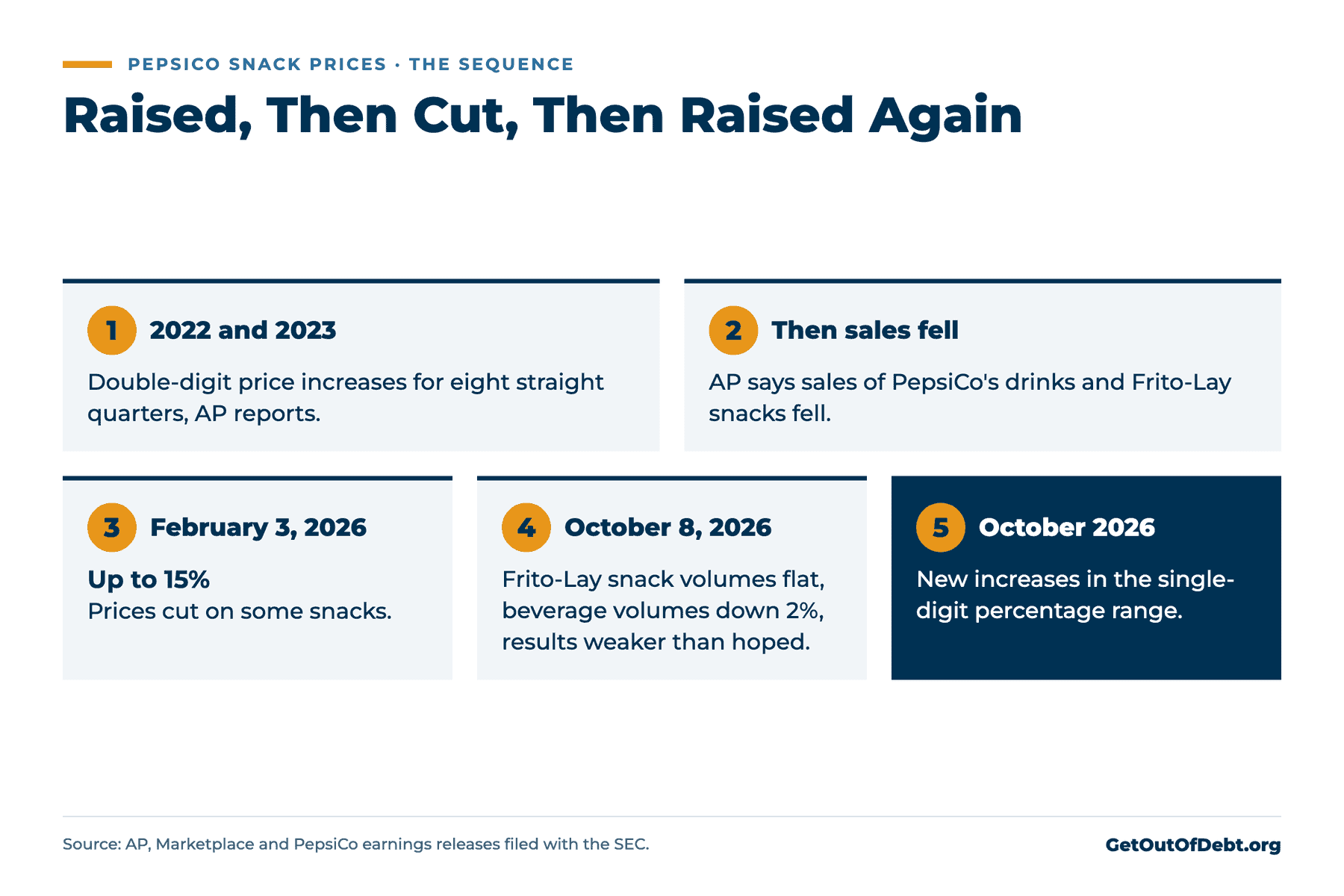
That is the sequence. Notice what the words say and do not say. The cut came after sales fell. That is a timeline. Marketplace’s headline called the cut a “bid to boost sales.” PepsiCo’s own documents call it affordability.
What the Companies Say Versus What the Coverage Says
PepsiCo’s own words are about affordability. Its October 8, 2026 earnings release says that in North America convenient foods, organic volume and volume market share increased “aided by innovation and affordability initiatives.” That is a year-to-date statement. The same release talks about “organic volume growth across both global beverages and convenient foods.” AP says Frito-Lay snack volumes were flat and beverage volumes fell 2%. Do not treat these as one number. The release’s table for the third quarter alone shows worldwide convenient foods volume up 1% and beverage volume up 3%. In the same table, PepsiCo Foods North America is flat, and PepsiCo Beverages North America is down 2%, which lines up with AP’s figures. So in the third quarter, volume was up worldwide and flat to down in North America.
The coverage uses a harder word. “Consumers revolted” is AP’s. Marketplace reported that Peter Galbo, an analyst with Bank of America, said consumers are less willing to spend on chips and pretzels. I did not find a PepsiCo document that says it cut prices because customers bought less. So the cut followed the drop in sales, and PepsiCo describes it as a move on affordability.
McDonald’s filings use the same kind of words, not the same price move. In its Q2 2024 release, global comparable sales fell 1.0% and the CEO said “consumers are more discriminating with their spend.” In its Q3 2024 release, global comparable sales fell 1.5%. In its Q4 2025 release, the company said: “By listening to customers and taking action, we have improved traffic and strengthened our value & affordability scores.” I am not saying McDonald’s cut prices. I am showing how the company talks.
General Mills’ July 1, 2026 release says company-wide organic net sales were down 2 percent, “due in part to weaker consumer sentiment and significant volatility that weighed on category volume growth and drove a higher share of consumer purchases on promotion.” It calls its pricing work “price investment.” The release never says “price cut,” so I am not calling it one.
Put together, companies talk about value, affordability and sentiment. None of the sources I read separates shoppers pulling back from everything else going on at the same time. That is why I will not write that buying less made any of these prices drop.
Where It Got Complicated
PepsiCo is taking some of it back. The February cuts covered Lay’s, Doritos, Cheetos and Tostitos. In October, AP reported single-digit increases coming on Doritos, Ruffles, SunChips and some sodas, with prices still lower than at the start of the year. Doritos is on both lists. So on that one, part of the cut is going back, and by AP’s account not all of it. The CEO said the lower prices brought some shoppers back, and the quarter still came in weaker than hoped.
General Mills is hard to read either way. The release says “With our price investment work behind us.” The release says the unit’s sales include a 9-point headwind from divestitures, including its U.S. yogurt business, so I am using the release’s organic table, which leaves those sales out. For fiscal 2026, the North America Retail row shows organic price/mix down 2 points and organic volume down 1 point. I cannot tell from the release whether volume would have been worse without the pricing work, and I am not reading that 1-point slip as its result.
A Quiet Pullback Versus an Organized Boycott
The PepsiCo story is about a lot of shoppers buying less. No source I read says whether anyone organized it, either way. An organized boycott is a different thing, and the evidence I could read about those is thin.
The one study I can describe is about Goya Foods. Researchers Liaukonyte, Tuchman and Zhu studied sales after the Goya CEO’s comments in 2020 set off both a boycott and a buycott (people buying more to show support). An Imperial College summary of the study says sales rose about 22%, “predominantly affected by the buycott effect,” then returned to pre-incident levels after only two weeks. It says Goya’s core Latino customers did not decrease their overall purchases, though they bought less in categories where it was easy to switch to another bean brand. I read the summary, not the paper itself.
The one boycott study I could read about was not about prices, and I could not read the two main studies of the 2023 Bud Light boycott. So I have no evidence either way on whether an organized boycott lowers a price.
Where You Have a Swap, and Where You Do Not
Economists measure how much buying changes when a price changes. They call it price elasticity, and the textbook definition is the percentage change in the amount people buy divided by the percentage change in the price. A number near zero means people keep buying almost the same amount when the price moves. The same textbook says goods with many substitutes tend to respond a lot, and that necessities with no close substitutes tend not to, naming life-saving drugs and gasoline as examples.
Soft drinks. A review of 160 studies of U.S. estimates from 1938 to 2007, published in the American Journal of Public Health, found that soft drinks, juice, meats and food away from home respond most to price. Its example: “a 10% increase in soft drink prices should reduce consumption by 8% to 10%.” That review has no category for salty snacks, so it says nothing direct about chips.
Gasoline. A 2006 National Bureau of Economic Research paper by Hughes, Knittel and Sperling found that gasoline use barely moved with price. Its short-run price elasticities (the percentage change in gasoline use for each 1% change in price) were -0.034 to -0.077 during 2001 to 2006. In plain words: a 10% price rise cut gasoline use by about 0.3% to 0.8%, well under 1%. I wrote about a gas price drop in July 2026 if you want the money side of that.
These are two different studies of different things, so do not read them as one scoreboard. The textbook’s rule is that goods with many substitutes respond more, and it names gasoline as a necessity with no close substitute. I am using that rule to read the gap. The two studies did not measure how many substitutes each product has.
The bills you cannot buy less of. I found no measured figure for rent, electricity, insurance, prescription drugs or snack foods, so I will not give you one. As an observation, not a measurement, rent and basic electricity are hard to walk away from. Using less power lowers your bill, but it does not change the rate, and there is no store brand of rent. Some insurance can be shopped, though a plan may be tied to a job or a plan year. Some drugs have a generic, and that is a question for your pharmacist or prescriber. Do not skip or split doses to save money. Those bills are a different post.
Store brands. The Private Label Manufacturers Association (PLMA), the trade group for store brands, so it has a stake in the answer, reports from Circana data that store brands set all-time highs in 2025: a 21.3% dollar share and a 23.5% unit share for the period from December 29, 2024, to December 28, 2025. PLMA also estimates that shoppers saved about $35 billion in 2025 by choosing a store brand over a national brand, using average cost per unit. That is an estimate from the people who promote store brands. It is not a number for the item in your cart.
The Bigger Squeeze
None of this happens in a vacuum, so here are the current numbers.
Groceries. By my arithmetic from the Bureau of Labor Statistics index for food at home (not seasonally adjusted), prices were about 32% higher in August 2026 than in January 2020 (321.500 versus 243.110). In the 12 months through August 2026 the rise was about 2.2% (321.500 versus 314.608 in August 2025). Slower increases are not lower prices. I wrote about tariffs and the grocery bill in April 2026 and about wholesale inflation and a grocery price timeline in May 2026.
A $400 surprise. The Federal Reserve’s 2025 household survey (report dated May 2026) found that 63% of adults would cover a $400 emergency expense using cash, savings or a credit card paid off at the next statement. The Fed calls that “cash or its equivalent.” Twelve percent said they would be unable to pay the expense by any means, down slightly from 13 percent in 2024. That is not the same as saying 37% have no way to pay. The Fed says most of the other 37% would pay some other way.
Who holds the wealth. The Fed’s Distributional Financial Accounts for the second quarter of 2026 put the top 1% at about 32% of household net worth and the bottom half at about 2.3%. Those shares are my arithmetic from the Fed’s data file.
Here’s Where I Land
I am not telling you that your grocery cart moves a price. Nothing I read says one household’s cart does. What the research shows is narrower. Some of what you buy has easy swaps, and when prices rise on those, people cut back. Some of what you pay for has no easy swap, and people keep paying. The PepsiCo sequence shows a price cut can come after sales fall. It also shows a company can start raising prices again within months. That is a sequence, not a promise.
So here is where I land. When grocery prices are up about a third since 2020, what goes in the cart and what you pay per unit is one of the few parts you still decide yourself. It is a small part. It does not fix rent. But a decision made with the real numbers in front of you is a different thing than one made by habit. If that sounds like a small amount of control, it is. I would rather give you a small real one than a big pretend one.
One Thing You Can Do This Week
Pick one packaged brand-name item you buy every week that has a store brand beside it, such as a drink or a juice. At the store, find it on the shelf. Many stores print a unit price on the shelf tag, usually in smaller type than the package price. It is the price per the measure printed on the tag, which may be ounces, fluid ounces, pounds or a count. Read it. Then read the unit price on the store brand next to it. Then decide. I wrote a separate post on how to catch a smaller package at the shelf with the unit price.
I suggest the unit price because the two packages may not be the same size, and the package price hides that. Check that both tags use the same measure. If your store shows no unit price, divide the price by the net amount printed on the package, and use the same measure for both items. If either one is on sale, make sure the unit price on the tag matches the sale price. And if the register ever charges you more than the tag showed, here is what I wrote about getting that money back: Dollar General Charged Me More Than the Shelf Price. Can I Get My Money Back? The Government Accountability Office’s shrinkflation work shows how much a size change can hide: it found downsizing “impacted less than 5% of items we looked at,” and on those items “the per-unit price increase … ranged from 12% for paper towels to 32% for coffee.” That is a reason the package price can mislead. It is not a description of this week’s shelf.
Stay with the brand name if you like it. Switch if the numbers say so. If the store brand is not cheaper per unit, you learned something too. If you do switch, take the difference between the two package prices for the same amount and multiply it by how many you expect to buy in a year. That is a snapshot, since tags change, but it is your number, not an industry estimate. You do not need a budget for this. If budgets are not your thing, I have a post called Budgets Are a Page of Lies, and an older list of 31 tips for cutting your grocery bill.
What I Could Not Confirm
- Whether PepsiCo, or any company I read, cut prices because customers bought less. The documents talk about affordability, value and sentiment.
- What the Bud Light boycott studies found. One was behind a paywall and one was blocked, so I could not read them.
- What the Goya paper itself says beyond the Imperial College summary.
- A measured figure for how much people cut back on rent, electricity, insurance, prescription drugs or snack foods.
- A government figure for the price gap between store brands and national brands. PLMA gives a dollar estimate and no percentage.
Key Takeaways
- PepsiCo cut some snack prices by up to 15% in February 2026 after sales fell, according to the Associated Press, and AP reported new single-digit increases in October 2026. The cut followed the drop. Marketplace called it a bid to boost sales, and no PepsiCo document I read says customers buying less was the reason.
- You cannot set the price. Where there is a swap, you can choose what you buy.
- I found no evidence either way on whether an organized boycott lowers a price.
- In the studies I read, with data ending in 2007, people cut back a lot on soft drinks when prices rose and barely on gasoline in the short run. I have no measured figure for rent, electricity or insurance.
- One thing you can do this week: compare the unit price of one brand-name item with the store brand beside it.
The Bottom Line
Buying less can come before a price cut. It is not a guarantee, and it does nothing for bills you cannot buy less of. What you can do is decide on purpose, with the unit price in front of you, which items earn a place in your cart. You are not your grocery bill. A unit-price choice is a small piece of control over the cart. It does not set the price, and it is not a plan for debt, but it is yours.
Frequently Asked Questions
Does buying less actually bring prices down?
The one documented case I could verify shows a price cut after a drop in sales, which is not proof that the drop caused it. PepsiCo cut prices on some snacks by up to 15% in February 2026 after sales of its drinks and Frito-Lay snacks fell, according to the Associated Press. No company document I read says it cut prices because customers bought less, and in October 2026 AP reported new single-digit increases, with prices still below the start of the year.
Did PepsiCo cut prices because people stopped buying chips?
PepsiCo’s own words are about affordability: “offering sharper value to address consumer affordability dynamics.” The Associated Press says “Consumers revolted” and sales fell, and Marketplace reported an analyst saying shoppers were less willing to spend on chips and pretzels. The cut followed the drop in sales. Marketplace described it as a bid to boost sales, and no PepsiCo document I read says customers buying less was the reason.
Do boycotts lower prices?
I found no evidence either way. The one boycott study I could read about was not about prices, and I could not read the main Bud Light studies. An Imperial College summary of a Goya Foods study reports a sales rise of about 22%, mostly from people buying more in support, that returned to earlier levels after two weeks.
Why do people cut back on soft drinks but barely on gasoline?
A textbook rule says goods with many substitutes respond more to price, and it names gasoline as a necessity with no close substitute. A review of 160 studies found a 10% rise in soft drink prices should reduce consumption by 8% to 10%. A 2006 National Bureau of Economic Research paper found that in 2001 to 2006 a 10% rise in gasoline prices cut gasoline use by about 0.3% to 0.8% in the short run. They are two different studies of different things, so they are not a single scoreboard.
Are store brands really cheaper?
I found no government figure for the price gap, so the number that matters is the unit price on the shelf tag for the item you buy. The Private Label Manufacturers Association, a trade group with a stake in store brands, estimates shoppers saved about $35 billion in 2025 by choosing them, using average cost per unit, and that is not a number for your cart.
This is what I’m telling friends like you over coffee. Take it as input, not instruction, and remember, you do you.
If this made sense to you, send it to someone who is watching the grocery bill closely. Not to worry them, only so they have the numbers in one place.
Dealing With Debt? Understanding your options is the first step. See how all your debt relief options compare — including ones most sites won’t tell you about. The Find Your Path quiz gives a recommendation based on your actual numbers, and the Scam-O-Meter checks any company’s complaint history before you sign. Federal Reserve Bank of New York research shows bankruptcy filers recover faster than those who don’t file.



