

Do This Today
- Find the date on the letter and the appeal deadline printed on it.
- Put that date on your calendar today, and plan to get your appeal to the plan before it, not on it.
- Call the number on the letter and ask how to appeal, by what date, and (if your coverage is through a job) whether the plan is self-funded.
The call is not the appeal. Ask whether a call counts as filing, and if they do not say it does, file the way they tell you and keep proof it arrived.
If your notice says coverage of a hospital, skilled nursing, home health or hospice stay is ending, follow the fast-appeal instructions on that notice today, because that deadline can be the next day. On any other denial, if waiting would seriously threaten your health, ask on that call for an expedited appeal (Medicare calls it a fast appeal).
Prefer to watch? I walk through the whole thing in this video.
A denial letter is a decision your insurer made. It is not the last decision anyone gets to make.
The part the headline left outEach weekday I send one short email: one story that caught my attention, why it might matter to you, and one manageable thing you can do with it. A couple of minutes, and a dad joke.
In the latest issue (Nov 13): The shelf price isn't always what you pay
Free. I sell nothing. Unsubscribe any time.
If you are holding a health insurance denial letter right now, I want you to hear something before the next paragraph: you are not your bill, and that letter is not a verdict. Debt is math wrapped in emotion, and a denial lands right on the emotion. You are scared, you are angry, and you are pretty sure “denied” means “done.”
It does not have to mean done. But I am not going to oversell this either. You have probably seen headlines and videos claiming that about 80% of appeals win. The 80% figure is a real 2024 Medicare Advantage prior-authorization result, and it does not mean 80% of appeals win. So here is what the record actually shows, what it does not show, and the deadlines, because a missed deadline is the mistake that is hardest to undo.
Almost Nobody Asks
In a 2023 survey, KFF (a nonprofit health policy organization, formerly known as the Kaiser Family Foundation) found that 18% of insured adults had a claim denied in the past year. Of those, 84% took some action to try to resolve the biggest problem they had with their insurance, and “15% filed a formal appeal.” The same survey found that most people with a denied claim “do not know whether they have appeal rights (69%).” Put plainly, the vast majority did not file a formal appeal, and most did not know whether they had appeal rights at all.
That last number comes from a second KFF report on marketplace plans, which found that consumers “appealed at least 262,982” of roughly 85 million denied in-network claims in 2024, “an appeal rate of less than 1%.” KFF adds that CMS suppresses small counts, so the number of appealed claims could be higher.
Now the honest part. The same KFF report says insurers “upheld 165,863 (66%) denials on appeal” in those marketplace plans (66% is KFF’s percentage; it is not 165,863 divided by the 262,982 above, and KFF notes some counts are suppressed). An internal appeal means asking the insurer to look at its own decision again, and in that data the insurer often said no a second time. Asking is not magic. That is why the next step matters more than most people realize.
The 80% Number, and What It Actually Measures
Here is where the headline comes from. KFF’s 2026 analysis of Medicare Advantage looked at prior authorization, which is the approval a plan requires before a service, for care your doctor ordered. In 2024, Medicare Advantage insurers decided 52.8 million of those requests and denied 4.1 million, in full or in part. Of the denied requests, 11.5% were appealed, and KFF reports that “most appeals (80.7%) were partially or fully overturned in 2024.”
That is a real finding, and I am not going to tell you it means “80% of patients who appeal win,” because the data cannot say that:
- It covers Medicare Advantage prior authorization requests only, not claims after you already got care, which KFF’s analysis says it excludes.
- KFF says of the denials that were appealed and overturned that they “represent medical care that was ordered by a health care provider.” The KFF page does not say who filed those appeals, the patient or the doctor’s office, and no source I found separates the two.
- KFF itself says a high overturn rate “raises questions about whether the initial request should have been approved, although it could also indicate that the initial request was missing the required documentation.”
So the honest version of that number is this: in 2024, most appealed Medicare Advantage prior authorization denials were fully or partly reversed, and the public data does not say how many of those appeals were filed by patients.
Where the Record Gets Interesting: The Outside Review
Two terms, because jargon is only a problem when nobody explains it. An internal appeal is you asking your insurer to review its own decision. An external review (some states call it an independent medical review) sends the decision to a reviewer outside the insurer. HealthCare.gov puts the rule this way: an external review “either upholds your insurer’s decision or decides in your favor,” and the insurer “is required by law to accept the external reviewer’s decision.”
Some states publish what those outside reviewers decide, and that is the closest thing to real outcomes I could find:
In California, the Department of Managed Health Care’s 2024 annual report says 3,477 independent medical reviews were resolved that year: 22% were reversed by the health plan, 27% were upheld by the reviewer, and 51% were overturned by the reviewer. “Members received the requested services in 73.1% of the cases qualified by the Department for the IMR program in 2024.” The department’s FAQ says an independent medical review “is free to enrollees.” (That FAQ gives a different figure, about 78%, and says it is based on the same annual report; I cannot explain the gap, and I am using the 73.1% because that is the number in the report itself.)
In Pennsylvania, the Insurance Department’s April 3, 2026 announcement said it referred 1,353 eligible cases to independent external review, and 655 of those initially denied claims were overturned, which the state describes as about 48%.
A January 2026 paper in Health Affairs points the same direction. Its abstract says “almost one-half of health plan coverage denials that were appealed to independent medical review in four states were overturned” during 2019 to 2023. (I read the abstract on PubMed, not the full paper.)
What These Numbers Do Not Tell You
These are the outcomes of cases that qualified for review and were resolved, in one state each, so they are not your odds, and I would not say “half of outside reviews win” nationwide. A doctor can request an outside review on your behalf too, so I would read these figures as “a person or their doctor,” not “a person alone,” and the sources I read do not split the two. Employer coverage is the biggest group: the Census Bureau says 53.5% of people had employment-based coverage for some or all of 2025. Some of it is in these state numbers — in California’s 2024 report, 65.1% of the resolved reviews were employment-based coverage, and Pennsylvania says its review covers policies employers buy from an insurer — and some of it is not. Self-funded plans, where the employer pays the claims itself, are outside both state programs — but that does not mean there is no outside review, because federal rules require most employer plans, self-funded ones included, to offer one. Grandfathered plans are one exception, and I did not check church plans or government employers’ plans, which can follow different rules, so ask the plan in writing whether an outside review exists and by what date. What I could not find is public data on how those reviews turn out: KFF writes, “There is no publicly available prior authorization data for self-funded plans sponsored by private employers, which cover the majority of workers with employer-sponsored health insurance.” For people in a self-funded employer plan, I could not find public numbers on how often an appeal works. The insurance company’s name on your card does not tell you which kind of plan you have — KFF says a self-funded plan’s card “will typically look the same as an insurance card for a fully-insured plan” — so your plan documents or your HR office are what can tell you.
So here is the claim I will stand behind, and nothing bigger: a real share of the denials that reach an outside review in the states that publish results get changed — those reports do not say how many of the requests came from patients and how many from doctors — and in KFF’s marketplace data fewer than 1% of denied claims were appealed at all. No promises. But if the alternative is accepting the first “no” because nobody told you there was a second door, that is information you deserve to have.
The Deadlines, by Kind of Plan
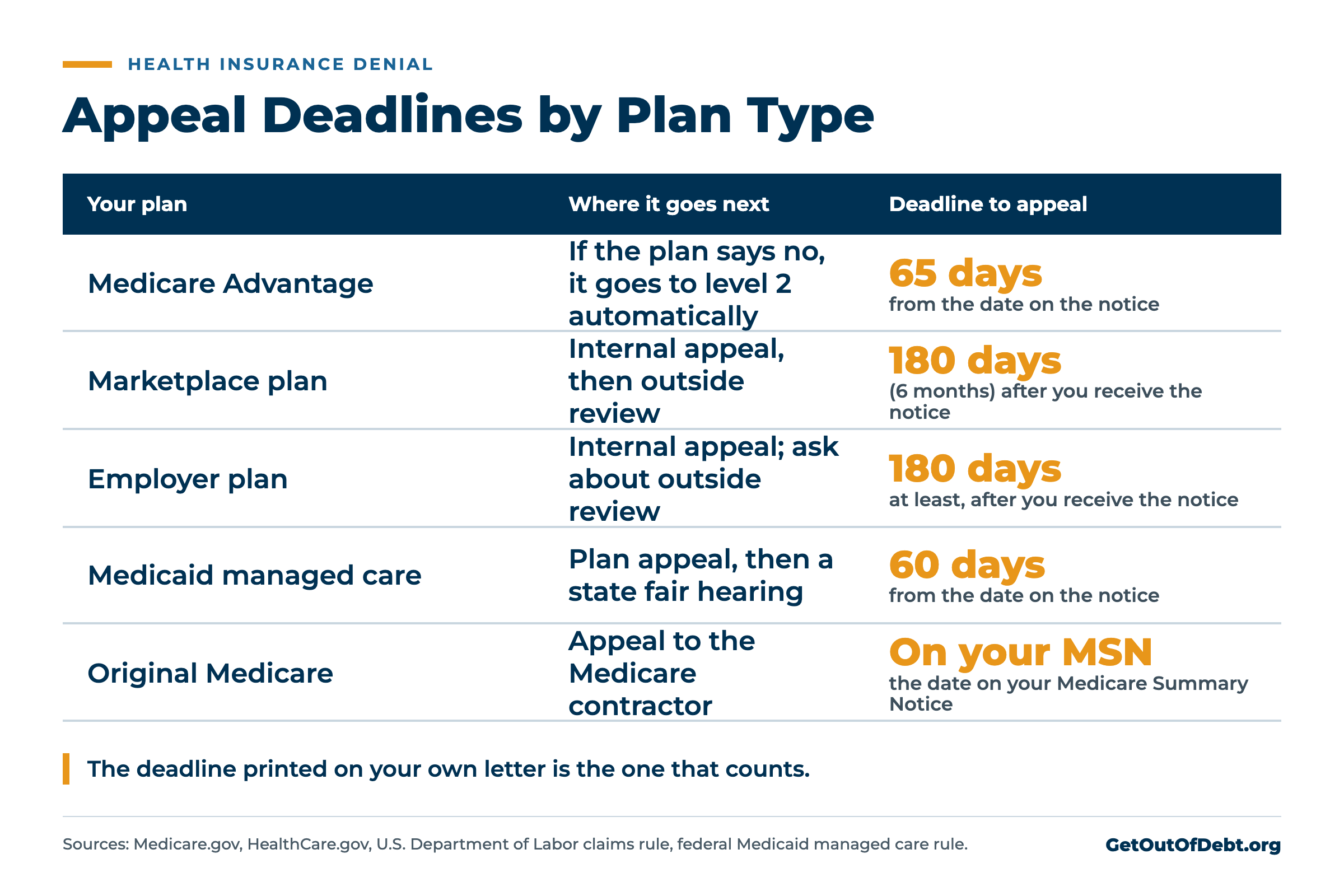
Start with the date on your own letter and file by it if you still can. If the date on your letter is sooner than the period below for your kind of plan, go by the letter. Everything below is what the government pages say, and your letter, your plan and your state can differ. If your letter gives a date, file by it if you still can; if that date has passed and you are still inside the period described here for your kind of plan, file anyway and ask the plan in writing which deadline applies.
- Medicare Advantage: Medicare.gov says “you, your representative, or your doctor or healthcare provider must file an appeal within 65 days from the date on the initial denial notice sent by your plan.” If you miss it, you must give a reason for filing late, and the plan decides whether to accept it — the regulation says that if you show good cause the plan “may extend the timeframe for filing a request for reconsideration.” The plan has to receive your appeal by the deadline, so mailing it on the last day is too late. For any kind of plan, I would get it there early and keep proof it arrived. If the plan decides against you, “your appeal is automatically sent to level 2,” an independent review entity. For the other kinds of plans below, nothing is forwarded automatically and you have to ask for the outside review or hearing yourself. A notice that a hospital stay, skilled nursing, home health or hospice coverage is ending has its own fast-appeal steps and a much shorter clock — Medicare.gov says to ask “no later than noon the day before the termination date listed on the notice,” or, for a hospital stay, “no later than the day you’re scheduled to be discharged from the hospital” — and a denial under Medicare drug coverage has its own appeal steps too, so follow the notice you were given.
- Marketplace plans: HealthCare.gov says “you must file your internal appeal within 180 days (6 months) of receiving notice that your claim was denied.” That 180 days is for the internal appeal and runs from the denial notice. The plan then has 30 days to decide a service you have not received yet, and 60 days for one you already received. The outside review is the next step, after the insurer still says no, and it has its own clock: you must file a written request “within 4 months after the date you receive a notice or final determination from your insurer that your claim has been denied,” which can be the denial notice or the insurer’s later decision on your internal appeal — so use the date on your letter, and if you see two dates, file by the sooner one and ask the plan in writing which one controls.
- Employer plans: the Labor Department’s claims rule requires group health plans to give you at least 180 days after you receive the denial notice to appeal. How an outside review works for your particular plan, I cannot give you as one deadline, so ask the plan in writing how to request it and by when.
- Medicaid managed care: the federal rule gives you 60 calendar days from the date on the denial notice to appeal to the plan. In the ordinary case a state fair hearing comes after the plan has decided your appeal and upheld its denial — if the plan misses the rule’s notice or timing requirements, you do not have to wait for it and may ask for the hearing — and the rule has each state set that window at no less than 90 and no more than 120 calendar days from the date of the plan’s notice of resolution, so the number on your notice is your state’s. If the plan is ending, suspending or cutting services you were already approved for, the rule says the plan must keep them going during your appeal only if you meet its conditions, including asking the plan to keep the services going, not just filing the appeal, and doing it in time — within 10 calendar days of the plan sending its notice or by the date the change is set to take effect, whichever is later. If the plan’s appeal decision then goes against you, the same rule keeps the services going only if you ask for the state fair hearing and for the services to continue within 10 calendar days of the plan sending that decision, which is far shorter than the hearing window. And if the final decision goes against you, the plan may seek repayment of what it paid for those continued services, consistent with the state’s usual policy and the plan’s contract — that is a risk of asking for services to continue, not a charge for filing an appeal.
- Original Medicare (not Medicare Advantage): Medicare.gov says to file “by the date in the MSN,” your Medicare Summary Notice, and that a late filing can still be accepted if you can show good cause.
If waiting would seriously threaten your health, there are faster tracks. HealthCare.gov says you can file an expedited appeal “if the timeline for the standard appeal process would seriously jeopardize your life or your ability to regain maximum function,” and an expedited external review is decided no later than 72 hours after the request. On its internal appeals page HealthCare.gov also says that in urgent situations “you may file an internal appeal and an external review request at the same time.” Medicare.gov says a Medicare Advantage plan must decide a fast appeal within 72 hours if it determines, or your doctor tells the plan, that waiting could seriously jeopardize your life, health, or ability to regain maximum function — and that the time may be extended by up to 14 days in some cases.
What I Would Do With the Letter in My Hand
This is not legal advice and I cannot tell you what to do about your specific claim. This is the order I would work through it, using what the regulators’ own pages say:
- Read the letter for three things: the date, the reason, and the deadline.
- Write the appeal down. HealthCare.gov says to write to your insurer with “your name, claim number, and health insurance ID number,” and to keep your explanation of benefits (the statement your insurer sends after a claim) and copies of everything.
- Bring in your doctor’s office. In Medicare Advantage your doctor or healthcare provider can file the appeal, and for an outside review you can appoint a representative “like your doctor.” KFF notes an overturn can happen because the first request “was missing the required documentation,” which is a good reason to ask what the plan said was missing. Under an employer plan, the Labor Department’s claims rule says you are entitled, on request and free of charge, to “reasonable access to, and copies of, all documents, records, and other information relevant to the claimant’s claim for benefits,” so I would ask for them in writing.
- Ask for help. HealthCare.gov says the Consumer Assistance Program in your state, if your state has one, “can file an appeal for you.”
- If the insurer says no again, ask for the outside review. Not every denial qualifies. HealthCare.gov lists three types that can go to external review: any “denial that involves medical judgment where you or your provider may disagree with the health insurance plan,” any “denial that involves a determination that a treatment is experimental or investigational,” and a “cancellation of coverage based on your insurer’s claim that you gave false or incomplete information when you applied for coverage.” Your final denial letter should say whether you can ask for an outside review, a state’s process may go beyond the federal standards, and a denial that does not qualify can still go through the internal appeal. HealthCare.gov says a standard external review is decided no later than 45 days after the request. If your insurer uses the federal process there is no charge, and otherwise “the charge can’t be more than $25 per external review.” Your explanation of benefits or the final denial of your internal appeal gives the contact information for the organization that handles it.
What Happens to the Bill While You Wait
This is the part everyone asks about, and here is the plain version: I found nothing in the HealthCare.gov, Medicare.gov and CFPB pages I read that says an appeal stops the bill, so I would not count on it — the appeal is with your insurer and the bill is from your provider. What I would do is ask the provider’s billing office, in writing, to hold the account while the appeal is pending, and keep their reply with the rest of your paperwork. They can say no. If you want the full playbook for a bill that has already moved on, I wrote it up in A Medical Bill Went to Collections and Nobody Warned Me, and Your Hospital Bill Is Probably Wrong covers how to fight the bill itself. If the bill has already gone to a collector and you believe your insurance should have paid it, I put the order of moves, with the deadlines, in my guide for that exact situation.
If you disagree with the charges, the CFPB says, “You have a right to both an “internal appeal” and an “external review” of the charges.” In an October 2024 consumer advisory, which the CFPB now marks as archived and possibly outdated, the Bureau said debt collectors “aren’t allowed to ask you to pay charges that you don’t actually owe,” including bills that were already paid by you or by your insurance. That could matter if a claim you win on appeal was already sent to a collector.
One caution on credit reports. The CFPB’s rule to keep medical debt off credit reports was vacated on July 11, 2025 in Cornerstone Credit Union League v. CFPB, so please do not assume a federal rule is protecting you. In April 2023 the three credit bureaus said they had removed medical collections with an initial balance under $500, and moved the wait before unpaid ones appear from six months to one year. That is a voluntary policy and not a law, I have not confirmed it is unchanged today, and nothing I found ties it to a pending appeal. I wrote about the credit report side in Medical Debt on Credit Reports.
And if the appeal does not go your way and the bill is real and unpayable, that is a different math problem with real options, including bankruptcy. Nobody should make that call from inside a panic, and none of this changes the point of the post: do not let the first “no” be the only conversation you have.
Key Takeaway: A denial is the insurer’s decision, not the last word. In KFF’s 2023 survey only 15% of people with a denied claim filed a formal appeal, and 69% did not know whether they had appeal rights. The unfavorable number belongs next to the favorable ones: in HealthCare.gov marketplace plans in 2024, insurers upheld 66% of denials on appeal, by KFF’s count. California and Pennsylvania publish outside-review results, a later step than an appeal to the insurer, and California reported 73% of qualifying cases got the requested service in 2024 — a figure that includes cases where the plan reversed itself (22% of the 3,477 resolved reviews) — while Pennsylvania reported about 48% overturned. Those are one state each, and a doctor can ask for these reviews too, so none of this is your odds. Self-funded employer plans are outside the state programs, and federal rules still require most of them to offer an outside review, but I found no public data on how those turn out. Find the deadline on your letter first.
Frequently Asked Questions
How long do I have to appeal a health insurance denial?
It depends on the plan, and the date on your own letter is where to start: file by it if you still can. Medicare.gov says Medicare Advantage appeals must be filed within 65 days from the date on the denial notice. HealthCare.gov says marketplace internal appeals must be filed within 180 days (6 months) of receiving the notice, and an external review request within 4 months of the notice or final determination. The Labor Department’s rule gives employer group health plan members at least 180 days, and Medicaid managed care gives 60 calendar days.
Do most people who appeal a denial win?
The public data does not say that for patients specifically. No source I found separates appeals filed by patients from appeals filed by doctors or hospitals. KFF reports that in HealthCare.gov marketplace plans in 2024, insurers upheld 66% of denials on appeal, by KFF’s count, and that in 2024 most Medicare Advantage prior authorization appeals (80.7%) were partially or fully overturned — a figure that includes requests that began with a doctor’s office. California and Pennsylvania are outside reviews, a later step than an appeal to the insurer: in California’s 2024 independent medical reviews, members received the requested services in 73.1% of qualifying cases, a figure that includes cases where the plan reversed itself (22% of the resolved reviews), and Pennsylvania reports about 48% overturned. These are not predictions for your case.
Can my doctor file the appeal or the outside review for me?
In many cases, yes. Medicare.gov says in Medicare Advantage “you, your representative, or your doctor or healthcare provider” can file an appeal. HealthCare.gov says you may appoint a representative, like your doctor, to file an external review for you. For Medicaid managed care the rule lets a provider appeal with your written consent where state law permits it.
What does an external review cost?
HealthCare.gov says there is no charge if your insurer uses the federal external review process, and otherwise “the charge can’t be more than $25 per external review.” California’s Department of Managed Health Care says an independent medical review there is free to enrollees.
Does filing an appeal stop the bill from going to collections?
Do not count on it. I found nothing in the government pages I read that says an appeal stops billing or collection, and the appeal is with your insurer while the bill is from your provider. Ask the provider’s billing office in writing to hold the account while the appeal is pending, and keep their answer — they can say no.
Does any of this data cover employer plans?
Partly. State outside-review numbers include employer plans bought from an insurer — in California’s 2024 report, 65.1% of resolved reviews were employment-based coverage. For self-funded employer plans, where the employer pays the claims itself, I found no outcome data: KFF notes there is no publicly available prior authorization data for those plans, which it says cover the majority of workers with employer coverage. The deadline rule for employer group health plans, at least 180 days, does exist. Being outside the state programs does not mean there is no outside review: federal rules require most employer plans to offer one, grandfathered plans being one exception, and I found no public data on how those reviews turn out. The insurance company’s name on your card does not tell you whether your plan is self-funded, so ask your HR office or check your plan documents.
This is what I’m telling friends like you over coffee. But remember, you do you: take it as input, not instruction, because only you know your own situation.
If you know someone holding a denial letter, send this to them today. The deadline clock is already running on their letter, and most people never hear that there is a second door.
Dealing With Debt? Understanding your options is the first step. See how all your debt relief options compare — including ones most sites won’t tell you about. The Find Your Path quiz gives a recommendation based on your actual numbers, and the Scam-O-Meter checks any company’s complaint history before you sign. Federal Reserve Bank of New York research shows bankruptcy filers recover faster than those who don’t file.



