

Quick Answer: Some people feel unneeded when work ends, and that is not a character flaw. The research I read says most retirees are not lonelier than people still working. People pushed out of work, and workers whose whole social world was the job, tend to have a harder time. The money risk shows up in two places: helping grown children past what you can afford, and people who make you feel needed and then cost you, including scammers. The one decision I would make this week is a number: the most you can give the people you know and love over the next 12 months without dipping into the money you need for your own bills, emergencies and the years ahead, and without borrowing or co-signing. A stranger, or someone you have only met online or by phone, gets no number at all. The answer is no. No study I found proves that number works. It is a planning move.
Prefer to watch? I walk through the whole thing in this video.
Expert Context: I am not a psychologist or a gerontologist. For this post I read the National Academies’ 2020 report on social isolation and loneliness in older adults, the U.S. Surgeon General’s 2023 advisory on loneliness, two research reviews on retirement and depression, a 2007 study on feeling useful, the FBI’s 2025 Internet Crime Report, a 2019 Consumer Financial Protection Bureau report on bank-flagged elder exploitation, a 2025 FINRA Foundation research brief, a September 2026 Census Bureau story and a 2024 Pew Research Center report. I name the source next to each claim. I have been helping people with money since 1994.
The job ends, or the role that came with it does. The phone rings less. Nobody needs a decision from you by Friday. For some people that is freedom. For others it is a quiet that gets loud. This post is about the second group, and about the money decisions that can follow, because those decisions are where I can actually help.
Each weekday I send one short email: one story that caught my attention, why it might matter to you, and one manageable thing you can do with it. A couple of minutes, and a dad joke.
In the latest issue (Nov 13): The shelf price isn't always what you pay
Free. I sell nothing. Unsubscribe any time.
Debt is math wrapped in emotion. Feeling unneeded is the emotion. The math still has to protect your future.
— Steve Rhode
The Feeling, Named Plainly
People in problem debt often feel lost, alone, afraid and confused. I do not think those feelings should be brushed aside, and that goes double for people over 65 who may be wondering whether anyone still needs them.
The National Academies of Sciences, Engineering, and Medicine reviewed the research on this in 2020 and put it this way: “Some retirees feel a loss of identity without their former job title and responsibilities, and some miss the challenges, demands, or appreciation they received at work.” Notice the word “some.” It is not everyone. If it is you, that description fits: a loss of identity that comes with losing a work role. It is not a diagnosis, and it is not a weakness.
If it has gone further than that: If feeling unneeded has turned into feeling like you do not want to be here, please call or text 988, or chat at 988lifeline.org, to reach the 988 Suicide & Crisis Lifeline in the U.S. today. If you are in immediate danger, call 911. The money will wait. You matter more than any balance.
What the Research Actually Says About Retirement and Loneliness
The common story is that retirement makes people lonely and depressed. The evidence I read does not back that up as a general rule.
Most retirees are not lonelier. The same National Academies chapter says “most retired people are less lonely than employed workers or people who are simply unemployed, and women typically have an easier time transitioning into retirement than men.” That chapter is a review of the research, not a new measurement, and it says itself that research on these topics is sparse.
Retirement overall is not tied to more depression. A 2021 review in Epidemiology and Psychiatric Sciences pooled 60 datasets covering 557,111 people and found retirement associated with a lower risk of depression, nearly 20% lower, and the results varied a lot from study to study.
Being pushed out is different. A 2022 review in Frontiers in Psychiatry pooled four long-term studies covering 14,604 people. Across those four studies, people who retired involuntarily had a pooled relative risk of depression of 1.31 compared with people still employed, about 1.3 times the risk. The same review found the link runs the other way too: in a separate set of studies covering 26,822 people, people with depression had about 1.7 times the risk of later being pushed out of work, and those studies disagreed with each other a lot. The authors say the two may feed each other. Neither number is a forecast for you.
Loneliness before retirement matters. The National Academies chapter says “Workers who are lonely are at an increased risk of having difficulty transitioning to retirement and can experience a worsening of depressive symptoms because they often lack an established social network outside of the workplace.”
So it is not everyone who retires. It is more likely when the role ended without your choosing or the job was your whole social world. If you feel it anyway, that counts too.
Isolation and loneliness are not the same thing. The National Academies summary says about 24% of community-dwelling Americans 65 and older are considered socially isolated, and 43% of adults 60 and older report feeling lonely. Isolation means few contacts. Loneliness is the feeling. The Surgeon General’s 2023 advisory adds a twist: “while the highest rates of social isolation are found among older adults, young adults are almost twice as likely to report feeling lonely than those over 65.” Someone can have a full calendar and still feel unneeded, or live alone and feel fine. Feeling this way is not a sign of getting old.
Feeling useful matters. One study is worth knowing about, with its limits first. It followed 1,189 adults aged 70 to 79, starting in 1988 and 1989. The group was 80.7% white and, in the authors’ words, “relatively high-functioning,” and the study was observational, so it shows an association, not a cause. The majority said they frequently felt useful to family and friends. Those who never or rarely felt useful were more likely to see their disability increase, or to die, over the next seven years. The authors say this “suggests that feelings of usefulness may shape health trajectories in older adults.” It is not a prediction for you.
That last finding is why I take this seriously. The need to be needed is not silly. I could not find a study showing that people spend money to feel useful, so I am not going to claim it. What I can show you, from letters people have sent me and from the reports, are two places where money goes out when someone asks for it: grown children, and people who use the feeling of being needed.
Helping Grown Children: Love, and a Cost
Parents help adult kids. That is not news. Here are the real numbers, with their limits.
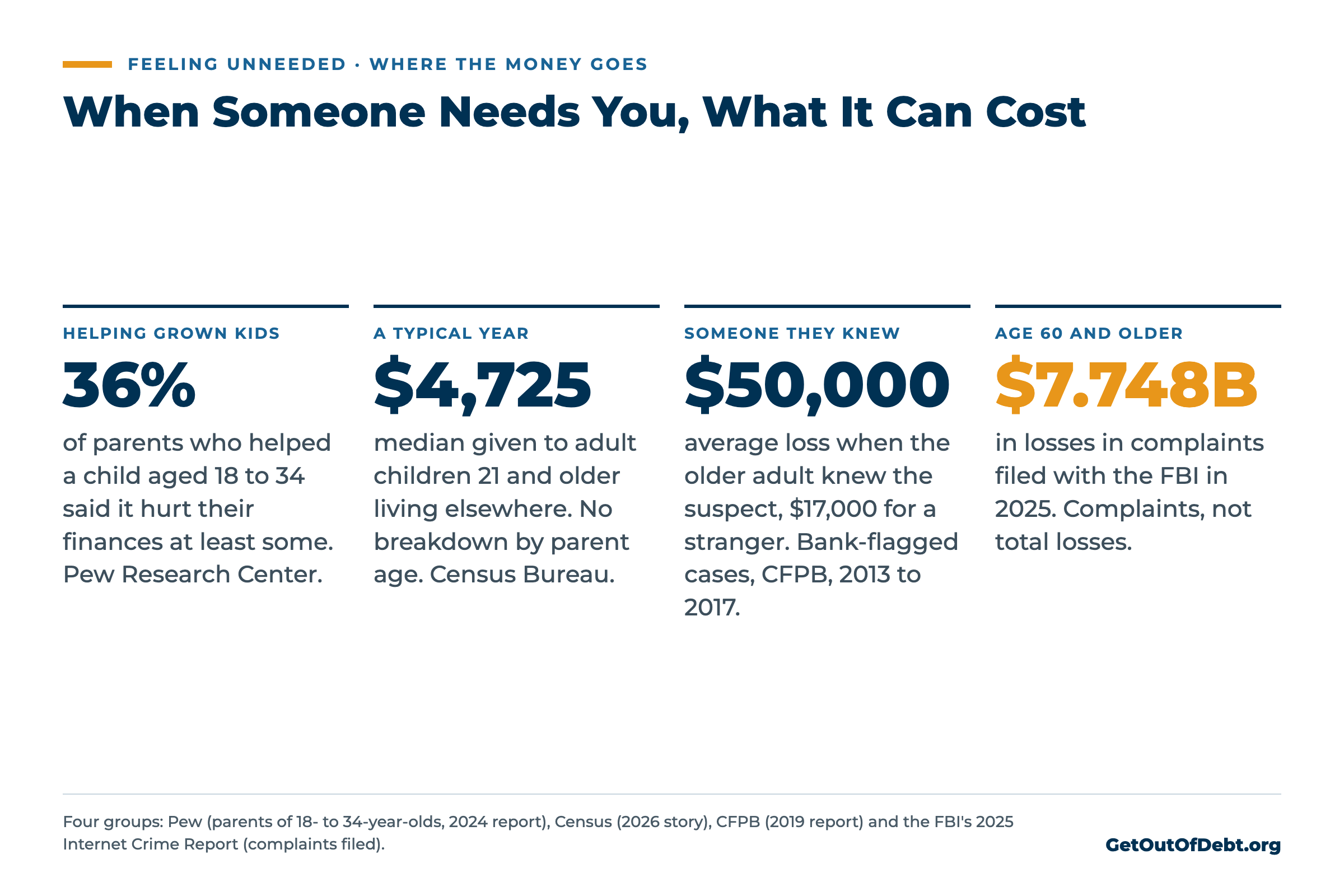
The Census Bureau reported in September 2026 that about 2.6 million U.S. parents gave $26.6 billion in 2024 to 3.7 million children age 21 or older who lived outside their households. The median parent gave $4,725 for the year, meaning half gave more and half gave less. Most givers, 72.7%, supported one adult child. The Census story has no breakdown by the parent’s age, so this is not a number about retirees, and it does not count money spent on adult children living at home.
Help goes to parents too. The same Census story says people in the U.S. gave $20.2 billion in 2024 to 7.2 million parents who lived outside the giver’s household.
Does helping hurt? Pew Research Center surveyed parents of 18- to 34-year-olds in late 2023. 59% said they gave financial help to a child in that age range in the past year. Among those who helped, 36% said it hurt their own finances at least some, and that rose to 49% among lower-income parents. That is parents’ own report, about kids 18 to 34, and those parents could be any age. More than six in ten who helped, 64%, said it did not hurt their finances much or at all.
I have been the grown child on the receiving end. As I said on the podcast I do with Damon Day, when I went bust in the late ’80s and start of the ’90s, I had to move back home at 30-something with a three-year-old. My parents took me in and did not charge me rent, because they watched me working hard to get back on my feet. Help like that can be exactly the right thing.
Help can also slide past what a parent can afford. A reader named Lou wrote to me with about $50,000 of debt in her name. In her words: “Alot of it has come thru my fault of continuing to help my grown children.” And then: “We are not spenders on material things. I shop at thrift stores, take my lunch to work, etc.”
She called it her fault. From her own letter, this was not about spending on herself; a lot of it went to her kids. She was still working when she wrote, and the pull to keep saying yes does not stop at retirement.
Myth: Helping my grown kids is always the loving thing to do.
Reality: Often it is. It is never free. In Pew’s survey of parents of 18- to 34-year-olds, 36% of those who helped said it hurt their own finances at least some, and 49% of lower-income helping parents said so. The question is not whether to help. It is what the help costs you, and whether you decided that or it just happened.
On the show I put it this way about lending to family: “If you want to help somebody out, lend them the money and make them pay you. And when they don’t pay you, which many times they won’t, that’s going to be a gift, and you better be ready for that.” If you have the cash, give it as a gift you can absorb losing. Either way, assume it may not come back. If you are also helping an aging parent, the sandwich generation squeeze makes this harder.
When Someone Makes You Feel Needed, and It Costs You
Being the one who can fix a problem feels like being needed. That feeling can be used.
A reader named Tonia wrote to me about her husband. In her words, when her mother died and left her some money, “as soon as she died my husband approached me about a credit card he owed on stating he was stressed over it.” She paid off $6,000 “with agreement he would never do such a thing again.” About two years after they bought a home with her down payment, he wanted to refinance. When she said no, by her account he told her the real reason: he had run up the cards again and could not make the house payment. They took out a $54,000 mortgage, and $45,000 of it went to pay off his cards. When she filed for divorce, she also found an investment account in his name: “at the time he came to me crying about debt he had a balance of 36,000 yet he made no attempt to obtain that money to pay his debt, instead he used my money.” She estimated she would lose around $50,000.
My answer to her started: “It sounds like you got played by a pro.” I meant her husband, not a stranger. I also told her, “These patterns of bailing someone out repeatedly are not that uncommon. I’ve seen the same pattern repeat over and over again.”
People you know can cost more than strangers. The Consumer Financial Protection Bureau studied a sample of 1,051 suspicious activity reports that banks and money transmitters filed from 2013 to 2017. It found “The average loss per person was about $50,000 when the older adult knew the suspect and $17,000 when the suspect was a stranger.” The medians, from the same reports, were much lower: $23,200 and $8,500, because a few large cases pull the averages up. Both count only reports where the whole amount was lost by the older adult. These are what banks flagged, not how often it happens, and the “known” group includes family, caregivers, friends, fiduciaries and contractors. It does not say family is the usual culprit.
Then there are scams. The FBI’s 2025 Internet Crime Report lists 201,266 complaints from people 60 and older, with $7.748 billion in reported losses and an average loss of $38,500, which works out to total losses divided by the number of complaints. These are complaints filed, not total losses, and an average can be pulled up by a few huge losses. Most of those dollars were not romance scams. Investment fraud accounted for about $3.52 billion and tech or customer support scams about $1.04 billion. Confidence and romance scams were about $584 million.
The scams built on someone needing you are real, even if they are the smaller dollars. In its section on artificial intelligence, the FBI report describes “grandparent scams, or ‘distress’ scams, in which voice cloning technology is used to mimic the sound of a loved one in distress,” and says victims claimed losses over $5 million in 2025 to distress scams. That figure covers all ages. I wrote about voice cloning calls earlier this year, and the site has a warning list on romance scams.
Loneliness, not living alone. A FINRA Foundation brief from February 2025 summarizes a survey of 905 known fraud victims with a mean age of 75. It found “Higher levels of loneliness, defined as feelings of social isolation, were tied to more unique incidents of financial fraud victimization.” The surprise: “Living alone and being less socially engaged were not risk factors; however, loneliness—a subjective measure of social isolation—was a risk factor.” The brief also says “Many scammers actively appeal to these social and psychological states and exploit targets’ emotional vulnerability.” This is a survey of known victims, so it may not describe fraud victims in general, and it shows a link, not a cause.
A widow wrote to me after she was scammed through a dating site. She wrote, “I have lost my lifetime savings,” over $250,000, plus about $32,000 in credit card bills. And then: “I blame myself for allowing all these to happen.” If that is how you feel, I want to say this plainly. The people who do this are professionals. Being targeted is not a verdict on you. You are not your debt, and you are not your loss. If a loss like that has you thinking about not being here, call or text 988 today.
If it has already happened, the FBI’s own instruction in the report is: “Regardless of the amount lost, file a complaint at www.ic3.gov.” If a scammer got you to send money through Western Union between Jan. 1, 2004, and March 9, 2020, the Justice Department’s announcement dated Oct. 7, 2026 says the third and final compensation phase is open and that “The deadline to file a petition for remission is Dec. 31.” The announcement does not print the year, and I could not open the administrator’s website to check it, so file well before then. DOJ says neither it nor the administrator will ask for any payment, so anyone who offers to recover that money for a fee is running the next scam. I wrote about how the program works.
Being Needed Without It Running Through Your Wallet
The National Academies chapter says “Roughly 26 percent of people who retire from their careers end up embarking on second careers,” often involving volunteer work, and that these bridge jobs and volunteer positions “help to ease the transition into retired living by allowing people to find new meaning in their post-career lives.” A standing commitment to a person or a group is one way to be needed that costs little or no money. I am not promising it fixes loneliness.
Here’s Where I Land
If feeling unneeded is where you are, the feeling deserves respect, not a lecture.
Where I can help is the money. When the role that made you feel needed goes away, the person who asks you for help, whether it is your son, your spouse or a stranger on the phone, can feel like they are handing that feeling back. From family, the request is often honest and helping is right. Sometimes it is not. Either way, a decision made on a calm day is a different thing from one made in the moment someone needs you. That is my opinion, not a research finding.
One Decision You Can Make This Week
Pick one number: the most you can give to your grown children, or anyone else you know and love, over the next 12 months without dipping into the money you need for your own bills, emergencies and the years ahead, and without borrowing or co-signing. Write it down. Next to it, write the date you will look at it again.
This number is only for people you know and love. A stranger, or someone you have only met online or by phone, gets no number at all. The answer is no. If a call sounds like family and asks for money in a hurry, hang up and call that person back on a number you already have before you send anything.
That is the whole decision. You do not have to announce it. It is for you, so that when the call comes you are not deciding from scratch. If the answer is zero right now, that is a real answer too. Protecting your own future is not selfish. Keeping your own future steady is one of the ways you keep taking care of your family.
To be honest about it, no study I found proves this works. It is a planning move. It gives you something to measure a request against.
What I Could Not Confirm
- Any study showing that what parents give adult children lowers their retirement security at 65 and over.
- How much parents give by the parent’s age. The Census story has no age breakdown.
- A current national figure for how many people 65 and older feel unneeded.
- Any study showing that retirees spend money to fill time or to feel useful.
- A study I could read that follows people over time and shows loneliness leads to later scam losses.
- Federal Trade Commission fraud figures for people 60 and older in 2025. I could not open them, so I used the FBI report.
Key Takeaways
- Most retired people are less lonely than people still working, per the National Academies. It tends to be harder when the role ended without your choosing or the job was your whole social world.
- The two places I see money go out when someone asks are grown children and people who use the feeling of being needed. In Pew’s survey of parents of 18- to 34-year-olds, 36% of those who helped said it hurt their finances at least some.
- One decision this week: the most you can give the people you know and love over the next 12 months without dipping into the money you need for your own bills, emergencies and the years ahead, and without borrowing or co-signing, written down with a date to revisit it. A stranger, or someone you have only met online or by phone, gets a no.
The Bottom Line
Feeling unneeded is real for some people after work ends, and it deserves respect. It can also make a yes come out before the math is done, whether the request comes from a child or a spouse. Decide your number for the next 12 months on a calm day. If the request comes from a stranger, the answer is no. Then you can help the people you love from strength, and your future stays protected.
Frequently Asked Questions
Is it normal to feel unneeded after retiring?
Some retirees do. The National Academies wrote in 2020 that “Some retirees feel a loss of identity without their former job title and responsibilities,” and that is a description, not a diagnosis. The same review lists what goes with a successful retirement: “having good physical and mental health, financial stability, good social integration, the option of retiring by choice, and knowing how to enjoy leisure time.”
Why do the Census and Pew numbers on helping adult children look so different?
They measure different things. The Census Bureau counted about 2.6 million parents who gave support in 2024 to children 21 and older living outside the parent’s home, with a median of $4,725 for the year. Pew asked parents of 18- to 34-year-olds whether they gave any financial help in the past year, and 59% said yes. Neither one breaks its numbers out for parents 65 and older.
Is loneliness linked to fraud?
One survey of 905 people who had already been defrauded, with a mean age of 75, found that lonelier people reported being defrauded more times. Living alone and being less socially engaged were not linked. It only studied victims, so it cannot say whether loneliness makes someone more likely to be targeted in the first place.
Why not just say “don’t touch your retirement accounts”?
For a lot of retirees, every dollar is retirement money: Social Security, savings and account withdrawals. So the line I suggest is the money you need for your own bills, emergencies and the years ahead. The decision is the most you can give the people you know and love over the next 12 months without dipping into that, and without borrowing or co-signing. A stranger, or someone you have only met online or by phone, gets no number at all. The answer is no.
This is what I’m telling friends like you over coffee. Take it as input, not instruction, and remember, you do you.
If this made sense to you, send it to someone who just retired or lost the role that defined them. Not to worry them, only so they have the numbers in one place.
Dealing With Debt? Understanding your options is the first step. See how all your debt relief options compare — including ones most sites won’t tell you about. The Find Your Path quiz gives a recommendation based on your actual numbers, and the Scam-O-Meter checks any company’s complaint history before you sign. Federal Reserve Bank of New York research shows bankruptcy filers recover faster than those who don’t file.



