

Fact-checked by Steve Rhode, consumer debt expert since 1994 • Last reviewed October 13, 2026 • Every sourced claim below links to the CFPB or to the scoring companies, FICO and VantageScore, that designed those scores.
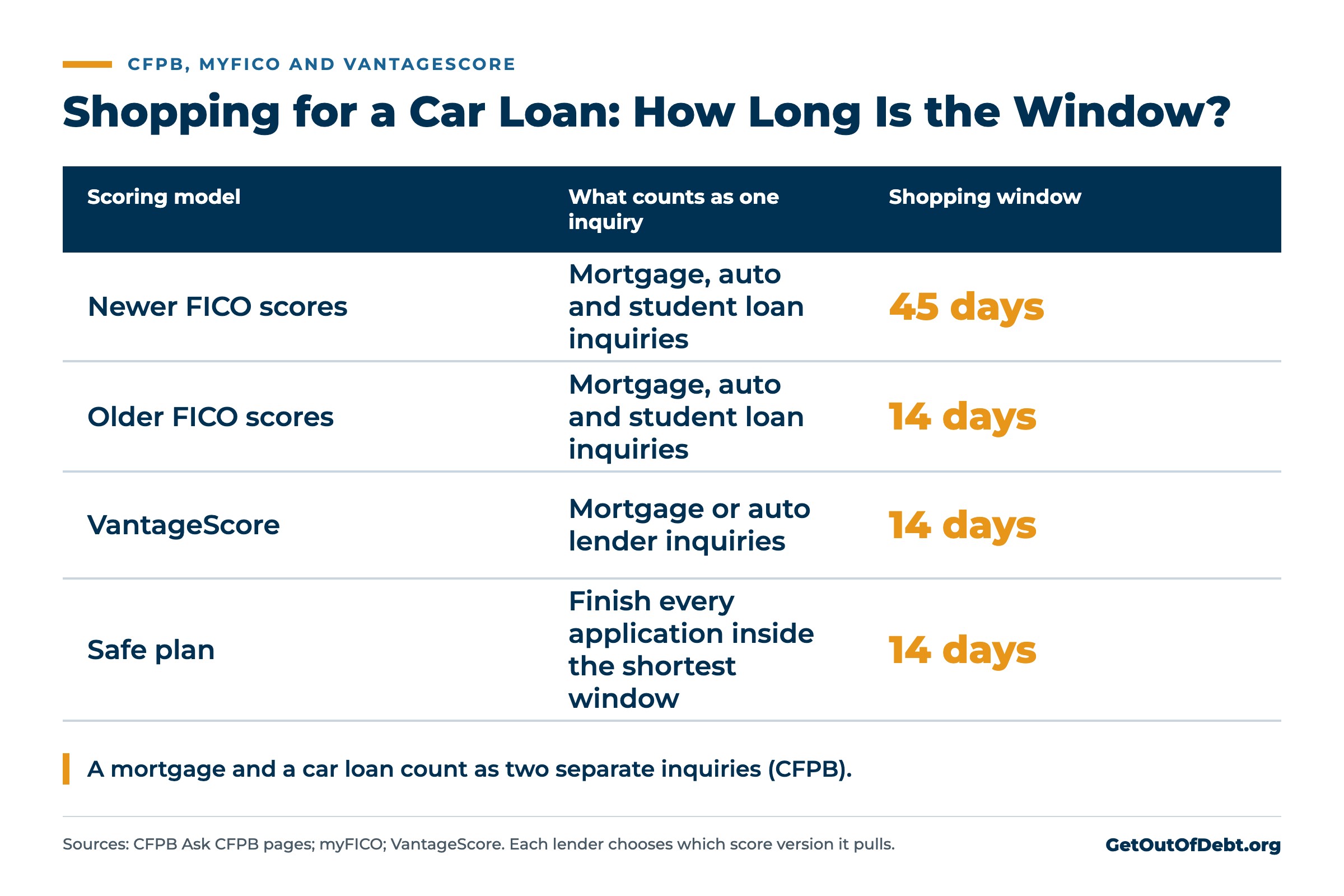
The verdict: Myth. The CFPB says shopping for the best deal on an auto loan will generally have “little to no impact” on your credit scores, because lender credit checks made within a short window generally count as a single inquiry. One inquiry still costs a little, so the honest answer is a small effect, not none — and the CFPB says the benefit of shopping “will far outweigh” it. The window runs from 14 to 45 days depending on the scoring model, so keep all your applications inside two weeks.
Well, Actually…
Here’s the part the scary version leaves out. The fear isn’t made up. A hard inquiry is what happens when a lender looks at your credit report because you applied for credit, and the CFPB says these inquiries “will impact your credit score because most credit scoring models look at how recently and how frequently you apply for credit.” So if you applied for five credit cards in a month, that would show up. But a person comparing car loans is doing something different, and the scoring models know it.
The CFPB’s own answer on car loans is that shopping for the best deal “will generally have little to no impact on your credit score(s)” and that lender requests “will generally only count as a single inquiry if they’re made within 14 to 45 days of each other.” Its page on mortgages says the same about shopping for a home loan: within a 45-day window, multiple credit checks from mortgage lenders are recorded as a single inquiry, and the effect of an additional inquiry after that window is “small,” so shopping around is “usually still worth it.” The shortest window in these sources is 14 days, so I’d keep mortgage applications inside 14 days too.
Why “14 to 45” and not one number? Because there isn’t one number. FICO, whose own site says 90% of top lenders use its scores, describes two ways it handles this for mortgage, auto and student loan inquiries: it ignores rate-shopping inquiries that are under 30 days old, and it counts several inquiries as one if they fall inside its rate-shopping window. Older versions of the FICO Score use a 14-day window, newer versions use 45 days, and each lender chooses which version it uses. VantageScore, the other big scoring model, says its model “incorporates a 14-day rolling window” that treats multiple inquiries from mortgage or auto lenders as a single search for credit. You can’t know which model the lender down the street will pull, and that is why I tell people to treat 14 days as the safe number. myFICO’s advice is to do your rate shopping “within a focused period such as 14 days.”
And what does one inquiry cost? FICO says that for most people, one additional hard inquiry takes less than five points off their FICO Score, and that FICO Scores only consider hard inquiries for 12 months even though they can stay on your report for up to 24. That’s FICO’s description of how its own score works, not a guarantee for every person: myFICO also says inquiries can have a greater impact if you have few accounts or a short credit history. The mortgage page puts it in plain English: an inquiry “typically has a small negative effect on your credit scores.” VantageScore puts it a bit higher: it says “an inquiry can reduce your credit score by between five and 10 points, but that decrease can be made up in as little as three months.” The two scoring companies don’t give the same figure, and neither says zero. Small and temporary is what I’d tell a friend.
Now compare that with what a better offer is worth. The CFPB says getting preapprovals from different lenders before you go to a dealer “could save hundreds or even thousands of dollars over the life of your loan.” Here’s my own arithmetic, with made-up rates, not a quote from anyone: a $30,000 loan over 60 months at 7% costs about $5,640 in interest, and at 9% about $7,365. That 7% versus 9% gap is roughly $1,720 over the loan. Debt is math wrapped in emotion, and the emotion here says “protect the score,” while the math says a few points that fade are cheaper than $1,720 you never get back.
Every lender that checks my credit will ding my score separately.
For auto loans and mortgages, lender requests made within the shopping window generally count as a single inquiry, and the CFPB gives that window as 14 to 45 days. FICO’s newer versions use 45 days and its older versions 14; VantageScore uses 14. Which one applies depends on the model the lender pulls, so staying inside 14 days covers all three scoring versions named here.
CFPB, “How will shopping for an auto loan affect my credit?” (last reviewed Jan. 30, 2024); myFICO, “How to Rate Shop and Minimize the Impact to Your FICO Scores”; VantageScore
It’s safer to take the first offer than to shop around.
The CFPB says the benefit of shopping for an auto loan “will far outweigh any impact on your credit,” and that preapprovals from different lenders before you visit a dealer could save “hundreds or even thousands of dollars over the life of your loan.” On mortgages, the CFPB adds that even if a lender checks after the 45-day window is over, shopping around is “usually still worth it,” because “the effect of an additional inquiry is small.”
CFPB, auto loan page (reviewed Jan. 30, 2024); CFPB, mortgage lender page (reviewed Aug. 28, 2026)
So shopping is free — the inquiries don’t count at all.
Going the other way is also a mistake. Shopping inside the window generally adds no extra scored inquiries beyond the first (each one can still show on your report), but that first one still counts a little: the CFPB says an inquiry “typically has a small negative effect on your credit scores,” and shopping for two different types of loans, such as a mortgage and an auto loan, “will count as two separate credit inquiries.” The CFPB also says that, in some cases, applying for multiple loans over a long period of time can affect your scores. The window limits the stacking; it doesn’t erase the inquiry.
Why You Were Told This
I can’t point to one source of this belief, and I won’t pretend I can. What I can tell you keeps it alive is that the two true parts are easy to stretch into a false one. Hard inquiries really do count against you, and the CFPB says so. And you may see several lender names listed on your own report after shopping, which looks like damage. myFICO says that if you apply for multiple auto loans within a two-week period, then even if several auto-loan inquiries show up on your report, the scoring model should treat them as one for score calculation purposes (its example uses an older FICO version). (The CFPB’s mortgage page words it a little differently, saying shopping inquiries are recorded on your credit report as a single inquiry.) Either way, the number that matters is how the score counts them.
There is also a plain reason the myth sticks. It works in favor of whoever makes the first offer. I’m not accusing anyone of spreading it on purpose; I have no evidence of that. But a belief that tells you to stop comparing is a belief that helps the lender or dealer you happen to talk to first. If you want to understand more of how scores work, start with what you need to know about credit scores. And if you’ve been told your credit is too far gone to bother shopping, I took apart a related fear in They Said Bankruptcy Ruins Your Credit for 10 Years.
What to Actually Do
- Check your own credit reports first. The CFPB says checking your own credit does not affect your credit scores, and you can get a free copy at annualcreditreport.com. If you find an error, dispute it before you apply. I explain the difference between your own check and a lender’s in They Said Checking My Own Credit Score Hurts It.
- Get your preapprovals before you walk onto a dealer’s lot. That’s the CFPB’s advice: get preapprovals with different lenders before going to a dealer so you can compare offers and loan terms.
- Do all your applications inside 14 days. The CFPB says those auto-loan checks generally count as one inquiry when they fall inside a 14-to-45-day span. Which end of that span applies depends on the score the lender pulls (see myFICO and VantageScore above). Forty-five days is not safe on every model, so finish inside 14 days.
- Ask each lender, before you apply, whether it will run a hard inquiry now. I don’t assume it will or won’t. Asking costs you nothing and tells you what you’re agreeing to.
- Don’t stack other applications on top. The CFPB says a mortgage and a car loan count as two separate inquiries, and it also says to try to avoid applying for a car loan or credit card right before getting a mortgage or during the mortgage process. If you’re planning both, think through which one needs to come first.
- Compare the full cost, not just the monthly payment. A lower payment spread over a longer term can cost more. I wrote about one version of that trap in the car loan interest deduction and the payment dealers sell.
Steve’s Take
I filed bankruptcy in 1990, and I didn’t lose my future — I got it back. So I have little patience for a credit-score fear that makes people overpay for years to avoid a few points that fade. If you’re rebuilding, I get it: every point feels like it matters, and being scared of a number is a real feeling. But the fear is telling you to skip the one step that can save you more than the inquiry could ever cost. Do the shopping in two weeks, write down every offer, and make the call with the numbers in front of you. You are not your credit score, and you are not your debt.
Frequently Asked Questions
Does shopping around for a car loan hurt my credit score?
The CFPB says it will generally have little to no impact, because lender requests generally count as a single inquiry when they are made within 14 to 45 days of each other. One inquiry can still have a small effect, so I’d say a small, temporary effect rather than none.
How many points does a hard inquiry take off my credit score?
There is no set number. FICO says that for most people one additional hard inquiry takes less than five points off their FICO Score, and that it can matter more if you have few accounts or a short credit history (myFICO). VantageScore gives a different figure: between five and 10 points, which can be made up in as little as three months. Those are the scoring companies’ own descriptions of their scores, and the CFPB pages I read don’t give a point figure.
Is the car loan shopping window 14 days or 45 days?
It depends on the scoring model. Per myFICO, older FICO versions use a 14-day window and newer ones use 45 days, and VantageScore uses a 14-day rolling window. The CFPB’s car loan page gives the range as 14 to 45 days. Because each lender chooses which version it pulls, I’d finish my applications inside 14 days.
Does the shopping window work for credit card applications too?
I haven’t found a source that says it does, so I wouldn’t count on it. The CFPB pages I used cover auto loans and mortgages, and myFICO’s rate-shopping page lists mortgage, auto and student loans, contrasting them with a run of credit card applications, which it says can look like a consumer seeking multiple new lines of credit.
If I shop for a car loan and a mortgage at the same time, is that one inquiry?
No. The CFPB says that shopping for two different types of loans, such as a mortgage loan and an auto loan, will count as two separate credit inquiries.
How long do hard inquiries stay on my credit report?
According to myFICO, hard inquiries can stay on your credit report for up to 24 months, but FICO Scores only consider them for 12 months.
I’m rebuilding my credit after bankruptcy or collections. Is it still worth shopping around?
The CFPB pages I read don’t carve out an exception for people rebuilding credit, and the CFPB’s auto loan page says the benefit of shopping for the best deal will far outweigh any impact on your credit. Because myFICO says inquiries can matter more on a thin file, I would keep the window tight, ask each lender whether it is running a hard inquiry before I apply, and compare the total cost. For how credit behaves after a bankruptcy, see my post on the 10-year credit myth.
This is one informed perspective from someone who has watched how this plays out since 1994 — not financial or legal advice for your situation. Only you can decide what’s right for your budget and your credit, so take this as input, not instruction, and make the call that serves your future.
The bottom line: Shopping around for a car loan or mortgage generally counts as one inquiry if you do it within a short window, and the CFPB says the savings far outweigh the small effect on your score. If someone you know is about to take the first offer out of fear, send them this page.
Dealing With Debt? Understanding your options is the first step. See how all your debt relief options compare — including ones most sites won’t tell you about. The Find Your Path quiz gives a recommendation based on your actual numbers, and the Scam-O-Meter checks any company’s complaint history before you sign. Federal Reserve Bank of New York research shows bankruptcy filers recover faster than those who don’t file.



