

Quick Answer: Medicare Open Enrollment runs from October 15, 2026 to December 7, 2026, and it lets you leave a Medicare Advantage plan for Original Medicare starting January 1, 2027. But Medicare’s official Medigap guide says an insurer “may deny you a policy” unless you are in your one-time Medigap enrollment window or have a guaranteed issue right, and the guide lists those rights narrowly. So the order matters. Apply for the Medigap policy while you are still in your Advantage plan, and get the insurer’s acceptance, the plan letter, the premium and a January 1, 2027 start date in writing. Then, on or before December 7, 2026, join a standalone Medicare drug plan; for most Advantage plans (HMO or PPO) that enrollment is itself what moves you back to Original Medicare, so confirm with your plan or 1-800-MEDICARE how your specific plan handles it (and if you have Medicaid, call your SHIP counselor before joining any drug plan). If the written Medigap answer is not in hand by December 7, 2026, stay in your Advantage plan for now — but only if your Advantage plan will still cover you on January 1, 2027 and your SHIP counselor confirms no trial-right or guaranteed-issue deadline runs out while you wait; the January to March window does not extend a Medigap right. The January 1 to March 31, 2027 window lets someone already in an Advantage plan return to Original Medicare and join a drug plan, and you can run the same Medigap-first order then; ask the plan when that change takes effect and have the Medigap policy start that same day, not January 1. If you leave first and get turned down, you can end up on Original Medicare with 20% of the Medicare-approved amount for most Part B services, with no yearly cap, and, if you left without joining a drug plan, no drug coverage.
Expert Context: I’ve helped people with debt since 1994, and a big unpaid medical bill is one of the oldest ways an ordinary budget breaks. Debt is math wrapped in emotion, and a Medicare choice is both. This is a post about one thing you can do in the right order so you don’t have to repair the wrong order later.
If you’re thinking about using Open Enrollment, which starts October 15, 2026, to drop your Medicare Advantage plan and go back to Original Medicare, the question to answer first is not “which Medigap plan do I want?” It is “will an insurer actually sell me one?”
What You Need to Know: Leaving Is Easy, Getting a Medigap Policy Is Not Guaranteed
Medicare.gov lists the annual Open Enrollment Period as October 15 to December 7. During it you can “switch from Original Medicare to a Medicare Advantage Plan or from a Medicare Advantage Plan to Original Medicare,” and coverage starts January 1 of the next year, as long as the plan gets your request by December 7 (Medicare.gov, Joining a plan). For this fall, that means October 15, 2026 to December 7, 2026, with new coverage starting January 1, 2027. Federal regulations set the same dates (42 CFR 422.62(a)(2)).
Each weekday I send one short email: one story that caught my attention, why it might matter to you, and one manageable thing you can do with it. A couple of minutes, and a dad joke.
In the latest issue (Nov 13): The shelf price isn't always what you pay
Free. I sell nothing. Unsubscribe any time.
Here is the catch, and it is in Medicare’s own guide, Choosing a Medigap Policy (CMS Product No. 02110, March 2026 edition). Medigap is the private insurance that helps with the costs Original Medicare leaves behind. Your best time to buy it is the six-month window that starts the first month you are 65 or older and have Part B. After that window, the guide says (page 11):
“There’s no guarantee that an insurance company will sell you a Medigap policy if you don’t meet their medical underwriting requirements. They may deny you a policy unless you have a guaranteed issue right.”
The guide also says that outside your Medigap Open Enrollment Period you “may have to pay more for a policy” and “fewer policy options may be available to you.” Medical underwriting means the insurer can look at your health history before it decides whether to sell you a policy and what to charge. Federal law, in the Social Security Act provision that governs Medigap, bars that kind of underwriting for the six-month window at 65 and for the listed guaranteed issue situations (42 U.S.C. 1395ss(s)(2) and (s)(3)). It does not make the same promise to someone who has simply been in an Advantage plan for years and has decided it is not working.
Why You Need to Know It: The Mistake Gets Much Harder to Undo After December 7, 2026
I’m not telling you Medicare Advantage is the wrong choice or Original Medicare with Medigap is the right one. Plenty of people are happy with Advantage plans, and some people leave one because a doctor or hospital they need is out of network, or because their health changed. That is your call.
What worries me is the order of events. Medicare.gov says Original Medicare has “no yearly limit on what you pay out-of-pocket, unless you have supplemental coverage,” such as a Medigap policy, or other insurance such as Medicaid or retiree coverage. Advantage plans, by contrast, have a yearly limit on what you pay for covered Medicare services (Medicare.gov, Compare Original Medicare & Medicare Advantage). In 2026, Medicare.gov says you pay a $283 Part B deductible (I did not find a 2027 amount on Medicare.gov, and 2027 is the year a January 1 switch would land in), and after that usually 20% of the Medicare-approved amount for each covered service (Medicare.gov, Costs).
The math (hypothetical, to show the size of 20%): Suppose a course of outpatient treatment carried a Medicare-approved amount of $50,000 for Part B services. After the Part B deductible, 20% of a $50,000 Medicare-approved bill is roughly $10,200 out of your pocket. That number is only to show the size. With a Medigap policy that covers the Part B coinsurance, much of that falls on the insurer. With no supplement and no yearly cap, it falls on you. I picked $50,000 to make the arithmetic easy, not because it is typical.
That is how a health plan switch becomes a medical bill, and a medical bill becomes debt. And the Advantage plan you just left may not be easy to get back: Medicare.gov describes the January 1 to March 31 Advantage window as “only if you’re already in a Medicare Advantage Plan.” Once your Original Medicare coverage has started with no supplement, that window is not described as a way back in.
Things to Consider: Do You Have a Guaranteed Issue Right?
A guaranteed issue right, which the guide also calls “Medigap protection,” means that in a listed situation an insurer “must sell you a Medigap policy,” “must cover all your pre-existing health conditions” and “can’t charge you more for a Medigap policy because of past or present health problems” (guide, page 15). The ones that touch someone leaving Medicare Advantage are these (the CMS guide, pages 17 and 18; most of these are also in 42 U.S.C. 1395ss(s)(3)):
- Your plan is leaving Medicare, stops giving care in your area, you move out of its service area, or its network has a significant change. You can buy Medigap Plan A, B, C, D, F or G sold in your state, but only if you switch to Original Medicare rather than another Advantage plan. The guide doesn’t define “significant,” so ask your SHIP counselor whether your plan’s change counts.
- The trial right, first version. You joined a Medicare Advantage plan (or PACE) when you were first eligible for Medicare Part A at 65, and within the first year you decide to switch to Original Medicare. You can buy any Medigap policy sold in your state.
- The trial right, second version. You dropped a Medigap policy to join a Medicare Advantage plan for the first time, you have been in the plan less than a year, and you want your Medigap back. You can get your old policy if the same company still sells it, or Plan A, B, C, D, F or G.
- The plan misled you or broke the rules. If you leave a Medicare Advantage plan because the company hasn’t followed the rules, or it misled you, you can buy Plan A, B, C, D, F or G.
Notice what is not on that list: “I have been in my Advantage plan for several years and I want out.” If none of the situations above is yours, you may have only the insurer’s willingness to sell, and an insurer can say no. The guide also notes that the trial rights “may last for an extra 12 months under certain circumstances” and says to check your State Insurance Department. Plans C and F are not sold to people who became newly eligible for Medicare on or after January 1, 2020; the guide says those people have the right to buy Plan D or G instead. If you are under 65 and on Medicare because of a disability, the trial right described here does not apply to you, and the federal six-month Medigap window does not open until you turn 65 — it does open then, even though you had Medicare earlier. Your state may give you a right sooner. Ask your SHIP counselor before you leave an Advantage plan.
Timing matters too. For most of these situations the guide gives an application window that opens 60 days before your Advantage coverage ends (or, if your plan is ending, by the date in its termination notice) and closes no more than 63 days after it ends. The statute sets the window for a voluntary disenrollment as beginning 60 days before the disenrollment takes effect and ending 63 days after.
Your state may give you more. I verified the year-round rule for only one state, New York, below.
The guide says “Some states have additional Open Enrollment Periods” and that “You may have additional rights under state law.” I can tell you what I read on an official page for one state. New York’s Department of Financial Services says insurers writing Medigap there “must accept a Medicare enrollee’s application for coverage at any time throughout the year,” and may not deny a policy or make premium distinctions because of health status, with an exception for group policies (New York DFS, Medicare information for consumers). I did not verify the rules for any other state, and I won’t guess. Massachusetts, Minnesota and Wisconsin sell differently structured Medigap policies, and the guide has a separate section for them. Your State Insurance Department (find yours through the NAIC) and your State Health Insurance Assistance Program counselor (shiphelp.org) can tell you what your state does.
What I could not verify
I could not find a standard document called an “approval letter” in Medicare’s guide or in the statute. What the guide does say is that an insurer must give you “a clearly worded summary of your Medigap policy,” and that if you buy from an agent you should “get a receipt with the insurance company’s name, address, and phone number.” So “get it in writing” is my practical advice, not a federal requirement, and I can’t tell you how quickly each insurer issues its answer. Ask them.
What to Think About Doing: Put the Medigap Answer Before the Exit
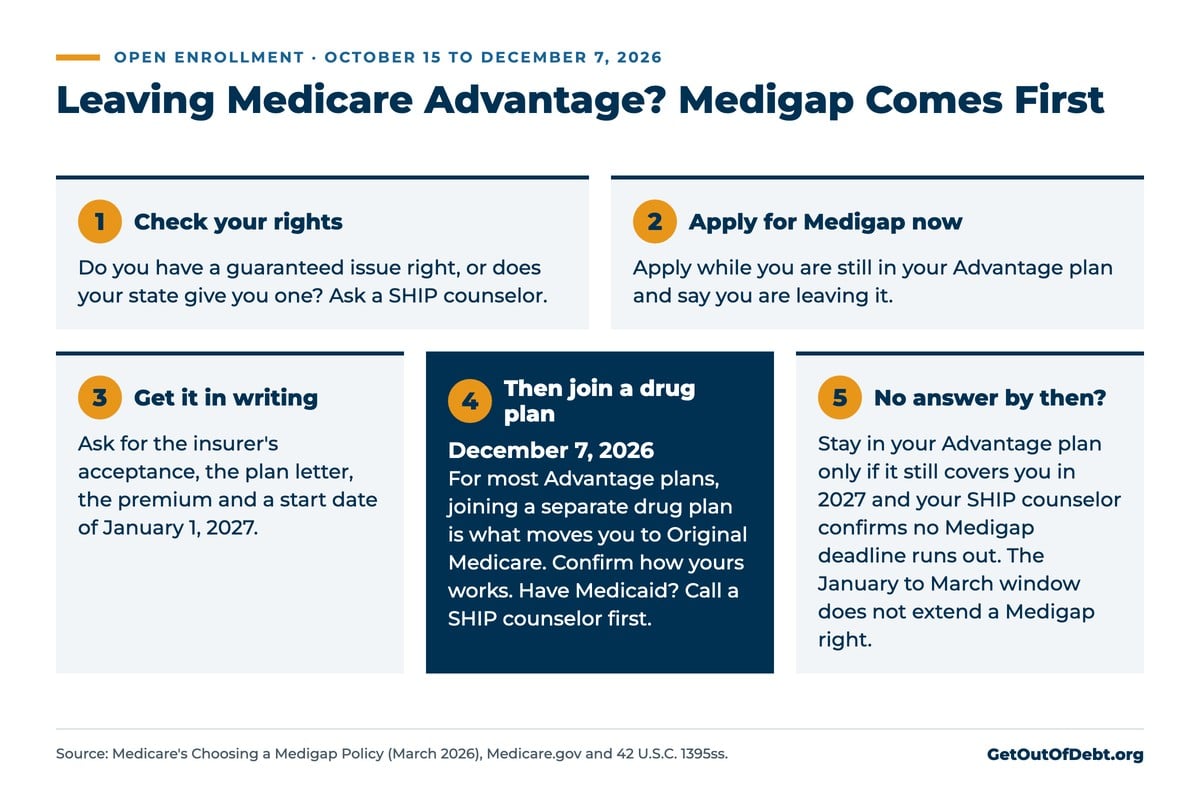
1. Find out which category you are in
Do you have one of the guaranteed issue situations above, or does your state give you a year-round right? If you aren’t sure, call your SHIP counselor (free, and not connected to an insurance company) before you call a Medigap agent. Keep any termination notice your plan sent you. The guide says to keep copies of “letters, notices, emails, or claim denials that have your name on them,” and the postmarked envelope, because you may need them with your application. If your Advantage plan comes through a former employer or union, leaving it can end that retiree benefit for good, so talk to the benefits office first.
2. Apply for the Medigap policy while you are still in your Advantage plan
The guide says: “If you have a Medicare Advantage Plan but plan to return to Original Medicare, you can apply for a Medigap policy before your Medicare Advantage coverage ends. The Medigap insurance company can sell it to you as long as you’re leaving the Medicare Advantage Plan.” Tell the agent plainly that you are leaving the Advantage plan. The guide lists it as illegal to sell you a Medigap policy while you are in an Advantage plan unless you are switching back to Original Medicare, and says Medigap policies “can’t start until your Medicare Advantage Plan coverage ends.” Ask each insurer how early it will accept an application for a January 1, 2027 start, and how long its answer takes.
3. Get the answer and the start date in writing
Ask the insurer to confirm in writing that it has accepted you, which plan letter, what the premium is, and that coverage starts the day after your Advantage coverage ends (January 1, 2027). The guide’s advice is: “Ask that the new Medigap policy start when your Medicare Advantage Plan enrollment ends, so you’ll have continuous health coverage.” If the insurer says you’re “approved pending” something, ask what is pending and by when. And ask whether a pre-existing condition waiting period applies. The guide says that with a guaranteed issue right the insurer must cover your pre-existing conditions without one, so if you are relying on an insurer’s willingness to sell rather than a right, the question is worth asking.
4. Then, by December 7, 2026, join a drug plan, which for most Advantage plans moves you to Original Medicare
Original Medicare does not include drug coverage, so you’ll need a separate Medicare drug plan for January 1, 2027, and the federal regulation says that if you change from a Medicare Advantage plan to Original Medicare you may also elect one. Medicare.gov says that if you have an Advantage HMO or PPO plan and “join a separate drug plan, you’ll be disenrolled from your Medicare Advantage Plan and switched to Original Medicare” (Medicare.gov, Choose how you get drug coverage). So for most Advantage plans, joining the drug plan is itself the step that moves you back to Original Medicare, which is why it comes after the written Medigap answer and not before. Plans differ, so confirm with your plan or 1-800-MEDICARE how your specific plan handles it. If you have Medicaid or are in a plan for people with both Medicare and Medicaid, stop and call your SHIP counselor before you join any drug plan. Price drug plans beforehand. The change has to be requested by December 7, 2026 to take effect January 1, 2027. Don’t wait until December 7, 2026 to start step 2. Leaving an Advantage plan without joining a drug plan can leave you without drug coverage until a later enrollment period and can mean a late-enrollment penalty; ask a SHIP counselor before you do it. Medicare.gov also says that if you decide not to get drug coverage when you’re first eligible and you don’t have creditable coverage, “you may have to pay a Part D late enrollment penalty if you join a Part D plan later.” I can’t tell you how that applies to your situation, so ask.
If you end up shopping for a stand-alone drug plan, see why some 2027 Part D premiums jump $50 or more and how to compare them.
5. No written Medigap answer by December 7, 2026? Stay in your Advantage plan for now, if it still covers you
If the answer is no, or you don’t have it in writing by December 7, 2026, you still have your Advantage plan, and you can use the time to decide — but only if your Advantage plan will still cover you on January 1, 2027 and your SHIP counselor confirms no trial-right or guaranteed-issue deadline runs out while you wait; the January to March window does not extend a Medigap right. There is a second window: from January 1, 2027 to March 31, 2027, if you are still in an Advantage plan, Medicare.gov and the federal regulation allow one election to drop it and return to Original Medicare, and Medicare.gov says you will also be able to join a separate Medicare drug plan then. You can run the same Medigap-first order at that point; ask the plan when that change takes effect and have the Medigap policy start that same day, not January 1. That window is a slower route, and nothing I read says it comes with a Medigap guaranteed issue right, so the same underwriting question applies.
6. If you’ve already left and were turned down
Call your SHIP counselor and your State Insurance Department today. The guide says to “Call your State Insurance Department if you’re denied Medigap coverage” in a guaranteed issue situation. Ask other Medigap insurers too; one company’s no is not every company’s no. If a medical bill is already on its way, start with A Medical Bill Went to Collections and Nobody Warned Me. Here’s What to Do Right Now and Your Hospital Bill Is Probably Wrong. Here Is How to Fight It. If you’re on a fixed income and the collectors are already calling, read I’m Retired on Fixed Income and Debt Collectors Won’t Stop Calling.
If you’re deciding whether to stay in an Advantage plan at all, my post on the new ratings, Medicare’s 2027 Star Ratings Are Out, covers the cost numbers to check first. If your reason is a denied claim, see Your Medicare Advantage Plan Can Deny Rehab and Get Away With It. And if you’re planning around a Social Security check, the 2027 COLA and Medicare’s hold-harmless law shows how Medicare premiums can eat into it.
Key Terms Defined
Medigap (Medicare Supplement Insurance): Private insurance that helps pay costs Original Medicare leaves, like coinsurance and deductibles. It works only with Original Medicare (Medicare’s Medigap guide).
Medical underwriting: The insurer reviewing your health history to decide whether to sell you a policy and what to charge. The guide says insurers can’t use it during your Medigap Open Enrollment Period or when you have a guaranteed issue right.
Guaranteed issue right (“Medigap protection”): A right, in certain listed situations, to buy a Medigap policy the insurer must sell you, with no health-based price increase.
Trial right: The guaranteed issue right to try a Medicare Advantage plan and still buy Medigap if you change your mind within the first year.
Key Takeaways
- Open Enrollment runs from October 15, 2026 to December 7, 2026, and a switch to Original Medicare takes effect January 1, 2027.
- Medicare’s Medigap guide says that outside your six-month Medigap window an insurer “may deny you a policy” unless you have a guaranteed issue right.
- The listed guaranteed issue rights for people leaving Advantage are narrow: a plan leaving Medicare or your area, a significant change to the plan’s network, a move out of the service area, the one-year trial right, or a plan that misled you.
- Original Medicare has no yearly out-of-pocket limit unless you have supplemental coverage, and Part B usually leaves you 20% after the deductible.
- Apply for Medigap first and get the answer and start date in writing. Then, by December 7, 2026, join a drug plan (for most Advantage plans that moves you to Original Medicare; if you have Medicaid, call your SHIP counselor first); with no written answer by then, stay in your Advantage plan for now, but only if it will still cover you on January 1, 2027 and your SHIP counselor confirms no deadline runs out while you wait. Some states add rights, and I verified the year-round rule for only one state, New York.
The Bottom Line
A big Medicare decision with a deadline can make your stomach tighten, and that is normal. You are allowed to slow down and put the questions in the right order. You are not your medical bills, and a few phone calls before December 7, 2026 can keep a plan change from turning into a debt problem you didn’t have to have.
Frequently Asked Questions
When can I leave a Medicare Advantage plan for Original Medicare in 2026 and 2027?
Medicare.gov lists Open Enrollment as October 15 to December 7, with coverage starting January 1 of the next year, so October 15, 2026 to December 7, 2026 for coverage starting January 1, 2027. There is also a Medicare Advantage Open Enrollment Period from January 1 to March 31 (January 1, 2027 to March 31, 2027 for the coming year), which Medicare.gov and 42 CFR 422.62 limit to people already in a Medicare Advantage plan and to one election. Special Enrollment Periods exist for certain life events, and a SHIP counselor can tell you whether one applies to you.
Can a Medigap insurer turn me down if I’m leaving Medicare Advantage?
Sometimes, yes. Medicare’s Medigap guide says that outside your six-month Medigap Open Enrollment Period an insurer “may deny you a policy” unless you have a guaranteed issue right. Some states add rights beyond the federal ones; New York’s Department of Financial Services says insurers there must accept applications at any time throughout the year. Check your own State Insurance Department.
What is the Medicare Advantage trial right?
It is a guaranteed issue right to try Medicare Advantage and still buy Medigap. Under the guide and 42 U.S.C. 1395ss(s)(3), it applies if you joined a Medicare Advantage plan when you were first eligible for Part A at 65 and switch to Original Medicare within the first year, or if you dropped a Medigap policy to join an Advantage plan for the first time and want to return within the first year. The guide says your rights may last an extra 12 months in certain circumstances, so check with your State Insurance Department.
Can I buy a Medigap policy before my Advantage coverage ends?
Yes. The guide says you can apply for a Medigap policy before your Medicare Advantage coverage ends, and the insurer can sell it to you as long as you are leaving the Advantage plan. The policy can’t start until your Advantage coverage ends, so ask for a start date that matches, which for a switch made during Open Enrollment 2026 would be January 1, 2027.
What happens if I leave Medicare Advantage and I can’t get a Medigap policy?
You would be on Original Medicare without a supplement. Medicare.gov says there is no yearly limit on what you pay out-of-pocket unless you have supplemental coverage, and that in 2026 you usually pay 20% of the Medicare-approved amount for covered Part B services after a $283 deductible. I did not find the 2027 deductible posted there yet. Call your SHIP counselor and your State Insurance Department right away, and read my medical bill guides above if bills are already arriving.
This is what I’m telling friends like you over coffee. Take it as input, not instruction, because you know your own situation and I don’t. But remember, you do you.
If you know someone who is about to drop their Advantage plan before December 7, 2026, send them this post first. It’s easier to ask the question before the deadline than after it.
Dealing With Debt? Understanding your options is the first step. See how all your debt relief options compare — including ones most sites won’t tell you about. The Find Your Path quiz gives a recommendation based on your actual numbers, and the Scam-O-Meter checks any company’s complaint history before you sign. Federal Reserve Bank of New York research shows bankruptcy filers recover faster than those who don’t file.



