

Quick Answer: Damon Day and I recorded a 43-minute podcast episode about getting started with gig work: which apps to download, why to learn one app at a time, and why the episode argues the my-car-will-wear-out excuse is weaker than it sounds. I like a lot of it. But a gross payout on a phone screen is not income. Miles, wear on the car, taxes and your time come out first, and that subtraction is the part most gig-work advice skips. The dollar figures in this post are examples, and one driver’s results, not a promise of what you would make. Damon Day, an independent debt coach and my co-host on the Get Out of Debt Guy podcast, whom you can reach at DamonDay.com — I receive no payment for this referral.
Debt is math wrapped in emotion. A $10 delivery offer is a number on a screen. What is left after the miles, the tax and the half hour in traffic is the money.
A disclosure first, because you deserve to know where I stand. I co-founded The Penny Stupid Project with Damon in 2022, a public test of side hustles where neither of us sold anything. Damon runs it now. His half of the experiment was gig work, and it is his work today, not a joint operation. His own site is damonday.com. He is also my co-host on the Get Out of Debt Guy podcast, and I receive no payment for featuring his work or for sending you to his site. There is one more thing to disclose: I am in this video. It is the first episode back of a podcast Damon and I used to do together, after a break of roughly two years, relaunched as the Gigalicious Podcast, and I am the other voice on it. So treat what follows as me writing about something I helped make, and read my asterisks accordingly.
The video is titled “Need an Extra $500 This Week? Start With Gig Work.” That is the title Damon’s channel gave it, not a promise I am making. The video’s own description says the conversation is about getting started, not a guaranteed $500 result, and I would put that sentence in front of every viewer if I could.
Each weekday I send one short email: one story that caught my attention, why it might matter to you, and one manageable thing you can do with it. A couple of minutes, and a dad joke.
In the latest issue (Nov 13): The shelf price isn't always what you pay
Free. I sell nothing. Unsubscribe any time.
The Method the Episode Walks Through
YouTube’s auto-generated captions garble names badly enough that I will not put them in quotation marks and call them anyone’s words. What follows is my paraphrase of the ideas in the episode. Watch the video for what is actually said.
Get out of your own way. The episode opens on the excuses that keep people from trying gig work at all: I’m not smart enough, my car will wear out, I don’t live in a good area. Damon’s view, after four years of doing this, is that the biggest obstacle for most people is not the apps, it is the story they tell themselves about the apps. I have watched the same thing happen with debt for more than 30 years. People decide they cannot do the thing, and then every fact gets filed under proof. Some of the excuses are real, though, and I will come back to that.
Start before you need the money. This is the best point in the episode, and it is a debt point more than a gig point. The advice is to get the apps set up and figured out while you are not in a crisis, because approval, background checks and waitlists take time, and the first week of any gig is slow and awkward. The episode says there may be a background-check fee of at most about $20 on one of the apps, and that some apps have waitlists. If rent is due Friday, you do not want your first-ever shift to be the one you are counting on.
Learn one app at a time. The advice is to download a small handful of apps, pick one to start, and spend a couple of weeks learning how its offers work, how long pickups really take and what your area is like. The episode warns against accepting two signup bonuses at once, because each one starts its own 30-day clock and you may not be able to hit both. The video’s description adds that bonuses are different in every city. Only after one app feels familiar does he suggest adding another, and only much later, stacking orders from several at once.
People or food? The episode’s suggestion is that food and grocery delivery is the easier place to begin, because you do not have strangers in your car and you can learn the app first. Ride-sharing works for some people and the episode says it depends on your personality, your car and how clean you keep it. Before you do either, call your auto insurer and ask whether your policy covers delivery or rideshare use. The episode does not cover that and I would want the answer before my first order.
The car argument. This is the longest stretch. Damon’s position is that the my-car-will-get-worn-out excuse is usually a cover for a different fear, and that a car is a tool, like a saw to a carpenter. His example is his own Tesla, which he says has about 186,000 miles on it, most of them family miles rather than gig miles. His rule is to take orders that are profitable, to account for the car’s cost and to set that money aside so there is money to replace the car when it is time. I agree with that rule almost completely. The part I would underline is the rule, not the excuse: set money aside for the car, and measure it.
Getting paid. The episode says the big apps tally a week at a time and the money usually lands on a Tuesday or Wednesday, depending on the app, and that you can cash out instantly for a small fee if you need to. It cites about $1.75 on one app. Fees and timing change, so check them in the app you actually use. The episode is also clear that cashing out $7 early for a fee like that is not a good trade, and I agree. A flat fee on a small amount is a high percentage. On $7 it is roughly a quarter of the money.
The Math to Run Before You Download Anything
Here is the arithmetic I wish more gig-work videos did out loud. The episode itself touches on it with a hypothetical: a delivery that goes 10 miles and pays $10. It looks like a dollar a mile. Then you find out the route is 12 minutes on a freeway, or 30 minutes through downtown traffic. Let me run that made-up order through the subtraction. It is not Damon’s result and it is not anyone’s earnings. It is only a way to see the shape of the math.
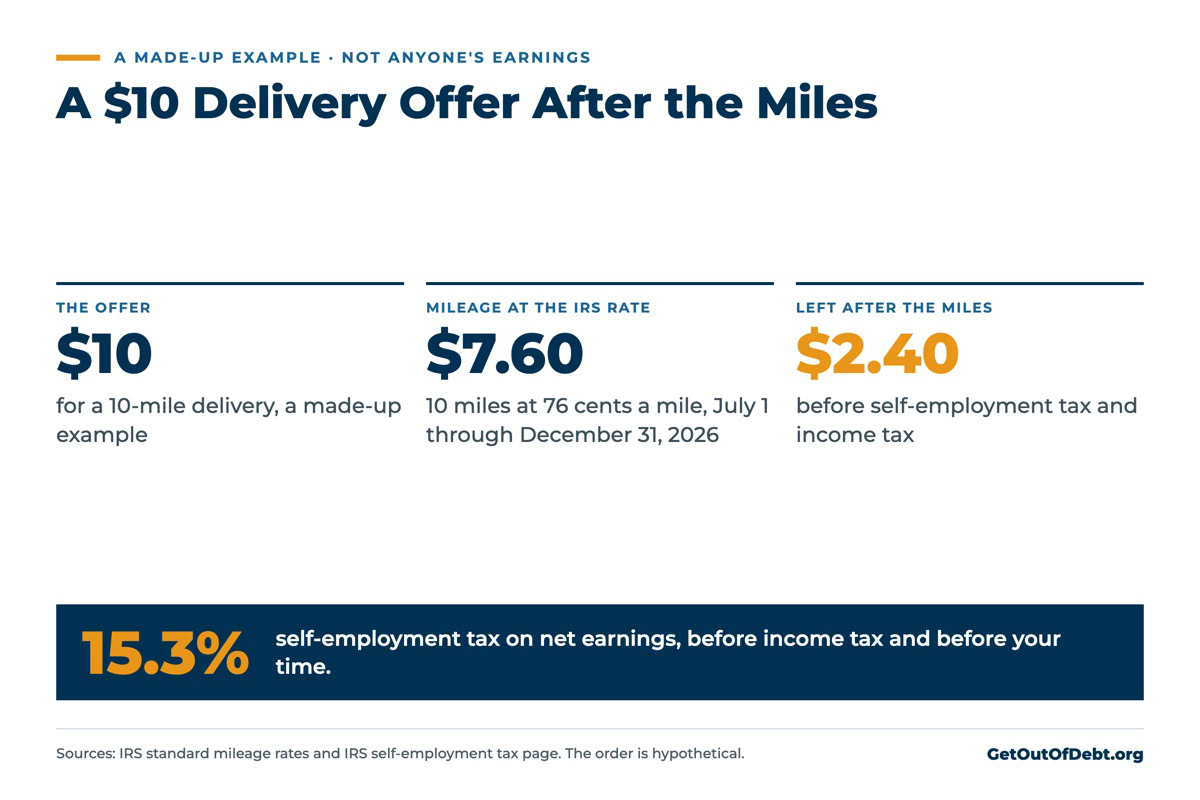
What a $10, 10-Mile Offer Looks Like After the Miles
The IRS’s own standard business mileage rate is 76 cents a mile from July 1 through December 31, 2026 (it was 72.5 cents in the first half of the year). It is the number the IRS uses as a stand-in for what gas, maintenance, tires, insurance and depreciation cost per mile. It is a yardstick, not a measurement of anyone’s actual costs, and an electric car’s fuel line looks different from a gas car’s.
The offer: $10 for 10 miles. Ten miles at 76 cents is $7.60. That leaves $2.40. Gig drivers are generally independent contractors, and the IRS puts the self-employment tax rate at 15.3%. Applied to that $2.40, that is up to about 37 cents more, so you are down to roughly $2.03, and that is before federal income tax. Those 10 miles took 12 minutes on a freeway? Roughly $10 an hour on that order. Thirty minutes downtown? Roughly $4 an hour, and still before income tax, and before the drive to the pickup, the wait at the counter and the parking. If you’re paid in cash or tips instead of through an app, here’s how I’d handle the tax share, night by night.
That is a bad order, and a smart driver turns it down. The episode’s point about learning your area is exactly this: after a few weeks you know which restaurants make you wait, which neighborhoods are slow, and which offers only look good. But notice what the new driver pays to learn it. The episode’s advice for the first couple of weeks is to take most reasonable offers instead of screening hard, because you learn more by doing. That is a sound way to learn. It also means your learning phase is the most expensive part of the whole thing in miles per dollar, so go in with a small budget for it and write the miles down from day one. For the same subtraction on one real night, see Damon’s worst earning night in a long time, when he grossed $121.33 over roughly four hours.
In another episode, Damon and I talked through his first Instacart shop, which grossed about $25 and took roughly three hours according to the video’s description.
Damon has also worked a Walmart Spark, Instacart, DoorDash and Uber Eats shift from a loaner Tesla on Full Self-Driving (Supervised); I wrote up that day’s math, including why the car was not what made the money decisions. And for the rideshare version of this math, here is Damon’s night driving Lyft Black and Uber.
I also want to be fair to the miles. They are a real cost, and the episode is right that they are not a reason by themselves to never try. The honest framing is that the miles are a cost you price in, not a cost you ignore in either direction. If you want to see what six years of a high-mileage car can really cost, I wrote that up with Damon’s own numbers: Damon Day’s Tesla Has 185,000 Miles. Here’s What 6 Years of Repairs Really Cost.
Where I Would Put an Asterisk
Gross is not profit. In the episode, Damon describes his results over four years in gross terms, including a figure in the six figures, and he is clear that this is gross. I am not repeating his monthly and hourly figures here. They are his, they come after four years of practice, a Phoenix market and stacking several apps at once, and they would read as a promise the moment I put them in a sentence. What I will say is that the number to ask about is always the one after the car and the tax. The IRS says you must report income from the gig economy even if no form is sent to you, and that includes income the platform never reports.
The confidence is earned, but it is his. Early in the episode Damon says, with the swagger of someone who has done it for years, that an extra $1,000 in a month is easy for him. I do not doubt it is true for him. It is one experienced driver’s read of his own market and his own car, after four years of learning. It says nothing about what you will net in your first month, in your city, in your car. The video’s own description says earnings vary. I agree with the description.
Get paid within days is a real advantage, and a trap. It is useful to be able to start gig work and see money in a few days when you are closing a short-term gap. The same speed is why people reach for it in a panic, and a panic number is the worst way to evaluate a job. Run the subtraction first, then decide.
Referral codes. The description under the video includes referral links and codes for several of the apps and says there may be bonuses for both the new driver and the person who referred them. I have not copied those links here, I am not recommending any particular app, and I have not checked the offers, which change by city and by month. If you use a referral code, read the actual bonus terms before you start counting on it.
The Earnings Caveat: Every dollar figure in this post is either a made-up example or a number I am passing along as one person’s account. None of it is typical, expected or achievable for you. Gig income varies by city, time of day, the offers that happen to appear, your car and your skill, and it comes with costs the app never shows you: miles, wear on the car, fuel or charging, and taxes.
What I Would Do If I Were Behind on Bills
I hear this question constantly: should I drive or deliver to catch up on debt? My answer is the one I give about every option on this site. It depends on your numbers. Gig work can be a legitimate source of fast, flexible money, and for some people it is the difference between getting through a rough month and not. Start the apps before you are desperate, track your miles, set money aside for taxes as you earn because no one is withholding it for you, and look at what is left after all of it. If the math shows it will not get you where you need to go, that is useful information, not a failure on your part.
And if the debt itself is the problem, gig work is only one tool. It adds income. It does not stop a collector or a lawsuit, and it does not change a balance that has outgrown your paycheck. Sometimes the cleaner answer is a different tool entirely, like a hard look at whether bankruptcy fits. You are not your debt, and you do not have to drive your way out of it if the numbers say otherwise. No sense wasting a perfectly good mistake either: if a first week of gig work teaches you it does not pay in your market, you just bought that lesson for the price of some gas.
The Episode’s Own Chapter List
These are the chapter titles the video’s own description lists, so you can jump to the part you care about. The timestamps are from that list.
- 0:00 Meet the Gigalicious Podcast
- 0:55 What stops people from starting gig work?
- 6:42 Listen Linda, turtles, Apparently Kid and Taco Bell (a detour through internet clips)
- 12:13 Drop the assumptions and try an app
- 13:55 Why we started testing gig work
- 18:12 Car costs and the excuses we hear
- 30:18 Deliver people or deliver food?
- 35:10 Which apps should you download?
- 40:05 Learn one app at a time
- 42:13 The first app to try
More From the Side Hustle Archive
Damon and I have been writing about this experiment since it started in 2022. A few pieces that pair well with this episode:
- Side Hustles for Debt: When They Help and Hurt, the introduction to the original 2022 experiment
- Quick Cash for Bills: Myth vs Reality, the honest version of “I need money fast”
- Side Hustles: When They Help and When They Hurt, the honest boundaries of what a side hustle can fix
- Side Hustle Success: What It Means and What to Do, the mindset piece behind the math
- Damon Day’s 27-Item Instacart Shop Took 45 Minutes. Here’s the Math.
- Damon Day Thought a $55 Walmart Order Was Worth It. Here’s the Math.
- Instacart’s $5 Million Settlement Is About Job Applicants, Not Shopper Pay, what that headline covers if you are weighing shopper work
- Damon Day Passed on a $41 Walmart Spark Order for a $28 One. Here’s the Per-Mile Math. — a later video, where the bigger payout lost to the smaller one once the miles were counted
- Damon Day Misread Walmart Spark’s Sapphire Tier. Here’s What He Corrected. — a later episode, where he says 120 is points and the 10% bonus covers only eligible incentives
Key Takeaway
Gig work is a real way to add income, and the episode’s best advice is to set the apps up before you need the money and learn one at a time. But a gross offer is not income. At the IRS’s 76-cent standard mileage rate, a made-up $10, 10-mile delivery keeps $2.40 before the 15.3% self-employment tax, income tax and your time. Run that subtraction on every offer, and treat every dollar figure you hear, including the ones in this episode, as one person’s result and not a plan.
This is what I’m telling friends like you over coffee. But remember, you do you. Take it as input and make the call that fits your own life.
If you know someone thinking about gig work to get through a tight stretch, send them this before they count the gross number as real money. Share this with a friend who is weighing a side hustle, because running the subtraction first is worth more than any pep talk.
Common Questions
What is the Gigalicious Podcast, and are you really in it?
Yes. It is the relaunch of a podcast Damon Day and I used to do together, now under the name Gigalicious Podcast, and the episode on this page is the first one back. I co-founded The Penny Stupid Project with Damon in 2022 and Damon runs it now, so I am telling you both that I helped start it and that I appear in this episode. That is why I have put my own asterisks on it.
Can gig work really bring in a lot of extra money in a week?
Nobody can answer that for you, and I would not trust anyone who does. The video’s own description says it is about getting started and not a guaranteed result. What you keep depends on your city, the hours you work, your car, how well you read offers and what comes out first: miles, wear, fuel or charging, and taxes. Run the subtraction on real offers before you count any number as income.
What do miles actually cost me when I do gig work?
The IRS’s standard business mileage rate is 76 cents a mile from July 1 through December 31, 2026, and it was 72.5 cents in the first half of the year, according to the IRS standard mileage rates page. I use it here only as a yardstick for what the miles cost. Your actual costs will differ, and a tax professional can tell you how a mileage deduction applies to your own return.
Do I owe tax on gig income if the app never sends me a form?
The IRS says you must report gig-economy income on a tax return even if it is not reported on a 1099 or other information form. Self-employment tax is 15.3% of net earnings, and the IRS lists net earnings from self-employment of $400 or more as one of the triggers for filing a return, per its self-employment tax page. The apps do not withhold it for you, so set money aside as you earn.
Should I sign up for several delivery apps at once?
The episode’s advice is to start with one, learn it, and add others later. One reason it gives is that signup bonuses usually come with a deadline, such as a set number of deliveries in 30 days, and two bonuses at once can mean two clocks you cannot both beat. Bonus terms differ by city and change often, so read the actual terms in your own app before you plan around one.
Can gig work get me out of debt?
It can help close a short-term gap, and some people use it that way successfully. Whether it can get you all the way out depends on what is left after miles, wear and taxes compared with what you owe. If the math says it will not, other options exist, and I lay all of them out in the debt options comparison, including bankruptcy, which I rate highest across credit, collections, speed and retirement.
Dealing With Debt? Understanding your options is the first step. See how all your debt relief options compare — including ones most sites won’t tell you about. The Find Your Path quiz gives a recommendation based on your actual numbers, and the Scam-O-Meter checks any company’s complaint history before you sign. Federal Reserve Bank of New York research shows bankruptcy filers recover faster than those who don’t file.



