
Quick Answer: Social Security’s 2027 cost-of-living adjustment (COLA) is 3.6%, the Social Security Administration announced on October 14, 2026, and because SNAP, HUD-assisted rent, the Medicare Savings Programs, Extra Help and Medicaid all count Social Security as income, part of that raise can come back out of the help you already get. Taken one program at a time, the give-back is a slice, not the whole raise: SNAP takes 30 cents of every extra dollar of net income out of your benefit, and because a bigger check also shrinks the excess shelter deduction, by my arithmetic the hit can reach about 45 cents of each dollar of the raise itself, while HUD-assisted rent is built on 30% of your adjusted income, so about 30 cents on the dollar. The expensive part is the cliff: the Medicare Savings Programs have hard income limits, and one dollar over the top one can cost you the Part B premium help, which was worth $202.90 a month in 2026, though federal law keeps the COLA out of the QMB income test through the month after the new poverty line is published. Social Security checks rise in January 2027 and SSI payments rise on December 31, 2026, so the time to learn your own dates and deductions is before the notices arrive, not after.
Expert Context: I took my own Social Security at 62, so I read this announcement as a recipient, and then I did what almost no headline does: I read the federal rules each program uses to count the raise. After 30 years of working with people on tight budgets, I can tell you the thing that breaks a fixed-income budget is rarely the big number. It is a small monthly change nobody warned them about, and this is a post about seeing those changes coming.
The headline number is 3.6%. The number that decides your January is how much of it is still yours after the programs that count it.
Key Terms Defined
COLA (cost-of-living adjustment): The yearly increase in Social Security and SSI. SSA says it is tied by law to the rise in the Consumer Price Index for Urban Wage Earners and Clerical Workers (CPI-W), measured from the third quarter of one year to the third quarter of the next (SSA, Latest COLA).
Each weekday I send one short email: one story that caught my attention, why it might matter to you, and one manageable thing you can do with it. A couple of minutes, and a dad joke.
In the latest issue (Nov 13): The shelf price isn't always what you pay
Free. I sell nothing. Unsubscribe any time.
Net income (SNAP): Your countable income after SNAP’s deductions, such as the standard deduction, medical costs over $35 a month for an elderly or disabled household member, and shelter costs over half your remaining income. SNAP takes 30% of it off your maximum benefit (7 CFR 273.10(e)(2)(ii)(A)).
Adjusted income (HUD): Your annual income minus HUD’s deductions, including a flat deduction for an elderly or disabled family (the rule says $525, and HUD adjusts it for inflation each year) and medical costs above 10% of your income. Your rent share is built on it (24 CFR 5.611).
Medicare Savings Programs (QMB, SLMB, QI): State programs that help pay your Medicare Part B premium, and for QMB also deductibles and copays, if your income and savings are under a limit (Medicare.gov).
Extra Help: The federal program that lowers Medicare drug plan costs for people with limited income and savings (Medicare.gov).
What You Need to Know: The 2027 Social Security COLA Is 3.6%
The Social Security Administration announced a 3.6 percent benefit increase for 2027. In its words, “Nearly 72 million Social Security beneficiaries will see a 3.6 percent cost-of-living adjustment (COLA) beginning in January 2027. Increased payments to about 7.3 million people receiving SSI will begin on December 31, 2026.” SSA estimates that on average, Social Security retirement benefits will rise by $75 a month. Its 2027 fact sheet puts the average retired worker’s check at $2,095 before the COLA and $2,170 after it, the average disabled worker’s at $1,642 before and $1,701 after, and the SSI federal payment standard for an individual at $994 rising to $1,029.
If you are a military retiree, your retired pay gets its own COLA, and not every retiree gets the full 3.6%. I explained who gets less and how to budget around it.
The math behind it is public. SSA’s COLA page shows the average CPI-W for the third quarter of 2025 at 317.265 and for the third quarter of 2026 at 328.746, and “(328.746 – 317.265) / 317.265 x 100 = 3.6 percent.” SSA’s COLA history table shows this is the biggest raise since the 8.7% COLA that began in January 2023. For comparison, the 2026 COLA was 2.8%.
Two things the announcement does not give you yet. First, your own number: SSA says you can see your COLA notice online in your my Social Security account starting in late November, up to three weeks before the paper notice, and that people without a paperless account get theirs by mail in December. To see it online you have to enroll in paperless notices by November 18. Second, your 2027 Medicare Part B premium: SSA’s release says “the 2027 premium amount will be available via my Social Security Message Center starting in late November.” That means the Part B figure that will take a bite out of your January check is not published yet. If you want the Medicare side of this, I covered it in September in what Medicare’s hold-harmless law protects and what it doesn’t. This post is about the other thing the raise runs into.
Why You Need to Know It: Five Programs Count the Raise, and Each Gives It Back Differently
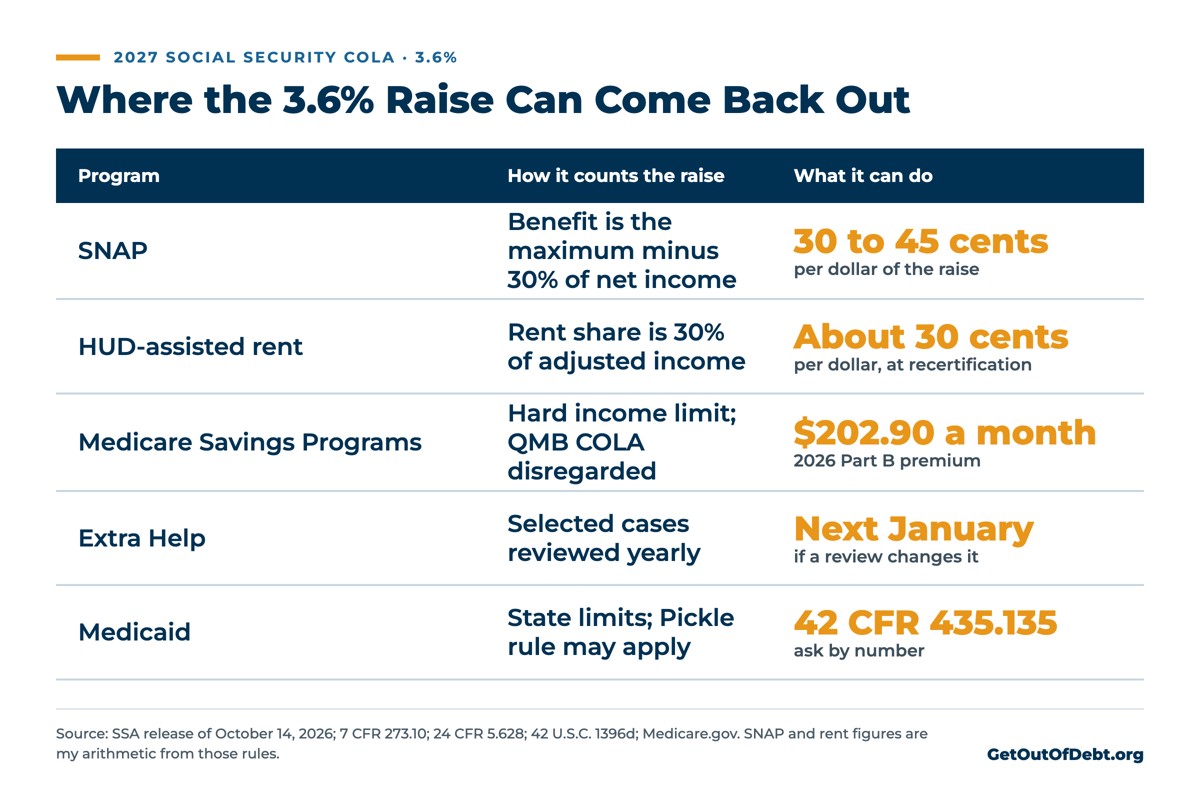
A COLA is not a bonus. To every one of these programs it is simply a higher monthly income. Some respond slowly and smoothly. One responds like a trapdoor. The picture below summarizes all five, and the sections after it show the sources and the math.
SNAP: 30 cents on the dollar, sometimes more
SNAP’s own rule lists “old-age, survivors, or social security benefits” as unearned income (7 CFR 273.9(b)(2)(ii)). A household with an elderly or disabled member has to pass the net income test, which is the poverty line, but not the gross income test (273.9(a)). USDA’s fiscal year 2027 numbers, effective October 1, 2026, put that net limit at $1,330 a month for one person in the 48 states and D.C., with a $306 maximum benefit, a $25 minimum benefit for households of one or two, a $217 standard deduction for households of one to three, and an asset limit of $4,750 when someone in the household is 60 or older or disabled (USDA’s August 21, 2026 memo). Those numbers took effect before your raise does.
Your benefit is the maximum allotment “reduced by 30 percent of the household’s net monthly income” (7 CFR 273.10(e)(2)(ii)(A)). That is the 30 cents. Here is the part that surprises people: if you take the excess shelter deduction, it is the shelter costs above 50% of your income after the other deductions (273.9(d)(6)), and a higher check shrinks that deduction. For a household with an elderly (60 or older) or disabled member that deduction has no cap, because the cap applies only to households that do not contain an elderly or disabled member (7 U.S.C. 2014(e)(6)(B)). While that uncapped deduction is in play, every extra dollar of check raises net income by about $1.50, so the benefit drops about 45 cents per dollar of the raise; without it, 30 cents. By my arithmetic, not an official calculator, here is a single person 60 or older, so the shelter deduction is uncapped, with a $1,000 Social Security check, $800 a month in rent and utilities, and no medical expenses over $35. Their benefit works out to about $193 a month. After a 3.6% raise, the check is $1,036 and the benefit works out to about $177. The $36 raise cost $16 of SNAP. Your state’s rounding, options and your own deductions will move that number, so treat it as a sense of scale and ask your caseworker for the real one.
The federal rule on how states apply a COLA is more forgiving than people expect. A state “shall establish procedures for making mass changes to reflect cost-of-living adjustments,” and households that are not on a monthly report “shall not be responsible for reporting these changes.” If the state applies the percentage increase itself, it has to show up “no later than the second allotment issued after the month in which the change becomes effective” (7 CFR 273.12(e)(3)). A mass-change notice has to explain your right to a fair hearing (273.12(e)(4)). Your Medicare costs also work in your favor here: SNAP’s medical deduction counts “Medicare premiums related to coverage under Title XVIII” and health insurance premiums (273.9(d)(3)(iv)-(v)), so when your 2027 Part B premium is known, that is a deduction to make sure your caseworker has, as long as you are the one paying it: if a Medicare Savings Program pays your Part B premium, you have no premium to deduct. One more caveat: households that are “categorically eligible” under their state’s rules “do not have to meet either the gross or net income eligibility standards” (273.9(a)), so whether the $1,330 line applies to you depends on your state. If a SNAP notice ever lands and you are not sure what to do, my guide to protecting your benefits from a paperwork closure walks through it.
HUD-assisted rent: about 30 cents on the dollar, and it lags
HUD counts “all amounts, not specifically excluded” that you receive from all sources (24 CFR 5.609(a)(1)), and your total tenant payment is “the highest of” 30 percent of monthly adjusted income, 10 percent of monthly income, a welfare-rent amount, or the minimum rent (24 CFR 5.628(a)). For most older and disabled tenants the first one controls. Adjusted income takes off a flat deduction for an elderly or disabled family (the rule’s figure is $525, adjusted by HUD each year) and medical costs above 10 percent of annual income (24 CFR 5.611(a)), though HUD phases that threshold in for some families, so ask your provider which applies to you. Housing providers have also moved to HUD’s newer income rules on different dates, and under the older rules the deduction and the medical threshold were different, so ask which version your provider is using. Using the same $1,000 check, the raise is $36 a month, and your rent share rises by 30 percent of that, about $10.80. It can be slightly more if you claim the medical deduction, because the 10 percent threshold rises along with your check.
The timing is the part to watch. A public housing agency must reexamine income “at least annually” (24 CFR 960.257(a)), and the voucher program says the same (24 CFR 982.516(a)). The rule requires an interim reexamination when adjusted income rises by an estimated “ten percent or more,” and a 3.6% raise alone is usually unlikely to reach that (a very large medical deduction can make adjusted income small enough that it does), so the COLA usually lands on your rent at your next annual recertification, not on January 1. HUD also lets a housing agency use a “streamlined income determination” for fixed income (960.257(c)), which is a shortcut where the provider applies the published COLA percentage to your fixed income instead of asking you to re-document it, and project-based Section 8 owners who use it “must apply a COLA” to fixed-income sources such as Social Security (24 CFR 5.657(d)). If an interim reexamination raises your rent, a public housing agency must give you 30 days’ notice when you reported the change on time (960.257(b)(6)), and project-based Section 8 owners must do the same (5.657(c)(5)); ask your provider how much notice it gives for an increase at annual recertification. How and when you report is set by your housing provider’s written policy, so ask for it.
Medicare Savings Programs: this is where the cliff is
These programs pay your Part B premium, which was $202.90 a month in 2026. The 2026 federal monthly income limits for a single person (every state except Alaska and Hawaii, and some states are more generous) are $1,350 for QMB, $1,616 for SLMB and $1,816 for QI, with a $9,950 resource limit (SSA, POMS HI 00815.023). For a married couple, they are $1,824, $2,184 and $2,455. Go over the QI limit, the top line, and the Part B premium help stops, whether you are over by $400 or by $4. When a state ends its Part B buy-in, Medicare continues and SSA “deducts the Part B premium amount from the beneficiary’s monthly benefit payment” again, and because of a lag it may deduct “up to three months’ worth of Part B premiums” at once, so your deposit can start to drop by the whole premium, and for a month by more (SSA, POMS HI 00815.042, which also describes a waiver and an installment plan). Going over the QMB or SLMB line moves you down a tier: Part B is still paid, but QMB’s help with deductibles and copays ends, and so does its billing protection (Medicare.gov: “Medicare providers aren’t allowed to bill you for services and items Medicare covers, including deductibles, coinsurance, and copayments”).
There is a protection, and it is worth knowing about. For QMB, federal law says that when income is determined in a year, it “shall not include any amounts attributable to an increase in the level of monthly insurance benefits payable under such subchapter,” meaning the Social Security COLA, for each “transition month,” which runs “through the month following the month in which the annual revision of the official poverty line … is published” (42 U.S.C. 1396d(p)(2)(D)). In 2026, HHS published the new poverty guidelines on January 15, and in recent years the annual notice has come out between January 15 and January 21 (January 17 in 2025, January 17 in 2024, January 19 in 2023 and January 21 in 2022, though 2021 slipped to February 1), so the QMB window has usually run through about February. I cannot promise a date for 2027. In the 2026 cycle, California’s letter (“until the 2026 FPL rates take effect on April 1, 2026”) and Montana’s manual (“until the new MSP benefit standard is implemented”) disregarded the COLA for the Medicare Savings Programs, and New York re-budgeted Medicare Savings Program-only cases on the 2025 benefit amount “until the 2026 FPLs are released.” None of that is a 2027 calendar, so ask your state whether SLMB and QI are covered, and until when. The federal statute itself names QMB.
The protection is temporary, which makes the comparison that follows it the real story. The poverty line is updated for price changes, and the 2026 update reflected “the 2.63 percent price increase between calendar years 2024 and 2025,” according to the same Federal Register notice. But after rounding, the published poverty guideline for one person rose only from $15,650 to $15,960, about 2%, while the 2026 COLA was 2.8%. This year’s COLA is 3.6%, and the 2027 poverty line is not published yet. Here is the stylized example I would run. A single person with $1,780 a month in income, all of it Social Security, has $1,844 after a 3.6% raise, about $28 over the 2026 QI figure, though the test that matters is the 2027 limit once it is published; if part of that income is a pension, only the Social Security part grows 3.6%, so run your own split. Also ask whether your state counts your Social Security before Part B comes out and whether its chart already includes the $20 disregard (the federal figures above are 100%, 120% and 135% of the poverty line plus $20). Whether the 2027 limit moves above $1,844 depends on a number HHS has not released. Medicare.gov also notes that “some states don’t count certain types or specific amounts of income,” so you may qualify above the federal numbers. The way to find out is to ask your state Medicaid office or your State Health Insurance Assistance Program, not to assume.
Extra Help: reviewed once a year, not at the moment of the raise
The 2026 Extra Help limits are $23,940 in annual income and $18,090 in resources for an individual, and $32,460 and $36,100 for a married couple living together. SSA’s August 2026 guide lists “Social Security benefits” among the income you report, and says SNAP and housing assistance do not count as income for Extra Help. Medicare.gov, which still lists only the 2026 limits, says: “Even if your income changes in the middle of the year, you’ll keep getting Extra Help through December 31.” SSA runs eligibility reviews every year, “usually at the end of August,” for the people it selects (“If you aren’t selected for a review, there will be no change”), and any change takes effect “in January of the following year.” If you get a review form (SSA-1026), you have 30 days to return it, and if you do not return it, your Extra Help stops the following year. The practical point: answer that form.
If you are on Extra Help or might qualify, my Part D plan check before December 7 shows how to compare your own drugs in Plan Finder.
Medicaid: state rules, with one federal safety net
Medicaid income limits for older and disabled adults differ by state, and I did not verify any individual state’s calculation. One federal protection is worth knowing by name. A state that provides Medicaid to people receiving SSI must also cover people who “were eligible for and receiving SSI or State supplements but became ineligible” because of Social Security cost-of-living increases, if they would still be eligible once those increases were deducted (42 CFR 435.135). The protection applies to people who were getting Social Security and SSI at the same time, and it is often called the Pickle amendment (Section 503 of Public Law 94-566). If a COLA ever ends your SSI and your state is about to close your Medicaid, ask the caseworker about 435.135 by number. If you are on SSI, you may also want to read my guide to the SSI and SSDI asset limit trap.
Things to Consider: What Is Solid, and What I Could Not Verify
- Solid: the 3.6% figure, the January 2027 and December 31, 2026 dates, the SNAP 30 percent rule, HUD’s 30 percent of adjusted income, the QMB COLA disregard, and the Extra Help year-end rule are all in the sources linked above.
- My arithmetic, not an official calculation: the $193 to $177 SNAP example, the “up to about 45 cents” figure, the $10.80 rent example and the $1,844 QI example. They show scale. Your caseworker’s worksheet is the real number.
- If you get SNAP and HUD-assisted rent: do not add the two examples above together, because they use different households and the two programs interact. When your rent goes up, report the new rent to SNAP: a higher shelter cost raises your SNAP benefit back by about 30% of the rent increase, but only while the excess shelter deduction is in play, meaning your shelter costs are above half of your income after the other deductions. The two changes also land at different times, because rent changes at your housing recertification and SNAP changes through the state’s mass change. SNAP also has a small cliff of its own: once net income passes the $1,330 line, even the $25 minimum (for households of one or two) is gone, unless your state’s categorical eligibility applies.
- If you get both Social Security and SSI: your SSI payment is the federal rate minus your countable income, and Social Security counts as income (20 CFR 416.420, 416.1121), so by my arithmetic the Social Security COLA mostly comes back out of your SSI, and your real gain is roughly the rise in the SSI federal payment standard, $994 to $1,029, or $35 a month, per SSA’s fact sheet. If the COLA ends your SSI eligibility altogether, SSI-linked Medicaid can end with it unless the Pickle protection (below) or another coverage category applies.
- Not published yet: your 2027 Medicare Part B premium (SSA says late November), the 2027 poverty line that sets the Medicare Savings Program and Extra Help limits, and any 2027 Medicare Savings Program or Extra Help limits. I will not guess at them.
- Varies by where you live: state SNAP options and categorical eligibility, how each housing provider writes its reporting policy, and each state’s Medicare Savings Program and Medicaid rules.
The Claim: “If I’m on benefits, the COLA is a wash. They take the whole raise back.”
The Reality: Taken one program at a time, SNAP and housing assistance leave you with more than half of the raise, not none of it; if you are on both, together they can take more than half, so work out your own numbers with your caseworker. The costly cases are the cliffs, where a few dollars of income over a hard limit can cost far more than the dollars themselves. That is why I would rather you know your lines than guess at them.
One thing I will say plainly, because I would rather you hear it from me: the answer to a cliff is never to leave income off a form. Where a program tells you to report, report it. The right lever is making sure every deduction you are entitled to is counted, and checking whether your state has a rule that helps.
What to Think About Doing: A Short List Before January
- Find your three dates. Your SNAP recertification date, your housing recertification date, and the date your Medicare Savings Program or Medicaid is next reviewed. The raise lands on each at a different time. Write them on one page.
- Do the dollar math. Multiply your monthly benefit, before Medicare’s premium is taken out, by 0.036. On $1,000 that is $36, on $1,500 it is $54. Knowing your own raise in dollars lets you check every notice against it.
- Update your medical deductions when the Part B number lands. SNAP and HUD both count medical costs, and Medicare premiums are medical costs. When SSA posts your 2027 premium in late November, give it to both programs, if you are the one paying it; if a Medicare Savings Program pays your Part B premium, there is nothing to deduct.
- Do the cliff test for Medicare help. Take your monthly income, raise the Social Security part by 3.6%, and compare it with your state’s limit. If you land near a line, call your state Medicaid office or SHIP before the notice arrives, and ask about disregards that apply in your state.
- Read every notice and ask for the worksheet. If a notice shows a benefit drop or a rent increase, ask for the calculation in writing and check that your deductions are in it. A SNAP notice of a benefit cut must explain your right to a fair hearing, and federal rules (7 CFR 273.15) let you ask for one on any action in the prior 90 days. A COLA mass change is the narrow case: your old benefit goes back during an appeal “only if the issue being contested is that SNAP eligibility or benefits were improperly computed or that Federal law or regulation is being misapplied or misinterpreted by the State agency,” and if the state’s action is upheld, “a claim against the household shall be established for all overissuances” (273.15(k)(1)). In plain terms, an appeal will not keep your old amount in place for a correctly applied COLA, and keeping the old benefit during a lost appeal can mean paying it back, but a wrong worksheet, such as a Medicare premium or your new rent left out, is worth contesting.
- Build your 2027 budget on what is left, not on 3.6%. If you rely on SNAP or subsidized rent, count only the raise that survives. Most creditors legally cannot touch your Social Security, with narrow exceptions such as federal taxes, some federal debts, and court-ordered child support or alimony, so the raise is yours to plan with, but do not borrow against a raise you have not seen yet.
- Watch for the scam that rides along every fall. If anyone contacts you about your “new” raise and asks for your Social Security number, your bank details or a payment, hang up and call SSA yourself at 1-800-772-1213, the number printed in SSA’s own guide. I wrote up the red flags of spoofed SSA calls in an earlier post.
If your plan costs are part of the worry, my post on what a 2027 Medicare plan will actually cost you goes through that side, and if you are weighing a Medicare Advantage exit, read why you should get the Medigap answer in writing first. I also wrote about how Social Security is being squeezed from two directions.
Key Takeaways
- SSA announced a 3.6% COLA for 2027: Social Security checks rise in January 2027 and SSI payments rise December 31, 2026.
- SNAP, HUD-assisted rent, Medicare Savings Programs, Extra Help and Medicaid all count Social Security as income.
- SNAP takes 30 cents of each extra dollar of net income out of your benefit, and HUD builds your rent share on 30% of adjusted income.
- The cliff is the Medicare Savings Program limit: the QMB COLA disregard lasts only through the month after the new poverty line is published, and the 2027 poverty line is not published yet.
- Extra Help does not change mid-year, but it is reviewed every year, so return the form if you get one.
- The 2027 Part B premium is not published yet, and SSA says it will be in your account in late November.
The Bottom Line
If you read a headline about a raise this week and felt your stomach drop because you wondered what it would cost you, that worry is reasonable and you are not behind. The reframe is that this is not a fight with a program, it is a piece of arithmetic you can do before the notice arrives: your raise in dollars, your dates, your deductions and your distance from each line. Debt is math wrapped in emotion, and the math here is smaller and friendlier than the dread. A 3.6% raise is real money for people living on a fixed income, and most of it can stay yours if you know where the lines are. Check your dates, check your deductions, and keep what you have earned.
Frequently Asked Questions
What is the 2027 Social Security COLA and when does it start?
The Social Security Administration announced a 3.6 percent COLA for 2027 on October 14, 2026. Nearly 72 million Social Security beneficiaries will see it beginning in January 2027, and about 7.3 million people receiving SSI will see higher payments beginning December 31, 2026. SSA estimates the average retirement benefit will rise by $75 a month.
Will my SNAP benefits go down when my Social Security COLA arrives?
They can. SNAP counts Social Security as unearned income and subtracts 30 percent of your net income from the maximum benefit, so a higher check usually means a somewhat lower benefit, roughly 30 cents less for each extra dollar of net income, and by my arithmetic up to about 45 cents per dollar of the raise while an uncapped excess shelter deduction (for a household with an elderly or disabled member) is in play. States apply federal COLAs through mass changes, and households not on a monthly report are not responsible for reporting the COLA itself. Your Medicare premiums count as a medical deduction, which is for medical costs over $35 a month (7 CFR 273.9(d)(3)); Part B taken out of your Social Security check counts as paying it yourself, since the law excludes only expenses “paid on behalf of the household by a third party” (7 U.S.C. 2014(e)(5)(A)), so make sure your caseworker has your premiums.
Free Tool — Benefits & Free Money Finder: There may be government programs, creditor hardship options, or nonprofit grants available to you. The free Benefits Finder personalizes results by state and situation — SNAP, Medicaid, LIHEAP, and more. Find Your Benefits →
Will my rent go up in HUD-assisted housing after the COLA?
Usually yes, by about 30 percent of the increase in your adjusted income, and usually at your next annual recertification rather than on January 1. A 3.6 percent raise on a $1,000 check is $36 a month, which raises a rent share built on 30 percent of adjusted income by about $10.80. HUD requires an interim review only when adjusted income rises an estimated ten percent or more, and your housing provider’s written policy sets the reporting rules.
Can the COLA make me lose a Medicare Savings Program or Extra Help?
It can, which is why the cliff matters. The Medicare Savings Programs have hard income limits ($1,350, $1,616 and $1,816 a month for QMB, SLMB and QI for a single person under the 2026 federal limits, with some states more generous), and the QMB COLA disregard only lasts through the month after the new poverty line is published. The federal statute names QMB, so ask your state whether it applies the same disregard to SLMB and QI. Extra Help is different: Medicare.gov says you keep it through December 31 even if your income changes mid-year, and SSA reviews selected cases once a year. Ask your state or a SHIP counselor what applies in your state.
Do I have to report my COLA to SNAP or my landlord?
For SNAP, federal rules say households not required to report the COLA on a monthly report are not responsible for reporting it, and the state is supposed to adjust benefits itself. For HUD-assisted housing, your annual recertification will count the new amount, and your housing provider’s written policy tells you when and how to report changes in between. If you are unsure, ask for the policy in writing.
If you know someone on a fixed income who is living on SNAP, subsidized rent or Medicare help, send them this before their notice arrives. A little warning is the difference between a plan and a surprise.
This is what I’m telling friends like you over coffee. Take it as input, not instruction, because you know your own situation and I don’t. But remember, you do you.
Dealing With Debt? Understanding your options is the first step. See how all your debt relief options compare — including ones most sites won’t tell you about. The Find Your Path quiz gives a recommendation based on your actual numbers, and the Scam-O-Meter checks any company’s complaint history before you sign. Federal Reserve Bank of New York research shows bankruptcy filers recover faster than those who don’t file.



