
Quick Answer: A prepaid heating oil contract means you pay a dealer now for fuel that arrives over the winter, so in practice you are lending money to a small business, and how well that loan is protected depends on your state. The U.S. Energy Information Administration (EIA) said on October 6, 2026 that homes heating mainly with oil could see the biggest jump in winter heating costs of any fuel, forecasting a 21% rise in heating oil spending from last winter with heating oil prices up more than 30%. Before you sign a prepay, know that Connecticut, Maine, New Hampshire and Vermont require dealers to secure prepaid contracts with fuel purchase commitments or a surety bond, among other options (Maine, New Hampshire and Vermont also allow a letter of credit), and that the kind of security matters: a bond is sized against all of a dealer’s prepaid customers together, a letter of credit may cover more, and purchase commitments secure the dealer’s own supply rather than a fund you can claim against, so in a failure you may recover only part of what you paid. A fixed or capped price paid on delivery is a different and smaller risk than handing over the season’s money up front. Get the security method, the refund terms and the “what if you can’t deliver” clause in writing.
Expert Context: I am not an oil-heat expert and I am not going to pretend to be one, so everything in this post that is a fact comes from EIA, a state statute or a state agency, and I link each one. What I do have is 30 years of watching what happens to people on a tight budget when they are asked for a lump sum by a deadline. I started helping people with debt in 1994, and the pattern I know best is this one: a decision that sounds like saving money turns into a debt problem the one time it goes wrong. A prepay is a decision like that, so I read it like a loan.
The price headline is real and it comes from a federal source. The sales pitch that follows it, “pay now and your price is locked,” is a loan to your oil dealer, and it deserves the same reading you would give any other loan contract.
Key Terms Defined
Distillate fuel: The petroleum category EIA says “includes heating oil” (Winter Fuels Outlook). When the news says distillate stocks are low, heating oil is part of what is being counted.
Each weekday I send one short email: one story that caught my attention, why it might matter to you, and one manageable thing you can do with it. A couple of minutes, and a dad joke.
In the latest issue (Nov 9): Check your power bank and your French press
Free. I sell nothing. Unsubscribe any time.
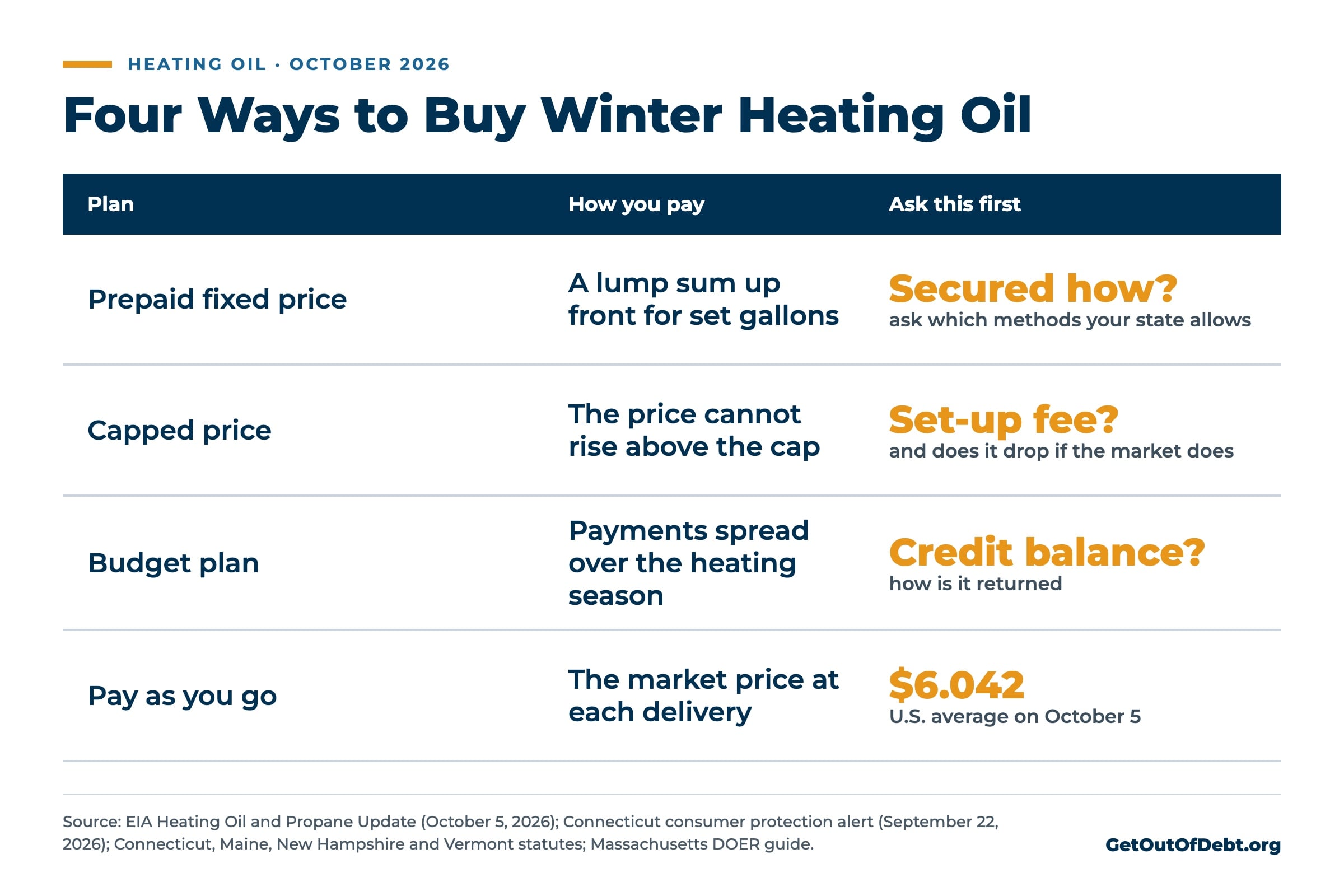
Prepaid contract: You pay for a set amount of fuel up front, and the dealer delivers over the heating season. Connecticut calls it a “prepaid guaranteed price plan” (Conn. Gen. Stat. § 16a-23m, the definitions section).
Capped price: A plan where, in the words of Connecticut’s consumer protection department, “there is a maximum price the consumer can pay, but the price may drop if the market drops” (CT DCP, September 22, 2026). Massachusetts’s energy office notes that in some contracts you pay the lower price and in others you keep paying the cap.
Purchase commitments, futures and inventory: The dealer locking in its own wholesale supply of oil, by contract (futures, forwards, supply contracts) or by holding fuel it owns, so it can deliver what it promised customers. Connecticut’s statute lists these as one way to secure a prepaid contract (Conn. Gen. Stat. § 16a-23n(d)).
Surety bond: A bond a dealer buys from a surety company that is meant to pay valid claims if the dealer fails to perform. The state rules below set how large it has to be.
Budget plan: Payments spread over the heating season, based on your estimated use (Massachusetts DOER). On its own it spreads the payments; ask whether it also fixes or caps the price.
Free Tool — Contract Decoder: Have a contract from a debt relief company? The free Contract Decoder analyzes it for red flags, hidden fees, and problematic terms — before you sign anything. Decode My Contract →
What You Need to Know: EIA Says Heating Oil Is the Big Winter Increase, and Supply Is Tight
The story that sent me here was about diesel, and I am not going to use the word “shortage” for heating oil, because EIA does not. What EIA says, in its Winter Fuels Outlook published October 6, is this: “Global production of distillate fuel, which includes heating oil, has dropped because of reduced global refining activity,” and “U.S. distillate fuel stocks are low heading into winter.” For gasoline, I also looked at what an October 22 Defense Production Act memo does and does not say about prices.
The numbers behind that are public. In its October Short-Term Energy Outlook (STEO), EIA says East Coast distillate inventories “fell 32% below their five-year seasonal average in September” and that it expects them to recover but stay around 20% below the 2021-2025 average through the winter. In the latest weekly report I could pull (week ending October 2), U.S. distillate stocks were 105.138 million barrels, 13.5% below a year earlier. East Coast stocks were 21.687 million barrels, 28.2% below, and New England’s were 2.461 million barrels, 39.5% below.
The price you would pay is already up. EIA’s Heating Oil and Propane Update put the U.S. average residential price at $6.042 a gallon on October 5, up $2.487 from the same week a year ago. Among the Northeast states it lists, the averages run from $5.833 in Pennsylvania to $6.230 in New York. The Winter Fuels Outlook forecasts a winter-average price of $5.26 a gallon, up 34% from last winter, and a household bill of about $2,115 for the average oil-heated home, up 21%, on 402 gallons of use, down 9%, with EIA assuming warmer Northeast temperatures than last winter. About 3% of U.S. households heat mainly with oil, mostly in the Northeast, and EIA says they could see the largest increase of any heating fuel.
Here is the sentence in EIA’s report that matters if you are being pitched a prepay: “Many heating oil and propane users buy supplies ahead of the winter and refill as needed. When forecasting expenditures, our calculations do not account for fuel that consumers purchase ahead of its use or fuel that was contracted at prices set before the start of the winter.” In other words, the 21% number describes people who buy as they go. Your prepay price is whatever your dealer quotes and your contract says.
Why You Need to Know It: A Prepay Is a Loan to a Small Business, and Your State Decides How Safe It Is
Connecticut’s consumer protection department said it plainly on September 22: “Most businesses will offer a long-term prepaid contract to lock in a fuel rate, protecting consumers from potential price spikes,” and also, “It is possible that businesses can struggle to secure their own fuel supply due to market fluctuations.” It added that “Consumers are not required to pre-buy home heating oil.” Both halves are true at the same moment: the lock protects you from a price spike, and the dealer who sold it still has to buy the oil.
If the dealer fails, you are in line with everyone else the dealer owes. Federal bankruptcy law gives an individual who paid a deposit for goods or services they never received a seventh-priority claim, for the first $3,800 of the deposit (the figure was adjusted from $3,350 effective April 1, 2025, per the notes to 11 U.S.C. § 507). A priority claim moves you ahead of ordinary creditors, but it is paid only after the claims ahead of it and only from whatever is left, so it is a place in line and not a guarantee. That is why the state security rules are the part to read.
The four states where I verified a statute
I read the current text of each of these on the state’s own site. None of this is legal advice, and a contract can add protections beyond the statute.
- Connecticut (Conn. Gen. Stat. §§ 16a-23n, 16a-23r, 16a-23v): within five business days of a prepaid contract, the dealer must hold fuel inventory, futures, supply contracts or similar commitments (its own wholesale supply locked in) to buy at least 80% of the gallons it has promised, or a surety bond of at least 50% of the money consumers paid. The contract cannot run more than 18 months or renew automatically, and it must state the amount you paid, the maximum gallons, that performance is secured, and that undelivered fuel will be reimbursed within 30 days of the end date unless the parties agree otherwise. A capped plan cannot rise above its cap. A dealer who knowingly fails to secure a prepaid contract commits a class A misdemeanor. And no dealer may offer a prepaid plan from November 1 through March 31, and Connecticut’s consumer protection department says “if you do purchase pre-paid oil, those contracts should be negotiated and signed by October 31.”
- Maine (10 M.R.S. § 1110): the dealer must hold fixed-price purchase commitments for at least 75% of the gallons it has promised, or a surety bond of at least 50% of the money consumers prepaid, or a letter of credit for 100% of it. The contract must be in writing and say how much you paid, the maximum gallons and that it is secured, and any undelivered balance is to be reimbursed within 30 days after the contract ends unless you agree otherwise. Dealers who sell prepaid contracts must register each year and file a report by October 31 showing how the contracts are secured.
- New Hampshire (RSA 339:79): within seven days the dealer must hold a futures commitment for 75% of promised gallons, a surety bond payable to the attorney general for at least 50% of prepaid funds, a letter of credit from an FDIC-insured bank covering 100% of the dealer’s cost, or inventory equal to 75% of the outstanding obligation. The contract must explain how the dealer will meet its obligations, give you the option of reimbursement for undelivered fuel within 30 calendar days of the contract’s end, and include the state Department of Justice consumer protection hotline. A dealer who falsely claims coverage, or lets it lapse before the contract ends, commits a class A misdemeanor. Dealers may not advertise or solicit prepaid contracts before May 1 or after October 31.
- Vermont (9 V.S.A. § 2461e): within seven days the dealer must hold commitments for 75% of promised gallons, a surety bond of at least 50% of prepaid funds, or a line of credit, letter of credit or cash for 100% of its cost. The contract must state the amount paid, the maximum gallons and that it is secured, and undelivered fuel is to be reimbursed within 30 days of the end date unless the parties agree otherwise.
Read the 50% bond again. It is measured against all the prepaid money the dealer has collected from all its customers, not against your payment, and it is only one of the options. A bond is a single pool for all of a dealer’s prepaid customers, so in a failure you may recover only part of what you paid. A letter of credit may cover more. Purchase commitments and inventory, in my read, secure the dealer’s own supply rather than a fund you can claim against. The rules are meant to be a floor, and I would treat them as one.
Massachusetts and New York: a 2014 report from Connecticut’s Office of Legislative Research said neither state has specific prepaid-oil contract statutes, and I could not confirm that nothing has changed since, so ask your attorney general. Massachusetts’s Department of Energy Resources guide says “Oil heat dealers are not required to be licensed in Massachusetts” and suggests asking: “Has the dealer already purchased the gallons they are committing to under the contract? How will they guarantee that the oil will be available?”
Everywhere else: I could not confirm a prepay-security statute for Pennsylvania, New Jersey or any other state, so I left them out rather than guess. That is not the same as saying you are unprotected. Call your state attorney general or consumer protection office and ask the question directly.
The risk is not abstract. The Connecticut report was written to answer which dealers “have gone out of business, or filed for bankruptcy, without delivering the oil specified in the prepaid contracts,” and it found bankruptcies to report. I am not suggesting your dealer is one of them. Most are not. The point of the rules is that you cannot tell which kind you have from the brochure.
Things to Consider: The Math, the Fine Print and the Cash
The Claim: “If I prepay, my oil is guaranteed.”
The Reality: What is guaranteed is what the contract says. Massachusetts’s energy office warns that some contracts include language like “while supplies last” and tells consumers the contract “should tell you what happens if the dealer is unable to provide you with oil.” Ask where that sentence is in yours.
The price you lock is today’s price, and EIA expects prices to ease. EIA’s base-case forecast for the average retail heating oil price runs $5.79 in November, $5.46 in December, $5.26 in January, $5.06 in February and $4.84 in March. Those are forecasts, not a schedule: EIA calls weather “a significant source of uncertainty” in them, and it flags a strong El Niño that “could lead to large temperature variations” from its forecast, so the real path can move with the weather. The October 5 weekly average was $6.042. By my arithmetic, 402 gallons at $6.042 comes to about $2,429, against the $2,115 EIA forecasts for the same gallons at its winter-average price, a gap of roughly $314. Also by my arithmetic: a quote below EIA’s $5.26 winter-average forecast beats the forecast; at $5.26 you are paying EIA’s own forecast in exchange for certainty; above $5.26 you are betting the winter comes in higher than EIA expects. A bet can be reasonable. It should be called a bet.
A price lock and prepaid cash are two different things. Connecticut’s statute defines a guaranteed price plan (it lists “fixed price,” “lock in,” “capped” and “price cap” among its names) as a contract “that is not paid in advance of delivery,” and a prepaid plan as one “paid for in advance of delivery” (Conn. Gen. Stat. § 16a-23m(a)(8), (14)). A fixed or capped price that you pay for on delivery puts no season’s money in the dealer’s hands, and it is also insurance for a household that cannot absorb a price spike. The risk I am warning about is the lump sum, so do not refuse both. A price promise is only as good as what you can show in writing, and that is the issue in the New York Attorney General’s October 2026 T-Mobile settlement over plans sold with a price guarantee.
A cap is a different animal. Connecticut’s rules say a capped plan “shall not increase above a specified price per gallon.” Massachusetts’s guide notes cap plans are more complicated and sometimes carry a set-up fee, so ask for the fee and ask whether the price falls when the market does. A cap limits how high your price can go, and if it is paid on delivery it puts no lump sum in the dealer’s hands (a cap can also be sold prepaid, so check which kind you are being offered), though the contract still controls what you get.
Budget plans are a payment tool, not a price tool. In Vermont and New Hampshire the security requirement for prepaid contracts does not apply to budget plans that spread your payments in equal monthly installments. My read is that this is because you are not sitting on a large prepaid balance, but ask whether your plan can leave a credit balance with the dealer after a warm winter, and how that balance is returned.
Paying by credit card is not a free safety net. Connecticut requires a prepaid-plan dealer to give you a notice that if you pay by credit card, you “may be entitled to recovery payments pursuant to the federal Fair Credit Billing Act or your credit card company’s terms and conditions if heating fuel is not delivered to you in accordance with the contract.” That is real: federal rules define a billing error to include an extension of credit “for property or services … not delivered to the consumer … as agreed” (12 CFR 1026.13(a)(3)). But the written dispute notice generally has to reach the card company no later than 60 days after the first statement that shows the charge. A charge in October and a failed delivery in January may not fit inside that window, so ask your issuer what applies. Separately, 12 CFR 1026.12(c) lets a cardholder raise claims against the card issuer over a dispute about goods or services bought by card, if you first make a good-faith attempt to resolve it with the seller, the amount is over $50 and the purchase was in your state or within 100 miles of your address. It has no 60-day clock, but the claim cannot exceed the credit still outstanding on that charge when you first notify the issuer (official interpretation, comment 12(c)-4), so paying the card in full can leave nothing to assert. That is a real tradeoff: carrying the balance keeps that right alive and costs interest, and I would not put a four-figure oil payment on a card you will carry a balance on, because the interest eats whatever a lock saved. Paying the card does not end a timely billing-error notice under section 1026.13. Read your card agreement. I wrote about that trap in why another loan won’t fix credit card debt.
The cheapest option may be not to prepay. Connecticut’s regulator says consumers are not required to pre-buy. Paying as you go means calling ahead and paying the market price at each delivery, which exposes you to price moves, but it keeps your cash in your hands and puts no money at risk with the dealer. With stocks low, I would expect will-call customers to be served last, and it is worth asking about minimum delivery sizes and cash on delivery. That is my advice, not a statistic: call when the tank is about a quarter full, not empty, and ask your dealer now about minimum deliveries and midwinter service. For a stretched household, cash on hand is a safety feature. If the pitch is that you must decide by Friday, that is a reason to slow down, not speed up.
What to Think About Doing: Eight Steps Before You Hand Over a Dollar
- Learn your own numbers. Connecticut’s regulator advises knowing your tank capacity and what you use in an average year so you do not buy too much oil. Your delivery tickets have last year’s gallons. EIA’s 402-gallon figure is a national average, not yours.
- Get the contract in writing before you decide, with the price type spelled out: fixed, capped (and does it drop?) or market. Ask how long it runs and whether it renews itself.
- Ask how your money is secured, and get the answer on paper. Connecticut’s regulator suggests asking exactly how prepaid funds are secured against business failure or insolvency. Ask which of the allowed methods the dealer uses: purchase commitments, a bond, a letter of credit or inventory. If it is a bond, ask who the surety is.
- Find the refund clause. In the four states above the contract is supposed to provide that undelivered fuel is reimbursed within 30 days of the end date. That refund comes after the contract ends, so it is not a plan for heat in January. Make sure it is in your contract, look for any clause saying the parties “agree otherwise” (Connecticut, Maine and Vermont allow the refund to be changed that way), and ask what happens if you move or stop using oil midwinter.
- Look for exits and extras. Connecticut’s regulator suggests asking about exit penalties, rolling renewals, automatic delivery and surcharges for off-hour, weekend or emergency deliveries.
- Mind the date, and whose date it is. The Connecticut bar on offering prepaid plans from November 1 through March 31 and the New Hampshire limit on advertising or soliciting them after October 31 are state rules. In Connecticut the bar covers only a “prepaid guaranteed price plan,” which the statute defines as paid in advance of delivery and not including a budget plan. Fixed or capped plans not paid in advance, and budget plans, are defined separately, and I found no November 1 bar on them in section 16a-23v. Everywhere else, a deadline is the dealer’s, not the state’s, and you can still say no.
- Check for help before you borrow. The federal Low Income Home Energy Assistance Program (LIHEAP) provides federally funded help with home energy bills, and the Administration for Children and Families (ACF) points people to EnergyHelp.us or the National Energy Assistance Referral line at 1-866-674-6327 to find where to apply in their area. Eligibility, amounts, application dates and funding vary by state and by year, so check your state’s program now. The federal government does not send LIHEAP money to people directly (ACF says “LIHEAP does not provide direct grants to individuals”), so you apply through your state or local agency, and ACF adds that LIHEAP does not charge a fee. Anyone offering you a LIHEAP grant for a fee is a red flag to report to the HHS Fraud Hotline at 1-800-447-8477.
- Know what you will do if the dealer stops delivering. The sequence is just below, and it starts with keeping the house warm, not with the paperwork.
If Your Dealer Won’t Deliver
- Get oil today from another dealer, and keep the receipt. A refund at the end of a contract does not fill a tank in January. In a tight market other dealers may refuse new will-call customers or require a minimum delivery paid on delivery, so call other dealers and your local 211 or energy assistance office at the same time, and say it is an emergency. The receipt is a record of the extra cost you can claim, not a promise you will be repaid.
- Put your demand in writing to the dealer, using the method your contract specifies for notices, and keep proof of delivery along with a copy, the contract and every payment record. A text is a copy of your demand, not necessarily notice.
- Ask for crisis help. Call your local 211, which the FCC says refers callers to resources “including food and clothing banks, shelters, rent assistance, and utility assistance” (FCC), and your state or local energy assistance office through EnergyHelp.us or 1-866-674-6327. ACF describes LIHEAP as assistance for “home energy bills, energy crises, weatherization, and minor energy-related home repairs.” I cannot promise a response time, so ask each office how fast it can help.
- Report it to your state attorney general or consumer protection office. Connecticut’s Department of Consumer Protection says its Food and Standards Division “accepts consumer complaints regarding fuel, oil, and propane in Connecticut.”
- Ask in writing how to claim against the dealer’s bond or other security, and by what deadline. Ask the dealer who holds the surety bond or other security, and ask the state office how and by when a claim has to be made. In New Hampshire the surety bond is payable to the attorney general (RSA 339:79(IV)(b)), so ask that office about a claim.
- If you paid by card, send the issuer a written billing-error notice now. Under 12 CFR 1026.13(b) it must be written, go to the billing-error address on your statement, and be received no later than 60 days after the issuer sent the first statement that shows the charge. A phone call does not preserve those rights, so call only as a backup.
- If the dealer files bankruptcy, file a proof of claim and ask the court or trustee about priority treatment for a consumer deposit, which 11 U.S.C. § 507(a)(7) sets at $3,800 for each individual. The court’s notice sets a filing deadline (in a voluntary Chapter 7 case, 70 days after the order for relief under Bankruptcy Rule 3002, which also says a creditor must file a proof of claim for the claim to be allowed) — and if the notice says there is nothing to pay creditors yet, it will tell you to wait for a later deadline — so a missed deadline can cost you the claim. A lender with a lien on the dealer’s assets is treated as secured to the extent of what those assets are worth (11 U.S.C. § 506(a)) and is paid from them ahead of unsecured claims like yours.
If the oil bill is landing on top of a water bill, a rent increase and everything else, that is not a character flaw. It is math. My earlier posts on rising water bills, a 30-day household checklist and what to do when a utility is about to be shut off go through the same squeeze from other angles, and 32 ways to cut utility bills is worth a skim before winter.
Key Takeaways
- EIA’s October 6 Winter Fuels Outlook forecasts the largest winter increase for oil-heated homes: heating oil spending up 21%, with prices up more than 30% from last winter.
- EIA describes distillate stocks as low and tight, not as a shortage, and its forecast does not capture prepaid or pre-contracted fuel.
- A prepay is a loan to a small business: in a bankruptcy a consumer’s undelivered-deposit claim gets priority only up to $3,800.
- Connecticut, Maine, New Hampshire and Vermont each require security for prepaid contracts, but a bond is one pool for all of a dealer’s prepaid customers and commitments secure the dealer’s supply, so you may recover only part of what you paid.
- A fixed or capped price paid on delivery is a different risk from prepaid cash, and if a dealer stops delivering, buy oil elsewhere first and sort out the paperwork second.
- Ask for the security method, the 30-day refund clause, the price type and any “while supplies last” language in writing.
- Prepaying is optional. A capped plan, a budget plan or paying as you go can fit a tight budget better.
The Bottom Line
If you read a headline about oil prices and felt your stomach drop because you do not know how you will pay to stay warm, that reaction is reasonable and you are not behind. The reframe is that the loudest pitch is not the only plan: you can ask questions, compare a cap and a budget plan, and say no to a deadline. Debt is math wrapped in emotion, and the math here is a gallon count, a price and a refund clause you can read before you pay. Do the math first, keep your cash if you can, and stay warm without handing over your winter budget before you have read the fine print.
Free Tool — Benefits & Free Money Finder: There may be government programs, creditor hardship options, or nonprofit grants available to you. The free Benefits Finder personalizes results by state and situation — SNAP, Medicaid, LIHEAP, and more. Find Your Benefits →
Frequently Asked Questions
Is prepaying for heating oil a good idea?
It depends on your cash, your state and the contract. EIA forecasts that heating oil prices stay high this winter, but it also forecasts them easing from $5.79 a gallon in November to $4.84 in March, so a prepay near the October 5 price of $6.042 is a bet that prices rise. Connecticut’s regulator says consumers are not required to pre-buy, and a capped plan, a budget plan or pay-as-you-go may fit a tight budget better.
What happens to my prepaid heating oil money if my dealer goes out of business?
In Connecticut, Maine, New Hampshire and Vermont the dealer must hold security such as purchase commitments, a surety bond or a letter of credit, but a bond is one pool for all of the dealer’s prepaid customers, a letter of credit may cover more, and purchase commitments secure the dealer’s supply rather than a fund you can claim against, so you may recover only part of what you paid. Outside those protections you may be an unsecured creditor, and federal bankruptcy law gives a consumer’s undelivered-deposit claim priority only up to $3,800. First get oil from another dealer and keep the receipt, then put your demand in writing, call your attorney general and, if you paid by card, your card issuer right away.
Which states regulate prepaid heating oil contracts?
I verified statutes in Connecticut (Conn. Gen. Stat. § 16a-23n), Maine (10 M.R.S. § 1110), New Hampshire (RSA 339:79) and Vermont (9 V.S.A. § 2461e). A 2014 Connecticut legislative report said Massachusetts and New York had no specific prepaid-oil statutes. I could not confirm rules for other states, so ask your state attorney general or consumer protection office.
Is a capped price plan better than a fixed price or prepay?
It can be, because a cap limits how high your price can go without necessarily requiring you to pay the whole season up front. Connecticut says a capped price may drop if the market drops, while Massachusetts’s energy office says some contracts keep charging the cap, and cap plans can carry a set-up fee. Ask which kind yours is.
Can I get help paying for heating oil?
Possibly. The federal LIHEAP program provides federally funded help with home energy bills, and eligibility and amounts vary by state. Start at EnergyHelp.us or call 1-866-674-6327, and never pay anyone a fee to apply, because ACF says LIHEAP does not charge one.
If you know someone who heats with oil and has a prepay offer sitting on the kitchen table, send them this before they sign. A little warning is the difference between a plan and a surprise.
This is what I’m telling friends like you over coffee. Take it as input, not instruction, because you know your own situation and I don’t. Nobody gets to tell you what to do with your money, not a dealer with a deadline and not me, so you do you.
Dealing With Debt? Understanding your options is the first step. See how all your debt relief options compare — including ones most sites won’t tell you about. The Find Your Path quiz gives a recommendation based on your actual numbers, and the Scam-O-Meter checks any company’s complaint history before you sign. Federal Reserve Bank of New York research shows bankruptcy filers recover faster than those who don’t file.



