

Quick Answer: The $8.75 million University of Phoenix website-tracking settlement is a privacy settlement, not student loan forgiveness: if you were enrolled at Phoenix at any time from April 1, 2023 to October 6, 2026 (April 1, 2020 to October 6, 2026 if you are located in Illinois), you can claim up to $25 (and that amount can be cut) by November 5, 2026, and that payment does not change what you owe on a single student loan. The $8.75 million is a cap on what Phoenix pays in total, including lawyers’ fees and administration costs, and it rises only if the class has 385,000 members or more, so it is a ceiling and not a pot of money split among everyone. The lawsuit alleges Phoenix disclosed students’ information to Meta Platforms and other third parties through its websites without consent, and Phoenix denies violating any law. If your real problem is a Phoenix student loan balance, the places to look are the Department of Education’s borrower defense process and the FTC’s 2019 Phoenix case history, both covered below.
Expert Context: I have been helping people with debt since 1994, and since I started GetOutOfDebt.org in 2008 I have watched which settlements pay and which ones only sound like they do. A big dollar figure in a headline makes people with student loans hope relief is coming, and with this one the hope is pointed at the wrong program.
If you ever enrolled at the University of Phoenix, you may have an email in your inbox about an $8.75 million settlement, and if you are carrying Phoenix student loans, it is easy to read that number as relief. It is not. This settlement is about website tracking, it pays up to $25 to people who claim it, and it has nothing to do with your loan balance.
Key Terms Defined
Gross Maximum Funding: The settlement agreement’s name for the $8,750,000 figure. Under paragraph 1.17 of the Settlement Agreement, it is “the most that Defendant shall have to pay in relation to this settlement,” and it includes payments to class members, service awards to the class representatives, the cost of administering the settlement and the class lawyers’ fees and costs. The cap rises only if the class has 385,000 members or more, as I explain below.
Claiming money you are owed is one good day. What you do over the following year is what actually changes your position.
In the latest issue (Nov 11): I let AI shop my insurance. I saved $2,000.
Each weekday I send one short email: one story that caught my attention, why it might matter to you, and one manageable thing you can do with it.
Free. I sell nothing. Unsubscribe any time.
Pro rata reduction: If valid claims at $25 each would add up to more than the money available for claims, every claimant’s payment is cut by the same percentage.
Borrower defense to repayment: A federal process that lets a borrower with federal student loans ask the Department of Education to cancel those loans because the school misled them. It covers federal loans only, and you apply through studentaid.gov.
Release: What you give up if you stay in a class action settlement. Here it is written around claims about tracking technologies on Phoenix’s websites, and I quote the language in the claim section below.
What the University of Phoenix settlement actually is
The case is Brand, et al. v. The University of Phoenix, Inc., Case No. 2026LA000170, in the Circuit Court for Sangamon County, Illinois (Seventh Judicial Circuit), before Judge Gail L. Noll, according to the official settlement website’s FAQ. The class representatives are Lauren Brand and Janielle Dawson. The lawsuit claims Phoenix violated the Video Privacy Protection Act, the Electronic Communications Privacy Act and the Illinois Eavesdropping Act by disclosing its students’ personally identifiable information to Meta Platforms, Inc. and other third parties without consent. Phoenix denies that it violated any law, and it agreed to the settlement, in the website’s words, “to avoid the uncertainties and expenses associated with continuing the case.” The court has not decided who is right, so everything in the complaint is an allegation, not a finding.
That is the whole case. It is not about tuition, loans, grades or the quality of any degree. The agreement’s release, which I quote below, covers claims about “cookies, pixels, code, analytics tools, and/or tracking technologies, including, but not limited to the Meta Pixel, on Defendant’s websites.” In plain English, it is a close cousin of the case I covered in the Forbes website-tracking settlement: a website allegedly sent visitor data to a tech platform, and a court is being asked to approve a payout for the people affected.
The administrator’s dates page shows the court granted preliminary approval on September 22, 2026, a notification email went out October 6, 2026, and the final approval hearing is November 20, 2026. The preliminary approval order carries the same hearing date. Preliminary approval means a judge has said the deal looks fair enough to send out notice. It does not mean the money is guaranteed.
Who qualifies for the University of Phoenix settlement
The official site says you are included if you were enrolled at The University of Phoenix at any time from April 1, 2023 to October 6, 2026, or, if you are located in Illinois, at any time from April 1, 2020 to October 6, 2026. Anyone who was enrolled in that window counts, so this is not limited to graduates and it is not limited to people who borrowed. Do not guess whether the Illinois dates apply to you: if you lived in Illinois at any time from 2020 to 2026 and are unsure, ask the settlement administrator at info@UOPPixelSettlement.com or (866) 675-2696.
You file with a Login ID and PIN printed on the notice emailed to you. The FAQ says that if you believe you are a class member but never got the email, you can ask for your Login ID and PIN at info@UOPPixelSettlement.com. The administrator’s toll-free line is (866) 675-2696.
What you can get, and why $8.75 million is not what it sounds like
Each valid claimant is promised $25.00, “subject to pro rata reduction should the Gross Maximum Funding amount of $8,750,000 be reached,” according to the FAQ. You must file a claim to get anything. Payment is by check by default, or you can pick Zelle, Venmo, PayPal or a similar electronic method. The FAQ says approved claims are paid about 100 days after final approval and any appeals are finished, so if the judge approves the deal on November 20, 2026, I would not expect money before 2027.
Here is the part the headline hides. The $8.75 million is not a fund that gets divided by however many people claim. It is the ceiling on what Phoenix can be made to pay for everything (it rises only if the class has 385,000 members or more, which I explain below): claims, administration, the class representatives’ service awards and the lawyers. Class counsel say they will ask for no more than 35% of that ceiling, which the agreement values at $3,062,500, and the class representatives will ask for no more than $5,000 each, though the FAQ is clear the court may award less.
My own arithmetic, not a number from the settlement: if the court granted the full fee request and both $5,000 service awards, about $5.68 million would be left under the cap for claims and administration, which is enough for roughly 227,000 full $25 payments before administration costs come out. The agreement does not state the class size, though it uses 350,000 people as its reference point, and $25 times 350,000 is exactly $8.75 million. If the class has 385,000 members or more, the cap rises by $25 for every member beyond 350,000. So I cannot tell you whether a pro rata cut will happen. What I can tell you is that $25 is the most anyone is promised.
The Claim: “An $8.75 million University of Phoenix settlement means my Phoenix student loans are getting reduced.”
The Reality: The case is about tracking tools on Phoenix’s websites, the payment is up to $25, and the release language covers tracking technologies, not loans. Nothing in the settlement website’s description of the benefits touches a loan balance.
How to claim, and what your other choices are
The official site lists four options, and three of them share the same date.
- Submit a claim form by November 5, 2026. This is the only way to receive a cash payment. You can file online at UOPPixelSettlement.com or by mailing a paper form, and you need the Login ID and PIN from your notice. The claim starts with the Login ID and PIN from your notice; it has nothing to do with your FSA ID or your studentaid.gov login, so never enter your FSA ID on a settlement site, and type the settlement address yourself.
- Exclude yourself by November 5, 2026. You receive no cash, but you keep whatever right you have to sue Phoenix over these claims. The FAQ says you do this by mailing or delivering a letter, so read FAQ 14 before you try it.
- Object by November 5, 2026. You stay in the class and write to the court explaining what you dislike. You can ask to speak at the November 20 hearing.
- Do nothing. You get no payment and, if the court approves the settlement and you did not exclude yourself, you give up the right to sue Phoenix over the claims in this case.
That last point matters for everyone, including people who never file. Under FAQ 10, staying in the class releases the claims “regardless of whether you submit a claim or not.” The release in paragraph 1.25 of the agreement is written around the “alleged disclosure, use, interception or transfer of information” through cookies, pixels, code, analytics tools and tracking technologies on Phoenix’s websites, and it says nothing in it is “intended to release any claims any governmental agency” has against Phoenix. I read nothing in that paragraph about student loans or borrower defense, but I am not your lawyer, so if you are in an active dispute with Phoenix, have an attorney read it before November 5.
Watch for fake notices. Real settlement claims cost nothing to file and do not ask you to pay a fee or “release” your student loan to a third party. Fake settlement notices are a real scam pattern, and I covered the red flags in the BBB warning post. If an email says it is about this settlement, type UOPPixelSettlement.com into your browser yourself instead of clicking the link.
Where Phoenix borrowers should actually look for student debt help
If the reason you opened this post is a loan balance, here is what I could verify on the government’s own pages on October 15, 2026, and what is open today.
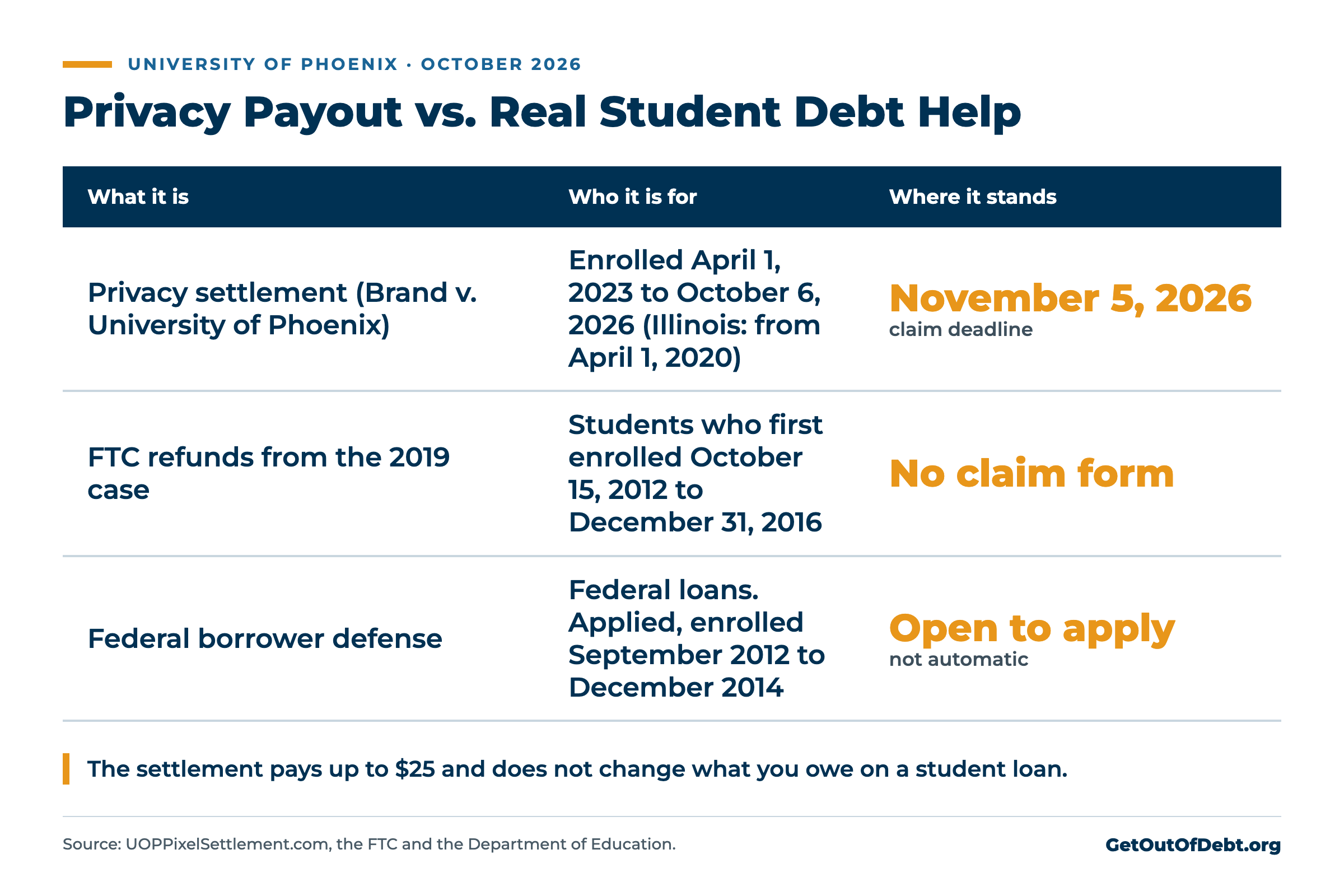
1. Federal borrower defense: open to apply
Of the settlement, the FTC refunds and borrower defense, borrower defense is the only one that can cancel a federal loan. Studentaid.gov lists other federal discharge and forgiveness programs too, but I have not checked whether any of them fit Phoenix borrowers. In September 2023 the Department of Education announced it had approved more than 1,200 borrower defense claims from students who enrolled at Phoenix between September 21, 2012 and December 31, 2014, for nearly $37 million in discharges, according to its own borrower defense update page. The Department said it found Phoenix’s “Let’s Get to Work” national ad campaign “was false and misleading,” because the school’s corporate partnerships did not give students the hiring benefits it represented. The Department’s executive summary says it relied on evidence the FTC provided from its investigation, and it granted 100% relief to borrowers who applied and enrolled in that period because of the employer-partnership claims.
The borrower defense page currently says “borrowers may still apply online” and that “the Department will continue to adjudicate borrower defense applications,” while, the page says, a court injunction against the Department’s 2022 borrower defense regulation remains in effect. An application takes about three hours and requires your FSA ID. The FTC’s Phoenix refund page, in an update carried over from the 2023 announcement, still says the Department “is continuing to process new and existing applications and expects to approve additional claims.”
Five honest limits. It covers federal loans only, so private loans and any balance owed directly to the school are not part of it. The Department’s 2023 relief went to borrowers who applied and who enrolled between September 21, 2012 and December 31, 2014 because of Phoenix’s employer-partnership claims. Enrolling in those dates is a reason to apply, not approval, and you still have to apply and make your case. If you enrolled outside that window, I did not find a Department finding that covers you, so you would be making your own case from scratch. Approval is not guaranteed and I found no processing-time estimate on the page. The page I read states no deadline for applying, but borrower defense may have time limits depending on when your loans were disbursed, so check studentaid.gov and do not wait. And Phoenix’s entry on the Department’s update page is still the September 20, 2023 announcement, with no newer Phoenix action listed when I read it.
One piece of my own advice, not something the borrower defense page says: do not stop paying your federal loans just because you applied. Keep paying unless your servicer confirms in writing that your loans are in forbearance or paused.
If you filed a borrower defense application years ago, check “Manage My Applications” on that page, which the FTC points to for status. Applications filed on or before November 15, 2022 are also affected by the Sweet v. McMahon settlement, which I explained in my Sweet v. McMahon post (its April 15, 2026 deadline has passed, and the point for you is applications already filed; if you already applied, check your status on studentaid.gov).
2. The FTC’s 2019 case: refunds that are not a claim form
On December 10, 2019 the FTC announced a $191 million settlement with the University of Phoenix and its parent, Apollo Education Group: $50 million in cash and the cancellation of about $141 million in debts owed to the school. The FTC alleged that ads from Phoenix and Apollo falsely suggested relationships with employers like Microsoft, Twitter, Adobe and Yahoo! created job opportunities for Phoenix students, according to the FTC’s press release. The release does not say Phoenix admitted wrongdoing. I covered the 2019 announcement at the time in my earlier Phoenix post.
The part people miss is in the same press release: “This settlement will not affect student borrowers’ federal or private loan obligations.” The $141 million was money owed directly to the school, not federal loans or private loans from a bank or other lender. The FTC’s 2021 refund announcement repeats it: other debts “such as federal and private student loans or military benefits, are not affected by this settlement.”
On the refunds, the FTC’s Phoenix refund page says payments went out in March 2021, July 2023 and September 2025, totaling more than $49 million, and that the FTC is now sending Zelle payments to eligible people who did not cash their check or accept their PayPal payment. The page lists no claim form. The 2021 round went to students who first enrolled in a master’s, bachelor’s or associate degree program between October 15, 2012 and December 31, 2016, paid more than $5,000, and did not receive the debt cancellation. If you think you qualified and never saw a payment, the FTC page lists a refund administrator line, 1-877-310-0487. There is no application for these refunds; the page lists no claim form or deadline, and the FTC says it never asks you to pay to get a refund.
3. Anyone charging you a fee to “get your Phoenix loans forgiven”
Borrower defense costs nothing to apply for, and the FTC said so in its 2019 release, in a passage about income-driven repayment plans and borrower defense: “Applying for these programs does not cost anything.” A company that wants a fee to file it for you is selling you what the government gives away, and I covered that pattern in my post on student loan forgiveness fees.
Why this matters beyond $25
Here is what bothers me about stories like this one. A settlement with a famous school’s name and a big number lands in the news cycle, and a person who is drowning in student debt gets a flash of hope that is aimed at the wrong thing. Then the $25 shows up, or it does not, and the loan balance is exactly where it was. I do not want you to skip the $25 if you qualify, because it takes a few minutes. I do want you to know it is a privacy payout so you do not stop looking for real help.
If the loan balance is the crisis, the options are wider than most people have been told. Borrower defense is one. Another is that student loans are not off the table in bankruptcy, because federal and private student loans can be discharged in bankruptcy in some situations and the rules are narrower and more conditional than for credit cards. I explained how that changed in my post on the 2022 change and how the private-loan test works in this one. If a Phoenix balance owed to the school itself is what is chasing you, I walked through one version of that fight in my post on Phoenix debt and transcripts. Debt is math wrapped in emotion, and the math here has more than one answer.
What I would think about doing
- Find the email and decide on the $25 before November 5, 2026. If you qualify and have the Login ID and PIN, filing takes a few minutes. If you do not have the email, ask the administrator for your credentials.
- Do not treat that email as a sign anything happened to your loans. It did not.
- If you took out loans for Phoenix, log in to studentaid.gov, find which loans are federal, and look at borrower defense. Especially if you enrolled between September 21, 2012 and December 31, 2014, because that is the window the Department has already acted on, though enrolling in those dates is a reason to apply, not approval.
- If you owe private loans or a balance directly to Phoenix, do not wait on a settlement. Look at your actual options for that debt, including a statute-of-limitations check and bankruptcy.
- You never need to pay a company to apply for borrower defense or to claim this settlement for you. Borrower defense is free to apply for, and free legal help exists.
Key Takeaways
- The $8.75 million Phoenix settlement is a website-tracking privacy case, and the payout is up to $25 per valid claim, not student loan relief.
- The $8.75 million is a cap on everything Phoenix pays, including lawyers and administration, not a pot split among claimants, and it rises only if the class has 385,000 members or more.
- The claim, opt-out and objection deadline is November 5, 2026; the court’s final approval hearing is November 20, 2026.
- The FTC’s 2019 settlement “will not affect student borrowers’ federal or private loan obligations”; its $141 million was debt owed to the school.
- Borrower defense is open to apply on studentaid.gov, and the Department granted relief to borrowers who applied and who enrolled from September 21, 2012 to December 31, 2014 because of Phoenix’s employer-partnership claims; enrolling in those dates is a reason to apply, not approval, and approval is not guaranteed.
The Bottom Line
If you read “University of Phoenix” and “$8.75 million” and felt a flicker of hope about your student loans, I understand, because I have watched people with this exact kind of debt grab for every headline. This one is a privacy settlement worth up to $25 if you claim it, and the real help for a Phoenix borrower lives somewhere else, in a process the government already has open. Take the $25 if you qualify, then spend your energy on the loan, because a balance is a math problem with more than one answer. You are not your debt, and a smaller payout than you hoped for does not change that.
Frequently Asked Questions
Is the University of Phoenix $8.75 million settlement student loan forgiveness?
No. The settlement resolves a lawsuit over website tracking, and the official site says valid claimants receive $25.00 each, subject to a pro rata cut. The $8.75 million is a cap on what Phoenix pays in total, including fees and administration (it rises only if the class has 385,000 members or more), and none of it cancels or reduces a student loan balance.
Who can claim the University of Phoenix website tracking settlement?
People who were enrolled at The University of Phoenix at any time from April 1, 2023 to October 6, 2026, or, if located in Illinois, at any time from April 1, 2020 to October 6, 2026. You file with the Login ID and PIN on your emailed notice, and you can request them from the administrator at info@UOPPixelSettlement.com if you never received one. If you lived in Illinois during 2020 to 2026 and are unsure which dates apply to you, ask the administrator rather than guessing.
What is the claim deadline, and what happens if I miss it?
The claim deadline is November 5, 2026, the same day as the deadlines to opt out or object. The court’s final approval hearing is November 20, 2026. If you miss the claim deadline you get no cash, and if the court approves the settlement and you did not exclude yourself, you still give up the right to sue Phoenix over the tracking claims in this case.
If I claim the $25, do I give up my student loan rights?
The release in paragraph 1.25 of the agreement is written around claims about cookies, pixels, analytics tools and other tracking technologies on Phoenix’s websites, and it says it does not release claims a governmental agency has against Phoenix. I found nothing in that paragraph about student loans or borrower defense, but I am not your lawyer, so if you are in an active dispute with Phoenix, have an attorney read the agreement before November 5.
Are there any University of Phoenix student loan relief programs still open?
Federal borrower defense is open to apply on studentaid.gov, and the Department of Education has already approved more than 1,200 Phoenix claims for students who enrolled between September 21, 2012 and December 31, 2014. The FTC’s refunds from the 2019 case have no application or claim form; the FTC is sending Zelle payments to eligible people who did not cash earlier checks. Neither is guaranteed to help you, and neither costs anything to use. Borrower defense may have time limits depending on when your loans were disbursed, so check studentaid.gov and do not wait, and you still have to apply because it is not automatic.
This is what I am telling friends like you over coffee, and it comes from the settlement website, the court’s own order and the FTC and Department of Education pages. But remember, you do you: only you know your loans, your income and what you can live with, so take this as input, not instruction.
If you know someone who went to Phoenix, send them this before November 5, 2026. They will get the email, they will wonder if it is about their loans, and now they will know it is not.
Dealing With Debt? Understanding your options is the first step. See how all your debt relief options compare — including ones most sites won’t tell you about. The Find Your Path quiz gives a recommendation based on your actual numbers, and the Scam-O-Meter checks any company’s complaint history before you sign. Federal Reserve Bank of New York research shows bankruptcy filers recover faster than those who don’t file.



