
Written by Steve Rhode, consumer debt expert since 1994 • Last updated October 19, 2026
Quick Answer: A collector calling your job is not automatically illegal, and it is not a free pass. Under 15 U.S.C. § 1692c(a)(3) it may not contact you at work if it knows or has reason to know your employer prohibits it, and under § 1692b it may contact an employer only to confirm or correct your location information, and in that call it may not say you owe a debt. Tell it to stop calling your job (saying so on the phone counts, and a letter is your proof), document everything, and search your county’s court records for any lawsuit or judgment. For an ordinary consumer debt, a private collector cannot garnish your pay until it sues you and a court orders it, but taxes, defaulted federal student loans and other debts owed to the federal government, and child support work differently and can reach your pay without a collection lawsuit, so never ignore a garnishment notice because you were never sued.
What Just Happened: Three Different Calls, Three Different Rules
You were at your desk, or somebody on your team walked over, and a stranger on the phone was asking for you about a “personal financial matter.” Your face went hot. Money was already stressful enough. Now it has reached the one place that was supposed to be separate from all of it, and the fear isn’t only about the money. It’s about your job, what your boss thinks, and what your coworkers heard.
Slow down for a minute, because the law treats three situations very differently, and the first job is figuring out which one you’re in:
- The collector called you at work. The federal rule is that a collector may not contact you “at the consumer’s place of employment if the debt collector knows or has reason to know that the consumer’s employer prohibits the consumer from receiving such communication” (15 U.S.C. § 1692c(a)(3); 12 CFR § 1006.6(b)(3)). Look at the words “knows or has reason to know.” The rule doesn’t switch on by itself. The CFPB says it plainly: “If your employer does not allow you to receive personal calls at work you should let the debt collector know that.” A collector also may not contact you at a place it knows or should know is inconvenient (12 CFR § 1006.6(b)(1)(ii)), and that is a second hook if your workplace is one.
- The collector called your employer, your manager, or a coworker. A collector may contact someone other than you only for a narrow purpose: acquiring “location information,” which Regulation F defines as your place of abode and phone number there, or your place of employment (12 CFR § 1006.10(a)). When it does, it must identify itself by name, say it is confirming or correcting your location information, and “[n]ot state that the consumer owes any debt” (§ 1006.10(b); 15 U.S.C. § 1692b(1)–(2)). It may not contact the same person more than once “unless requested to do so by such person or unless the debt collector reasonably believes that the earlier response of such person is erroneous or incomplete and that such person now has correct or complete location information” (§ 1692b(3)).
- The collector said more than that. Once it tells your employer, a manager, or a coworker about the debt, it has left the location exception and landed in § 1692c(b), which says a collector “may not communicate, in connection with the collection of any debt, with any person other than the consumer, his attorney, a consumer reporting agency if otherwise permitted by law, the creditor, the attorney of the creditor, or the attorney of the debt collector,” unless you gave prior consent directly to the collector, a court expressly permitted it, or it was reasonably necessary to carry out a postjudgment judicial remedy. The CFPB’s version: “A debt collector may not tell your employer that you owe a debt.”
Here is the part nobody likes to say out loud. A collector asking your employer to confirm where you work is something the law usually allows once, and the FTC says the same thing: “A collection company can contact other people to find out your address, your home phone number, and where you work, but usually it can’t contact them more than once, and it can never tell them you owe a debt”. The CFPB has criticized how that exception gets used. In a January 2025 blog post, written under the agency’s previous leadership and since marked as archived content on the CFPB’s site, the agency wrote that it was “concerned that companies are exploiting an outdated provision of the FDCPA that allows debt collectors to contact third parties for the purpose of obtaining ‘location information,’ including ‘place of employment,’” and that companies may be calling you at work “when the real point is to embarrass, pressure, or otherwise coerce you to pay.” Archived means the CFPB is no longer updating that page. A blog post never changed the law in either direction; the statute above is still the rule. So one short, tight call to your employer can be legal. A call that says you owe a debt is a different animal, and so is one that hints at it loudly enough to tell your boss what it’s about. Whether a vague “urgent financial matter” message crosses the line is the kind of question a consumer attorney can answer in one sitting. If you are on active duty and those calls turn into a court judgment against your pay, I explain what happens next in my guide to military pay garnishment.
The same Regulation F that governs the phone also covers email. A collector may not email you at an address it knows your employer provided, unless it is an address you used to email this collector about the debt, or one you directly consented to, and you have not opted out, or one a prior collector obtained properly and used without you opting out (12 CFR § 1006.22(f)(3), which points to § 1006.6(d)(4)).
One more check, and it changes which laws apply: who is actually calling? The FDCPA binds a “debt collector” as 15 U.S.C. § 1692a(6) defines it: a business whose principal purpose is collecting debts, or one that regularly collects debts owed to someone else. The definition excludes “any officer or employee of a creditor while, in the name of the creditor, collecting debts for such creditor.” So if the lender or card issuer itself is calling your job in its own name, the federal rules above may not reach it, but several states’ laws do (more on that below). Same panic, different rulebook, which is why step 3 below has you find out who is on the other end.
The Mistake You’re About to Make: Taking the next call at your desk and saying yes to things. “Sure, you can reach me here.” “Fine, I’ll pay Friday.” “Here’s my card number, just make it stop.” That is exactly what the exception in the rule is waiting for: a collector may contact you at work with “the prior consent of the consumer, given directly to the debt collector during a communication that does not violate” the time, place, and workplace rules (12 CFR § 1006.6(b)(4)(i)). Anything you say can also follow you: the CFPB warns that collectors keep records and can track “if you apologize or admit to owing the debt,” and those statements could be used against you, and the FTC says that in some states a payment or a written acknowledgment that you owe the debt restarts the statute of limitations clock. And the CFPB adds a flat warning about the caller on the line: “Never give sensitive financial information to the caller, at least not until you’ve confirmed they’re legitimate.” Say “I can’t discuss this at work. Calling me here is inconvenient,” add “my employer doesn’t allow these calls” if that’s true, then hang up and use the steps below.
Free Tool — Statute of Limitations Checker: Dealing with old debt? The free Statute of Limitations Checker tells you if the collection clock has expired in your state — including the zombie debt and clock-restarting traps collectors use. Check My Status →
Your Options Right Now
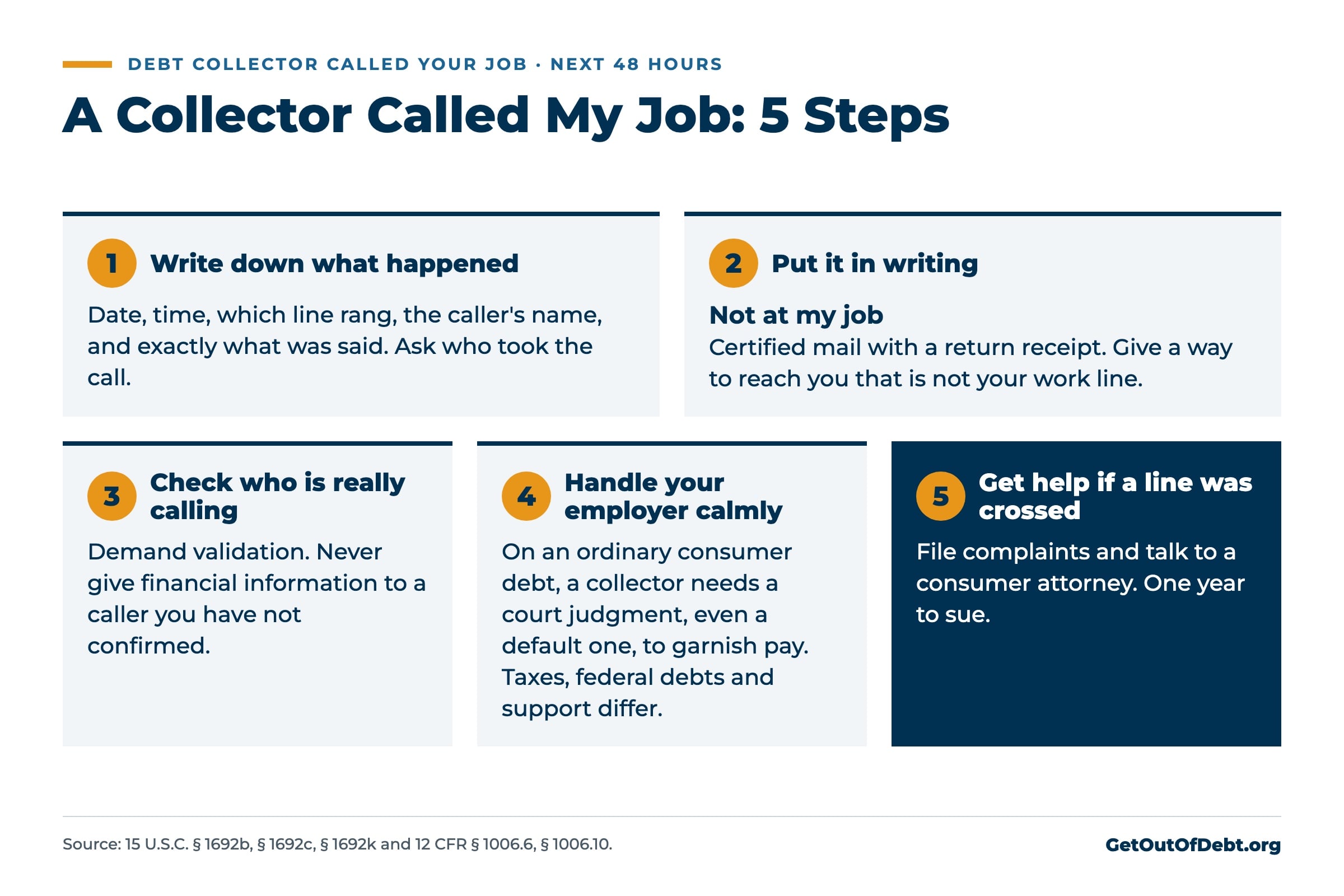
What to Do in the Next 48 Hours
- Write down exactly what happened, today. On one sheet of paper: the date and time of every call, the number it came from, which line rang (your direct line, the main line, a coworker’s), the name the caller gave, and what was said, word for word as best you can. Then ask whoever took the call what the caller said. The CFPB suggests exactly that: “you might want to talk to the person who took the call to find out what the debt collector said.” Save any voicemail, message slip, or email. If the collector told someone you owe a debt, write down who heard it. Notes made now are what turn “they can’t do that” into a claim.
- Put “not at my job” in writing, this week. Telling the collector on the phone already counts as letting it know; the letter is your proof that you did. In Massachusetts, if you already told it out loud, get the letter postmarked within seven days of that call, because an oral request there lasts only ten days without it. Mail the collector a letter by certified mail with a return receipt (keep a copy). Say that it must not contact you at your place of employment, and, if it’s true, that your employer does not allow you to receive these calls. Give it a way to reach you that isn’t your work line, such as your mailing address or personal cell. The CFPB has a sample letter for this, “I want to specify how the debt collector can contact me,” and says that if a collector is calling at an inconvenient place, “you have the right to ask the debt collector to call you at a more convenient time or place you specify.” Don’t write “I owe this” anywhere in it. Once it has the letter, it can no longer say it was never told that your employer prohibits the calls, if that is what you wrote and it is true, or that you never told it your job is an inconvenient place to reach you. If you want the stronger move, a letter telling it to stop communicating altogether, read my guide to using a cease-and-desist letter with a plan, not as a reflex first, because that letter has a price.
- Find out who is actually calling, and whether the debt is real. Is it a debt collector, the original lender, or somebody who isn’t a collector at all? If the caller is a debt collector under the FDCPA, it has to give you validation information in the first communication or within five days of it. An original creditor calling in its own name often doesn’t have to, so a missing notice is a reason to ask who they are, not automatic proof of a scam. The CFPB says that “If the debt collector doesn’t or can’t provide this information, it could be a scam.” Use my free Debt Validation Letter Generator to demand the proof, check the company in the Scam-O-Meter, and if the call threatened arrest, read what to do when a collector threatens to have you arrested. If the 30-day dispute window has already passed, here is what you still keep.
- Decide what, if anything, to tell your employer, and know what they can’t do to you. You don’t owe your boss an explanation of your finances. If nobody at work has mentioned a call, you don’t have to bring it up. If someone has, a short, calm line is enough: “A company called about a personal matter. I’m handling it. If they call again, please take a message and don’t discuss my situation with them. If anything official from a court ever arrives, please give it to me right away.” If your job comes with a duty to report financial trouble, such as a security clearance or a license from a financial regulator, check that rule before you decide what to say. Here is what protects you in the meantime. For an ordinary consumer debt, a private collector has no pay to take from you until a court says so: the FTC says “the collector must first sue you to get a court order — called a garnishment — that says it can take money from your paycheck.” And under 15 U.S.C. § 1674(a), “No employer may discharge any employee by reason of the fact that his earnings have been subjected to garnishment for any one indebtedness.” Search your county’s court records, and the county where the debt started, for any lawsuit or judgment in your name, including old ones. If court papers or a garnishment order ever reach your employer, that is not a phone call: your employer has to follow it, so don’t ask them to ignore it. And taxes, defaulted federal student loans and other debts owed to the federal government, and child support work differently and can reach your pay without a collection lawsuit (see below), so never throw away a garnishment notice because nobody sued you. For how garnishment actually works and how to stop it, see my guide to what to do when your wages are being garnished.
- If they crossed a line, or this is one of several debts you can’t carry, get help. If the collector told your employer or a coworker that you owe a debt, or kept calling your job after your letter, file complaints (links below) and talk to a NACA consumer attorney, because you have one year from the violation to sue (15 U.S.C. § 1692k(d)). If the collection pile is bigger than this one debt, for most people the bankruptcy automatic stay takes effect the moment you file. Not weeks later. The collector may keep calling until it hears about the filing, so give it notice the same day. Take the 2-minute bankruptcy quiz or find a NACBA attorney. And talk it through: schedule a free consultation with Damon Day, an independent debt coach (not an attorney) and my podcast co-host. I receive no payment for this referral.
How to Actually Stop It — Your 4 Paths
- Bankruptcy — when this call is one symptom of a pile you can’t carry. The automatic stay takes effect the moment you file. Not weeks later. Under 11 U.S.C. § 362(a) a petition operates as a stay, “applicable to all entities,” of “any act to collect, assess, or recover a claim against the debtor that arose before the commencement of the case under this title,” and § 362(k)(1) says “an individual injured by any willful violation of a stay provided by this section shall recover actual damages, including costs and attorneys’ fees, and, in appropriate circumstances, may recover punitive damages.” The stay is in effect when you file, but a collector can keep calling until it knows, so give notice the same day; a call before it had notice is not automatically a willful violation. A collector that keeps phoning your job after it has notice of a filing is a different kind of problem for itself. The stay has limits: under § 362(c)(3) and (c)(4) it can end after 30 days, unless a court extends it on a motion filed before then, if you had one earlier case dismissed within the past year, and if you had two or more it may not start on filing unless the court imposes it on a motion, so ask your attorney about that motion rather than assuming a prior dismissal makes filing useless. Under § 362(b)(2)(C) it does not stop wages being withheld for a domestic support obligation, such as child support or alimony. I’ve pulled together the research on how filers recover in my bankruptcy benefits research post, and a NACBA attorney can tell you whether it fits your numbers.
- Limit where and how they can reach you, in writing. The “specify how to contact me” letter in step 2 is the low-risk version. A written notice that you want the collector to cease communication is the stronger one: under § 1692c(c) the collector must stop communicating with you about the debt except to say it is ending its efforts or to notify you that it or the creditor may invoke, or intends to invoke, a specified remedy. It doesn’t erase the debt or stop a lawsuit, and it can shut off settlement conversations, so it deserves a plan.
- Make them follow the rules, and enforce them if they don’t. Every call, voicemail, and name you wrote down in step 1 is evidence. File complaints with the CFPB and your state attorney general. Under § 1692k, a collector that breaks the FDCPA is liable for your actual damages, up to $1,000 in additional damages in an individual case as the court may allow, and your costs plus a reasonable attorney’s fee if you win. A consumer attorney can tell you whether what happened at your job is worth a claim. If the caller is the original lender collecting in its own name, the FDCPA may not reach it, and the state rules below are the tool.
- What won’t work: panic-paying to make the calls stop, agreeing to calls at work, arguing with the collector on your employer’s phone, or ignoring everything and hoping it fades. Paying a stranger on a call before you’ve seen validation is how people pay scammers, and ignoring a real lawsuit is how a collector gets a court order. The one deadline that really bites is the response date on a summons: see what to do if you were just served, and if you disputed the debt and the collector won’t validate it but won’t stop calling, read what to do next.
What You Need to Know About Your Rights When a Collector Contacts Your Job
Once
How many times a collector may contact an employer or other third party to get location information, absent a request from that person or a reasonable belief the first answer was wrong or incomplete (15 U.S.C. § 1692b(3))
7 in 7
A collector is presumed to violate the call-frequency rule if it calls a particular person (usually you, not your boss) about a particular debt more than seven times within seven consecutive days, or calls at all within seven days after a phone conversation with that person about the debt (12 CFR § 1006.14(b)(2))
25%
The most a court-ordered garnishment can take of your disposable earnings in an ordinary consumer-debt case, or the amount above 30 times the federal minimum wage, whichever is less (15 U.S.C. § 1673(a))
1 year
The deadline to sue a collector under the FDCPA, counted from the date of the violation (§ 1692k(d))
The workplace rules sit inside a much bigger law. A collector may not engage in conduct “the natural consequence of which is to harass, oppress, or abuse any person” (15 U.S.C. § 1692d; 12 CFR § 1006.14(a)). It may not threaten wage garnishment it doesn’t intend to take or can’t lawfully take: § 1692e(4) bars “the representation or implication that nonpayment of any debt will result in the arrest or imprisonment of any person or the seizure, garnishment, attachment, or sale of any property or wages of any person unless such action is lawful and the debt collector or creditor intends to take such action,” and § 1692e(5) bars “the threat to take any action that cannot legally be taken or that is not intended to be taken” (15 U.S.C. § 1692e). Garnishment itself comes from a court order, though tax levies and federal agency garnishments work differently. The Department of Labor’s fact sheet says “Most garnishments are made by court order,” and lists IRS or state tax collection agency levies for unpaid taxes and federal agency administrative garnishments for non-tax debts owed to the federal government as other types of garnishment procedure.
| Who / Where | What the rule says about your workplace | Notes |
|---|---|---|
| Federal baseline: calls to you at work | No contact at your workplace if the collector “knows or has reason to know” your employer prohibits it | 15 U.S.C. § 1692c(a)(3); 12 CFR § 1006.6(b)(3). Applies to a “debt collector” as defined in § 1692a(6) |
| Federal baseline: contacting your employer | Location information only, once, no statement that you owe a debt | § 1692b; 12 CFR § 1006.10 |
| California (Rosenthal Act) | A collector may not communicate with your employer about your consumer debt unless necessary to collect it (verifying employment, locating you, effecting garnishment after judgment, or, for a medical debt, discovering insurance) or you or your attorney consented in writing. Such contact is generally in writing, though one communication solely to verify employment may be oral | Cal. Civ. Code § 1788.12(a); its definition of “debt collector” reaches a person collecting on its own behalf (§ 1788.2(c)) |
| Florida | No communicating or threatening to communicate with your employer before a final judgment, unless you give written permission or acknowledge the debt in writing after it was placed for collection. A collector may still tell you your employer will be contacted if a final judgment is obtained | Fla. Stat. § 559.72(4) (“a person may not”) |
| Massachusetts | No calls to your workplace after you make a written or oral request. An oral request is valid for only ten days unless you confirm it in writing within seven days | 940 CMR 7.04(1)(h); applies to a “creditor,” which 940 CMR 7.03 defines as a person, and that person’s agents, employees, or attorneys, engaged in collecting a debt owed to that person |
| Work email | No email to an address the collector knows your employer provided, with narrow exceptions | 12 CFR § 1006.22(f)(3) |
If you live in California, Florida, or Massachusetts and the call came from a collector or from the lender itself, the state rules above may give you more than the federal baseline, and in Massachusetts the oral-request clock is short, so put it in writing. I have not confirmed whether the Massachusetts rule reaches an outside collection agency collecting someone else’s debt, so ask a Massachusetts consumer attorney or the Attorney General’s office about your caller. Other states have their own collection laws too. Your state attorney general’s office can tell you which ones apply. For everything else collectors can and can’t do, see my complete guide to debt collectors and your FDCPA rights, and if the collector went after a relative instead of your employer, here is what to do when a collector calls your family.
If a collector told your employer you owe a debt, called your job after you told it to stop, or won’t stop calling, file a complaint with the CFPB, with the FTC, and with your state attorney general. A complaint creates a dated record whether or not any agency acts on it. To bring your own claim, ask a NACA consumer attorney whether they take FDCPA cases; the statute provides for costs and a reasonable attorney’s fee in a successful action (§ 1692k(a)(3)). If you need legal help but can’t afford an attorney, find free legal aid through LSC.gov.
Steve’s Take
I filed bankruptcy in 1990, so I know what it’s like when money trouble stops staying in the mailbox and starts showing up where you earn your living. A call to your job is designed to feel like an emergency, because shame moves people faster than math does. Debt is math wrapped in emotion, so take the emotion off the table: what was said, who heard it, which rule it touches, and what you do next. The law gives you real leverage here, and one written letter plus good notes is worth more than ten angry phone calls. You are not your debt, and a stranger’s phone call doesn’t change what you’re worth to your employer.
Free Tool — Wage Garnishment Calculator: Worried about your paycheck being seized? The free Wage Garnishment Calculator shows exactly how much creditors can legally take in your state — and some states prohibit garnishment entirely. Calculate My Risk →
Frequently Asked Questions
A debt collector called my job — is that legal?
It depends on what the collector said and who it called. A collector may not contact you at work if it knows or has reason to know your employer prohibits it (15 U.S.C. § 1692c(a)(3)). If it called your employer or a coworker, it may do so only to confirm or correct your location information, may not say you owe a debt, and generally may not contact the same person more than once (§ 1692b). A single short call that asks whether you work there can be legal. A call that mentions the debt is not. If the caller is the lender collecting its own account in its own name, the federal rules may not apply, but state law might.
A debt collector told my boss I owe money — what can I do?
Write down who was told, when, and exactly what was said, and ask the person who took the call for their account. The CFPB says “A debt collector may not tell your employer that you owe a debt. If the debt collector has told your employer that you owe a debt, you may want to speak to an attorney about your rights.” The prohibition in 15 U.S.C. § 1692c(b) has exceptions (your prior consent given directly to the collector, a court’s permission, or a postjudgment remedy), so tell the attorney whether you ever agreed to anything. File complaints with the CFPB and your state attorney general, and remember the one-year deadline to sue in § 1692k(d).
I told the collector to stop calling me at work and it still does — now what?
Telling it on the phone already counted as letting it know. Now put it in writing and send it by certified mail with a return receipt. The federal workplace rule turns on whether the collector “knows or has reason to know” your employer prohibits the contact, and a dated letter is the best evidence that it knows (12 CFR § 1006.6(b)(3)). Keep a log of every call after the letter arrives. Calls can also pile up into harassment: a collector is presumed to violate the call-frequency rule if it calls a particular person about a particular debt more than seven times in seven consecutive days, or at all within seven days after a phone conversation about it (12 CFR § 1006.14(b)(2)). In Massachusetts, an oral request is valid for only ten days unless you confirm it in writing within seven days (940 CMR 7.04(1)(h)).
Can a debt collector garnish my wages without suing me?
For an ordinary consumer debt, a private debt collector can’t. The FTC says the collector must first sue you to get a court order that says it can take money from your paycheck. A collector may not claim it will garnish your pay unless that action is lawful and it intends to take it (15 U.S.C. § 1692e(4)). Taxes, defaulted federal student loans and other debts owed to the federal government, and child support work differently and can reach your pay without a collection lawsuit (see the Department of Labor fact sheet), so never ignore a garnishment notice because you were not sued. If you have been sued, respond by the date on the court papers; see my guide to what to do if you were just served.
Can I be fired because a debt collector called my job or my wages were garnished?
Federal law protects you from one specific thing: 15 U.S.C. § 1674(a) says “No employer may discharge any employee by reason of the fact that his earnings have been subjected to garnishment for any one indebtedness.” The Department of Labor describes it the same way: an employer may not fire an employee whose earnings are subject to garnishment for any single debt. That language is about garnishment and one debt. It doesn’t tell me how your particular employer would treat a collector’s phone calls or garnishment on several debts, and your state may add protection, so if your job feels at risk, ask an employment or consumer attorney.
The caller to my job threatened a lawsuit or arrest — could this be a scam?
It could be. The CFPB says “If the debt collector doesn’t or can’t provide this information, it could be a scam. Never give sensitive financial information to the caller, at least not until you’ve confirmed they’re legitimate.” A collector also may not falsely imply that the debt will lead to arrest or imprisonment (15 U.S.C. § 1692e(4)). Don’t pay or give account numbers to a caller on your employer’s line, ask for validation, and check the company in the Scam-O-Meter. If you already paid someone who turned out to be fake, read what to do if you paid a fake debt collector.
I filed bankruptcy — how fast does it stop a collector from calling my job?
The automatic stay takes effect the moment you file, not weeks later. 11 U.S.C. § 362(a)(6) stays “any act to collect, assess, or recover a claim against the debtor that arose before the commencement of the case,” and a collector that willfully violates the stay can owe actual damages, costs and attorneys’ fees, and in appropriate circumstances punitive damages (§ 362(k)(1)). Give the collector notice of the filing the same day, tell your attorney about any call after that, and keep your call log. The stay has limits for people with a recent earlier case dismissed and for support withholding such as child support or alimony, so ask your attorney how they apply to you. Whether bankruptcy fits your whole situation depends on the type of debt and the type of case, so talk to a NACBA attorney.
Does my state give me extra protection when a collector contacts my employer?
Many do. California bars a collector from communicating with your employer about a consumer debt unless the communication is necessary to collection or you consented in writing (Cal. Civ. Code § 1788.12(a)). Florida bars communicating or threatening to communicate with your employer before a final judgment unless you give written permission or acknowledge the debt in writing after it was placed for collection (Fla. Stat. § 559.72(4)). Massachusetts bars workplace calls after your written or oral request, with a ten-day limit on an oral one (940 CMR 7.04(1)(h)). Other states have their own rules, and your state attorney general’s office can tell you which apply.
One more thing — everything I share here is based on 30 years of helping people through exactly this. But my advice is input for your decision, not the decision itself. Only you know your full situation. Talk to an attorney, look at your numbers, and make the choice that serves your future.
Important: This guide is for informational purposes only and is not legal advice. Laws vary by state, and your situation may have details that change what options are available to you. For legal advice specific to your case, consult an attorney licensed in your state. NACBA can help you find a bankruptcy attorney, NACA can connect you with a consumer attorney, or schedule a free consultation with Damon Day, an independent debt coach and my podcast co-host — I receive no payment for this referral.
Key Takeaway: A collector calling your job is serious but it’s not permanent, and for an ordinary consumer debt it does not mean your wages are about to disappear unless a court has already ruled against you, including a judgment you have not heard about, so search the court records. Taxes, defaulted federal student loans and other debts owed to the federal government, and support obligations can reach pay without a collection lawsuit, so never ignore a garnishment notice because nobody sued you. This week you can have the calls written down, one letter in the mail, and the caller’s identity checked. Run the debt option calculator if this is one of several debts, and talk to an attorney this week if anyone at work was told you owe money. The longer you wait to put it in writing, the harder it is to prove you told it.
The Bottom Line
You are not bad with money because a stranger rang your desk. The law set limits on exactly this: who a collector can call, what it can say, and how often. The people who come out of this better are the ones who write down what happened, put their limits in a letter, and don’t pay anybody on a recorded line while their coworkers listen. If someone you know just had a collector call their job, send them this page — it may be the thing that gets them through the day. See the full Crisis Guides hub and take the Find Your Path quiz if the call is part of a bigger pile.
Dealing With Debt? Understanding your options is the first step. See how all your debt relief options compare — including ones most sites won’t tell you about. The Find Your Path quiz gives a recommendation based on your actual numbers, and the Scam-O-Meter checks any company’s complaint history before you sign. CFPB and academic research shows bankruptcy filers recover faster than those who don’t file.
Right now you are dealing with the thing in front of you, and that is exactly where your attention belongs. When it is handled — and it will be — there is a next stage, and it is the one I most enjoy writing about.
In the latest issue (Nov 12): A 10% cap on your credit card rate? Here's what's real.
Each weekday I send one short email: one story that caught my attention, why it might matter to you, and one manageable thing you can do with it. It is free, I sell nothing, and I take no money from any company I write about.



