

Quick Answer: Damon Day — my podcast co-host and an independent debt coach — filmed a night of Instacart, DoorDash, Uber Eats and Walmart Spark driving in which, by his account, an Instacart order showed $73 on his screen and the completed batch then showed $10.67. He had no screenshot, Instacart support told him it could only see the finished batch, and the video never settles what happened. The dollar figures in it are one driver’s numbers on one night in one market, not typical pay and not a promise. The lesson is the arithmetic: the number on an offer screen is not the number you keep, and a night that goes badly is exactly when it is most tempting to stop doing the math.
Debt is math wrapped in emotion, and a gig offer is the same thing in a smaller package. The number on the screen is never the number you keep, and a bad hour is when you are most likely to stop checking.
I co-created The Penny Stupid Project with Damon in 2022 as a public experiment in side hustles, and Damon runs it now. It lives on YouTube as @pennystupid, and the gig-work videos are the ones where he does the driving. I tell you I helped start it every time I feature a video, because you deserve to know where I stand before you weigh my opinion. Damon also runs his own debt-coaching practice at damonday.com, the first link in the channel’s own description. He is also my podcast co-host, and I receive no payment for featuring his videos or for recommending him.
His newest long video, posted October 18, 2026, is titled This $73 Instacart Order Nearly Made Me Quit. It runs a little under 24 minutes. Its description says he rides along through Instacart, DoorDash, Uber Eats and Walmart Spark while he decides whether to call it a night or keep going.
Each weekday I send one short email: one story that caught my attention, why it might matter to you, and one manageable thing you can do with it. A couple of minutes, and a dad joke.
In the latest issue (Nov 6): Owed money on an Amazon return? Check by Dec. 1
Free. I sell nothing. Unsubscribe any time.
The Order That Looked Like the Best of His Night
The night starts with a Walmart Spark offer of $20 for a pharmacy pickup plus a seven-item shop, with a delivery of about two miles, back in his own neighborhood. He figures it is a good way to get started and that he can finish it in under half an hour. Then a $73 Instacart order for four items appears. He says it was one bag of energy drinks, cheese and gum, he accepts it, and he cancels the $20 Walmart order because he does not want to juggle the two.
He is about 31 minutes into the night and a minute from the drop-off when he says out loud that this may be the best order he has ever had on any app. Then he delivers it and looks at his screen. By his account, it reads $5.27 in batch earnings and a $5.40 tip: $10.67 for the whole thing. He says he is certain he did not misread the offer, and that he was about 45 minutes into the night with roughly ten dollars to show for it.
Here is the part I want you to hold onto, because it is where most people get it wrong in the other direction. I don’t know what happened to that order, and neither does anyone from the video alone. Damon had no screenshot, because he did not want to stop and risk losing a big order. He called Instacart support, which told him it could only see the completed batch, and that batch was $10.67. He considered whether the customer had cut the tip afterward. He reasoned that was unlikely because the lower number was there the moment he sat back in the car and nothing was shown crossed out. I am not claiming Instacart or anybody else did anything wrong, and I am not saying he misread it. I am saying the video leaves the question open, and that is itself the lesson.
The offer he says he saw on screen, for four items
What the completed batch showed: $5.27 in earnings plus a $5.40 tip
The Walmart order he cancelled to take it, which he figured at under 30 minutes of work
These are one driver’s numbers for one order, taken from the video and its auto-captions. They are not typical pay, an average, or a projection. Check them against the video before you rely on any of them.
The Arithmetic That Comes Out First
The IRS’s own standard business mileage rate is 76 cents a mile for July 1 through December 31, 2026. It is the number the IRS uses as a stand-in for what gas, tires, maintenance, insurance and depreciation cost per mile. It is not a measurement of anyone’s actual costs, but it is a fair yardstick for a driver who has not tracked their own.
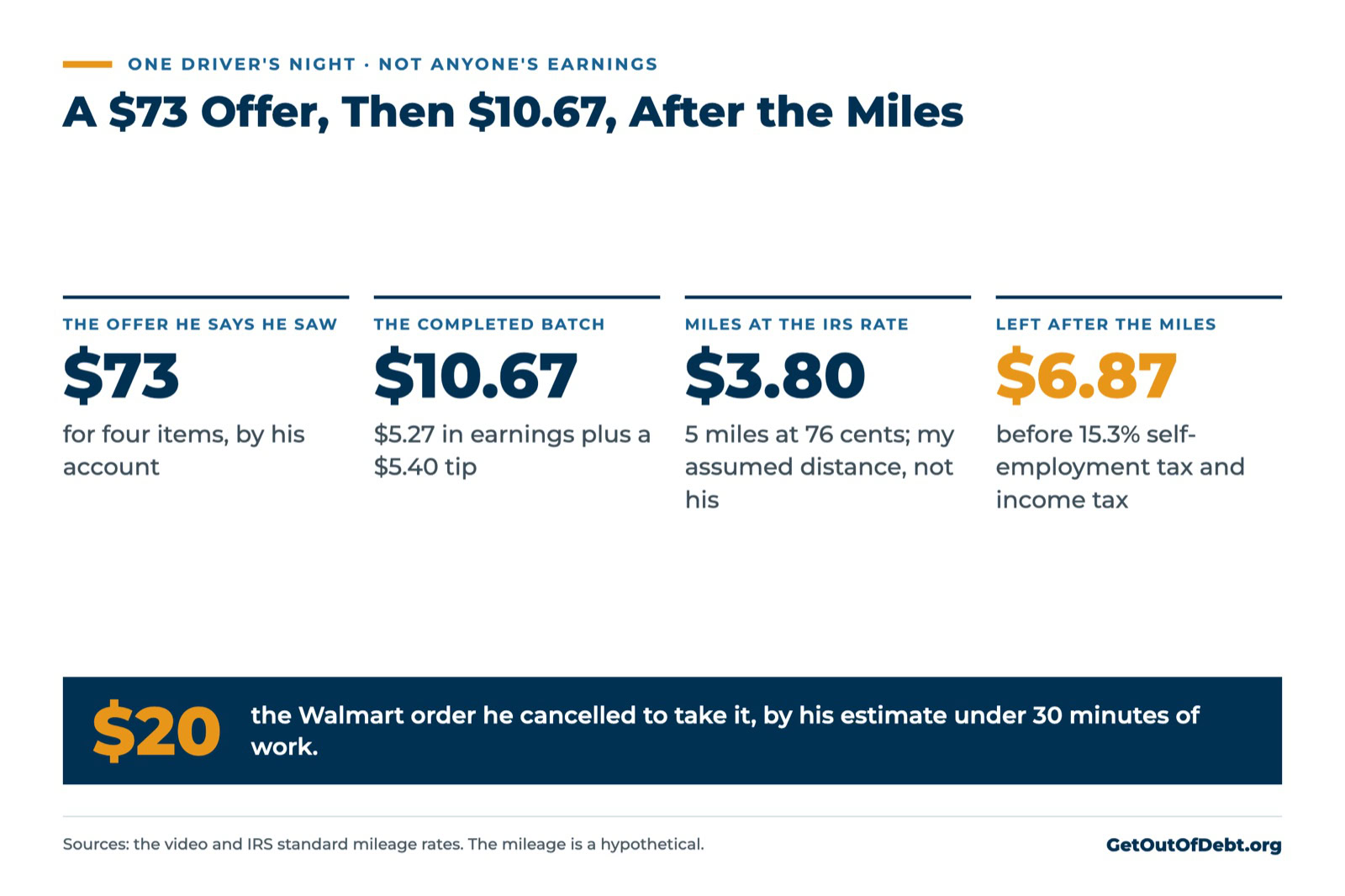
The $10.67 Order, Subtracted One Step at a Time
The payout he reads out. $10.67 for the order: $5.27 in batch earnings plus a $5.40 tip.
Take out the miles. I don’t know his exact route, so I’m assuming about 5 miles driven for this order, counting the pickup and the delivery of roughly two miles. That 5 is my number, not his. At 76 cents a mile that is $3.80, which leaves $6.87. It does not count the drive home afterward.
Take out self-employment tax. The IRS says the self-employment tax rate is 15.3% and applies once your net self-employment earnings reach $400 for the year. Taking the full 15.3% off $6.87 is about $1.05, which leaves roughly $5.82. This is a simplified illustration, and I’m not a tax professional.
What is left. Roughly $5.82, before federal and state income tax, for about 45 minutes of his night. It is also before the phone, the data plan, the delivery bags and anything else that isn’t in the mileage rate. I’m deliberately not turning that into an hourly rate, and neither should you.
Now put the cancelled order beside it. The $20 Walmart order he dropped to take the Instacart order, by his own estimate, was under half an hour of easy work for a short delivery. I can’t prove it would have beaten $10.67, but the comparison shows where the real cost sat: he gave up a sure thing for one he had not yet confirmed.
If you want to see how this looks on a beginner’s first try, Damon’s first Instacart shop math grossed about $25 over roughly three hours, by the video’s own description.
What He Did Next Is the Part Worth Copying
After the order, he sits in a parking lot annoyed, and he tells you he knows the right move is to close every app and go home. Then he does something I respect. Instead of taking whatever comes up to feel better, he turns down a run of poor offers. By his account, one Uber offer was $6 for 8 miles, one DoorDash offer was $15 for 15 miles, and another was $13 for 19 miles. He says, in effect, that being kicked in the stomach by one order does not make him desperate.
That is the honest version of a rule I give people in debt: desperation is expensive. The worst time to set a minimum is when you are down. A floor you choose while you are calm beats one you invent while you are tired in a parking lot.
The video then walks through the rest of the night as a string of small decisions, and a few of them are worth turning into questions for your own shifts:
- Two orders from the same parking lot. A DoorDash double, a Chipotle order and a Mod Pizza order going to the same customer, was offered at $16.50 for a delivery of about 1.7 miles. It looked good until the food was not ready: he says he had already waited about five minutes at the first restaurant, and the second wasn’t ready either. Waiting is unpaid time, and the offer screen never shows it.
- A gate with no code. That double delivery needed a gate code that wasn’t in the order, and he says that was the point where he decided it was not his night. Then he discovered he had accepted an Uber order of about $9 without realizing it, because he had assumed a request he made hadn’t gone through, so he had to go do it. The takeaway for you is to look at what is actually on your screen.
- A long shop for a slow night. A Walmart shop of 30 items for $39, with a delivery of 8 miles, which he points out is 16 miles with the drive back. He took it on a slow night, and a slow night is the reason he gives.
- Shopping pays more than just driving, when you check. He compares a curbside pickup of seven items at $19 for a six-mile trip with an exclusive offer of $39 for a 22-item shop over almost the same distance. The same miles, about $20 more for doing the shopping. He knew he could knock out the shop in roughly 20 to 25 minutes, so he took it. Pay per mile is one number. Pay per minute of your actual effort is the other.
- A two-item order that grew. A $28 shop of two items turned into four items for about a dollar more. Items added mid-order are time you did not agree to, and he was racing a clock he had set for himself.
He ends the night at about $167 in roughly four and a half hours, up from about $27 at the two-hour mark, and he credits Walmart Spark for turning the night around. I’m not dividing that into an hourly number, because it is a gross figure before miles, wear and taxes, and because a night that rescues itself is not a plan. A gross figure is where the arithmetic starts. It isn’t where it ends.
My Checklist Before Accepting an Offer
This is my checklist, not Damon’s, and I’d run it any time a number on a screen seems too good:
- Capture the offer before you accept. A screenshot or a quick screen recording takes a few seconds and is the only evidence you will have if the number changes. Damon’s no-screenshot choice is exactly why the video can’t answer its own question.
- Don’t cancel a sure order for one you haven’t finished confirming. A smaller order in hand and a bigger one on a screen are not the same thing until the bigger one is done.
- Price the loop. Add the drive to the pickup, the delivery, the wait, and the drive back to where you would have been anyway.
- Set your floor before you open the app. Set it from your own bills and your own miles, not from someone else’s best night.
- Subtract the taxes as you go. Nobody withholds anything for you. Set money aside as you earn it.
No sense wasting a perfectly good mistake. Damon accepted an order he could not prove, and the lesson is yours for free.
What I Take From It If You’re Behind on Bills
I hear some version of this all the time: should I pick up delivery work to catch up on my debt? My answer is the same one I give about every option on this site: it depends on your numbers, and most people never run them. Gig work can be fast cash when you need money now and don’t have savings, and that speed is real. If you are closing a short gap, it can help. If the Instacart settlement headline made you wonder about shopper pay, that $5 million settlement is about job applicants, not shoppers.
Before you count it as ongoing income, especially income you are relying on to get out of debt, track what you actually keep over a full week, not on the best order you saw one evening. Count your miles, count your minutes, and set money aside for self-employment tax. If the math says delivery work won’t get you where you need to go, that is useful information and not a failure on your part. Sometimes the faster, cleaner answer is a different tool entirely, like a hard look at whether bankruptcy fits. You are not your debt, and you don’t have to drive your way out of it if the numbers say otherwise. Here is another night where the offer screen and the real work told different stories: Damon’s worst earning night in a long time, with a 21-bag grocery pickup and a canceled pizza order.
Cleaned Auto-Transcript, Condensed
This is a cleaned and condensed rendering of YouTube’s auto-generated captions, using the video’s own chapter list for the timestamps and corrected names. It is not a record of his exact words. Auto-captions get names and numbers wrong, which is why none of it is in quotation marks. Watch the video above for what he actually says.
0:00 – $73 for four items. He opens on the surprise: the best order he had ever accepted, by his own description, followed almost at once by the worst one he took.
0:15 – Starting the shift. He turns his apps on at about five in the evening and sees a $20 Walmart pharmacy pickup with a seven-item shop and a delivery of about two miles. He plans to stay out four or five hours.
1:23 – The Instacart offer. A $73 Instacart order for four items comes in. He accepts it and drops the Walmart order.
3:18 – After the delivery. He reads $5.27 in batch earnings and a $5.40 tip, $10.67 in all, about 45 minutes after he left. He says he has no screenshot of the original number.
4:50 – Asking support. He contacts Instacart support, which says it can only see the completed batch, at $10.67. He talks through whether a customer could have changed the tip and concludes he doesn’t think so, but he can’t prove either way.
6:30 – Trying DoorDash. Sitting in a parking lot, he rejects a run of offers that pay little for many miles, then takes a DoorDash double from two restaurants in the same lot, headed to the same customer. Neither order is ready on time.
8:37 – An unexpected Uber order. He discovers he accepted an Uber order for about $9 without realizing it, and goes to deliver it.
9:27 – Walmart changes the night. Walmart Spark starts sending him better offers, including a $39 shop with a long delivery, and he takes them.
11:51 – Grocery-store jokes. While he shops, he riffs on the list and the aisles. It’s a lighter stretch of the video and doesn’t change the math.
13:01 – The no-tip pickup. A short curbside pickup boosts to $15. He almost passes on principle because the customer left no tip, then takes it because a short, easy job is not worth punishing himself over.
14:05 – Comparing the next offers. He compares a $19 curbside pickup with a $39 offer to shop 22 items over about the same distance, and picks the shop.
16:57 – One last shop. He takes a $28 two-item shop, which grows to four items, while trying to fit in a final order before the shopping window closes for the night.
20:26 – Take the win? No more orders appear. He decides to head home and call it a win.
21:57 – The night’s totals. He adds up about $167 for roughly four and a half hours, gross, helped slightly by a customer who raised the tip on that earlier Uber order, and credits Walmart Spark for turning it around. I’m not repeating an hourly number, for the reasons above.
More From the Side Hustle Archive
I’ve been writing about this project since it started in 2022. A few pieces that pair well with this video:
- Damon Day and I Talk Gig Work: The Math to Run Before You Download an App — the conversation about the questions to ask before you start
- Damon Day’s 27-Item Instacart Shop Took 45 Minutes. Here’s the Math. — another order priced against its minutes and miles
- Quick Cash for Bills: Myth vs Reality — the honest version of the I-need-money-fast question
- Side Hustles: When They Help and When They Hurt — the honest boundaries of what a side hustle can fix
- Side Hustle Success: What It Means and What to Do — the mindset piece behind the math
- Making More Money From Home With Online Arbitrage and Amazon — my own side of the original 2022 experiment
- Damon Day Asked for an Order Going His Way and DoorDash Delivered. Here’s the Math. — the next video, where the order he asked for still cost him a shop and a detour
- Damon Day Passed on a $41 Walmart Spark Order for a $28 One. Here’s the Per-Mile Math. — a later video, where the bigger payout lost to the smaller one once the miles were counted
- Damon Day Tried a 10-Stop Walmart Spark Delivery. Here’s the Math After Miles and Tips. — a later video, where bundled tips and incentives did most of the work once the miles were counted
Key Takeaway
By Damon Day’s account, a $73 offer became a $10.67 payout, and the video can’t say why, because he had no screenshot. The useful part isn’t the payout; it is the habit. Capture the offer before you accept, don’t cancel a sure order for an unconfirmed one, set your floor before you are tired, and take out the miles and the self-employment tax before you decide how the night went. The figures here are one driver’s results on one night, not a promise and not a plan.
This is what I’m telling friends like you over coffee. But remember, you do you. Take it as input and make the call that fits your own life.
If someone you know is counting on delivery work to catch up on their bills, send them this before they treat an offer on a screen as real money. Share this with a friend who has ever cancelled a sure thing for a better-looking one, because a screenshot takes three seconds and arguing with support without one takes much longer.
Common Questions
Who is Damon Day, and what is The Penny Stupid Project?
Damon Day is my podcast co-host and an independent debt coach, and his own site is damonday.com, listed first in the channel’s description. The Penny Stupid Project is a public side-hustle experiment I co-created with Damon in 2022, and Damon runs it now. It lives on YouTube as The Penny Stupid Project, and I tell you I helped start it every time I feature a video so you know where I stand. You can read why I recommend Damon in Why Do You Recommend Damon Day as a Debt Advisor? I receive no payment for featuring his videos or for recommending him.
Why did a $73 Instacart offer pay $10.67 in this video?
The video doesn’t establish why. By Damon Day’s account, he saw $73 for four items, and the completed batch showed $5.27 in earnings and a $5.40 tip. He had no screenshot, and Instacart support told him it could only see the finished batch. I’m not claiming anyone did anything wrong. If an offer matters to you, capture it before you accept it.
How do I tell if a gig offer is worth taking?
Price the whole loop, including the wait and the drive back. Take out the miles, using the IRS standard mileage rate of 76 cents a mile for July 1 through December 31, 2026, as a yardstick. Then take out self-employment tax, which the IRS puts at 15.3%, and ask what else you could have done with the time. The IRS rate is a stand-in, not your actual costs.
Are the dollar figures in the video typical gig pay?
No. They are one driver’s numbers on one night in one market. Pay varies by city, hour, app and the orders that happen to appear. Don’t treat any figure as an average or a guarantee for you.
Can delivery work help me get out of debt?
It can help close a short-term gap, and some people use it that way. Whether it can take you all the way out depends on what you keep after miles, wear, time and taxes compared with what you owe. If the math says it won’t, other options exist, and I lay all of them out in the debt options comparison, including bankruptcy, which I rate highest across credit, collections, speed and retirement.
Dealing With Debt? Understanding your options is the first step. See how all your debt relief options compare — including ones most sites won’t tell you about. The Find Your Path quiz gives a recommendation based on your actual numbers, and the Scam-O-Meter checks any company’s complaint history before you sign. Federal Reserve Bank of New York research shows bankruptcy filers recover faster than those who don’t file.



