

Quick Answer: Damon Day — my podcast co-host and an independent debt coach — filmed a Sunday night of Walmart Spark and DoorDash driving in which, by his account, he asked the app for a $9 order going his way, a $20 DoorDash order for Taco Bell and a seven-item Safeway shop popped up, and it then turned out to cost him a trip through the store aisles. He logged $72.87 gross in two hours and nine minutes and 38.3 miles, and stopped short of the $100 he wanted. That is one driver, one night, one market: not typical pay and not a promise. The useful part is the arithmetic, because miles and taxes come out of that number before it is yours.
Debt is math wrapped in emotion, and a gig offer is the same thing in a smaller package. The number on the screen is never the number you keep, and a slow night is when you are most tempted to say yes to anything.
I co-created The Penny Stupid Project with Damon in 2022 as a public experiment in side hustles, and Damon and I still run it together. The channel is @pennystupid, and the gig-work videos are the ones where Damon does the driving. I tell you I helped start it every time I feature a video, because you deserve to know where I stand before you weigh my opinion. Damon also runs his own debt-coaching practice at damonday.com, the first link in the channel’s own description. He is also my podcast co-host, and I receive no payment for featuring his videos or for recommending him.
His newest long video, posted October 20, 2026, is titled I Said Right Now… and DoorDash Delivered. It runs a little under 18 minutes. Its description says he asked for an order going his way, got one, and then the Taco Bell and Safeway bundle got more complicated than he expected. It also says making extra money means knowing which orders to skip, which is the thread I want to pull.
Each weekday I send one short email: one story that caught my attention, why it might matter to you, and one manageable thing you can do with it. A couple of minutes, and a dad joke.
In the latest issue (Nov 11): I let AI shop my insurance. I saved $2,000.
Free. I sell nothing. Unsubscribe any time.
A Slow Sunday Night, and a Goal of $100
By his account, Damon had not driven much that week and wanted to go out, make about $100 quickly, and go back home. He starts with a $20 Walmart Spark curbside pickup, two stops, about 7 miles. He says up front that he would not normally leave the house for $20. His reason for taking it is practical: he tends to get more offers when he is out moving than when he is sitting at home, and the $20 would fill the time while two other offers sat unboosted.
Those two other offers were exclusive to him, and he explains that he would only consider them if the boost went up to about $8. Exclusive offers do not reach the general board for a while, so he figured they might still be there in 45 minutes. The $20 was something to do in the meantime.
While that first order is running, he scrolls past a string of DoorDash and Uber Eats offers and turns them down. By his count, one sandwich order wanted 5 miles for about $5, and another paid $12.35 for 12 miles, which he figured was about 20 miles of driving once he counted the empty miles back. He does not take borderline DoorDash or Uber Eats offers while a bigger Walmart order might be waiting. The first order ends at $20.17, about 28 minutes after he started.
The night then goes the way a lot of slow nights go. A second Walmart curbside order pays $31.85, but it is 12 miles out and about 8 miles back. At that point the two exclusive offers he had been watching are gone, and he is told someone at Walmart released a large order right after he left. By his count he is about an hour in with around $52, and he decides out loud that the night is going to be a bust.
Gross for the night, by his count: $52.02 from Walmart Spark plus $20.85 from DoorDash
The goal he started with; he went home about $27 short
Miles he reads off at the end, over 2 hours and 9 minutes
These are one driver’s numbers for one night, taken from the video and its auto-captions. They are not typical pay, an average, or a projection. Check them against the video before you rely on any of them.
The Order He Asked For
Around the one hour and twenty minute mark, with a long drive ahead and no restaurants on the road he is about to take, he wishes aloud for a roughly $9 order going his direction, something that would put him back on pace. Then a DoorDash bundle appears: Taco Bell plus a seven-item Safeway shop, $20, headed exactly the way he is already going. He takes it and jokes that it is a sign from the gig gods.
Here is the part I want you to hold onto, because it is the lesson inside the good news. An order going your way can still cost more than it shows. By his account, three things were not on the offer screen:
- It was a shop, not a pickup. He had assumed the Safeway part would be a retail pickup, the kind where the bags are waiting. It was an actual shop, with him in the aisles finding seven items.
- The food rode along while he shopped. The app had him collect the Taco Bell first, so someone’s food sat in his car through the whole shop. The shop delivery was also on the way to the Taco Bell drop, so he had to drop the groceries before he could take the food to its customer. His takeaway is that the pickup should come after the shop, not before.
- Substitutions eat minutes. One item the customer wanted was out of stock. A pre-approved substitute would not scan, and he had to pick a different loaf of the same brand before the app accepted it. By his account he was in the store about 12 to 14 minutes when he had been planning on about five.
He also takes a short stretch of dirt road, about a quarter mile each way, a half mile of deviation in total, and winces for the car. Even so, he makes a fair point about stacking: the road for this order is the same road he was already driving to the Walmart delivery. Two orders on one road is how pay per mile climbs. I would add that it is also how you can get the pay per minute to disappoint you, because the stacking does nothing about the time in the aisles.
The Arithmetic That Comes Out First
The IRS’s own standard business mileage rate is 76 cents a mile for July 1 through December 31, 2026. It is the number the IRS uses as a stand-in for what gas, tires, maintenance, insurance and depreciation cost per mile. It is not a measurement of anyone’s actual costs, but it is a fair yardstick for a driver who has not tracked their own.
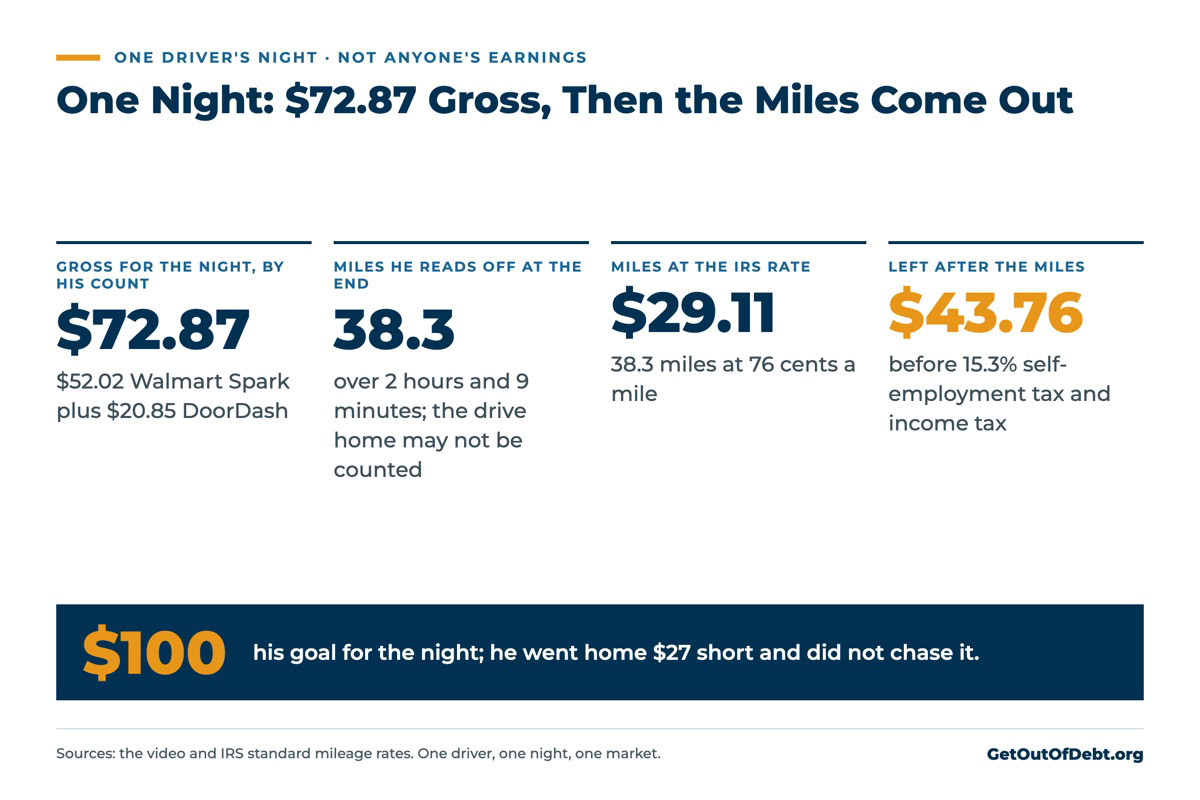
The $72.87 Night, Subtracted One Step at a Time
The gross he reads out. $72.87 for the night: $52.02 from two Walmart Spark orders plus $20.85 from the one DoorDash delivery.
Take out the miles. He reads 38.3 miles at the end of the night. I don’t know whether that counts the drive home, so treat it as a floor. At 76 cents a mile, 38.3 miles is $29.11, which leaves $43.76.
Take out self-employment tax. The IRS says the self-employment tax rate is 15.3% and applies once your net self-employment earnings reach $400 for the year. Taking the full 15.3% off $43.76 is about $6.70, which leaves roughly $37.06. This is a simplified illustration, and I’m not a tax professional.
What is left. Roughly $37, before federal and state income tax, for a little over two hours of his Sunday evening. It is also before the phone, the data plan, the insulated bags and anything else that isn’t in the mileage rate. I’m deliberately not turning that into an hourly rate, and neither should you.
The takeaway is not that he had a bad night. He says himself it was not the best night and not the worst. The takeaway is that the headline number he was chasing, $100, was a gross target, and the money that is actually his comes after the miles and the tax set-aside.
What He Did Next Is the Part Worth Copying
The last stretch is a decision, not an order. With about an hour left of the time he had set aside, he is offered a DoorDash order paying $17.95 for 11 miles, with a 12-item shop. He turns it down. He works out that the shop would take him 20 to 30 minutes, the delivery would be at least 5 miles, and he would have to come all the way back. By his count that is close to an hour for $17.95, and he says it is not in the ballpark.
Then he points the app at home, because home is on the way to Walmart and he is not going to sit and wait on a Sunday night. His store turns red in the Walmart app, which he reads as a sign that an order may be coming, but nothing appears. He says that if an order did pop up when he got home it would have to be a big one for him to go back out, because he has things to do before bed. He shuts the app off at 2 hours and 9 minutes.
That is the honest version of a rule I give people in debt: decide where you stop before the night decides for you. A stopping point you chose while you were calm, with your own bills and miles in mind, beats one you invent at 9 p.m. while you are tired and a red icon is blinking at you. The question the description ends on, would you have taken one more order, only has a good answer if you set it in advance.
- The offers he skipped. Orders that paid about a dollar a mile or less, especially in an area where the way back is empty, were turned down on principle. Skipping is part of the job.
- The order he did take. It went his way and came in right when he wanted it, and it still hid a shop, a substitution and a detour. A good-looking offer is a question, not an answer.
- The order of the stops. The offer screen did not show that the food would sit in the car through the shop. Read the stop order before you accept.
- The finish line. He went home $27 short of his goal and did not chase it. I respect that, whatever you think of the night.
My Checklist Before Accepting an Offer
This is my checklist, not Damon’s, and I’d run it any time a number on a screen seems too good:
- Find out if it is a shop or a pickup. A shop means time in the store, substitutions and scanning, none of which the offer price shows.
- Read the stop order. Food in your car while you shop for someone else is a clock you did not agree to.
- Price the loop. Add the drive to the pickup, the delivery, the wait, and the drive back to where you would have been anyway.
- Set your stopping point before you open the app. Set it from your own bills and your own miles, not from someone else’s best night.
- Subtract the taxes as you go. Nobody withholds anything for you. Set money aside as you earn it.
No sense wasting a perfectly good mistake. Damon accepted an order that came in on cue and cost him a detour, and the lesson is yours for free.
What I Take From It If You’re Behind on Bills
I hear some version of this all the time: should I pick up delivery work to catch up on my debt? My answer is the same one I give about every option on this site: it depends on your numbers, and most people never run them. Gig work can be fast cash when you need money now and don’t have savings, and that speed is real. If you are closing a short gap, it can help.
Before you count it as ongoing income, especially income you are relying on to get out of debt, track what you actually keep over a full week, not on the best order you saw one evening. Count your miles, count your minutes, and set money aside for self-employment tax. If the math says delivery work won’t get you where you need to go, that is useful information and not a failure on your part. Sometimes the faster, cleaner answer is a different tool entirely, like a hard look at whether bankruptcy fits. You are not your debt, and you don’t have to drive your way out of it if the numbers say otherwise.
Cleaned Auto-Transcript, Condensed
This is a cleaned and condensed rendering of YouTube’s auto-generated captions, with names corrected and timestamps taken from the caption timing, so they are approximate. It is not a record of his exact words. Auto-captions get names and numbers wrong, which is why none of it is in quotation marks. Watch the video above for what he actually says.
0:00 – The wish for an order. The video opens on the moment he wishes for a roughly $9 order that goes his way, then cuts back to the start of the night.
0:30 – Why he went out. It is Sunday evening, he has barely driven this week, and he wants to make about $100 and go home. He takes a $20 Walmart curbside pickup with two stops and about 7 miles, even though he would not normally leave the house for $20.
1:32 – The reasoning. He explains that two other offers exclusive to him are not worth taking at their current price, and that it could take a while before they reach the general board. The $20 order fills the time and keeps him moving.
3:01 – Skipping DoorDash and Uber Eats. While the first order is underway he declines low-paying, long-distance offers, including one that works out to roughly 20 miles for about $12 once the empty return miles are counted.
4:00 – First order done. $20.17 after about 28 minutes. He picks up a second Walmart order on the way.
5:01 – Second Walmart order. A curbside delivery of about $32 that is 12 miles out and roughly 8 miles back. The two exclusive offers he had been watching are gone, and someone at the store tells him a big order was released right after he left.
6:30 – Calling the night. About an hour and four minutes in, with roughly $50, he decides the night will be a bust and works through how long the drop-off and return will take.
7:34 – The wish. He asks for a roughly $9 DoorDash order going east, the direction he is headed, and says it needs to show up right now.
8:30 – The order arrives. A $20 DoorDash bundle of Taco Bell plus a seven-item Safeway shop appears, headed exactly his way. He takes it and calls it a sign.
9:30 – Taco Bell first. He is not sure why the app sends him to Taco Bell before Safeway, and it turns out the Safeway part is a real shop and not a pickup.
10:30 – The shop. A customer-approved bread substitute is out, a second option will not scan, and he finally gets a same-brand substitute accepted. He is in the store about 12 to 14 minutes.
11:30 – The stop order. The shop delivery is on the way to the Taco Bell drop, so he drops the groceries first while the food sits in his car. He takes a short dirt-road detour, about half a mile in total.
12:30 – Stacking. He argues that stacking orders on one road is how pay per mile goes up, even when the shop takes longer than it should.
13:32 – Back on the clock. About two hours in, with roughly $71, he says DoorDash came in clutch and that he needs about $30 more to reach $100.
14:03 – The offer he turns down. A $17.95 order for 11 miles with a 12-item shop gets a no, because he figures it would take close to an hour.
15:00 – Heading home. He sets his destination to home, which is on the way to Walmart. The store icon turns red but no order appears, and he says he is done once he is home.
16:31 – The night’s totals. He ends at 2 hours and 9 minutes and 38.3 miles, with $20.85 from DoorDash and $52.02 from two Walmart orders, $72.87 in all, and calls it not the worst night ever. I am not repeating an hourly number, for the reasons above.
More From the Side Hustle Archive
I’ve been writing about this project since it started in 2022. A few pieces that pair well with this video:
- Damon Day Saw $73 on an Instacart Order, Then Got $10.67. Here’s the Math. — another offer screen that did not match the payout
- Damon Day and I Talk Gig Work: The Math to Run Before You Download an App — the conversation about the questions to ask before you start
- Damon Day’s 27-Item Instacart Shop Took 45 Minutes. Here’s the Math. — another shop priced against its minutes and miles
- Quick Cash for Bills: Myth vs Reality — the honest version of the I-need-money-fast question
- Side Hustles: When They Help and When They Hurt — the honest boundaries of what a side hustle can fix
- Side Hustle Success: What It Means and What to Do — the mindset piece behind the math
- Making More Money From Home With Online Arbitrage and Amazon — my own side of the original 2022 experiment
Key Takeaway
By Damon Day’s account, an order that came in just as he wished for it still cost him a shop, a substitution and a detour, and he logged $72.87 gross on 38.3 miles before stopping short of his $100 goal. The useful part is the habit. Find out whether an offer is a shop or a pickup, read the stop order, set your stopping point before you are tired, and take out the miles and the self-employment tax before you decide how the night went. The figures here are one driver’s results on one night, not a promise and not a plan.
This is what I’m telling friends like you over coffee. But remember, you do you. Take it as input and make the call that fits your own life.
If someone you know is counting on delivery work to catch up on their bills, send them this before they treat an offer on a screen as real money. Share this with a friend who has ever taken one more order because it came in on cue, because the shop in the middle of it is where the evening quietly got longer.
Common Questions
Who is Damon Day, and what is The Penny Stupid Project?
Damon Day is my podcast co-host and an independent debt coach, and his own site is damonday.com, listed first in the channel’s description. The Penny Stupid Project is a public side-hustle experiment I co-created with Damon in 2022, and Damon and I still run it together. It lives on YouTube as The Penny Stupid Project, and I tell you I helped start it every time I feature a video so you know where I stand. You can read why I recommend Damon in Why Do You Recommend Damon Day as a Debt Advisor? I receive no payment for featuring his videos or for recommending him.
How much did Damon Day make in this video, and is it typical?
By his count he made $72.87 gross in 2 hours and 9 minutes and 38.3 miles: $52.02 from two Walmart Spark orders and $20.85 from one DoorDash delivery. It is not typical. It is what one driver logged on one Sunday night in one market. Pay varies by city, hour, app and the offers that happen to appear, so don’t treat it as an average or a guarantee for yourself.
What did the DoorDash order cost him that the offer screen did not show?
By his account, the Taco Bell and Safeway offer paid $20 and went the way he was already driving, but the Safeway part was a seven-item shop and not a pickup. He spent roughly 12 to 14 minutes in the store, including a substitution that would not scan, and the Taco Bell food rode in his car through the shop and the other delivery. The offer screen shows the pay and the miles, not the minutes in the aisles.
How do I tell if a gig offer is worth taking?
Price the whole loop, including the wait and the drive back. Take out the miles, using the IRS standard mileage rate of 76 cents a mile for July 1 through December 31, 2026, as a yardstick. Then take out self-employment tax, which the IRS puts at 15.3%, and ask what else you could have done with the time. The IRS rate is a stand-in, not your actual costs.
Can delivery work help me get out of debt?
It can help close a short-term gap, and some people use it that way. Whether it can take you all the way out depends on what you keep after miles, wear, time and taxes compared with what you owe. If the math says it won’t, other options exist, and I lay all of them out in the debt options comparison, including bankruptcy, which I rate highest across credit, collections, speed and retirement.
Dealing With Debt? Understanding your options is the first step. See how all your debt relief options compare — including ones most sites won’t tell you about. The Find Your Path quiz gives a recommendation based on your actual numbers, and the Scam-O-Meter checks any company’s complaint history before you sign. Federal Reserve Bank of New York research shows bankruptcy filers recover faster than those who don’t file.



