

Fact-checked by Steve Rhode, consumer debt expert since 1994 • Last reviewed October 20, 2026 • Every claim below links to a primary source.
Each weekday I send one short email: one story that caught my attention, why it might matter to you, and one manageable thing you can do with it. A couple of minutes, and a dad joke.
In the latest issue (Nov 10): Prices rose again. What's your own number?
Free. I sell nothing. Unsubscribe any time.
The verdict: Partly true. The IRS generally has 10 years from the date a tax is assessed to collect it — but “just wait it out” fails for most people, because the IRS can file a lien and apply refunds while the clock runs, and it can levy unless a legal bar applies (for example, a pending offer or payment-plan request, a plan in effect, a timely hearing, or a bankruptcy stay), a year you never filed may not have started a clock, and the things people usually do to deal with the debt (a payment plan request, an offer, a hearing, bankruptcy) pause it, as does living abroad for 6 months or more. The IRS’s own explanation and 26 U.S.C. §6502 confirm it.
Well, Actually…
You get the notice, the number is bigger than anything you can pay this year, and somebody tells you the IRS only has 10 years to collect. So lie low, don’t call, and one day the debt simply ages out. It’s a belief I keep seeing, and I understand why it’s attractive: it’s the only plan that costs nothing today and sounds like it has the law behind it. Part of it does.
The part that’s real: 26 U.S.C. §6502(a)(1) lets the IRS collect an assessed tax by levy or by a court proceeding only if it acts within 10 years after the assessment (with narrow exceptions for written agreements). The IRS calls that deadline the Collection Statute Expiration Date, or CSED, and its manual says that “The collection statute expiration ends the government’s right to pursue collection of a liability” (IRM 5.1.19.1.1). Two words in that rule do most of the work, and people skip both.
The first is assessed. The IRS says it “generally has 10 years – from the date your tax was assessed – to collect the tax and any associated penalties and interest from you” (IRS, Time IRS can collect tax). So the clock runs from the assessment, not from the tax year or the day the return was due. The second is each. The IRS says your account can include multiple assessments, each with its own CSED, such as the tax on your original return, additional tax from an amended return, a substitute for return, additional tax found in an audit, and civil penalties. There isn’t one ten-year clock on you. There can be a stack of them, started on different days.
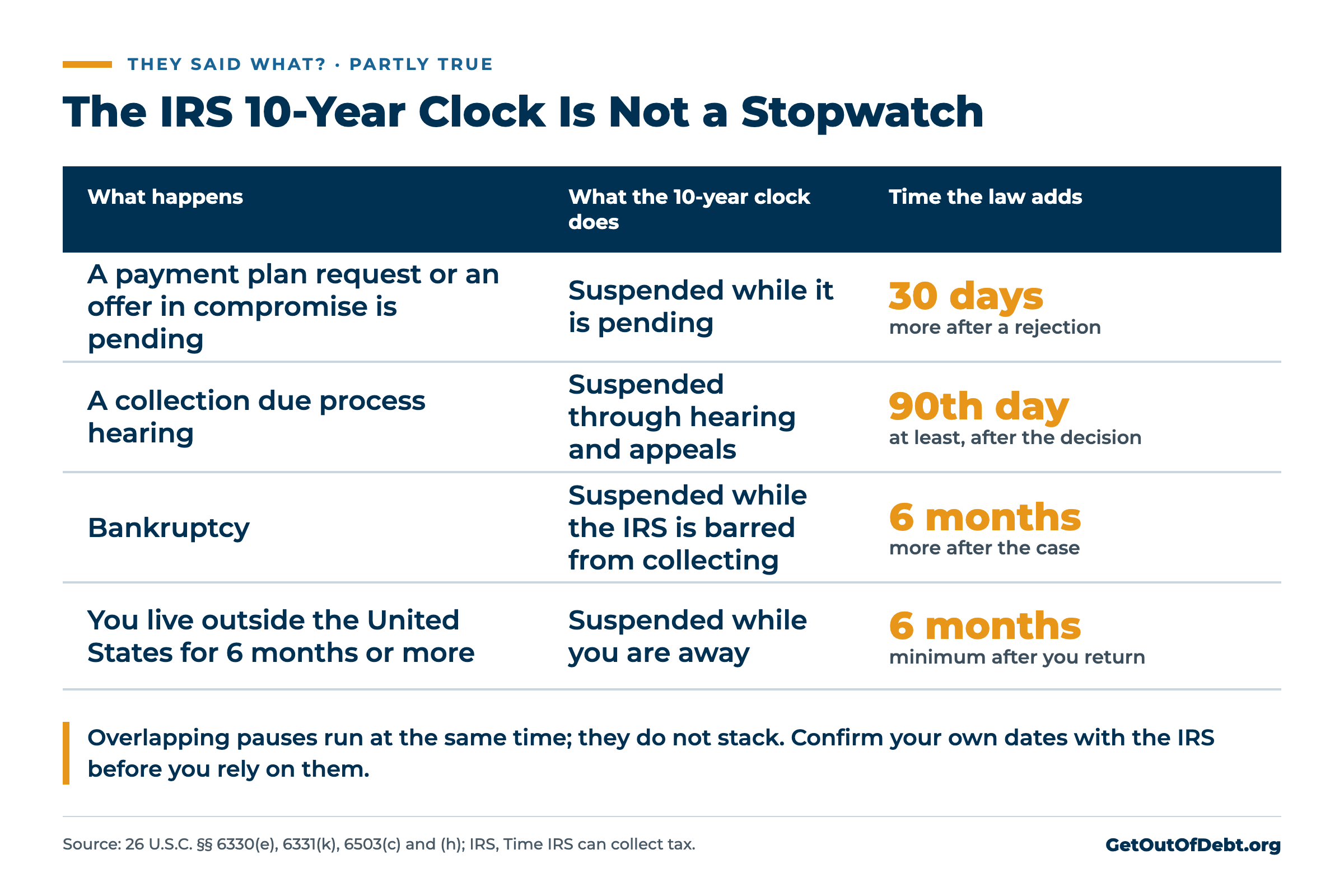
Now the part that breaks the plan. The clock isn’t a stopwatch. In the IRS’s words: “When we’re prohibited by law from collecting tax, the CSED collection period is generally suspended, which means the time we can collect tax pauses.” Here is what the statutes and the IRS say pauses it:
- A payment plan request. The clock is suspended while the IRS reviews it, for another 30 days if the request is rejected or an agreement is terminated, and throughout a timely appeal (IRS payment plans; 26 U.S.C. §6331(k)). A plan that is already in effect doesn’t suspend it by itself (IRM 5.1.19.3.5: “The CSED is not suspended while an installment agreement is in effect”), though the IRS generally can’t levy while one is in effect (§6331(k)(2)).
- An offer in compromise. Suspended while the IRS reviews the offer, for 30 days after a rejection, and during a timely appeal (§6331(k)(1); the IRS’s offer page says it extends your collection period).
- A collection due process hearing. Suspended from a timely request until the hearing and any appeals are done, and it can’t expire before the 90th day after the final determination (26 U.S.C. §6330(e)(1)).
- Bankruptcy. Suspended for the period the IRS is prohibited from collecting because of the case, plus 6 months after (26 U.S.C. §6503(h)).
- Living outside the United States. If you are outside the country for a continuous period of at least 6 months, the clock is suspended, and it can’t expire before 6 months after you return (§6503(c)).
- Military service. Entering a combat zone suspends it until you leave, plus 180 days (IRM 5.1.19.3.8). If military service materially affects your ability to pay an income tax and collection is deferred, the clock is suspended for your period of service plus 270 days afterward (50 U.S.C. §4000(c)).
- A collection lawsuit. If the IRS starts a timely court proceeding to collect, the period to levy doesn’t expire until the liability, or a judgment arising from it, is satisfied or becomes unenforceable (§6502(a)).
That isn’t every item. The IRS says a variety of laws affect the CSED and more than one can apply at once; overlapping pauses run at the same time rather than stacking (IRM 5.1.19.3). Look at the first four, though. They are things people do to fix a tax problem. The pause is the other side of the protection, because while a payment plan request or an offer is pending the IRS is generally barred from levying, though it can still apply your refunds (§6331(k)). The same statute bars a levy while a payment plan is in effect, but a plan in effect does not, by itself, add time to the 10 years (IRM 5.1.19.3.5). I don’t read that as a reason to avoid them. I read it as a reason to know your dates before you choose.
The IRS only has 10 years to collect a tax debt.
For a given assessment, the IRS generally has 10 years from the date of assessment to collect by levy or court proceeding (26 U.S.C. §6502(a)(1)) — a period that can be paused or extended, as the rest of this post shows. When it truly ends, the IRS manual says the collection statute expiration “ends the government’s right to pursue collection of a liability” (IRM 5.1.19.1.1), and a federal tax lien is released automatically (IRS Publication 594).
IRS, Time IRS can collect tax (page updated June 27, 2026) • IRM 5.1.19 (effective May 5, 2026)
If I keep out of the IRS’s way for 10 years, the tax debt just disappears.
The 10 years pauses, and sometimes extends, for events the law lists, including a pending payment plan request or offer in compromise, a collection due process hearing, bankruptcy, and time abroad (26 U.S.C. §6503; §6331(k); §6330(e)). While it runs, the IRS can file a lien and apply your future refunds, and it can levy unless a legal bar applies (for example, a pending offer or payment-plan request, a plan in effect, a timely hearing, or a bankruptcy stay), and a year you never filed may not have started a clock at all. Waiting is not a plan the law gives you; it is a gamble on dates you can look up.
IRS, Time IRS can collect tax • IRS Publication 594, The IRS Collection Process (Rev. 1-2026) • 26 U.S.C. §6503
While You Wait, the IRS Isn’t Waiting
The 10 years limits when the IRS has to stop. It doesn’t stop the IRS from collecting before then. Here is what the IRS and the statutes say it can do in the meantime:
- The lien reaches back to assessment. If you don’t pay after the IRS’s first bill, a lien arises by law (§6321), and the lien “shall arise at the time the assessment is made and shall continue until the liability for the amount so assessed … is satisfied or becomes unenforceable by reason of lapse of time” (26 U.S.C. §6322). The IRS describes it as a legal claim against all your current and future property (Publication 594). My post on what to do when the IRS files a tax lien covers the next step.
- A levy takes real money. The IRS defines a levy as a legal seizure of property or rights to property, such as your income, bank account, retirement account or Social Security payments (Publication 594). On a levy served before the CSED, the IRS says “we can continue to receive payments from that levy” (IRS), while Publication 594 says a wage levy continues until the debt is paid, other arrangements are made, the collection period ends, or the levy is released. Ask the IRS how that applies to your account. If a paycheck levy is already the problem, start with this post.
- Refunds go to the debt. The IRS lists applying your later-year refunds to the tax due, until it’s paid in full, among its collection actions (Publication 594).
- The balance keeps growing even if you do nothing. Interest runs on unpaid tax whether or not you ask for a plan (§6601(a); IRS, Interest), and some penalties keep adding up until they reach their limits, such as the failure-to-pay penalty, which the IRS says will not exceed 25% of your unpaid taxes (IRS, Failure to pay penalty). A payment plan carries accrued penalties and interest until the balance is paid in full (IRS), and when the IRS delays collection because you can’t pay, it still charges penalties and interest and may file a Notice of Federal Tax Lien (Publication 594).
One more trap: the 10-year clock doesn’t start until there’s an assessment. If you never filed a return, the IRS may assess the tax “at any time” (26 U.S.C. §6501(c)(3)), and the IRS says that when it files a substitute return for you and assesses the tax, that is when the 10-year collection period starts (IRS). So a year you never filed may have no clock running yet. I explain what skipping a return really costs in my post on filing when you can’t pay.
Why You Were Told This
I don’t think this one is mostly a sales pitch. It spreads because the true half is easy to repeat and the exceptions are not: a single number fits in one sentence, and a list of pauses doesn’t. It also gets blended with other clocks. The IRS says the CSED is one of three separate statutes of limitations: the time it can assess tax, the time it can collect tax, and the time you can claim a refund (IRS). Hear “3 years” for one and “10 years” for another often enough and they run together.
And waiting feels like doing something, when every other option feels like a confession. I get that. It’s why I’d rather hand you the dates than a lecture.
There’s Another Way This Ends, and It Can Be Faster Than a Decade
Waiting for the CSED is one way a tax debt ends. For income tax, bankruptcy can be another. Under 11 U.S.C. §523(a)(1) and §507(a)(8)(A), a Chapter 7 discharge does not reach an income tax if the return was last due (including extensions) within 3 years before you file, if the tax was assessed within 240 days before you file (that window is lengthened by any time an offer in compromise was pending or in effect during it, plus 30 days, and any time a prior case’s stay was in effect during it, plus 90 days), if the return was never filed or was filed late and within 2 years before you file, if there was a fraudulent return or willful evasion, or if the tax hasn’t been assessed yet but can still be assessed after you file (§507(a)(8)(A)(iii)). A tax that clears all of those can be discharged — though a properly filed tax lien can still reach property you owned when you filed, even property you could otherwise protect with an exemption (§522(c)(2)(B)). Those windows can also stretch: the periods in §507(a)(8), including the 3-year one, are suspended while the IRS is barred from collecting because you requested a hearing and an appeal (plus 90 days), and for time a stay was in effect, or collection was blocked by a confirmed plan, in a prior bankruptcy case (plus 90 days). The Code also says a substitute return the IRS makes for you under 26 U.S.C. §6020(b) is not a “return” for this purpose (§523(a), final paragraph), and courts have disagreed about whether a return filed late counts as a “return” at all; the First Circuit’s 2015 decision in In re Fahey, on late-filed state income tax returns, left the tax debts undischarged.
That is a starting checklist, not a ruling on your case, and a bankruptcy attorney in your area has to run the dates against your transcripts. I walk through the rules in when bankruptcy can erase tax debt and in the “never” myth. And an honest caution: a bankruptcy case pauses the CSED, so on a tax that does not clear the tests, filing adds time to the IRS’s clock (§6503(h)).
What to Actually Do
To be clear, I’m not telling you to dodge the IRS. I’m telling you the dodge doesn’t work the way it’s advertised, and if “staying out of their way” means hiding income or assets, a willful attempt to evade or defeat a tax is its own bar to discharge (§523(a)(1)(C)). So here is what changes in your week.
- Find your actual dates. The IRS says you can find a CSED in your account transcript, which you can get through your IRS Online Account, with Form 4506-T, or from its automated line at 800-908-9946. The IRS says to look under the Transactions section and “find the 3-digit IRS transaction code with a date below it. Generally, this date is the CSED plus any time we added by law.” The IRS page doesn’t say which code that is, so the CSED may not be labelled as such on your transcript. Don’t assume the first date you see is the CSED, and don’t add pauses of your own on top of a date the IRS says may already include them. The IRS says “You may contact us to verify the last day we can collect a tax debt for a specific tax period,” so confirm the date by calling 800-829-1040 (individuals) before you rely on it. Get one for every year you owe, because each assessment has its own (IRS).
- If the date looks wrong, say so. The IRS says to call 800-829-1040 (individuals) to check a CSED, and that you can ask the Taxpayer Advocate Service for help with Form 911 if you think it was computed incorrectly (IRS). Know that a Form 911 request itself suspends the collection statute while the Taxpayer Advocate works it (IRM 5.1.19.3.13).
- If a notice or levy is already in motion, protect your rights first. The IRS generally must give you written notice of your right to a hearing at least 30 days before the first levy (§6330(a)). A timely hearing request pauses the clock and generally bars the levy in dispute, so open the mail. My post on what to do when the IRS says you owe back taxes starts there.
- If you can’t afford to pay in full by the CSED, ask what fits. The IRS says you may qualify for a Partial Payment Installment Agreement if your payment won’t full-pay the balance by the CSED, with a financial review every two years (Publication 594). Its manual adds that in certain situations the IRS may ask for a written waiver extending the collection period with a partial payment plan, limited by IRS policy to five years plus up to one year (IRM 5.1.19.3.5). Read what you sign.
- If paying anything would keep you from basic living expenses, the IRS says you can ask it to delay collection and report the account as currently not collectible. It still charges penalties and interest and may file a lien, and it may ask for updated financial information later (Publication 594). My guide to requesting that status covers how to ask and what it leaves running. I could not confirm, in a source I reached, whether currently-not-collectible status pauses the clock, so don’t assume either way; ask the IRS for your CSED.
- Weigh an offer in compromise honestly. The IRS says it extends your collection period, and an offer isn’t automatic; see the real offer in compromise acceptance rate before you count on one.
- Ask a bankruptcy attorney about the dates. If an older income tax appears to pass the timing tests, a bankruptcy attorney can tell you whether Chapter 7 is the fastest route to discharge and whether a lien or other issue would remain. You can find one through NACBA, the National Association of Consumer Bankruptcy Attorneys.
- Check the date before you pay anything late in the game. The IRS says that if you paid a tax debt after the CSED expired, you may request a refund of what you overpaid, within the refund statute (IRS). The CSED can include added time, so confirm the date with the IRS first.
For a map of everything else, my complete tax debt guide pulls the options together, and if you’re scared the IRS will take your house or lock you up, here is the real risk. And if a tax-relief company has been pitching you, here are the listener questions I answered on my podcast.
Steve’s Take
Debt is math wrapped in emotion, and the IRS clock is a good example. The math is real: there is a 10-year limit, and for some people close to the end of one, knowing the date matters a great deal. The emotion is the wish that if I just stay quiet, the whole thing goes away. When I filed bankruptcy in 1990, what I learned was to deal with it and look to the future rather than spend 5 years repairing the past. Waiting out a tax debt is a decade of looking backward while the lien and the interest stay current and a levy stays possible. I’m pro-bankruptcy when the evidence supports it, and for an older income tax that clears the tests, bankruptcy deserves a real look next to a payment plan, which keeps penalties and interest running until it’s paid and can still come with a lien (Publication 594). It doesn’t fit everyone: a recent tax, an unfiled return or fraud can change the answer. For a recent tax, Chapter 13 can stop a levy through the automatic stay (11 U.S.C. §362(a)) and pay the priority tax through a repayment plan (§1322(a)(2)). What I want is for you to have the dates and every option in front of you, then decide. You are not your tax bill.
Frequently Asked Questions
Does the IRS really only have 10 years to collect from me?
Generally, yes, for each assessed tax — though the period can be suspended or extended, so it is not always 10 calendar years. 26 U.S.C. §6502(a)(1) lets the IRS collect by levy or court proceeding within 10 years after the assessment, and the IRS manual says the collection statute expiration “ends the government’s right to pursue collection of a liability” (IRM 5.1.19.1.1).
When does the 10-year clock start?
On the date the tax is assessed, not on the tax year or the due date (IRS). Each assessment has its own CSED, including additional tax from an amended return, an audit, a substitute for return, and civil penalties.
What can stop or extend the 10-year clock?
A pending payment plan request or offer in compromise (§6331(k)), a timely collection due process hearing (§6330(e)), bankruptcy plus 6 months (§6503(h)), 6 or more continuous months outside the United States (§6503(c)), military service, and a timely collection lawsuit (§6502(a)), among others the IRS lists.
Does an installment agreement extend the 10 years?
A request for one suspends the clock while it is pending, for 30 days after a rejection or a termination, and during a timely appeal (IRS; §6331(k)). An agreement already in effect does not suspend it by itself (IRM 5.1.19.3.5), though the IRS may ask for a written waiver in some partial payment plans.
Can the IRS take my paycheck or refund before the 10 years are up?
Yes, unless a legal bar applies. The IRS lists levies on income, bank accounts, retirement accounts and Social Security payments, and applying later refunds to the debt, among its collection actions (Publication 594). It generally can’t levy while a payment plan request or offer is pending or while a payment plan is in effect (§6331(k)), though it can still apply refunds. A timely hearing request or a bankruptcy case can also bar a levy. A plan in effect does not, by itself, add time to the 10 years (IRM 5.1.19.3.5).
What happens when the CSED passes?
The IRS manual says the collection statute expiration “ends the government’s right to pursue collection of a liability” (IRM 5.1.19.1.1), and Publication 594 says a federal tax lien is released automatically when the period for collection has ended (Publication 594). By statute the IRS issues a certificate of release within 30 days after it finds the liability legally unenforceable (§6325(a)).
If I never filed a return, is there still a 10-year limit?
The 10 years runs from assessment. With no return filed, the tax may be assessed “at any time” (§6501(c)(3)), and the IRS says its substitute return assessment is what starts the collection period. Don’t read that as a plan: it’s the opposite of safe.
Can bankruptcy get rid of IRS debt sooner than waiting?
It can for income tax that passes the timing tests in 11 U.S.C. §523(a)(1) and §507(a)(8)(A): the return last due more than 3 years before filing, the assessment more than 240 days before filing, a return filed more than 2 years before filing (and in some courts, including the First Circuit, a late-filed return may not count as a return at all), no fraud or willful evasion, and no tax that is unassessed but still can be assessed after you file — and those windows can stretch for a collection hearing request or a prior bankruptcy case, a filed tax lien can survive on property you own, and a bankruptcy attorney has to check your dates. A bankruptcy case also pauses the CSED, so it can add time on a tax that isn’t discharged. See my post on the “never” myth.
This is one informed perspective, not legal or tax advice. Your situation is yours, only you decide what to do, and I’d treat everything here as input, not instruction.
The bottom line: The IRS generally has 10 years from assessment to collect, but the clock pauses for events like payment plan requests, offers, hearings and bankruptcy, and the IRS can file liens and apply refunds while it runs and can levy unless a legal bar applies, so find your real dates before you bet on waiting. If someone you know is counting down a tax debt, send them this.
Dealing With Debt? Understanding your options is the first step. See how all your debt relief options compare — including ones most sites won’t tell you about. The Find Your Path quiz gives a recommendation based on your actual numbers, and the Scam-O-Meter checks any company’s complaint history before you sign. Federal Reserve Bank of New York research shows bankruptcy filers recover faster than those who don’t file.



