Written by Steve Rhode, consumer debt expert since 1994 • Last updated October 20, 2026
Quick Answer: Unless you are the debtor’s spouse, parent (if the debtor is a minor), guardian, executor, or administrator, a collector generally may contact you only to find the debtor, generally once, and may not say the debtor owes a debt (15 U.S.C. §§ 1692b, 1692c(b), (d); 12 CFR § 1006.10). If it is only looking for someone else, say you are not that person, give no identity numbers, and tell it not to call this number; saying so on the call counts, and if you can get its mailing address, follow up in writing as your proof (12 CFR § 1006.14(h)); don’t wait for a validation notice, because a wrong-number recipient may never get one. If it says you owe the debt, don’t pay or give Social Security digits, a birthday or account numbers until you have checked, and dispute it in writing within 30 days of receiving the validation notice, so a covered debt collector must pause until it mails verification (§ 1692g(b)); if there is any chance the debt is yours, ask for validation first. These federal rules cover third-party debt collectors, and an original creditor collecting its own debt in its own name may not be covered unless it uses a name suggesting a third party is collecting (§ 1692a(6)). My advice: don’t pay a debt you haven’t confirmed is yours, and don’t give an incoming caller personal details like Social Security digits or your birthday. Telling them you are not the person they want is fine.
What Just Happened: Three Different Problems That Sound the Same
The phone rings. Maybe it’s a number you don’t know, maybe the voicemail asks for a name that isn’t yours, maybe a letter showed up with your address on it and a stranger’s balance inside. Either way, you are now doing unpaid work on a debt you never signed for, and some part of you is quietly wondering whether you forgot something. Slow down. Debt is math wrapped in emotion, and the first piece of math is simple: whose debt is this?
The law treats three situations differently, so the first job is working out which one you’re in:
- The call is meant for someone else. A wrong number, a phone number that was reassigned to you, or a relative or friend who handed out your number. A collector may contact a person other than the debtor “for the purpose of acquiring location information,” and when it does, it has to identify itself, say it is confirming or correcting location information, “not state that such consumer owes any debt,” and “not communicate with any such person more than once unless requested to do so by such person or unless the debt collector reasonably believes that the earlier response of such person is erroneous or incomplete and that such person now has correct or complete location information” (15 U.S.C. § 1692b; 12 CFR § 1006.10(b)–(c)). Past that, the Act bars “engaging any person in telephone conversation repeatedly or continuously with intent to annoy, abuse, or harass any person at the called number” (§ 1692d(5)).
- The collector thinks you are the debtor. Same name, a mixed-up file, bad data, or a relative’s account attached to your Social Security number. The Act calls any natural person “obligated or allegedly obligated to pay any debt” a consumer (15 U.S.C. § 1692a(3); 12 CFR § 1006.2(e)). Look at the word allegedly. You do not have to owe the debt to get the protections that go with being collected from, including the validation notice and the right to dispute.
- It’s identity theft, or the caller isn’t a real collector. Someone opened an account in your name, or somebody is working a script to get your money. The FTC’s advice is blunt: “Before you pay, confirm a debt is actually yours — not someone else’s or a scam to get your money.”
One more check, because it decides which law applies: who is actually calling? The federal debt collection law covers a “debt collector,” which § 1692a(6) defines as a business whose principal purpose is collecting debts, or one that regularly collects debts owed to someone else, and it excludes “any officer or employee of a creditor while, in the name of the creditor, collecting debts for such creditor.” So if the bank or lender itself is dialing a number it has on file, the federal rules above may not reach it, though state laws often do. California’s Rosenthal Act, for one, defines “debt collector” to include a person who regularly engages in debt collection on its own behalf (Cal. Civ. Code § 1788.2).
You are far from the only one. In the CFPB’s public complaint database, 283,203 “Debt collection” complaints were received in calendar 2025. Of those, 115,682 were filed under “Attempts to collect debt not owed,” and within that group 65,482 picked “Debt is not yours” and 38,831 picked “Debt was result of identity theft.” Those are consumers’ own descriptions, not findings, and I pulled them from the CFPB’s complaint-search interface on October 20, 2026, so a later pull may differ a little — but the pattern is not subtle.
The Mistake You’re About to Make: Answering the collector’s first questions. “Am I speaking with [name]?” “For security, can you confirm the last four of your Social?” “Why don’t you pay a little so we can close this out?” My judgment, not a legal rule: I would not give a birthday, Social Security digits, an account number, or any other personal detail until I knew the call was about me, because each answer is something the collector can use to tie the debt to you, and money paid on a debt that isn’t yours is very hard to get back. Telling the caller “you have the wrong person” is fine, and a clear answer helps: a collector may contact you again if it reasonably believes your earlier answer was erroneous or incomplete and that you now have correct or complete location information (15 U.S.C. § 1692b(3)). You don’t need to win an argument on the phone. The law gives you a better tool, which is the written dispute below, and 12 CFR § 1006.38(d)(1) says that failing to dispute a debt “does not constitute a legal admission of liability.” Not an admission, but still no reason to wait. And if the debt belongs to someone you love and you’re tempted to pay it to make the calls stop, read what paying off someone else’s debt did to other people first.
Your Options Right Now
What to Do in the Next 48 Hours
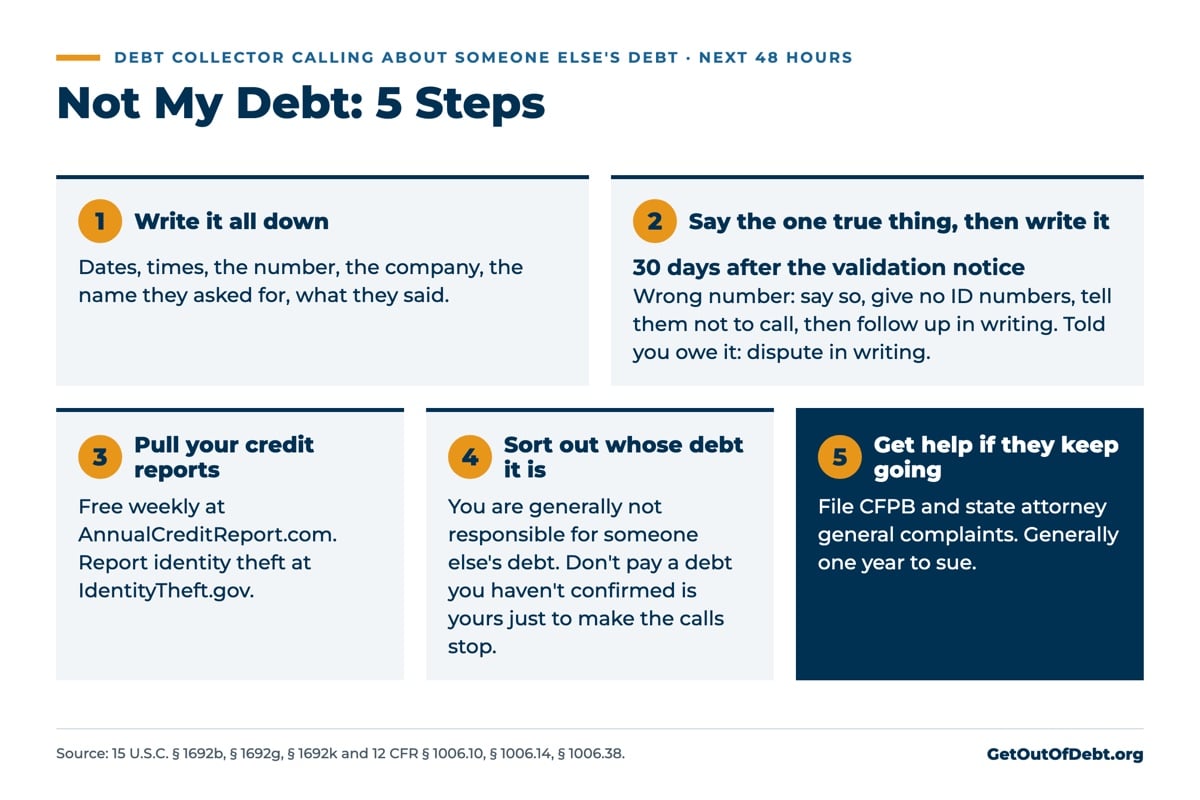
- Write down everything, today, before you say another word to them. The date and time of every call, the number it came from, the company name, the name they asked for, exactly what they said about the debt, and whether you told them they had the wrong person and when. Screenshot your call log, save voicemails, and keep every envelope. The CFPB’s own advice is to “keep a file of all letters or documents a debt collector sends you and copies of anything you send,” and write down dates and times of conversations. The count matters: a collector is presumed to violate the call-frequency rule if it calls a particular person about a particular debt more than seven times within seven consecutive days, or calls that person within seven consecutive days after having had a telephone conversation with them about the debt (12 CFR § 1006.14(b)(2)).
- Say the one true thing, then put it in writing. What you do next depends on what the collector says. If it is only looking for someone else: “You have the wrong person. This isn’t my debt. Don’t call this number again; send anything to me in writing.” Give no Social Security digits, birthday, account numbers, or payment, and don’t wait for a validation notice, because someone who just has the wrong number may never get one. Tell it not to call this number; saying so on the call counts, because the rule asks only whether you have “requested” that the collector stop using that medium, and the rule’s official commentary treats telling a collector to “stop calling” as that request. If you can get its mailing address, follow up with a short letter by certified mail with a return receipt, keeping a copy, saying you are not the person they want and that they should not call you, as your proof. A collector “must not communicate or attempt to communicate with a person through a medium of communication if the person has requested that the debt collector not use that medium” (12 CFR § 1006.14(h)(1)). If it says you owe the debt: don’t pay it and don’t give identity numbers until you have checked. When the validation notice arrives, send a written dispute saying you dispute the debt, want verification, and want the name and address of the original creditor. If you dispute in writing within 30 days of receiving the validation notice, a covered debt collector has to stop collecting until it mails you verification (15 U.S.C. § 1692g(b); 12 CFR § 1006.38(c)–(d)). The free Debt Validation Letter Generator builds the letter, and the CFPB has sample letters. A caution: if there is any chance the debt really is yours (a different last name, an old address, an account you forgot), ask for validation before you flatly deny it, and read my post on cease-and-desist letters before you send one, because a notice to stop communicating does not stop a lawsuit. One limit: these federal rules cover third-party debt collectors, and an original creditor collecting its own debt in its own name may not be covered unless it uses a name suggesting a third party is collecting (§ 1692a(6)); state laws may still apply.
- Pull your own credit reports and rule out identity theft. The FTC says, as of October 2026, all three nationwide bureaus let you check your report once a week for free at AnnualCreditReport.com, the only site authorized to fill those orders. Look for the account the collector is talking about. If it’s there and it isn’t yours, dispute it with the bureau, which generally must finish its investigation within 30 days of receiving your dispute, or 45 if you send more information during that time (15 U.S.C. § 1681i(a)(1)), and with the collector. If someone used your information, report it at IdentityTheft.gov, where the FTC gives you a recovery plan and pre-filled letters. (Only file an identity theft report if it is true; knowingly filing a false one is a crime, as I explain in this fact-check of the “dispute everything as identity theft” trick.)
- Sort out whose debt it is, especially if it’s family. The CFPB’s starting point, written about a spouse’s death: “You are generally not responsible for someone else’s debt.” For a spouse’s debt, it says you might be responsible if you are a co-signer on your spouse’s loan or a joint account holder (not just an authorized user). It lists two more categories: you live in a community property state, “which means you share responsibility for certain debts created during the marriage,” or in a state with necessaries statutes, “laws that say parents and spouses are responsible for paying certain necessary costs such as healthcare.” Those two are about marriage (and, for necessaries laws, parents), not about a stranger’s debt, and how they work for a living spouse’s debt depends on state law, so ask a local attorney. A collector may discuss a spouse’s debt with the spouse, but “this doesn’t mean that you’re responsible for paying it.” If the person has died, the collector may discuss the debt with the executor, administrator, or personal representative or a surviving spouse, but not with other relatives (see my dead-relative guide). And if a court paper ever arrives with your name on it, that is the one thing you cannot ignore; read what to do if you were just served, and what to do when a judgment lands on the wrong account.
- If they keep going, make it official and get help. File complaints with the CFPB and your state attorney general (links below), and talk promptly to a NACA consumer attorney, because § 1692k makes a collector that breaks the rules “with respect to any person” liable to that person, and any such claim generally must be filed within one year of the violation. If court papers arrive, answer by the deadline on the summons. If the collectors chasing you also include debts that really are yours, schedule a free consultation with Damon Day, an independent debt coach (not an attorney) and my podcast co-host. I receive no payment for this referral.
Free Tool — Debt Validation Letter Generator: Being contacted by a debt collector? The free Debt Validation Letter Generator creates a personalized FDCPA validation letter in seconds — forcing the collector to prove the debt is real before they can continue. Generate My Letter →
How to Actually Stop It — Your 5 Paths
- Make them prove it, in writing. When the collector treats you as the debtor, this is the fastest real stop, and it costs a stamp. A written dispute inside the validation window makes the collector “cease collection of the debt, or any disputed portion thereof, until the debt collector obtains verification of the debt or a copy of a judgment” and mails it to you (15 U.S.C. § 1692g(b)). The window runs 30 days from when you receive, or are assumed to receive, the validation information, and the collector may assume you received it at least five days after sending it, not counting weekends and legal holidays (12 CFR § 1006.34(b)(5)). Go by the end date printed on the validation notice. Missed it? Dispute anyway; here is what changes after the 30 days.
- Close the door on a wrong number. If the calls are meant for someone else, tell the caller once that it has the wrong person and not to call this number (saying so on the call counts), and follow up in writing as your proof if you can get its mailing address: a collector “must not communicate or attempt to communicate with a person through a medium of communication if the person has requested that the debt collector not use that medium” (12 CFR § 1006.14(h)(1)), and the rule says “a person,” not “the consumer.” Blocking the number on your phone is fine after you have saved your log. If the calls arrive with a prerecorded or artificial voice on your cell phone, a separate law may apply, and I cover it in robocalls meant for someone else.
- Fix the record where it does the damage. A wrong debt on your credit report hurts more than the phone calls do. Dispute it with the bureau (§ 1681i). If it’s identity theft, the bureau must block the information not later than four business days after it receives proof of your identity, a copy of an identity theft report, your identification of the information, and your statement that it doesn’t relate to any transaction by you (15 U.S.C. § 1681c-2(a)), and a collector that is told the debt may be fraudulent or the result of identity theft must notify the creditor (§ 1681m(g)). For a debt you simply don’t recognize on a report, see my guide to a debt on your credit report you don’t recognize.
- Bankruptcy — only for the debts that really are yours. Bankruptcy does not fix a debt that isn’t yours, and it isn’t the tool for a wrong number. But if, while you sort this out, you realize the collectors circling you include debts that are yours and you can’t carry them, the automatic stay takes effect the moment you file. Not weeks later. Under 11 U.S.C. § 362(a) a petition stops “any act to collect, assess, or recover a claim against the debtor that arose before the commencement of the case.” It has exceptions, so an attorney should check yours. I’ve gathered the research on how filers recover in my bankruptcy benefits research post, and a NACBA attorney can tell you whether it fits your numbers.
- What won’t work: paying a little “as a gesture,” giving personal details to a caller you haven’t verified, agreeing the debt is “handled,” assuming a relative’s debt is yours because the collector sounds sure, or ignoring a summons. A cease-communication letter alone won’t take a wrongly attributed account off your credit report or stop a lawsuit either; under § 1692c(c) the collector may still tell you it is ending its efforts or that it or the creditor may invoke, or intends to invoke, a specified remedy.
What You Need to Know About Your Rights When the Debt Isn’t Yours
Once
How often a collector may contact a third party to get location information, absent that person’s request or a reasonable belief the first answer was wrong or incomplete (15 U.S.C. § 1692b(3))
7 in 7
More than seven calls to a particular person about a particular debt within seven consecutive days, or a call within seven consecutive days after a telephone conversation with that person about the debt, is presumed to violate the call-frequency rule (12 CFR § 1006.14(b)(2))
30 days
From receiving the validation notice, the window to dispute a debt in writing and force a covered debt collector to stop collecting until it verifies (§ 1692g(b))
1 year
Generally the deadline to sue a collector under the federal law, counted from the date of the violation (§ 1692k(d))
These rules sit inside a bigger law. A collector may not falsely represent “the character, amount, or legal status of any debt” (§ 1692e(2)(A)), may not communicate credit information “which is known or which should be known to be false, including the failure to communicate that a disputed debt is disputed” (§ 1692e(8)), and may not use “any false representation or deceptive means to collect or attempt to collect any debt” (§ 1692e(10)). If it does, § 1692k(a) makes it liable to “such person” for actual damages, up to $1,000 in additional damages in an individual action as the court may allow, plus costs and a reasonable attorney’s fee if you win. Most courts read that $1,000 ceiling as applying per lawsuit, not per phone call or per violation. One honest caveat: whether you can sue over calls meant for someone else, as opposed to calls treating you as the debtor, depends on your facts and on how your court reads the statute, and that is a question for a consumer attorney, not a blog post.
| Who / Where | What the rule says | Notes |
|---|---|---|
| Federal baseline: a call to someone who isn’t the debtor | Location information only; the caller must identify itself, may not say anyone owes a debt, and generally may not contact that person more than once | 15 U.S.C. § 1692b; 12 CFR § 1006.10 |
| Federal baseline: the collector says you owe it | You count as “allegedly obligated.” Validation information comes in the first communication or within five days; a written dispute in the 30-day window stops collection until verification is mailed | § 1692a(3); 12 CFR § 1006.34; § 1006.38 |
| It’s your spouse’s debt | The collector may discuss the debt with you as the spouse, but that does not make you responsible for paying it | § 1692c(b), (d); CFPB |
| It’s another adult relative’s or a friend’s debt | Generally, the collector may contact you only to find that person and may not discuss the debt with you, unless you fall within the law’s definition of “consumer” (the debtor’s spouse, parent if the debtor is a minor, guardian, executor, or administrator) or the debtor gave the collector permission | § 1692c(b), (d); CFPB |
| Community property states: AZ, CA, ID, LA, NV, NM, TX, WA, WI (plus Alaska, Tennessee and South Dakota if you and your spouse elected it under that state’s law) | You may share responsibility for certain debts created during the marriage; the details vary by state | IRS Publication 555 (list of states, and the Alaska, Tennessee and South Dakota election, which it does not otherwise address); CFPB |
| Virginia (one example of a “necessaries” state) | The statute says: “Except as otherwise provided in this section, a spouse shall not be responsible for the other spouse’s contract or tort liability to a third party, whether such liability arose before or after the marriage. The doctrine of necessaries as it existed at common law shall apply equally to both spouses, except where they are permanently living separate and apart”; and “liability shall not be imposed upon one spouse for health care furnished to the patient spouse who predeceases the nonpatient spouse.” | Va. Code § 55.1-202 |
| Identity theft | The bureau must block the information not later than four business days after receiving the identity theft report, proof of identity, the identified information and your statement; a collector told it may be identity theft must notify the creditor | 15 U.S.C. § 1681c-2; § 1681m(g) |
If you live in one of the nine community property states (or in Alaska, Tennessee or South Dakota if you and your spouse elected it under that state’s law), or in a state with a necessaries law, the spouse answer above is the one that changes: ask a local attorney before you assume a spouse’s debt isn’t yours. If you live in California, the Rosenthal Act may reach a lender collecting its own debt, which the federal law generally does not. See the complete guide to debt collector rights for the long version, and my fact-check on whether marriage makes you responsible for a spouse’s debt.
If a collector keeps calling you about a debt that isn’t yours, file a complaint with the CFPB and your state attorney general. The FTC says to report problems with a debt collector to your state attorney general’s office, the FTC, and the CFPB. If you need legal help but can’t afford an attorney, find free legal aid through LSC.gov.
Steve’s Take
I filed bankruptcy in 1990, so I know how a collector’s call can make you feel guilty even when you did nothing wrong. A collector calling you about a stranger’s debt is not a verdict on you. It’s a records problem, and records problems get solved with paper, dates, and patience, not shame. So don’t panic-pay, don’t hand over personal details, and don’t carry a debt that isn’t yours for another day. The people who handle this well are the ones who write it down and send the letter.
Frequently Asked Questions
A debt collector keeps calling my phone for someone I don’t know. How do I make it stop?
Tell the caller once that it has the wrong person and not to call this number (saying so on the call counts, and if you can get its mailing address, follow up in writing as your proof), and don’t give personal details like Social Security digits or your birthday: a collector may not use a medium of communication a person has asked it not to use (12 CFR § 1006.14(h)(1)), and it generally may contact a third party only once to find the debtor (15 U.S.C. § 1692b(3)). Keep a log; calls that keep coming after you’ve said so are worth a complaint to the CFPB.
A collector says I owe a debt I know isn’t mine. What do I do?
Don’t pay it or give Social Security digits, a birthday, or account numbers until you have checked it, and dispute it in writing within 30 days of receiving the validation notice. A covered debt collector must then “cease collection of the debt” until it mails you verification (15 U.S.C. § 1692g(b)). Ask for the name and address of the original creditor in the same letter, then check your credit reports for the account. If the collector is only looking for someone else, say you are not that person and tell it not to call this number (saying so on the call counts, and if you can get its mailing address, follow up in writing as your proof) rather than waiting for a validation notice that may never come (12 CFR § 1006.14(h)).
The collector is calling about my spouse’s debt. Am I responsible for it?
Usually not just because you’re married, and the collector may talk to you about it as the spouse without that making you liable: the CFPB says “this doesn’t mean that you’re responsible for paying it” (CFPB). You may be responsible for a spouse’s debt if you co-signed or hold a joint account, or if you live in a community property state (Arizona, California, Idaho, Louisiana, Nevada, New Mexico, Texas, Washington and Wisconsin, plus Alaska, Tennessee and South Dakota if you and your spouse elected community property under that state’s law, per IRS Publication 555) or a state with a necessaries law; the CFPB says community property means you “share responsibility for certain debts created during the marriage.” How those laws work varies by state, so ask an attorney in your state before you decide.
A collector is calling me about my parent’s, sibling’s, or adult child’s debt. Do I have to pay it?
Usually not. You generally owe it only if you co-signed or hold the account jointly, though a few states have filial-support laws that can make an adult child liable for a parent’s care costs, and an executor who skips required probate steps can become personally liable, so ask a local attorney if either might apply. The CFPB says a collector generally may contact other people only to find out where the debtor lives, what the number is, and where the debtor works, and generally can’t discuss the debt with anyone but the debtor, the debtor’s spouse, and a few others (CFPB). If the debtor has died, collectors “should not discuss or mention the debt” to a relative who isn’t the executor or administrator (CFPB), the debt is paid from the estate, and family members usually don’t have to pay it from their own money (FTC); see my dead-relative guide. If you choose to help someone you love, make it a decision, not a response to pressure, and read this first.
I think someone stole my identity and this debt is the result. What now?
Report it at IdentityTheft.gov, which gives you a recovery plan and pre-filled letters, then send the credit bureaus what they need to block the information, which they must do not later than four business days after receiving the identity theft report, proof of your identity, your identification of the information, and your statement that it doesn’t relate to any transaction by you (15 U.S.C. § 1681c-2(a)). Tell the collector in writing that the debt may be the result of identity theft; it must then notify the creditor (§ 1681m(g)). If a tax form for a debt you never owed also shows up, see this reader question about a 1099-C for someone else’s debt.
I got court papers over a debt that isn’t mine. Can I just ignore them?
No. A lawsuit over the wrong person’s debt is still a lawsuit, and ignoring it is how a collector ends up with a default judgment against you. Respond by the deadline on the summons, tell the court the debt isn’t yours, and get a consumer attorney if you can (NACA, or free legal aid through LSC.gov). My guides on being served and on a judgment on the wrong account walk through the steps.
Can I sue a collector for calling me about someone else’s debt?
Possibly. A collector that breaks the law is liable “with respect to any person” for actual damages, up to $1,000 in additional damages in an individual action as the court may allow, and costs and attorney’s fees if you win, and the deadline is generally one year from the violation (15 U.S.C. § 1692k). Whether your facts support a case, especially if the calls were meant for someone else, is a question for a NACA consumer attorney.
Would filing bankruptcy stop collectors calling me about someone else’s debt?
Only for debts that are really yours. The automatic stay takes effect the moment you file and stops acts to collect a claim against you (11 U.S.C. § 362(a)), but it doesn’t turn a stranger’s debt into yours, and the fix for a debt that isn’t yours is the written dispute. If your own debts are the real problem, talk to a NACBA attorney, take the 2-minute bankruptcy quiz, and see my research on how filers recover.
One more thing — everything I share here is based on 30 years of helping people through exactly this. But my advice is input for your decision, not the decision itself. Only you know your full situation. Talk to an attorney, look at your numbers, and make the choice that serves your future.
Important: This guide is for informational purposes only and is not legal advice. Laws vary by state, and your situation may have details that change what options are available to you. For legal advice specific to your case, consult an attorney licensed in your state. NACBA can help you find a bankruptcy attorney, NACA can connect you with a consumer attorney, or schedule a free consultation with Damon Day, an independent debt coach and my podcast co-host — I receive no payment for this referral.
Key Takeaway: A collector calling you about someone else’s debt is stressful but fixable. Write down every contact, put it in writing (a dispute if the collector says you owe the debt, a follow-up letter as your proof if it has the wrong number and you can get its mailing address), check your credit reports, and don’t pay or give personal details until you know the debt is yours. Run the debt option calculator if some of what’s chasing you is yours, and talk to a consumer attorney this week if the calls don’t stop. The longer you wait to put it in writing, the harder it is to prove what you said and when.
The Bottom Line
You are not bad with money because a stranger’s debt found your phone. The law set limits on who a collector can call, what it can say, and how often, and it gave you a way to make a collector prove its claim. The people who come out of this best are the ones who write it down, send the letter, and refuse to pay for peace they could get for a stamp. If someone you know is being chased about a debt that isn’t theirs, send them this page — it may keep them from paying money they don’t owe. See the full Crisis Guides hub and take the Find Your Path quiz if some of the debt is yours.
Dealing With Debt? Understanding your options is the first step. See how all your debt relief options compare — including ones most sites won’t tell you about. The Find Your Path quiz gives a recommendation based on your actual numbers, and the Scam-O-Meter checks any company’s complaint history before you sign. Federal Reserve Bank of New York research shows bankruptcy filers recover faster than those who don’t file.
Right now you are dealing with the thing in front of you, and that is exactly where your attention belongs. When it is handled — and it will be — there is a next stage, and it is the one I most enjoy writing about.
In the latest issue (Nov 10): Prices rose again. What's your own number?
Each weekday I send one short email: one story that caught my attention, why it might matter to you, and one manageable thing you can do with it. It is free, I sell nothing, and I take no money from any company I write about.