

Quick Answer: Damon Day — my podcast co-host and an independent debt coach — filmed a Thursday night of Walmart Spark, DoorDash and Uber Eats driving that he calls his worst earning night in a long time. By the video’s description, he grossed $121.33 for roughly four hours of work. That is one driver’s number on one night in one market: not typical pay, not an average and not a promise, and it is a gross figure, before miles, wear, gas and taxes. The night turned on a 21-bag grocery pickup, a canceled pizza order and a Taco Bell order that no longer existed when he got there. The lesson is the arithmetic: the amount on an offer screen is not what you keep, and the minutes the screen does not show are the ones that cost you.
Debt is math wrapped in emotion, and a bad night of gig work is the same thing in a smaller package. The number you are chasing feels like proof you are not failing, and that is exactly when you stop checking what it costs.
I co-founded The Penny Stupid Project with Damon in 2022 as a public experiment in side hustles, and Damon runs it now. It lives on YouTube as @pennystupid, and the gig-work videos are the ones where he does the driving. I tell you I helped start it every time I feature a video, because you deserve to know where I stand before you weigh my opinion. Damon also runs his own debt-coaching practice at damonday.com, the first link in the channel’s own description. He is also my podcast co-host, and I receive no payment for featuring his videos or for recommending him.
His newest long video, posted October 16, 2026, is titled My Worst Earning Night in a Long Time | Uber Eats & DoorDash. It runs about 25 minutes. Its description sums it up as a 21-bag pickup, delays, a canceled pizza order, and one last Uber Eats offer that kept turning a simple night into more work.
Each weekday I send one short email: one story that caught my attention, why it might matter to you, and one manageable thing you can do with it. A couple of minutes, and a dad joke.
In the latest issue (Nov 9): Check your power bank and your French press
Free. I sell nothing. Unsubscribe any time.
A Night of Small Decisions, Most of Them Reasonable
Everything below is my paraphrase of what the video shows, built from YouTube’s auto-generated captions and the creator’s own description. Auto-captions get numbers wrong, so I’m hedging where I’m not sure, and the video is the record.
He heads out on a Thursday evening a little after 6 p.m. and says he has barely driven all week. A Walmart Spark offer comes in at about $27 for a 23-item shop and a delivery of about three miles. It is close to his minimum, but he takes it because he is going out anyway and he shops faster in that Walmart than in other stores. Then an offer of about $40 for a Walgreens shop pops up, and someone else grabs it before he can accept. He says he would have canceled the Walmart order to take it. He is about 47 minutes into the night when the $27 shop is done, and he is honest that some of that time was getting a few things for himself and not rushing.
Next comes a stretch of saying no. An Uber Eats offer asks him to drive 21 miles. Another is $14 for 14 miles. He points out that a double pickup is often two small orders combined to look like one bigger one: in his example, two orders of about $5.50 each, not an $11 order. He does take a batched order of a bit over $16 for about three total miles, a small grocery shop plus a restaurant pickup, because he is behind where he wants to be. He gets a free coffee out of it, which he jokes is one of the perks of the job and not a reason to do the job. About an hour and a half in, he says he is at roughly $43 gross and should be closer to $60.
The 21-Bag Pickup
Then Uber offers a grocery pickup for about $27. The listing says 21 bags. In his experience that number has been unreliable, and this time it was accurate. He has to scan each bag with the phone scanner at the store, and then scan every bag again at the customer’s door. He says it was dark, the phone’s flashlight was not available while the scanner was open, and the phone itself cast a shadow over each barcode. He puts the pickup at about 20 minutes and the drop-off at no less than 15. After that, he says, he is at about $70 gross and 2 hours 18 minutes, which he calls barely $30 an hour, and he says he won’t take another pickup that lists 20-some bags.
Nothing on the offer screen told him about the scanning. That is the first thing I want you to hold onto: an offer shows you pay and miles. It does not show you the minutes you will spend standing around, scanning, or waiting.
The Order He Didn’t Mean to Take
He then discovers he accepted a $24 pickup instead of the $24 shop he meant to. He rolls with it and says if you are going to make a mistake, make it in your favor, because the pickup leaves him in a better area. Then the route turns out to include a dirt road, which he says adds time and dirt to the car.
The part I would underline is what he says next. He knows that if he stays out trying to protect his hourly pace, he may end up with a worse pace, because he will sit around getting annoyed while his average drops. He also acknowledges, to his credit, that this is a first-world problem, and that some people watching would probably love to be in his seat. That is emotion and math in the same car, and he is saying it out loud.
The Pizza, the Dirt Road and the Taco Bell
Later in the night he stacks a $26 Walmart curbside order with a $15 pizza delivery that heads in the same direction. The pizza isn’t ready, and the restaurant tells him it will be at least 10 minutes, which in his experience tends to mean closer to 15. He cancels it. His reasoning, paraphrased: $15 for 15 minutes is attractive, but $15 for 30 is not, and waiting would have taken the profit out of it. Then the next delivery sends him back down the same dirt road he had just left, to the same customer, which he says deflates him.
He holds out for a Walmart shop to rise past $20 so it becomes worth the drive, and someone else takes it at $20. He is close to home, where his rule is to turn the apps off, when an Uber Eats offer of about $19 for a Taco Bell order about five miles away appears, and he makes an exception. When he gets there, the restaurant staff tell him several other drivers had already come for it and the order doesn’t exist. His read is that it kept boosting because it was broken, and that is only his read. He drove there for nothing. He decides a support call would cost more time and aggravation than it is worth.
He closes by saying he can control his decisions but not the orders that show up, and that as bad as the night was, it still came to a little over $30 an hour by his count.
Gross for roughly four hours, per the video description
Scanned at the store and again at the door, on a pickup of about $27
The Taco Bell offer he drove to, for an order that was gone
These are one driver’s numbers for one night, taken from the video, its description and its auto-captions. They are not typical pay, an average, or a projection. Check them against the video before you rely on any of them.
The Arithmetic That Comes Out First
The description calls $121.33 a gross figure, and it is the right place to be careful. Gross means before anything is subtracted. For delivery drivers, the things that come out include the miles you drive, the wear on the car, gas, and taxes.
The IRS’s own standard business mileage rate is 76 cents a mile for July 1 through December 31, 2026. It is the number the IRS uses as a stand-in for what gas, tires, maintenance, insurance and depreciation cost per mile. It is not a measurement of anyone’s actual costs, but it is a fair yardstick for a driver who has not tracked their own.
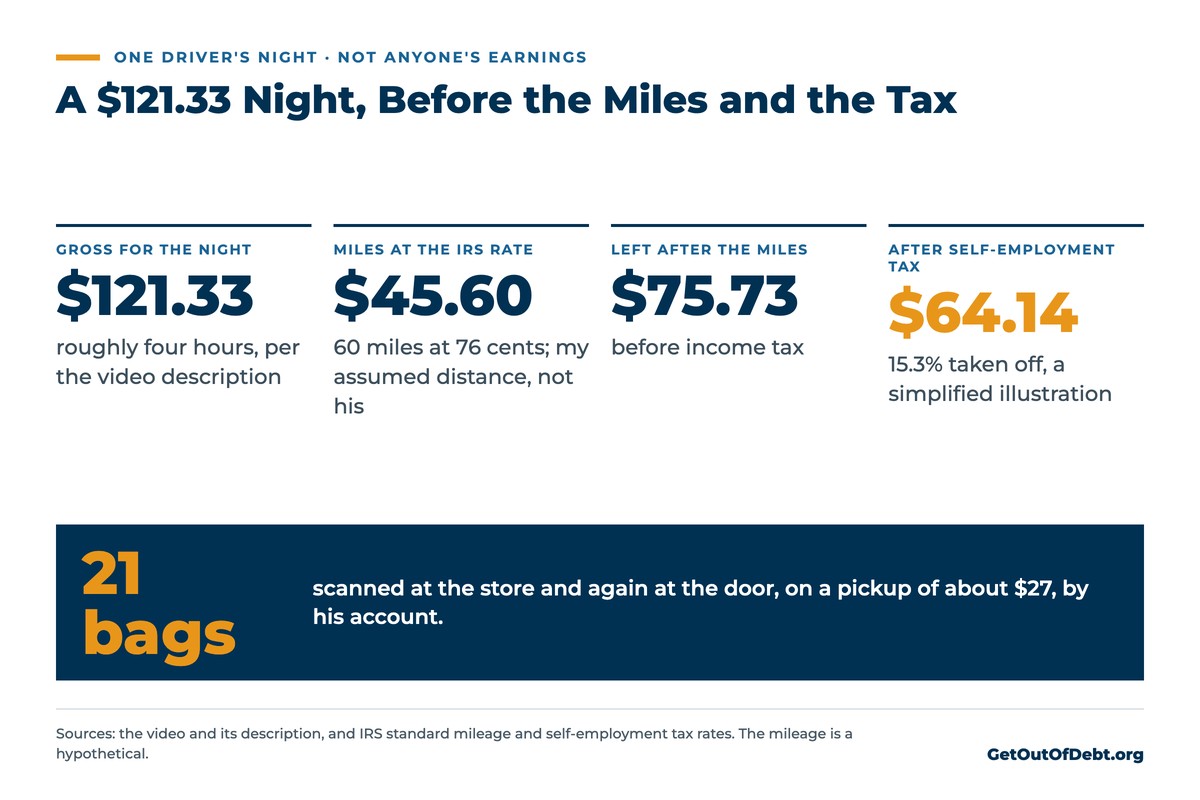
The $121.33 Night, Subtracted One Step at a Time
The gross he reports. $121.33 for roughly four hours of work, from the video description.
Take out the miles. I can’t read his odometer from the video, so I’m assuming 60 miles driven across the night, counting pickups, drop-offs, the dirt road twice and the drive to a Taco Bell that wasn’t there. That 60 is my round number, not his. At 76 cents a mile it is $45.60, which leaves $75.73. Every 10 miles more or less moves the answer by $7.60.
Take out self-employment tax. The IRS says the self-employment tax rate is 15.3% and applies once your net self-employment earnings reach $400 for the year. Taking the full 15.3% off $75.73 is about $11.59, which leaves roughly $64.14. This is a simplified illustration, and I’m not a tax professional.
What is left. About $64, before federal and state income tax, and before the phone, the data plan, the delivery bags and anything else that isn’t in the mileage rate. That is a little more than half of the gross, using my assumed miles. I’m deliberately not turning it into an hourly rate to hold up as a benchmark, and neither should you. Do this subtraction with your own miles.
What the Night Teaches, in My Words
This part is my commentary, not Damon’s, and I’m not putting words in his mouth. These are the questions I would take from the video into my own night.
- Price the minutes the screen hides. The 21-bag pickup shows $27 and a distance. It doesn’t show 20 minutes at the store or a long scan at the door. He did not know, and now he does. If you do not track your time, you will not know either.
- A rate per order counts only the order. $15 for 15 minutes sounds fine, and it is for the order itself. It leaves out the drive to the restaurant, the wait and the drive home, which is why he canceled the pizza once the wait stretched.
- Protecting a number can lower it. He says it himself: trying to hold a pace by staying out can pull the pace down. This is the same pull people in debt feel when they take on one more thing to prove the plan is working.
- Ask why nobody has taken the offer. He was glad to see a $19 offer on a bad night, and then learned others had come and gone. A boosted offer that sits can be a bargain, and it can be broken. His read of why was only a read.
- Decisions are yours; orders are not. That is his point, and it is the useful one. You cannot control what appears. You can control the floor you set before you open the app.
My Checklist Before Accepting an Offer
This is my checklist, not Damon’s, and I’d run it any time a number on a screen seems too good:
- Read the whole offer. Look at the item or bag count, the pickup type and the distance, and ask what work is hiding behind each of them.
- Price the whole loop. Add the drive to the pickup, the delivery, the wait, and the drive back to where you would have been anyway.
- Decide when you will stop before you start. A stop time you set while rested beats one you invent at 9:45 p.m. when you are down.
- Keep a mileage log. A running total of miles is the only way to turn a gross number into a real one.
- Set tax money aside as you earn it. Nobody withholds anything for you.
No sense wasting a perfectly good mistake. Damon filmed his and posted it, which is why you can learn from it for free.
What I Take From It If You’re Behind on Bills
I hear some version of this all the time: should I pick up delivery work to catch up on my debt? My answer is the same one I give about every option on this site: it depends on your numbers, and most people never run them. Gig work can be fast cash when you need money now and don’t have savings, and that speed is real. If you are closing a short gap, it can help.
Before you count it as ongoing income, especially income you are relying on to get out of debt, track what you actually keep over a full week, not on the best order you saw one evening, and not on one night in a video. Count your miles, count your minutes, and set money aside for self-employment tax. If the math says delivery work won’t get you where you need to go, that is useful information and not a failure on your part. Sometimes the faster, cleaner answer is a different tool entirely, like a hard look at whether bankruptcy fits. You are not your debt, and you don’t have to drive your way out of it if the numbers say otherwise. And if rideshare is the gig you are weighing, here is the math on Damon’s Lyft and Uber night.
Cleaned Auto-Transcript, Condensed
This is a cleaned and condensed rendering of YouTube’s auto-generated captions, using the creator’s own chapter list for the timestamps and corrected names. It is not a record of his exact words. Auto-captions get names and numbers wrong, which is why none of it is in quotation marks. Watch the video above for what he actually says.
0:00 – One more order. The video opens on the end of the night: a Taco Bell offer he drives to, and a restaurant staff member telling him other drivers had already come for it.
0:16 – Starting the night. A Thursday evening, a little after six. He has barely driven this week and decides to go out. A Walmart Spark shop of about $27 comes in, close to his minimum, and he takes it.
2:11 – A slow first shop. A $40 order is taken by another driver before he can accept it. The Walmart shop takes about 47 minutes, partly because he shops for himself too.
3:26 – DoorDash and the coffee benefits. He turns down a run of long, low-paying offers and takes a batched order of a bit over $16. A free coffee is one of the small perks, and he says not to take the job for them.
5:24 – Already behind target. About an hour and a half in, he is at roughly $43 gross and says he should be nearer $60. He says this is a good night to show that not all nights are good.
7:46 – The Uber Eats pickup. He takes a roughly $27 grocery pickup that lists 21 bags. He had doubted that number before, and this time it was real.
9:24 – Waiting for the Walmart offer to grow. He passes on a $22 offer for eight miles, then lets a Walmart shop sit while he waits for its pay to rise.
10:33 – Scanning everything again. The drop-off requires scanning all 21 bags again, in the dark, with a phone scanner that does not read well in shadow. He says it took at least 15 minutes.
13:13 – The wrong order. He realizes he accepted a pickup and not a shop. He decides it is not a bad outcome, since it keeps him in a better area, but the route includes a dirt road.
16:31 – Trying an Uber Eats and Walmart stack. He combines a $26 Walmart curbside order with a $15 pizza delivery, hoping to turn the night around.
18:32 – Canceling the pizza pickup. The pizza is not ready, and he cancels instead of waiting 10 to 15 minutes. The next delivery sends him back down the same dirt road.
20:09 – Should I call it a night? He weighs going home against waiting for a Walmart shop to rise, and another driver takes it at $20.
22:24 – The final Uber Eats problem. A $19 Taco Bell offer turns out to be an order that no longer exists. He decides not to call support.
23:44 – What I would do differently. He talks about controlling decisions and not orders, and says the night still came to a little over $30 an hour by his count.
More From the Side Hustle Archive
I’ve been writing about this project since it started in 2022. A few pieces that pair well with this video:
- Damon Day and I Talk Gig Work: The Math to Run Before You Download an App — the conversation about the questions to ask before you start
- Damon Day’s Gig Challenge, Day 2: A Ghost Order and the Real Cost of a Bad Night — another night that went sideways
- Damon Day Turned Down Low Walmart Spark Offers. Here’s the Math. — the case for a floor
- Quick Cash for Bills: Myth vs Reality — the honest version of the I-need-money-fast question
- Side Hustles: When They Help and When They Hurt — the honest boundaries of what a side hustle can fix
- Side Hustle Success: What It Means and What to Do — the mindset piece behind the math
Key Takeaway
Damon Day calls this his worst earning night in a long time, and the description puts it at $121.33 gross for roughly four hours. The useful part isn’t the number; it is what the number leaves out. Scan time, waiting time, a dirt road twice and a drive to an order that wasn’t there all cost minutes and miles that the offer screen never showed. Take out the miles and the self-employment tax before you decide how a night went. The figures here are one driver’s results on one night, not a promise and not a plan.
This is what I’m telling friends like you over coffee. But remember, you do you. Take it as input and make the call that fits your own life.
If someone you know is counting on delivery work to catch up on their bills, send them this before they judge a night by the gross number. Share this with a friend who has ever driven somewhere for an order that turned out not to exist, because the math on a bad night is worth running before you decide the next night.
Common Questions
Who is Damon Day, and what is The Penny Stupid Project?
Damon Day is my podcast co-host and an independent debt coach, and his own site is damonday.com, listed first in the channel’s description. The Penny Stupid Project is a public side-hustle experiment I co-founded with Damon in 2022, and Damon runs it now. It lives on YouTube as The Penny Stupid Project, and I tell you I helped start it every time I feature a video so you know where I stand. You can read why I recommend Damon in Why Do You Recommend Damon Day as a Debt Advisor? I receive no payment for featuring his videos or for recommending him.
Why did Damon Day call this his worst earning night in a long time?
By his account, a 21-bag grocery pickup took far longer than the offer suggested, a canceled pizza order and a repeat trip down a dirt road ate more time, and a Taco Bell order he drove to no longer existed. The description gives the night as $121.33 gross for roughly four hours. That is one driver’s one night, and it is before miles, wear, gas and taxes.
Is $121.33 for four hours what gig workers typically make?
No. It is one driver’s gross for one night in one market, and it is not an average or a promise for anyone else. Pay varies by city, hour, app and the orders that happen to appear. Gross is also not what you keep: miles, wear, gas and self-employment tax come out first.
How do I tell if a delivery offer is worth taking?
Price the whole loop, including the wait, the scanning or shopping time and the drive back. Take out the miles, using the IRS standard mileage rate of 76 cents a mile for July 1 through December 31, 2026, as a yardstick. Then take out self-employment tax, which the IRS puts at 15.3%, and ask what else you could have done with the time. The IRS rate is a stand-in, not your actual costs.
Can delivery work help me get out of debt?
It can help close a short-term gap, and some people use it that way. Whether it can take you all the way out depends on what you keep after miles, wear, time and taxes compared with what you owe. If the math says it won’t, other options exist, and I lay all of them out in the debt options comparison, including bankruptcy, which I rate highest across credit, collections, speed and retirement.
Dealing With Debt? Understanding your options is the first step. See how all your debt relief options compare — including ones most sites won’t tell you about. The Find Your Path quiz gives a recommendation based on your actual numbers, and the Scam-O-Meter checks any company’s complaint history before you sign. Federal Reserve Bank of New York research shows bankruptcy filers recover faster than those who don’t file.



