

Quick Answer: On October 21, 2026, 17 state attorneys general announced a settlement with Snap Finance LLC and Snap RTO LLC. Under Section X(A) of the settlement document, Snap will give full lease forgiveness (a total of $662,102,518 across 303,223 accounts) to people who signed a lease-to-own agreement in one of the 17 states from 2017 to 2022, whose accounts were still in Snap’s control in November 2025, and which Snap had identified as “charged off.” The Iowa Attorney General’s release says the cancellation is automatic and that customers keep the merchandise. The settlement document itself does not describe a claim form, a notice date, a credit-report fix, or a refund of money you already paid. This page covers what the documents say, what they leave out, and what I would do next.
Expert Context: I’ve worked on consumer debt since 1994, and I filed bankruptcy myself in 1990, so I read settlements like this one from the point of view of the person holding the bill. The headline number gets the attention. The part that decides whether you get anything is in the fine print, so I went to the actual Assurance of Voluntary Compliance (AVC) instead of working from the news summary.
If you bought something at a store checkout with a Snap Finance lease-to-own agreement and the account went bad, you may already be on a list to have the rest of that balance wiped out, and nobody may have told you yet. That is the good news. The catch is that the headline (“lease-to-own agreements from 2017-2022”) is wider than the settlement text, which limits forgiveness to accounts Snap had marked charged off. Below I walk through who qualifies, what is automatic, and the questions the documents never answer.
Key Terms Defined
Lease-to-own (LTO): You do not borrow money to buy the item. The company buys it from the store, owns it, and leases it to you until you have paid the full cost of the lease. The settlement document calls this a Rental-Purchase Agreement (RPA).
Claiming money you are owed is one good day. What you do over the following year is what actually changes your position.
In the latest issue (Nov 6): Owed money on an Amazon return? Check by Dec. 1
Each weekday I send one short email: one story that caught my attention, why it might matter to you, and one manageable thing you can do with it.
Free. I sell nothing. Unsubscribe any time.
Charged off: The company’s own bookkeeping label for an account it has given up expecting to collect on. It is not the same as the debt being forgiven. (This settlement is a case where charged-off accounts are being forgiven, and only because the settlement says so.)
Assurance of Voluntary Compliance (AVC): A settlement between state attorneys general and a company. It is generally not a court judgment (some states file an AVC with a court), and it is not a finding of wrongdoing.
Total Cost: The AVC defines it as the total potential cost of all lawful rental payments and fees if you make every payment on time for the full term. Early Purchase Option (EPO): A discounted lump-sum or series of payments that lets you buy the item for less than the full-term total.
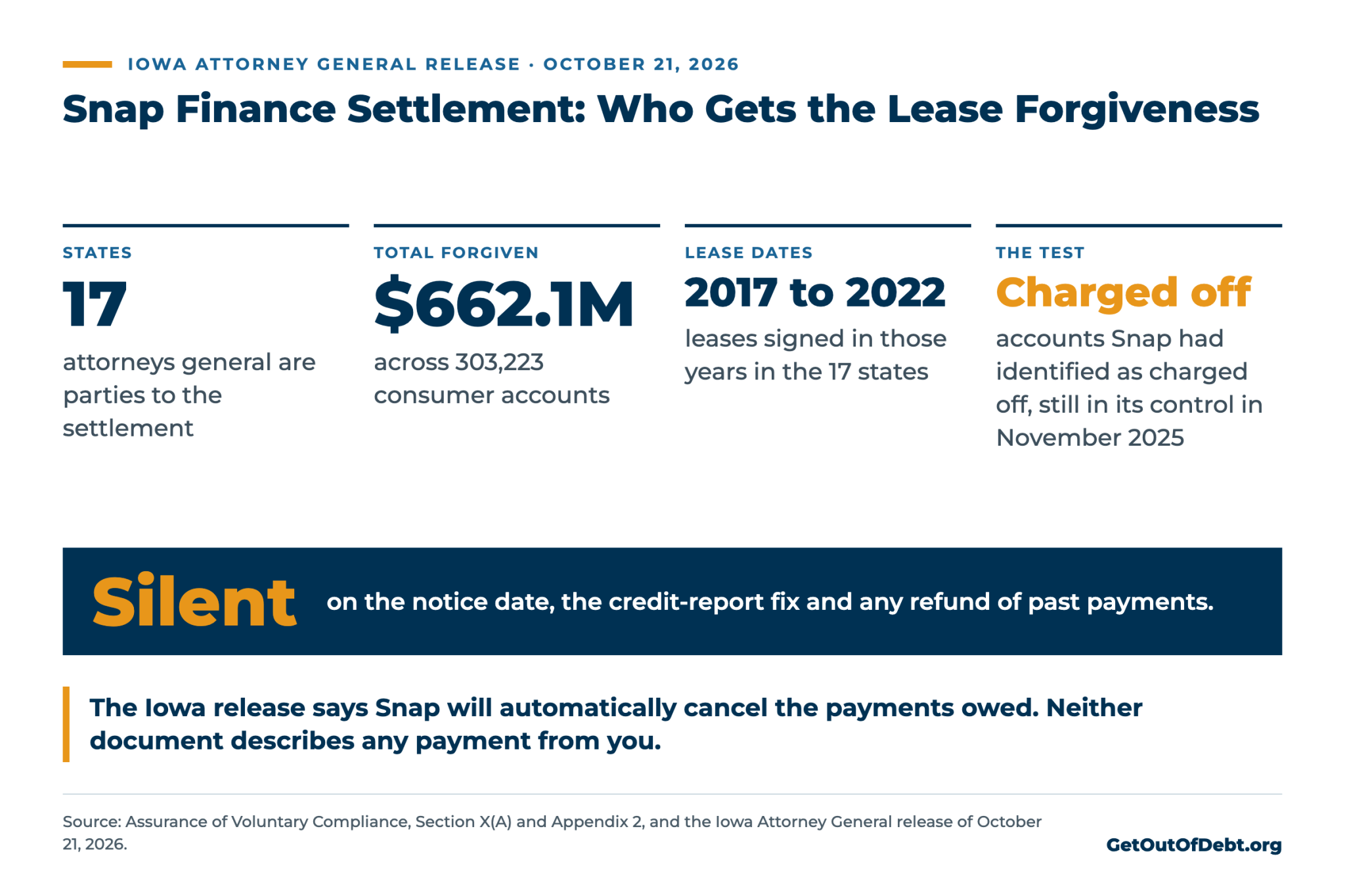
What the attorneys general announced, and what Snap says
Iowa Attorney General Brenna Bird announced that she is leading a coalition of 17 attorneys general. The Iowa Attorney General’s release describes the settlement as “nearly $664 million.” The settlement document (AVC) breaks that into two pieces: $662,102,518 in lease forgiveness for consumers and $2,750,000 that Snap pays to the states. The AVC defines the “Settlement Amount” as those two pieces added together, which comes to $664,852,518.
Here is what the states asserted, in the release’s own framing. These are allegations, not findings:
- The attorneys general said Snap used misleading disclosures about the nature of its leasing arrangements and did not let customers view the full terms of their contracts.
- The states asserted that some customers thought they were signing up for pay-back windows of 100 days or fewer but ended up in longer, more expensive contracts.
- The states say customers were told that leasing a product and making on-time payments could raise their credit score, and the states say customers had extreme communication problems when they tried to return products.
- The states said they investigated “potential bad debt collection practices” and a “potentially deceptive process” for returning products and ending leases.
Snap’s side, as the document records it: The release says Snap cooperated with the states’ investigation. The AVC says Snap is entering the agreement “without admitting or denying any factual allegations by the Attorneys General or admitting that it has violated the laws of any Participating State, the laws of any other state, and/or federal law.” Section XIV(G) adds that the agreement is not an admission, “does not constitute a finding of law or fact,” and that Snap “denies any liability or violation of law.” So when you read the claims above, keep both halves in view: the states said it, and Snap denies it. I am reporting what is in the documents, not deciding who is right.
Am I included? What the settlement text says
This is the part the headlines skip. Section X(A) of the AVC says Snap “will provide full lease forgiveness for Consumers who entered into RPAs in Participating States from 2017 to 2022 whose lease accounts were still in Snap’s control in November 2025 and were identified by Snap as in ‘charged off’ status.” Break that into the tests it contains:
- State: your agreement was entered into in one of the 17 participating states (table below).
- Dates: the agreement dates from 2017 through 2022.
- Control: the account was still in Snap’s control in November 2025. The AVC does not define “in Snap’s control.”
- Status: Snap had identified the account as “charged off.” The AVC does not say which date the charged-off status is measured on. My reading is that it is the same November 2025 snapshot, but the text does not say so.
If all four describe your account, Section X(B) says Snap will release its ownership of the merchandise to you. The Iowa release puts it as keeping and owning the merchandise “with no further payments.”
Who the text does not clearly cover: a lease that was still active and current, a lease signed outside 2017 to 2022, or an account that had left Snap’s control before November 2025 (for example, if it had been sold or placed elsewhere). The document does not say what happens to those. It also does not attach a list of the people covered. The fixed account counts in Appendix 2 suggest Snap has a defined list, but that is my inference, not something the AVC states.
| State | Accounts | Lease forgiveness |
|---|---|---|
| Arkansas | 9,352 | $18,449,844 |
| Florida | 62,753 | $135,643,677 |
| Georgia | 31,647 | $65,097,488 |
| Idaho | 1,846 | $3,404,135 |
| Iowa | 1,287 | $2,367,148 |
| Kansas | 2,996 | $5,143,468 |
| Kentucky | 6,046 | $12,313,492 |
| Louisiana | 6,259 | $13,249,796 |
| Mississippi | 4,266 | $8,467,609 |
| Missouri | 3,707 | $6,979,354 |
| Nebraska | 1,349 | $2,652,091 |
| North Dakota | 944 | $1,851,707 |
| Oklahoma | 9,439 | $18,050,323 |
| Texas | 148,295 | $344,486,039 |
| Utah | 8,913 | $16,758,262 |
| West Virginia | 2,505 | $4,442,388 |
| Wyoming | 1,619 | $2,745,697 |
| Total | 303,223 | $662,102,518 |
Source: AVC Appendix 2, “Lease Forgiveness by State.”
Do I have to do anything, and when will I hear?
The Iowa release says Snap “will automatically cancel” the lease payments owed. Neither the release nor the AVC describes a claim form, a deadline to apply, or a website to sign up on. On the how and when of being told, the settlement text is silent: I found no section that says how Snap must notify you, in what form, or by what date.
Here are the only dates in the document that I can point to:
- October 21, 2026: the effective date.
- Within 60 days of the effective date (about December 20, 2026): Snap must wire its $2,750,000 to the states (Section X(C)). That is the payment to the states, not a deadline for your forgiveness.
- 180 days after the effective date (about April 19, 2027, by my count): Snap’s deadline to put the non-monetary changes in place (Section IX(A)). The AVC does not attach this clock to the forgiveness.
So there is no date in the document by which your balance must be cancelled or by which you must be told. That is a real gap, and it is the first thing I would watch. What I would do: check the mail, the email address and the phone number tied to the old account, and log in to anything you still have with Snap. If you get a notice, keep it. If you are in a covered state and hear nothing, your own state attorney general is a party to the agreement and is the office to contact. Before sending another dollar on an old charged-off Snap account, I would ask Snap in writing whether the account is on the forgiveness list. In some states, a payment on an old account can restart the time limit to sue on it (I explain how here), so get Snap’s written answer first. A simple question to copy and paste: “Does Section X(A) of the Snap Finance settlement cover my account: a lease entered into in a participating state from 2017 to 2022, still in Snap’s control in November 2025 and identified by Snap as in ‘charged off’ status? Yes or no? If not, why not, and who holds the account now?” Don’t write anything that says you owe the balance or promises to pay, because in some states a written acknowledgment, not only a payment, can restart the time limit to sue. A “no,” or no answer, is not the end: take Snap’s writing to your state attorney general before you pay anything. Keep a copy of what you send and what they answer.
What happens to collections, credit reports and taxes?
Collections. Forgiveness applies to accounts “still in Snap’s control” in November 2025. The AVC does not say what happens to an account that Snap had already sold or placed with a collection agency, and it does not say whether Snap must recall those accounts. If a third-party collector contacts you about a Snap lease, you keep your normal collection rights. In writing, ask who owns the account and request validation. If a collector keeps pursuing an account after it was forgiven, that is worth a complaint to your state attorney general and to the CFPB. If you have been served with court papers on a Snap account, answer by the court’s deadline; the settlement does not say lawsuits stop. If Snap already has a court judgment against you or is garnishing you, ask Snap and your state attorney general in writing whether the forgiveness ends it, and do not assume it stops. My posts on what happens when a collector ignores a validation letter and on debt validation walk through it.
Credit reports. I searched the AVC for any term requiring Snap to delete a tradeline, update a balance, or ask the credit bureaus for changes. I did not find one. The only credit-related terms are advertising rules: Section IV(D) says Snap may not misrepresent that applying for or using its leases will help increase your credit rating. (The AVC’s definition of “Covered Conduct” mentions “consumer reporting practices,” but that defines what the states’ release covers, not an obligation to fix your report.) So whether a forgiven account shows a zero balance, shows as settled, or disappears is not answered by the document.
What I would do: pull your reports (I explain how free access really works here) and look for the Snap account. If it still shows a balance owed after you have been told the lease is cancelled, the CFPB explains how to dispute an error with the credit reporting company and with the company that supplied the information, in writing. Also remember that a charge-off by itself never meant the debt was forgiven. This settlement is the exception, and only for the accounts it lists.
Taxes. The AVC (Section X(D)) says that for purposes of the tax code, Snap’s $662,102,518 counts as restitution or remediation. That paragraph is about how Snap and the states report the settlement. It says nothing about how the IRS treats a forgiven balance in your hands, and calling the money “restitution or remediation” does not mean your forgiven balance is tax-free to you either. A rental-purchase balance may not be treated as canceled debt at all, so I am not saying the forgiveness is taxable income. The IRS says that in general, if your debt is canceled, forgiven, or discharged for less than the amount owed, the amount of the canceled debt is taxable, with exceptions; one is debt canceled to the extent you were insolvent. See Tax Topic 431, Canceled debt and Publication 4681. I cannot tell you how it applies to you. If a Form 1099-C arrives, take it to a tax professional, and ask about the insolvency exclusion (reported on IRS Form 982).
Free Tool — 1099-C Tax Calculator: Received a 1099-C for cancelled debt? The free 1099-C Tax Calculator runs the exact IRS insolvency math from Publication 4681 Worksheet 2 — and covers the partial insolvency case most people miss. Run the Calculator →
Is there a refund of what I already paid?
Not in the text I read. Section X(A) provides forgiveness of the lease account, and Section X(B) transfers ownership of the item. I found no provision paying back money you had already sent Snap on a forgiven account. The release describes the relief as cancelling the lease payments owed, not as sending checks.
Section VII does mention refunds, but those are conduct rules going forward: refunding renewal payments for property that was never delivered or that arrived damaged, and refunding payments made after you reported a repair problem if Snap cannot fix it and you choose to terminate and return the item. Snap has 180 days to put those in place. They are not a payout schedule for past customers.
One more point that matters. The release in Section XI is the attorneys general’s release of Snap. It lists “private rights of action, including any claims Consumers have or may have on an individual or class basis” as claims that are not compromised. Section XIV(P) also says Snap can raise defenses against any consumer. The AVC does not ask you to sign anything or give anything up to receive forgiveness. I am not a lawyer, and none of this says you have a claim. If you believe you lost real money, a consumer attorney can tell you.
What if the state isn’t on the list, or I’ve moved?
What counts is where the lease was entered into, not where you live today. Section X(A) covers consumers who “entered into RPAs in Participating States,” and Section II says the AVC applies “only to RPAs offered or executed in the Participating States.” So if your lease was entered into in a listed state, moving away later does not remove you, and if you moved into a listed state after signing somewhere else, that does not add you. One wrinkle: for online (e-commerce) leases, Section XIV(B) uses the state where the consumer resides to decide which state’s rental-purchase law applies, and the document does not spell out how that interacts with X(A), so if your lease was online and you are unsure, ask Snap and your state attorney general. Section XIV(X) says only the parties can enforce the AVC. The participating states are Arkansas, Florida, Georgia, Idaho, Iowa, Kansas, Kentucky, Louisiana, Mississippi, Missouri, Nebraska, North Dakota, Oklahoma, Texas, Utah, West Virginia and Wyoming. The document says nothing about leases entered into in other states.
If your lease was entered into somewhere else and you had a bad experience, you can file a complaint with your own state attorney general’s consumer protection office and with the CFPB. A complaint is how your state’s office hears about a problem. For context, here is my roundup of state attorney general consumer protection actions in early 2026.
The lease-to-own math I wish more people ran before signing
Debt is math wrapped in emotion, and lease-to-own is built to keep you in the emotion. The monthly or weekly payment feels small. The total is where the story is.
In a July 2001 release on its congressional testimony, the Federal Trade Commission said the total cost of buying through a rent-to-own transaction “is usually significantly higher than retail store prices,” and that its staff survey found 70% of rent-to-own merchandise was ultimately purchased by the customer. A Congressional Research Service report (updated April 2007) put it this way: “The total of the installment payments can be two to three times (sometimes more) the retail price of the item.” Its example, from testimony at a hearing, was a television with a $300 retail price on a rent-to-own plan of $16 a week for 52 weeks: a $832 total, roughly 2.8 times the retail price, or $532 more, with an effective APR of about 254%. That is an old example and not Snap’s pricing, but the arithmetic is the point.
The AVC bears on this. Snap must disclose the Total Cost in the agreement (Section V(D)) more prominently than any lower Early Purchase Option price, and it may not advertise that you will only pay the cash price (Section IV(A)). Those rules apply in the 17 states and, per Section XIV(F), run for five years. Here is the three-line calculation I would do on any lease-to-own offer:
Your numbers:
1. Find the Cash Price and the Total Cost in the agreement.
2. Total Cost ÷ Cash Price = the multiple you are really paying.
3. Total Cost − Cash Price = the dollars you pay for the privilege of paying later.
If you are still in a lease right now
- Find the three numbers: Cash Price, Total Cost and the Early Purchase Option window. Run the math above.
- Ask for the Early Purchase Option payoff in writing, with the date it expires. The AVC defines the EPO as a discount on the remaining total, which can cost less than paying out the full term if you want to keep the item.
- Know your right to terminate. Section VIII says Snap must disclose it, may not mislead you about it, and must promptly give you surrender options (the AVC’s examples include a prepaid shipping label or pickup). Your state’s rental-purchase statute (Appendix 1 lists each one) controls the details, including whether overdue payments must be paid first. Giving the item back means giving it back, so decide with open eyes.
- Keep records. Save the agreement, every payment confirmation and every message. Only the parties to the AVC (Snap and the participating states) can enforce it, so your records are what you will attach to a complaint if things go wrong.
- Do not stop paying on purpose hoping to land in the forgiveness group. The document’s numbers are fixed account counts for 2017 to 2022 leases, and a missed payment brings its own consequences. That is my opinion, not a term of the settlement.
If a lease is one of many debts you are drowning in
In my experience, a Snap lease rarely travels alone. The same budget that needed a lease-to-own couch or laptop usually has a credit card, a medical bill and a payday loan stacked beside it. A forgiven $2,000 lease is real relief, but it does not fix the math that put you there.
My published ratings of debt options are blunt: bankruptcy comes out ahead on credit, collections, speed and protecting your retirement. I filed bankruptcy in 1990, so that comes from more than theory. Bankruptcy is not right for everyone, which is why I want you to run your own numbers instead of taking my word for it. Start with the debt options calculator and the 2-minute bankruptcy quiz, and talk to a bankruptcy attorney in your state if the numbers point that way. Deal with it and look to the future rather than spend five years repairing the past.
How to spot a fake “Snap settlement” call or text
Big settlements attract impersonators. These are the red flags I would treat as a hang-up-and-verify moment. They describe what impostors do, not anything Snap or the attorneys general are doing.
- Anyone asking you to pay a fee, buy a gift card, or send a wire to “unlock” or “process” your forgiveness. The release describes the cancellation as automatic, and neither document describes any payment from you.
- A text or call demanding your bank login, card number or Social Security number to “verify eligibility.”
- A claim link or deadline. Neither document describes a claim form or an application deadline.
- Pressure and threats: “act in 24 hours” or “you will lose your forgiveness.”
If you get one, do not call back the number or click the link in the message. Go to the Snap account, app or website you already use, or to your state attorney general’s website, and look up the contact there yourself. You can report impostors at ReportFraud.ftc.gov. If you are unsure about any company that contacts you, check it with the Scam-O-Meter first.
Key Takeaways
- The AVC provides $662,102,518 in lease forgiveness for 303,223 accounts in 17 states, per Section X(A) and Appendix 2.
- The text limits forgiveness to leases from 2017 to 2022 still in Snap’s control in November 2025 and marked “charged off.” The news headline is broader than that.
- The Iowa release says it is automatic and you keep the merchandise. The AVC does not say how or when you will be notified.
- The AVC says nothing about deleting credit-report entries, collector accounts that left Snap, taxes on your side, or refunds of money already paid.
- The Iowa release says Snap cooperated; Snap did not admit wrongdoing and denies liability, and the allegations are the states’, not court findings.
- No one with a real settlement should ask you for a fee or your bank login.
The Bottom Line
If you signed one of these leases in the 17 states between 2017 and 2022 and the account was charged off, a sizeable balance may be about to disappear without you lifting a finger. That is worth knowing, and it is worth watching for, because the documents give no date and no notice process. Do not let the headline do your thinking. Check your mail, check your credit reports, keep your paperwork, and hold on to a healthy suspicion of any call or text that arrives before the real notice does. And if you are still in a lease, run the Total Cost math today. That one calculation is the part nobody can forgive for you.
Frequently Asked Questions
Do I have to file a claim to get my Snap Finance lease balance cancelled?
The Iowa Attorney General’s release says Snap will automatically cancel the lease payments owed, and neither the release nor the settlement document describes a claim form or application deadline. The document also does not say how Snap will notify you. Be careful with anyone who tells you that you must pay, or click a link, to claim it.
Who is included in the Snap Finance settlement?
Under Section X(A) of the settlement document, forgiveness goes to consumers who entered rental-purchase (lease-to-own) agreements in one of 17 states (Arkansas, Florida, Georgia, Idaho, Iowa, Kansas, Kentucky, Louisiana, Mississippi, Missouri, Nebraska, North Dakota, Oklahoma, Texas, Utah, West Virginia and Wyoming; what counts is where the lease was entered into, not where you live now) from 2017 to 2022, whose accounts were still in Snap’s control in November 2025 and were identified by Snap as “charged off.” Appendix 2 puts the total at 303,223 accounts.
Will I get a refund of the money I already paid Snap?
I found no refund of past payments on forgiven accounts in the settlement text. Section X provides forgiveness of the lease balance and transfers ownership of the item to you. The refund language in Section VII covers future conduct, such as undelivered or damaged property, not payments to past customers.
Will the settlement remove the Snap account from my credit report?
The settlement text does not require Snap to delete a credit-report entry or update it with the bureaus. Its credit-related terms are advertising rules. Check your reports after you receive notice, and if a balance still shows, you can dispute it in writing with the credit reporting company and with Snap, following the CFPB’s steps.
How can I tell a real Snap settlement notice from a scam call or text?
The release describes the forgiveness as automatic, and neither document describes a fee, a claim link, or a request for your bank login or Social Security number. Anyone asking for those is a red flag. Do not use the contact details in the message; look up Snap or your state attorney general yourself and report impostors at ReportFraud.ftc.gov.
If you know someone who has ever used a lease-to-own option at a store checkout, send them this page. A settlement only helps the people who find out about it.
That is what I am seeing in the documents and what I would tell my own family over coffee. But remember, you do you: take this as input, not instruction, because only you know your own situation and nobody gets to tell you what to do with your money.
Dealing With Debt? Understanding your options is the first step. See how all your debt relief options compare — including ones most sites won’t tell you about. The Find Your Path quiz gives a recommendation based on your actual numbers, and the Scam-O-Meter checks any company’s complaint history before you sign. Federal Reserve Bank of New York research shows bankruptcy filers recover faster than those who don’t file.



