

Quick Answer: The New York Attorney General’s T-Mobile settlement covers T-Mobile ONE accounts billed in New York that signed up between January 1, 2017 and April 30, 2019 and were still on that plan when prices went up in 2024. There is no claim form, but you do have to make choices. On October 20, 2026, the AG’s office announced the deal, and the signed document says T-Mobile must send each covered account a notice on a “Notification Date” that is no later than 150 days after October 20 (March 19, 2027, by my count, and it can come sooner). Your 45 days to choose run from the Notification Date, with 5 extra days for a notice sent by mail (if yours comes by mail, act on the date printed on it right away rather than counting on the full window). If you cancel, T-Mobile pays your last month’s recurring charge, and accounts with a line T-Mobile’s records show on less than 5G also get a $25 cash card. If you stay, T-Mobile commits not to raise your monthly recurring charge before May 30, 2029, and only while you stay on that plan; accounts with a line on less than 5G can also pick a 5G phone, free only for certain devices the document values at up to $250 and otherwise with a $150 credit. An account with incomplete device information gets neither the card nor the phone offer. T-Mobile neither admits nor denies the AG’s findings.
Expert Context: I have covered company settlements and refund programs, and the fake versions that imitate them, on this site for years, and I have been writing about consumer money traps since 1994.
The New York Attorney General says T-Mobile told customers in 2017 that it would “never change the price you pay” on certain plans, and then raised those prices by about $5 a line in 2024. T-Mobile did not admit that and did not deny it. I read the settlement document itself, so here is what it gives people, what it leaves out, and what to do before you pick.
What the New York AG Says Happened
Everything in this section is the Attorney General’s account, taken from the October 20, 2026 press release and the Assurance of Discontinuance (the settlement document, No. 26-042). The AG’s findings say that from January 2017 through April 2019, T-Mobile offered a price guarantee on certain T-Mobile ONE plans on its 4G network, and that its 2017 press releases and a January 2017 video interview with its then CEO included the statements that T-Mobile “will never change the price you pay” and that the offer “abolishes price hikes.”
The AG says New York consumers enrolled in approximately 252,957 of those plans, many with more than one line, and that in May and/or June 2024 T-Mobile raised prices on certain New York customers by about $5 per line, an average of $12 per account, including customers on those plans. The AG’s press release says T-Mobile “hid terms in fine print on its website that supposedly gave it the right to raise customers’ rates,” and the findings conclude that any disclaimers were ineffective because they contradicted what a reasonable consumer would understand the offer to mean or were not clear and conspicuous.
Here is T-Mobile’s side, as the document states it. Paragraph 8 says T-Mobile “neither admits nor denies” the findings, and paragraph 42 says nothing in the document is an admission of liability. T-Mobile’s own draft customer notice, attached to the document, describes the 2024 change as “small adjustments” to its oldest rate plan prices “in response to rising costs and inflation.” This is an agreement with the AG’s office, not a court ruling, and the document is the only T-Mobile-side wording I have seen.
Who Qualifies, in the Document’s Own Words
The document defines “Covered Accounts” narrowly. As written, an account has to meet all three tests:
- Billed in New York. The document covers “wireless accounts billed in New York” and says nothing about any other state. It does not define the phrase further.
- Signed up for a T-Mobile ONE plan between January 1, 2017 and April 30, 2019.
- Still on that T-Mobile ONE plan at the time of the 2024 price increase.
Covered accounts then split into two groups, based on what T-Mobile knows about your phones as of October 20, 2026:
“Upgrade Eligible” Accounts
At least one line is known to T-Mobile to be on less than 5G service. These accounts get the full menu below, including help with a 5G phone for each such line.
“Upgrade Ineligible” Accounts
Every line is on 5G, or T-Mobile has incomplete device information for the account. These accounts get the cancel option and the price freeze, but no phone offer and no $25 cash card.
What the document does not say: whether someone who left T-Mobile after 2024 and before October 20, 2026 is covered. The definition looks at the plan you were on in 2024, but the notice and benefits are written for people with a current account, so I cannot tell from the document. If that is you, ask T-Mobile and save its answer in writing.
One more thing to watch. If you know a line is on less than 5G and your notice has no phone offer or $25 cash card (the document’s draft notice for “Upgrade Ineligible” accounts leaves both out), challenge it in writing, to T-Mobile and to the New York AG through its complaint form. The document does not describe any way to dispute the classification, so a dated written challenge is your record. Note now which of your lines are on 4G, and screenshot your device list.
Automatic, or Do I Have to File Something?
The document contains no claim form. What it describes is a notice and a choice:
- T-Mobile sends the notice to every email address it has on the account. If there is no email address, or the email bounces, it mails the notice instead, and mailed notices get 5 extra days to respond. If your notice comes by mail, act on the date printed on it right away rather than counting on the full window.
- The notice goes out on the “Notification Date,” which paragraph 13 defines as “the date, no later than 150 days after the Effective Date, on which T-Mobile provides Covered Accounts initial Notice” of the benefits. By my count, 150 days after October 20, 2026 is March 19, 2027. That is only the last day T-Mobile may send it, and the notice may come much sooner. T-Mobile also has to put a reminder on the first bill after that date.
- Your 45 days run from the Notification Date, the day T-Mobile sends the notice, not from March 19 and not from today. The draft notices in the document show a “[DATE]” deadline, so the real one should print your actual date; write it on a calendar the day it arrives.
- The draft notice in the document tells you to click a button that gives you a phone number or to call T-Mobile’s care team.
So there is no claim form, but the cancel payment and the phone are things you choose, and the clock starts at the Notification Date. What happens if you do nothing? The document does not say in so many words. Paragraphs 21 and 22 give the price commitment to accounts that “choose not to cancel,” and the draft notice says T-Mobile is pledging not to raise the monthly recurring charge “as long as you stay on that plan.” The phone offer is “available for 45 days after the Notification Date,” and the document does not say what happens after that, so ask T-Mobile before assuming it is gone. Nothing in the document says you must reply to keep the price commitment, and it is silent on what the account looks like once the 45 days end. Do not click “cancel” just to lock something in, because cancelling is the one choice that ends your service. If you want the commitment confirmed, ask T-Mobile to put it in writing.
Cash, Credit, or a Phone? What You Actually Get
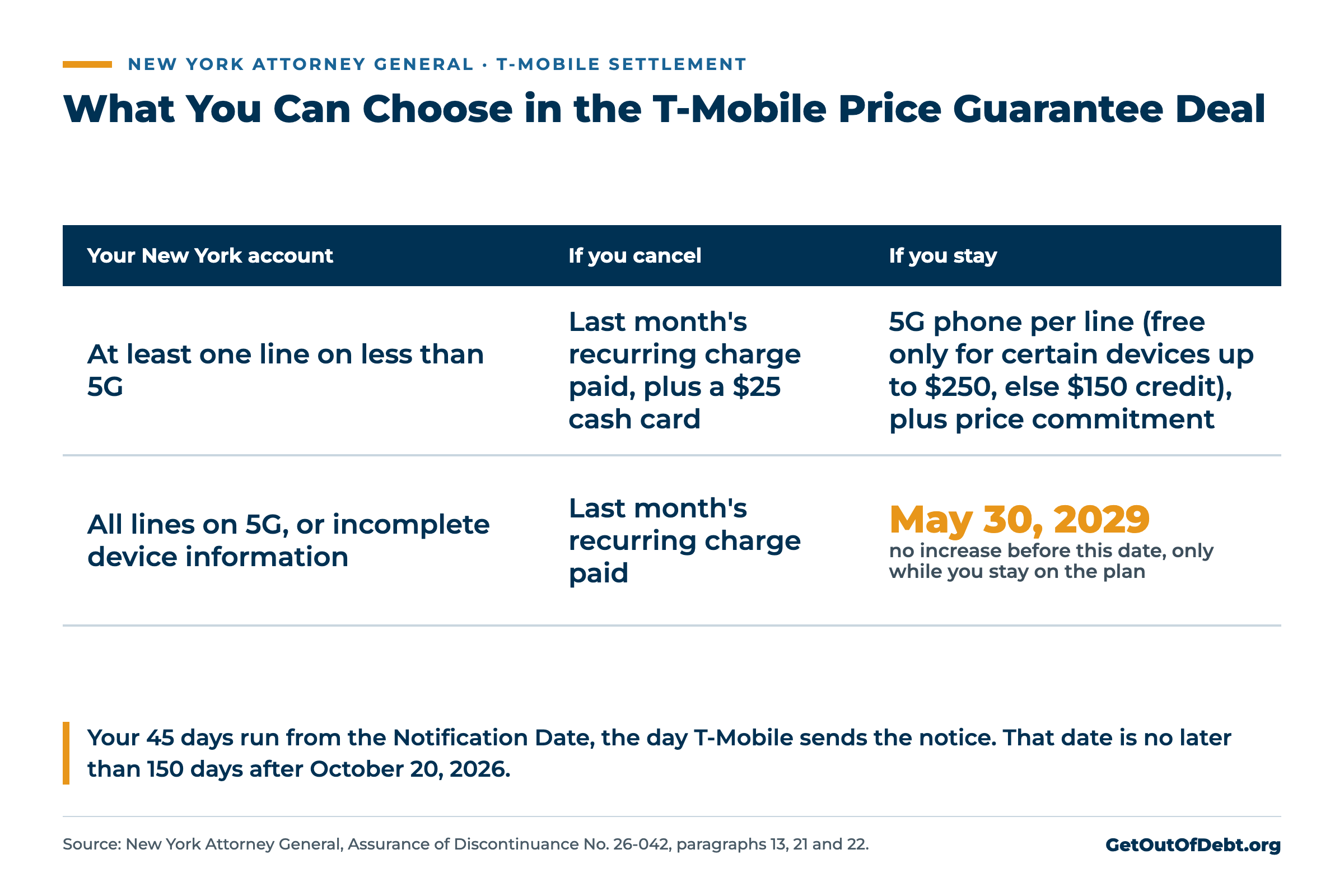
- Accounts with a line on less than 5G, if you cancel: T-Mobile pays your last month’s recurring charge and gives you a $25 cash card. The document defines the card as usable like cash at any retail store, with no fees and no expiration date. (The press release calls it a “gift card”; I am going with the document’s wording.)
- Same accounts, if you stay: for each line T-Mobile’s records show on less than 5G you can pick a 5G phone. Only certain devices valued up to $250 are free; for other devices you get a $150 credit. The document says no switching, transfer or activation fees apply to the upgrade. Do not accept a phone yet, and do not add or remove a line, until you have asked T-Mobile in writing (a) whether a new installment plan or a lost promotion credit attaches, and (b) whether it keeps you on the protected plan. The document does not say either. You also get the price commitment.
- All-5G accounts, or accounts with incomplete device information: cancel and T-Mobile pays your last month’s recurring charge, or stay and get the price commitment. That is all the document lists.
- The price commitment: T-Mobile commits not to raise the monthly recurring charge on your current plan before May 30, 2029, and only while you stay on that plan. T-Mobile may rename or recategorize the plan behind the scenes as long as the monthly recurring charge does not go up.
What the Document Leaves Unsaid: It does not say how “last month’s recurring charge” is paid (a check, a bill credit or a refund to your card; the press release says “refund,” the document says “payment”). It does not say whether the $150 credit hits one bill or is spread over months, or whether a new phone comes with a new installment plan. It does not say whether the price commitment covers taxes, fees or add-ons, since it names only the “monthly recurring charge” on your current plan. It does not say whether the cancel payment affects a device balance. And I find nothing in paragraphs 21 and 22 that refunds the increases you already paid. When the real notice arrives, read those exact points before you click.
How Much Is It Worth?
The press release says the options are “expected to provide up to more than $38 million in value.” That is the AG’s figure, it is an “up to,” and the document does not show how it was built, so I am not dividing it by anything. The roughly $98,800 payment ($98,834.75 in paragraph 26; the press release rounds it to $98,000) goes to the State of New York, not to customers.
The Math, For Scale Only: The AG’s findings say T-Mobile raised prices by approximately $5 per line and “an average of $12 per account.” The document does not say “per month” for either number. Because these are recurring plan charges I read them as monthly, but that is my reading, not the document’s. If the $12 is monthly, it is $144 a year, and about 28 months from June 2024 to October 2026 would be about $336. If it is not monthly, none of that math holds. The $12 is also an average across the customers the AG describes, not necessarily your account, so check your own bills. Either way, the benefits above are a last month’s bill, a $25 card or a phone, and a price commitment. They are not a refund of what the increase already cost.
Before You Do Anything: Pull Your Paperwork
A price-lock promise is only as good as the paperwork you saved. This is the lesson I would take from this case even if you are nowhere near New York. The AG says T-Mobile’s promise lived in press releases, a CEO interview and a website, which is exactly the kind of thing that disappears. Whatever promise you are relying on, from any company, get it in writing and keep a copy. Here is what I would gather for this one:
- Your plan name and sign-up date. The document’s window is January 1, 2017 to April 30, 2019, on a T-Mobile ONE plan. Old bills and emails usually show both.
- Bills from before and after May and June 2024. Look for the jump. The AG puts it at about $5 per line.
- Anything T-Mobile sent you about the 2024 change, and any screenshot or printout of the price-guarantee wording from when you signed up.
- A list of your lines, which are on 4G or 5G, and what you still owe on each device.
- The notice itself when it comes. Save the email or the mailed copy, and write the deadline on a calendar the day it arrives.
Paragraph 19 of the document also says T-Mobile will honor a price guarantee unless the customer “agrees in writing” to modify it based on clearly disclosed terms. The document does not define “in writing,” so read anything that asks you to agree to new terms, and do not click through it.
Before You Switch Carriers to Escape a Hike
Cancel is one of your choices, and for some people it is the right one. Do the math first, because walking away from a $5-a-line increase can cost you far more. T-Mobile’s own cancel-service page says that if the entire account is canceled, any remaining device balances become due on your final bill, that promotional credits tied to canceled lines may end, and that unpaid balances may be subject to collections activity. The settlement document says nothing about waiving a device balance.
Two more things before you leave. The usual advice, which I would confirm with your new carrier, is not to cancel until your number has been ported to the new carrier, because T-Mobile’s page says that after a cancellation, if you reactivate, “your previous number may not be available.” And ask T-Mobile in writing whether porting your number out counts as “cancel” for the last-month payment and the $25 cash card. The document does not say, and T-Mobile’s page says that if you port your number, service is billed through the end of the billing cycle.
Here is a made-up example, so you can see the shape of it. Say a phone has $600 left on its installment plan and a promotional credit still has 12 months to run. Cancel the whole account and, per T-Mobile’s page, the $600 becomes due on the final bill while the credits tied to those lines may stop. A $25 card and a paid last month do not cover that. If a final bill like that goes unpaid, see what happens when a phone bill goes to collections. Look at your device balances and your bill credits first, then decide.
Spotting a Fake “T-Mobile Refund” Text
Real settlements tend to attract imitators, so treat any unexpected “claim your T-Mobile refund” message as unverified until you check it yourself. This is what the document tells you about the real notice:
- The document names email, then U.S. mail, plus a reminder on your first bill. It does not name text messages as a channel. That does not prove T-Mobile will never text you, but it means a text is not what the document promises, so treat it as unverified.
- The timing is built around weeks, not hours. The notice can go out any time up to March 19, 2027, and your 45 days run from the day it goes out. A message demanding action within hours does not match that.
- Nothing in the document asks you to pay. It says the $25 cash card carries no fees or conditions, and that no switching, transfer or activation fee applies to the phone upgrade. Anyone asking you to pay to receive a benefit is contradicting the document.
- Check from your side, not theirs. The FTC says “Legitimate companies won’t ask for information about your account by text” and advises contacting the company using a phone number or website you know is real. Log in to the T-Mobile app or website you already use, or call the number on your bill. If it is junk, forward it to 7726 (SPAM) and report it at ReportFraud.ftc.gov, per the FTC’s guidance on spam texts.
For the general version of this, see my guides on telling a real settlement notice from a fake one and refund-approved text scams, and run any unfamiliar company through the Scam-O-Meter.
If You Are Outside New York, or Never Get the Notice
This document binds and benefits accounts billed in New York. It is silent on every other state, so do not assume you are covered, and check your own state attorney general’s website. If you are in New York and no notice arrives, you can file a complaint with the AG’s office. The document also requires T-Mobile to send the State two reports, 30 and 90 days after the notice date, on its notice efforts and how many accounts accepted each benefit. And one more point on rights: paragraph 31 says nothing in the document deprives any person of any private right, and the document does not ask you to sign away your own claims. I am not a lawyer, so if your own losses are bigger than this deal, talk to one before you accept anything.
My Take
This is my opinion, separate from the AG’s findings above. Debt is math wrapped in emotion, and a $5-a-line increase is exactly the kind of thing that stirs the emotion and hides the math. When the notice arrives, put three numbers side by side: what you get to stay (no price increase before May 30, 2029 while you stay on the plan, and maybe a phone), what you get to leave (a last month’s charge and maybe $25), and what leaving would cost you (device balances, lost credits, and a new plan’s price). On an older plan, that price commitment can be worth more than a phone. I cannot know your plan, so do your own numbers. And no sense wasting a perfectly good mistake: whatever you are promised next, save it in writing.
Key Takeaways
- Covered accounts are T-Mobile ONE accounts billed in New York, signed up January 1, 2017 to April 30, 2019, and still on that plan in 2024.
- There is no claim form, but you choose within 45 days of the Notification Date, the day T-Mobile sends the notice, which can be as late as March 19, 2027 and may be sooner.
- Accounts with a line T-Mobile’s records show on less than 5G can get a $25 cash card if they cancel, or a 5G phone if they stay (free only for certain devices valued up to $250, otherwise with a $150 credit). Accounts with incomplete device information get neither.
- T-Mobile commits not to raise your monthly recurring charge before May 30, 2029, and only while you stay on that plan.
- T-Mobile neither admits nor denies the AG’s findings, and the benefits do not refund the increases already paid.
- Check device balances and bill credits before you cancel. The usual advice, which you should confirm with your new carrier, is not to cancel before your number is ported, and ask T-Mobile in writing whether porting out counts as “cancel” for the last-month payment and the $25 cash card.
- The document does not name texts as a notice channel, so treat any text about this as unverified, do not use its links or phone numbers, and check the T-Mobile app or the number on your bill.
The Bottom Line
If a price that was supposed to hold went up, being annoyed about it is reasonable, and you are not foolish for having trusted a promise. The settlement gives New York customers a real choice, and the paperwork you save now decides how well you can use it. You are not your phone bill. Gather the documents, read the notice slowly when it arrives, and make the decision that fits your math.
Frequently Asked Questions
Who qualifies for the New York Attorney General’s T-Mobile settlement?
According to the settlement document, accounts billed in New York that signed up for a T-Mobile ONE plan between January 1, 2017 and April 30, 2019 and were still on that plan at the time of the 2024 price increase. The document says nothing about other states.
Do I have to file a claim, and what is the deadline?
The document contains no claim form. T-Mobile must send a notice by email (or by mail if there is no working email) on a Notification Date that is no later than 150 days after October 20, 2026, which is March 19, 2027 by my count, and it can come sooner. Your 45 days to choose run from the Notification Date, with 5 extra days if the notice came by mail; if yours did, act on the date printed on it right away rather than counting on the full window.
Is it a cash refund or a bill credit, and what about former customers?
The document says T-Mobile will pay your last month’s recurring charge if you cancel, plus a $25 cash card for accounts with a line on less than 5G. It does not say how the last month’s payment is delivered, and it does not say whether customers who already left are covered. It lists no refund of the increases already paid.
How much is the T-Mobile settlement worth?
The New York Attorney General says the reimbursement options are expected to provide up to more than $38 million in value. The document gives no per-person amount, and T-Mobile’s separate $98,834.75 payment goes to the State of New York.
How do I spot a fake T-Mobile refund text?
The document names email, mail and a first-bill reminder, not text messages. The FTC says legitimate companies will not ask for account information by text. Do not click, contact T-Mobile through the app or the number on your bill, forward the text to 7726 and report it at ReportFraud.ftc.gov.
Sources
- New York Attorney General press release, October 20, 2026
- Assurance of Discontinuance No. 26-042, In the Matter of T-Mobile USA, Inc.
- T-Mobile cancel service support page
- FTC: How to Recognize and Report Spam Text Messages
This is what I’m telling friends like you over coffee. But remember, you do you, and only you can decide what is right for your situation. Take what I have said as input, not instruction.
Know someone in New York who has had a T-Mobile plan since 2017 or 2018? Send them this before the notice shows up, so they know what to save and what to ignore.
For more stories like this, sign up for my free weekday email, Your Money Actually.
Dealing With Debt? Understanding your options is the first step. See how all your debt relief options compare — including ones most sites won’t tell you about. The Find Your Path quiz gives a recommendation based on your actual numbers, and the Scam-O-Meter checks any company’s complaint history before you sign. Federal Reserve Bank of New York research shows bankruptcy filers recover faster than those who don’t file.



