

Written by Steve Rhode, consumer debt expert for more than 30 years • Last updated October 21, 2026
Legal status verified as of October 21, 2026: the CFPB’s medical-debt credit-reporting rule (published January 14, 2025) was set aside and vacated by a federal court on July 11, 2025, so it is not in force, and the credit bureaus’ own medical-debt policies are voluntary, not law.
Quick Answer: Don’t pay the collector yet, and don’t wait for the insurance company to sort it out on its own, because nobody is working your file unless you are. Write down your deadlines first, because several clocks can be running at once: the collector’s 30-day window to dispute in writing (15 U.S.C. § 1692g), which runs from when you got its notice, so use the end date printed on it, because it may already be nearly over; your plan’s appeal deadline; and any court date. Then put your Explanation of Benefits (EOB) next to the bill and go after the right party: the hospital if it billed wrong, your plan if it paid wrong.
Where this topic came from: Conversations in my free Ask Steve chat keep raising situations like this: a hospital bill someone believes their insurance should have paid, never corrected, and then handed to a debt collector. I’m not giving away any personal information here — I never do — but when real questions show me a gap worth covering, I write the answer for everyone. If something like this is happening to you, ask me about it in the chat. It’s free, it’s private, and I’m not selling anything.
What Just Happened to Your Hospital Bill
Here is the part that makes this so maddening: a hospital bill is not one decision. The hospital sends a claim to your plan, the plan decides what it covers and sends you an EOB, and only then does the hospital bill you for what’s left. Any one of those steps can go wrong without anyone telling you. The CFPB warns that “a small mix up can lead to big bills for expenses that your insurance should have covered”: a charge for the wrong service, an out-of-date insurance card on file, or a claim that never reached the plan.
When the bill isn’t corrected and nobody answers, the hospital’s billing office can hand the account to a collection agency. That is where the letter in your hand came from. The collector is the messenger. The people who can actually fix the problem are the hospital and your plan.
One honest caution before you aim your anger anywhere. “Insurance should have paid 100%” is true in some situations and false in others, and your EOB is what tells you which one you’re in. Here is where it is real:
| Situation | What the rule says | The catch |
|---|---|---|
| Routine preventive care (screenings and immunizations on the federal preventive list), from an in-network provider | A plan generally may not charge a copayment, coinsurance or deductible for the preventive service itself (45 C.F.R. § 147.130). | The office visit can carry cost-sharing if it is billed separately or wasn’t mainly for the preventive service, and grandfathered plans are exempt. HealthCare.gov says “$0 cost isn’t guaranteed in all cases.” |
| You have reached your plan’s out-of-pocket maximum | After you spend that amount on deductibles, copayments and coinsurance for in-network care, your plan pays 100% of covered benefits. | Premiums, services your plan doesn’t cover, out-of-network care and costs above the allowed amount don’t count toward it. |
| Emergency room care from an out-of-network hospital or out-of-network ER doctors | Under the No Surprises Act they may not bill you more than your plan’s normal cost-sharing for those services (45 C.F.R. § 149.410). | That limit is your ordinary copay or coinsurance, not $0, and there are narrow notice-and-consent exceptions for post-stabilization care. CMS also lists non-emergency care related to a visit to an in-network hospital or surgical center, and air ambulance. CMS says ground ambulance services currently aren’t covered by those protections, though state law may limit what they can charge. |
| You went to an in-network provider | The bill generally should not be more than the “you owe” amount on your EOB. CMS describes balance billing as what can happen when a provider is out of network and charges more than the plan’s allowed amount. | Contracts and state law vary, so if the bill is higher than the EOB’s “you owe” line, ask the hospital and your plan in writing why. Match each bill to its own EOB: CMS notes you can get a separate EOB for each type of service when more than one provider treated you, and the CFPB notes that some providers who bill you directly may be associated with the hospital where you were treated, such as an anesthesia or radiology group. |
| You have Medicaid, and the provider accepts Medicaid | A state Medicaid plan must limit participation to providers who accept the agency’s payment, plus any deductible, coinsurance or copayment the plan requires, as payment in full (42 C.F.R. § 447.15). | You can still owe a required Medicaid copay, and the rule is about covered services. Ask whether the provider billed Medicaid. |
| You are a Qualified Medicare Beneficiary (QMB) | CMS says Medicare providers and suppliers must not bill QMBs for Medicare Part A or Part B cost sharing, and must remedy any QMB billing or collections. | The rule covers Part A and Part B cost sharing. Tell the provider and the collector in writing that you are a QMB. |
| A billing mistake: the wrong service or procedure, wrong dates, wrong or old insurance information, or a claim that was never sent | Once the claim is corrected and the plan reprocesses it, the amount you owe can change. | You have to get the hospital to correct it and the plan to reprocess it. The mistake doesn’t fix itself because it is obviously wrong. |
| A deductible you haven’t met, a copay or coinsurance, a service the plan doesn’t cover, or non-emergency out-of-network care | The plan may owe nothing, and the bill may be right. | Your EOB shows the amount you owe, if anything. If it matches the bill, your tools are financial assistance and negotiation (Path 3 and 4 below), not a billing dispute. |
The Mistake You’re About to Make: Picking one of the two easy moves. Paying the collector “to make it go away” can mean paying for something your plan owed, and on an old debt, in some states a payment can also restart the time limit to sue. The CFPB says debt collectors can’t demand charges you don’t actually owe, such as services you didn’t receive, inflated charges, or bills already paid. Ignoring it because “insurance will fix it” is the other trap: the collector’s dispute window is short, and the plan’s appeal clock keeps running while the letter sits in a drawer. Get the paperwork first. Pay second, and only the amount that turns out to be right.
Your Options Right Now
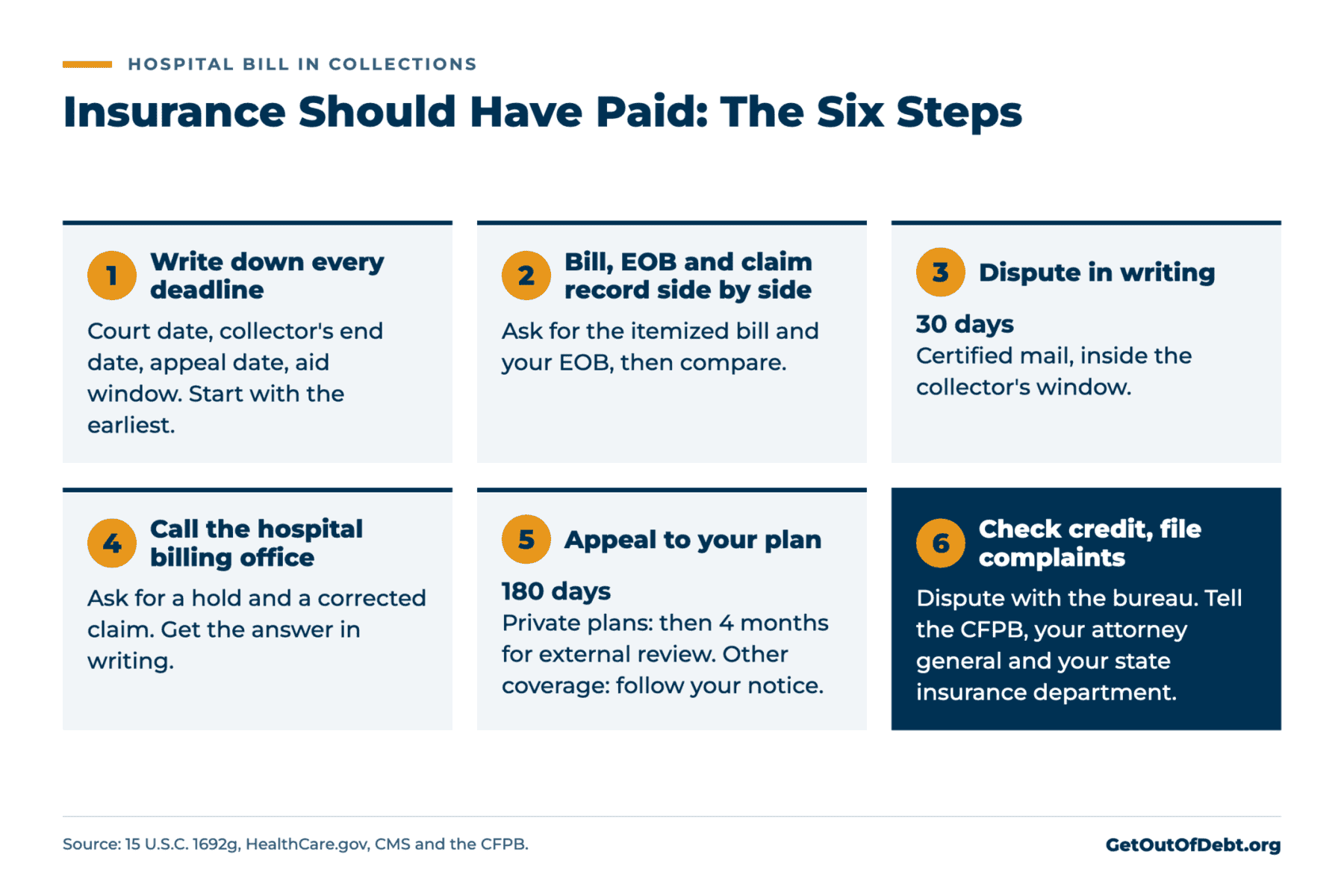
Start with step 1. Then work the steps in the order your deadlines fall, which may not be top to bottom.
What to Do in the Next 48 Hours
- Write down every date that applies, then work whichever expires first. Several clocks can be running at once, and they did not start on the same day. (a) The court’s answer date, if you were served with court papers: a collection letter is not a lawsuit, the answer deadline is its own clock, and you should not assume a dispute letter stops it; see what to do if you’re being sued for medical debt. (b) The validation end date printed on the collector’s notice: the validation period ends 30 days after you receive the validation information, and the collector may assume you received it five days (not counting weekends and federal holidays) after it was provided (12 C.F.R. § 1006.34(b)(5)). A written validation notice has to state that end date (§ 1006.34(c)(3)), so use the date printed on it. (c) The appeal deadline on your insurer’s denial notice or EOB, which for private plans is generally 180 days from the denial notice (step 5). It can be the shortest clock on your list, especially if the denial came months before the collector’s letter. (d) If the hospital is a nonprofit, the 240-day financial-assistance window, counted from your first post-discharge bill (26 C.F.R. § 1.501(r)-1). Whatever date comes first is where you start, and a date you have already passed is a reason to move today, not to give up.
- Put the bill, the EOB and the claim record side by side. Ask the hospital for an itemized bill. The CFPB calls it a “superbill”: each procedure code, the amount your insurance paid and the amount you owe. Get your EOB from the plan. CMS says you should get an EOB before the provider’s bill, and that if you never got one, you should contact your plan to make sure your provider’s office or facility sent a claim. Then compare the services, the dates and the “you owe” line. You can also ask in writing for what was billed and how the plan processed it: federal privacy law gives you a right of access to a hospital’s billing records and a health plan’s claims records, and they must act on your request within 30 days, with one possible 30-day extension (45 C.F.R. § 164.524).
- Dispute the debt with the collector in writing, by certified mail, inside the window. If you notify a debt collector in writing within the 30-day period that the debt, or any part of it, is disputed, the collector must stop collecting that amount until it mails you verification (15 U.S.C. § 1692g(b); 12 C.F.R. § 1006.38(d)(2)). A phone call doesn’t trigger that pause. Say something simple: “I dispute this debt. My insurance should have paid this claim and it is under review. Send me verification.” My free Debt Validation Letter Generator writes the letter. The pause buys time for steps 4 and 5; it is not a ruling on whether you owe. And if you miss the window, the law says failing to dispute can’t be treated by a court as an admission you owe it (§ 1692g(c)). One limit: this applies to collection agencies and debt buyers. A hospital’s own billing office collecting in its own name is generally outside the FDCPA’s definition of a “debt collector” (15 U.S.C. § 1692a(6)(A)), so if the letterhead is the hospital’s, go straight to step 4.
- Call the hospital billing office and ask for a hold. Tell them the claim is in dispute with your insurer. Ask them to correct and resubmit it if the EOB shows they billed wrong, and ask them to put the account on hold and pull it back from the collector while it is sorted out. Whether they agree is up to the hospital, so get the answer, and the name of the person who gave it, in writing. If it is a nonprofit hospital, you have extra leverage: the IRS says hospital facilities are accountable for the extraordinary collection actions of the agencies and debt buyers they refer or sell debt to.
- Appeal to your plan in writing if it paid wrong. This clock runs from the denial notice, not from the day the bill went to collections. For private health insurance, including most employer group coverage that isn’t grandfathered, you generally have 180 days (6 months) from the denial notice to file an internal appeal, and for care you’ve already received the plan has to finish that appeal within 60 days. Send the EOB, the itemized bill, your notes and any letter from your doctor (HealthCare.gov). If the plan still says no, you have 4 months from its final decision to ask for an external review, and the plan must accept the reviewer’s decision (HealthCare.gov). One limit: the federal external review covers denials that involve medical judgment, the surprise-billing protections, or a rescission of coverage, as decided by the external reviewer (45 C.F.R. § 147.136(d)), so a pure paperwork dispute may not qualify. Your state’s Consumer Assistance Program or Department of Insurance can help you file. If your plan is self-funded through your employer, contact the U.S. Department of Labor’s Employee Benefits Security Administration (EBSA) instead, at 1-866-444-3272 or askebsa.dol.gov. My guide to insurance denials and their deadlines covers the clock by plan type. For Original Medicare, the first-level deadline is the date printed on your Medicare Summary Notice, and each decision letter tells you how to move to the next level. If your coverage is a Medicare Advantage or Part D drug plan, use the deadline in your plan’s denial notice instead, because that clock starts on the date of that notice (Medicare.gov lists 65 days). If your coverage is Medicaid, TRICARE or VA, follow the notice you were sent instead of my numbers.
- Check your credit reports and file complaints. Pull your reports at AnnualCreditReport.com. If the collection shows up while you are disputing it, dispute it with the credit bureau, which has 30 days to investigate (15 U.S.C. § 1681i), and with the collector, which may not report information you have disputed to the bureaus without telling them it is disputed (15 U.S.C. § 1681s-2(a)(3)). If the insurer ends up paying, ask the collector in writing to delete the account, not just show a zero balance. File a complaint with the CFPB, your state attorney general and your state insurance department (or EBSA, if your plan is self-funded). If a surprise bill is involved, the No Surprises Help Desk at 1-800-985-3059 takes complaints.
Free Tool — Debt Validation Letter Generator: Being contacted by a debt collector? The free Debt Validation Letter Generator creates a personalized FDCPA validation letter in seconds — forcing the collector to prove the debt is real before they can continue. Generate My Letter →
How to Actually Stop It — Your 4 Paths
- Bankruptcy — the one path that doesn’t depend on who is right about the bill. If this is your only debt and the paperwork is fixable, fix the paperwork first. If it is one of several debts piling up, or the corrected balance is still more than your income can realistically clear, bankruptcy is the most complete option I know of. The automatic stay takes effect the moment you file and bars acts to collect a debt that arose before the case (11 U.S.C. § 362(a)(6)), with narrow exceptions: if you had a case dismissed within the past year, the stay can end after 30 days (11 U.S.C. § 362(c)(3)), and if two or more of your cases were dismissed within the past year, no automatic stay arises unless the court orders one (§ 362(c)(4)), so tell your attorney about any earlier filing. Ordinary medical bills are not on the list of debts a discharge can’t wipe out (11 U.S.C. § 523(a)), and a bankruptcy attorney can tell you whether anything in your situation changes that. See what the research says about how filers recover, take the free bankruptcy quiz, or find an attorney through NACBA.
- Get the bill corrected at the source — the only path that makes the debt go away because it was never yours. That is steps 2, 4 and 5 above: the hospital fixes and resubmits the claim, the plan reprocesses it, and you send the collector the corrected EOB and ask for written confirmation that the account is closed. My guide to medical billing errors goes deeper on reading a bill.
- Hospital financial assistance — if it is a nonprofit hospital and part of the balance is real. The IRS requires a nonprofit hospital to make reasonable efforts to find out whether you qualify for its financial assistance policy before it takes “extraordinary collection actions,” which include selling your debt (with limited exceptions), reporting you to a credit bureau, suing, garnishing wages and placing a lien. To meet that test, it has to give you at least 30 days’ written notice, wait at least 120 days from your first post-discharge bill, and accept your application for at least 240 days from that bill (26 C.F.R. § 1.501(r)-6; § 1.501(r)-1). This applies to care covered by the hospital’s own financial assistance policy, so ask which policy applies to your bill. If you have already paid something and your complete application is approved, the hospital meets the IRS test only if it refunds what you paid above what you owe as an eligible patient, unless that excess is under $5 (§ 1.501(r)-6(c)(6)). If the account has already gone to collections, don’t assume it’s too late: if you submit an application during the application period, the hospital meets the IRS test only if it does not start, or take further action on, collection actions it had already started until it decides whether you qualify (the exception is deferring or denying medically necessary care, which has its own notice rule) (§ 1.501(r)-6(c)(8)). Here’s exactly how to ask.
- Negotiation and a payment plan — for whatever balance is left after the paperwork is right. The CFPB suggests going back to the provider first to ask for a reduction, working with a patient advocate, and asking for a payment plan instead of putting a medical bill on a credit card, because interest and fees can add to what you owe (CFPB advisory). Get any deal in writing before you send a dollar.
What WON’T work: paying first and asking questions later. A payment doesn’t undo a billing error, and a collector that already has your money has less reason to look at the claim again. By their own account, collectors hear “my insurance should have paid” a lot. In the CFPB’s 2016 study of collection operations, two respondents said that 50 percent or more of the consumers they contact may initially say something like “my insurance should have paid for that,” but that a much smaller share (10 to 20 percent) keeps disputing after a discussion with the collector. Be the dispute that is backed by an EOB, an itemized bill and dates.
What You Need to Know About the Rules Behind This
Window to dispute in writing and trigger the collector’s pause on collection
Generally how long you have to file an internal appeal with a private health plan
Time to request an external review after a private plan’s final decision
Minimum wait a nonprofit hospital needs before taking extraordinary collection actions
On your credit report, the three nationwide bureaus announced voluntary policies in 2022 and 2023: paid medical collections are not included, medical collection debt with an initial reported balance under $500 is removed, and unpaid medical collections wait a year (up from six months) before appearing. The CFPB’s May 2023 blog summarizes the same changes. Those are policies the bureaus chose, not federal law, and I could not find an announcement that they have been withdrawn. The federal rule that would have gone further was vacated, so a medical collection that doesn’t fit the policy can still appear. Check your own reports rather than assuming you’re protected. Some states have their own medical-debt laws; see where states are fighting back.
If a collector is breaking the rules — reporting a disputed debt without saying it is disputed, or demanding money you’ve shown you don’t owe — file a complaint with the CFPB and your state attorney general. See the complete list of FDCPA violations. If you need legal help but can’t afford an attorney, find free legal aid through LSC.gov.
Steve’s Take
I filed bankruptcy in 1990, so I know what it feels like when paper from strangers decides your mood. Debt is math wrapped in emotion, and a hospital bill you believe is wrong stacks anger on top of fear. Here’s the math: a bill in collections is a claim, not a verdict. Someone made a mistake, maybe the hospital, maybe the plan, maybe neither, and your job for the next two weeks is to find out which, in writing, with dates. No sense wasting a perfectly good mistake: next time, read the EOB before the bill arrives. And if you do the work and the number is still more than you can carry, look to the future rather than spend five years repairing the past. Sometimes that means a fresh start, and I’d rather you know all your options than guess.
Frequently Asked Questions
My insurance should have paid this hospital bill. Do I still have to pay the collector?
Not until you know the amount is right. Send the collector a written dispute within its 30-day validation window and it must stop collecting the disputed amount until it mails you verification (15 U.S.C. § 1692g(b)). In the meantime, compare your EOB to the bill and take the problem to the party that caused it, the hospital or your plan. If the EOB shows you really do owe the amount, as with an unmet deductible, then the bill may be right and your options become financial assistance and negotiation.
The collector says it will report this to my credit. Can I stop that?
You can dispute it and you can slow it down, but I can’t promise you it never appears. A collector that has been told a debt is disputed may not report it without noting the dispute (15 U.S.C. § 1681s-2(a)(3)), and the bureaus must investigate a dispute within 30 days (15 U.S.C. § 1681i). The bureaus’ own policy keeps paid medical collections and balances under $500 off your reports and holds unpaid ones for a year, but it is a voluntary policy, and the CFPB’s federal rule was vacated in July 2025.
How long do I have to appeal my insurer’s decision?
For private health insurance, including most employer group coverage that isn’t grandfathered, you generally have 180 days (6 months) from the denial notice to file an internal appeal, and then 4 months from the final decision to request an external review (HealthCare.gov). Your denial letter has to tell you how to appeal, so read it for the exact date and don’t wait to file. For Original Medicare, the first-level deadline is printed on your Medicare Summary Notice. If your coverage is Medicare Advantage, a Part D drug plan, Medicaid, TRICARE or VA, follow the deadline on the denial notice you were sent instead of my numbers.
The ER or doctor was out of network and my insurance paid less. Can they bill me the rest?
For emergency room care, an out-of-network facility or doctor may not bill you more than your plan’s ordinary cost-sharing for those services under the No Surprises Act (45 C.F.R. § 149.410). That is your normal copay or coinsurance, not zero. If you were billed more than that, tell the hospital and your plan in writing and call the No Surprises Help Desk at 1-800-985-3059. See what to do about an out-of-network doctor bill.
Should I file bankruptcy over a medical bill that’s in collections?
If this is your only debt and the bill is wrong, fix the bill first. If it is one of several debts piling up, or the corrected balance is still more than you can realistically clear, bankruptcy is the option I rate highest, because it doesn’t depend on who is right about the claim. The automatic stay takes effect the moment you file and bars acts to collect debts that arose before the case (11 U.S.C. § 362(a)(6)), with narrow exceptions: if you had a case dismissed within the past year, the stay can end after 30 days (11 U.S.C. § 362(c)(3)), and if two or more of your cases were dismissed in that year, no stay arises unless the court orders one (§ 362(c)(4)). Take the 2-minute quiz, then talk to a bankruptcy attorney.
One more thing — everything I share here is based on more than 30 years of helping people through exactly this. But my advice is input for your decision, not the decision itself. Only you know your full situation. Talk to an attorney, look at your numbers, and make the choice that serves your future.
Important: This guide is for informational purposes only and is not legal advice. Laws vary by state, and your situation may have details that change what options are available to you. For legal advice specific to your case, consult an attorney licensed in your state. NACBA can help you find a bankruptcy attorney, NACA can connect you with a consumer attorney, or schedule a free consultation with Damon Day, an independent debt coach and my podcast co-host — I receive no payment for this referral.
Key Takeaway: A hospital bill in collections that you believe insurance should have paid is serious but fixable, and the fix is paperwork with dates, not a payment. Dispute the debt with the collector in writing, put the EOB next to the bill, and use the get-out-of-debt calculator to see where this fits in your bigger picture. The longer it sits, the more of your windows close.
The Bottom Line
Getting sick or hurt and being billed for something you thought was covered doesn’t make you bad with money. It makes you a person who used a system with too many hands in it. The people who come out ahead are the ones who read the EOB, put their dispute in writing and keep every date. If someone you know just opened a hospital bill that doesn’t match what their insurance said, send them this page. It could save them from paying something that was never theirs to pay. Explore the complete medical debt guide, read what to do when a medical bill goes to collections with no warning, or take the Find Your Path quiz.
Dealing With Debt? Understanding your options is the first step. See how all your debt relief options compare — including ones most sites won’t tell you about. The Find Your Path quiz gives a recommendation based on your actual numbers, and the Scam-O-Meter checks any company’s complaint history before you sign. Federal Reserve Bank of New York research shows bankruptcy filers recover faster than those who don’t file.
Right now you are dealing with the thing in front of you, and that is exactly where your attention belongs. When it is handled — and it will be — there is a next stage, and it is the one I most enjoy writing about.
In the latest issue (Nov 13): The shelf price isn't always what you pay
Each weekday I send one short email: one story that caught my attention, why it might matter to you, and one manageable thing you can do with it. It is free, I sell nothing, and I take no money from any company I write about.



