
Quick Answer: On October 19, 2026, the Justice Department announced that Village Capital & Investment LLC, a servicer of VA-guaranteed home loans, will pay over $500,000 to resolve allegations that it failed to properly apply Servicemembers Civil Relief Act (SCRA) interest rate benefits to at least 41 servicemembers’ mortgages and retaliated against servicemembers who asked for the benefit. At least $425,000 of that is for servicemembers DOJ determines were harmed, and neither DOJ’s release nor the agreement describes a claim form. The bigger lesson is for everyone else: the 6% cap on a debt you took on before you entered military service is switched on by written notice plus a copy of your orders. Send it as soon as you are serving if you can, because the outer limit is 180 days after your service ends (50 U.S.C. § 3937(b)). I walk through what that letter has to contain below.
Expert Context: I have covered military debt problems and the lenders that ignore the Servicemembers Civil Relief Act on this site for years, and I have helped people with debt since 1994. This post is built from the Justice Department’s own release, the settlement agreement it posted, the statute, and the government’s plain-language guides, and where those documents are silent I say so.
The Justice Department says a VA home loan servicer did not give servicemembers the 6% interest rate they asked for, and it says the company retaliated against some who asked. The company has agreed to pay, and the agreement I read contains no admission and no denial. Here is who gets paid, what the documents do not say, and the letter that turns the 6% cap on, because for most people this protection does not switch itself on.
What the Justice Department Says Happened
Everything in this section is the Justice Department’s account, not my own findings. In its October 19, 2026 announcement, DOJ said Village Capital will pay over $500,000 to resolve allegations about how it handled the 6% interest rate benefit under the Servicemembers Civil Relief Act (SCRA). The settlement agreement DOJ posted describes Village Capital as a mortgage banking company headquartered in Henderson, Nevada that originates, refinances and services VA-guaranteed home loans. DOJ alleges Village Capital:
- Did not cut the rate far enough back. DOJ alleges it failed “to reduce the interest rate on servicemembers’ pre-service debts to 6% retroactively to the date they received their military orders.”
- Did not lower the payment. DOJ alleges it failed “to reduce the monthly mortgage payments by the amount of interest forgiven.”
- Misled borrowers about their rate. The release says Village Capital “allegedly misled servicemember borrowers regarding the interest rates on their mortgages, telling them that their interest rate was already below 6% when the rate was in fact above 6%.”
- Retaliated. DOJ alleges it retaliated against servicemembers who requested the benefit “by accelerating the payment of principal on their loans and falsely reporting their mortgages as delinquent to the Department of Veterans Affairs.”
The agreement adds one detail about the third item. It says that after getting a request for a rate reduction, Village Capital issued a form letter stating that “since your current interest rate is below the 6.00% rate cap provided by the regulation, there will be no change to the interest rate or principal and interest payment for this loan,” and that the United States alleges Village Capital issued such letters even when the mortgage’s interest rate was above six percent.
Did Village Capital Admit Anything?
Not in the agreement I read. I searched the full text of the agreement, and it contains no admission of wrongdoing and no denial either. What it does say is that the United States “alleges” each of the points above, and that the parties agree the United States’ claims against Village Capital “should be resolved without legal proceedings.” So every claim about Village Capital in this post is an allegation by DOJ — and the company’s side of it is not in either document. I did not find a public statement from Village Capital in DOJ’s release or the agreement, and a web search I ran on October 21, 2026 turned up none.
Here is what the company agreed to, according to DOJ and the agreement:
- Pay at least $425,000 to servicemembers, plus a $79,380 civil penalty to the U.S. Treasury, which DOJ calls “the maximum penalty for a first violation of the SCRA.” My arithmetic: $425,000 plus $79,380 is $504,380, which is how I read “over $500,000.”
- Revise its policies and procedures and provide SCRA training to employees.
- Request correction, from the VA and the credit bureaus, of “any inaccurate credit reporting caused by the application of SCRA interest rate benefits to any account from March 1, 2020 to the effective date of this Agreement” (the agreement’s wording). The problem DOJ alleges is inaccurate reporting, namely mortgages falsely reported as delinquent, and the agreement itself says applying the benefits “will not result in an adverse report relating to the creditworthiness of the servicemember”; that is a requirement of this agreement for Village Capital (paragraph 17(g)), not a general rule I am stating for every lender, and the false-delinquency reporting is DOJ’s allegation. Village Capital must also give a supporting letter to a servicemember or co-borrower who asks for one.
- Stay under the agreement for four years from its effective date, which is the date of the last signature.
Who Gets Paid, and Do They Have to Do Anything?
The agreement says the $425,000 goes into an escrow account “to compensate servicemembers whom the United States determines have been harmed.” So the people who get paid are the ones DOJ identifies, and neither document sets up a way to apply. Here is what the two documents say, and what they leave out:
- Who DOJ has already identified. DOJ’s release says “at least 41 servicemembers’ mortgages,” and the agreement counts 41 accounts. The agreement says the United States reviewed requests for SCRA interest rate benefits between March 1, 2020 and April 1, 2025 and “has identified 41 accounts where SCRA interest rate benefits were incorrectly applied by Village Capital.”
- Who may be added. Village Capital must also give DOJ a list of every account that requested SCRA benefits from April 1, 2025 to the effective date, and DOJ then produces “the full list of violations and the amount of compensation to be paid to each aggrieved servicemember or coborrower.” That is why the release says “at least” 41, and why the $425,000 is a floor, since the agreement also says Village Capital “shall add funds to the escrow account as necessary.”
- What you have to do. The release and the agreement describe no claim form, no filing deadline and no hotline. The agreement puts the work on Village Capital: it must make good-faith efforts to deliver each payment, and it must “skip trace” and re-send any payment that comes back undeliverable.
- How long it takes. The agreement’s own clocks run in months. My arithmetic: Village Capital has 30 days after the effective date to hand over records, DOJ has up to 60 days after that to produce its list, Village Capital gets 30 days to object, and then payment is due within 30 days of DOJ’s final determination.
- If you get a check, read the letter first. The agreement says every check comes with a letter explaining that “cashing or endorsing the check releases all claims against Village Capital related to claims for violations of Section 3937 and 3919 of the SCRA through the effective date of this Agreement.” The agreement also says no individual can get the identifications or the payment amounts reviewed. That release covers only claims under those two SCRA sections, and the agreement says it “does not release any other claims.” Checks stay valid for at least six months, and Village Capital must reissue one on request while the agreement is in effect.
- Before you endorse it, ask whether your losses go beyond the formula. Federal law gives “any person aggrieved by a violation of this chapter” a private right to sue and to “recover all other appropriate relief, including monetary damages” (50 U.S.C. § 4042). I am not saying you have such a claim. I am saying that because cashing the check releases the section 3937 and 3919 claims against Village Capital, anyone whose harm goes past the formula, such as credit damage or a denied loan, should talk to military legal assistance or a private SCRA attorney first.
- If you asked Village Capital for SCRA relief between March 1, 2020 and the effective date, check your credit. Pull your credit reports, and if you see a delinquency on the loan, ask Village Capital in writing for the supporting letter the agreement says it must provide on request, to give to a lender, credit bureau or other entity that you name.
- A prior arbitration agreement or waiver. The agreement says Village Capital “will not refuse to make a payment” because of a waiver, release or arbitration agreement a servicemember signed earlier.
- Unclaimed money. Whatever has not been distributed within four years of the agreement goes to the U.S. Treasury.
How the amount is figured. For each violation DOJ identifies, the agreement says Village Capital pays (a) the accelerated principal and the interest or fees above 6% the servicemember paid, from the date of the orders until one year after service ended or the effective date, whichever is earlier, plus (b) “$500 or an amount equal to three times” (a), whichever is larger. Part (a) is split equally among co-borrowers, and part (b) goes only to the servicemember. Any refund Village Capital already issued is subtracted. My arithmetic, not DOJ’s example: if (a) is $100, then (b) is $500 and the total is $600. If (a) is $2,000, then (b) is $6,000 and the total is $8,000.
My advice, and not something either document says: if you think this is yours, keep your mailing address current with your servicer, pull together your orders and your payment history, and call a military legal assistance office rather than waiting for the mail. DOJ’s release itself says servicemembers and dependents who think their SCRA rights may have been violated “should contact the nearest Armed Forces Legal Assistance Program Office.” The documents also mention no fee and no claim form, so treat anyone who calls or texts asking you to pay to “claim” this money as a red flag.
The 6% Cap Is Something You Ask For, Not Something You Are Handed
This is the part that matters for every servicemember and not only the 41 mortgages in DOJ’s allegations. The statute, 50 U.S.C. § 3937, caps the interest on a debt “incurred by a servicemember, or the servicemember and the servicemember’s spouse jointly, before the servicemember enters military service” at 6 percent per year:
- For a mortgage: “during the period of military service and one year thereafter.”
- For any other debt: “during the period of military service” only.
- The extra interest is erased, not postponed. The statute says interest above 6 percent “is forgiven,” and that the periodic payment “shall be reduced by the amount of the interest forgiven.”
- Fees count. “Interest” includes “service charges, renewal charges, fees, or any other charges (except bona fide insurance).”
Notice the first condition: a debt you took on before you entered military service. A loan you signed while already serving is not covered by this section. The statute’s wording covers a debt incurred by the servicemember alone or by the servicemember and spouse jointly, so a loan in only your non-military spouse’s name falls outside it, and if someone else is on the loan with you, ask a legal assistance attorney how that affects you.
Ask before you refinance. A refinance closed while you are serving may count as a new debt incurred during service, and the statute covers a debt “incurred by a servicemember, or the servicemember and the servicemember’s spouse jointly, before the servicemember enters military service.” For a mortgage, the foreclosure protection in 50 U.S.C. § 3953 covers an obligation that “originated before the period of the servicemember’s military service.” So before you refinance a pre-service loan while you are serving, ask military legal assistance whether you would be giving up the 6% cap and the foreclosure protection. I am not telling you how a court would rule; I am telling you to ask first.
Guard and Reserve. “Military service” is defined in 50 U.S.C. § 3911. For Army, Navy, Air Force, Marine Corps, Space Force and Coast Guard members it means “active duty, as defined in section 101(d)(1) of title 10,” and for the National Guard it “includes service under a call to active service authorized by the President or the Secretary of Defense for a period of more than 30 consecutive days under section 502(f) of title 32 for purposes of responding to a national emergency declared by the President and supported by Federal funds.” The “period of military service” begins “on the date on which a servicemember enters military service.” So for a Guard or Reserve member, a loan signed before a qualifying activation can be a pre-service debt, and I would ask legal assistance whether your particular orders qualify.
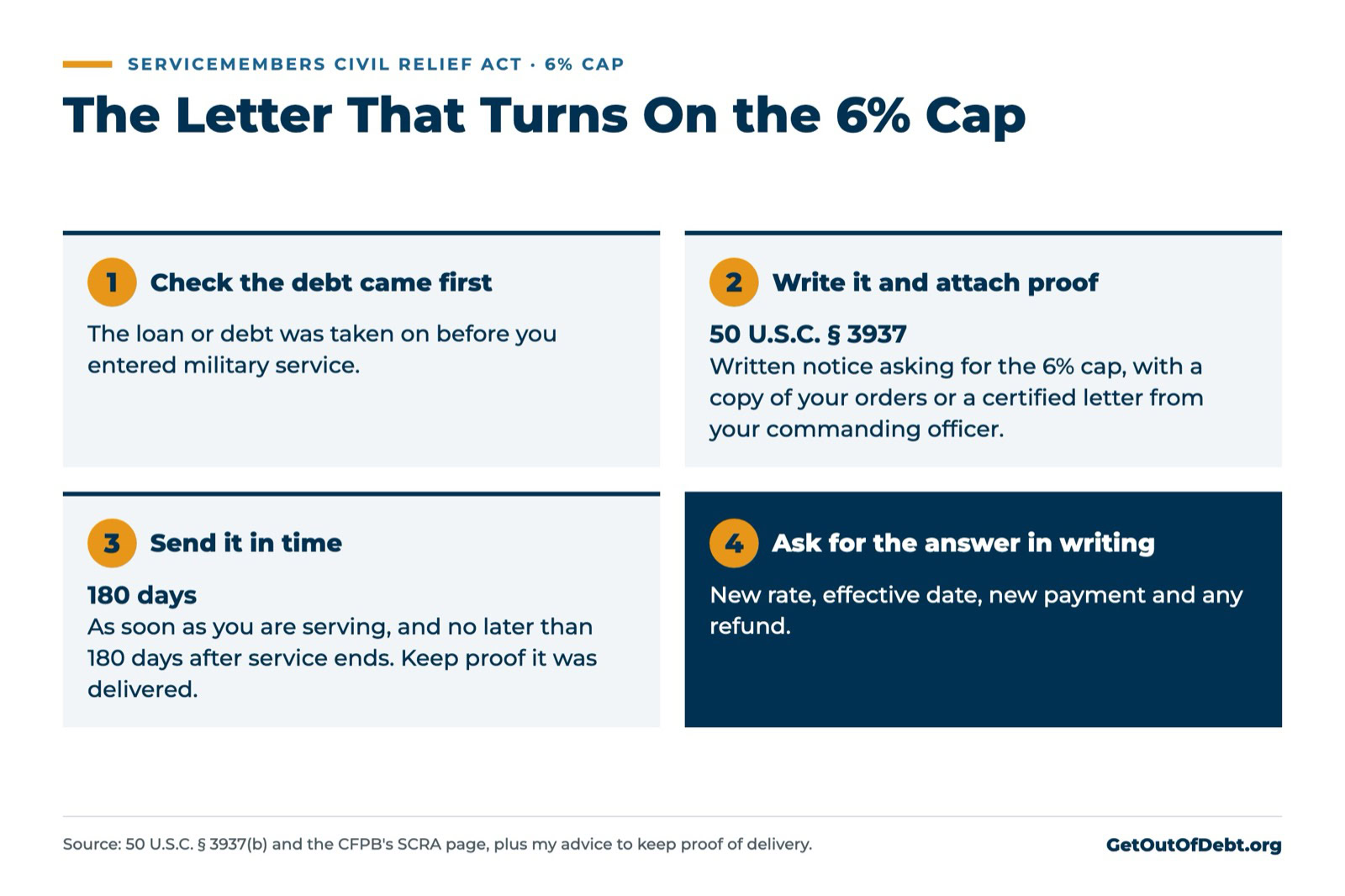
How it is switched on. Send the notice as soon as you are serving if you can. The outer limit is 180 days after your service ends, and the relief reaches back to the date you were called to service. The statute sets the deadline: “Not later than 180 days after the date of a servicemember’s termination or release from military service,” the servicemember “shall provide to the creditor written notice and a copy of” either the military orders calling you to service (and any orders extending it), or “any other appropriate indicator of military service, including a certified letter from a commanding officer.” Once the creditor has the notice and a copy of the orders, it “shall treat the debt in accordance with subsection (a), effective as of the date on which the servicemember is called to military service.” That retroactive date is what DOJ says Village Capital missed. The Consumer Financial Protection Bureau’s SCRA page gives the same steps: notify your lender in writing, include a copy of your orders or a letter from your commanding officer, and make the request while you are serving or up to 180 days after release.
- Separated within the last 180 days and never asked? The statute’s window is still open. The creditor must treat the debt as capped “effective as of the date on which the servicemember is called to military service,” so interest above 6 percent should be forgiven back to that date for your whole period of service and, for a mortgage, for one year after your service ended. Ask for a refund of anything you already overpaid, and ask legal assistance how that works for your loan.
- Released more than 180 days ago? The statute’s notice window has closed. Ask legal assistance what, if anything, is still open to you.
Which date counts? DOJ’s release says the 6% rate should reach back to “the date they received their military orders,” while the statute says “the date on which the servicemember is called to military service.” For a member of a reserve component, 50 U.S.C. § 3917(a) gives SCRA rights “during the period beginning on the date of the member’s receipt of the order” to report for service. That points the same direction for reservists, but I could not find a provision that says in so many words which date controls the 6% math for every set of orders, so ask legal assistance which date applies to you.
One honest wrinkle. The statute also says a creditor “may use, in lieu of notice and documentation,” information from the Defense Manpower Data Center that shows you are on active duty. “May” is not “must.” A servicer that checks that database might apply the cap without your letter, and a servicer that does not check will not. The agreement requires Village Capital to check the DMDC website when a borrower does not supply orders, but that is a term of this settlement and not a rule for every creditor. My advice: do not wait to find out which kind of servicer you have.
What the Letter Has to Contain
From the statute, the letter must be written, must come with a copy of your orders (and any extensions) or another appropriate indicator of service such as a certified letter from your commanding officer, and, as an outer limit, must reach the creditor no later than 180 days after your service ends (sooner is better). The statute does not prescribe a form or wording, and a phone call alone is not written notice. Everything below that line is my suggestion, not a statutory requirement:
- Identify the debt: your name, the account number and, for a mortgage, the property address.
- Say the debt came first: state that you incurred it before you entered military service, and give the date you received orders or were called to service (reservists, ask legal assistance which date applies).
- Ask for what the statute gives you: a rate of no more than 6 percent, interest above 6 percent forgiven back to the date you were called to service, and a monthly payment reduced by the interest forgiven.
- Ask for the answer in writing: the effective date, your new monthly payment, any refund of overpaid interest, the note rate and which fees it counted as interest.
- Keep paying: say you will keep paying the amount billed until the creditor confirms the new payment in writing.
- Keep proof: send it in a way that gives you a delivery record and keep a copy of everything you sent.
A short template you can adapt (not legal advice):
[Date]
[Servicer name and mailing address]
Re: Account number [____] (for a mortgage, the property address: [address])
This is written notice under the Servicemembers Civil Relief Act, 50 U.S.C. § 3937. I am, or within the last 180 days was, a servicemember; my military service began on [date] [and ended on [date]]. This debt was incurred before I entered military service. A copy of my military orders is enclosed. I received my orders / was called to military service on [date] [reservists: ask legal assistance which date applies].
Please reduce the interest rate on this account to no more than 6 percent per year, forgive interest above 6 percent back to the date I was called to military service, reduce my monthly payment by the amount of interest forgiven, and refund any overpayment. For a mortgage, please apply this during my military service and one year after; for any other debt, during my military service. Please do not report this request as a negative on my credit.
In your written answer, please state the effective date, my new monthly payment, the amount of any refund, my note rate, and which fees or charges you counted as interest. If you deny the request, please tell me why and what else you need. I will keep paying the amount you bill until you confirm the new payment in writing.
[Name, address, phone]
How to send it: by certified mail with a return receipt, or by uploading it through the servicer’s online portal and saving the confirmation, and keep a copy of everything.
What a good answer looks like. This binds only Village Capital, and it is not in the statute. The agreement sets a yardstick for this one company, and I think it is a decent yardstick for any servicer. Village Capital must decide eligibility within five business days of a request, apply the lower rate retroactively within ten business days of that decision, and send a written notice that states “the effective date of the interest rate reduction, the amount of the new monthly payment, and the amount of any interest overpayments to be refunded.” Do not stop or cut your payments while you wait for an answer. If you get a letter that says your rate is already below 6 percent, do not take it on faith: check the note rate and also the charges the statute counts as interest, which it says include “service charges, renewal charges, fees, or any other charges (except bona fide insurance),” and ask the servicer to state in writing which charges it counted.
One more detail from the statute: a court “may grant a creditor relief” from the cap if your ability to pay the higher rate “is not materially affected by reason of the servicemember’s military service,” so a creditor can push back, but it takes a court to decide that.
The agreement also targets the retaliation DOJ alleges, and the exact wording matters. The statute DOJ cites, 50 U.S.C. § 3919, says that “application by a servicemember for, or receipt by a servicemember of, a stay, postponement, or suspension pursuant to this chapter in the payment of a tax, fine, penalty, insurance premium, or other civil obligation or liability of that servicemember shall not itself (without regard to other considerations) provide the basis for” things such as “a change by the creditor in the terms of an existing credit arrangement” or an adverse credit report. The agreement reads the protection more broadly: it says Village Capital “shall not use a servicemember’s application for or receipt of an SCRA interest rate reduction or other benefit under the SCRA as the basis for a change in the terms of an existing credit arrangement or an adverse report relating to the servicemember’s creditworthiness.” The CFPB’s guide describes the same protection in broader plain English, and adds that a lender can still charge late fees, report late payments and try to collect the debt. I am reporting what DOJ and the agreement say, not ruling on how a court would read the statute. For a longer walk through the notice-and-orders rules, my guide for servicemembers whose creditor ignored their rights covers repossessions, leases and default judgments, and an older reader answer shows what happens when you ask a card company for the lower rate.
Free Tool — I'm Being Sued for Debt Guide: Being sued by a creditor or debt collector? The free I'm Being Sued Guide gives you a personalized action plan — deadlines, defenses, and options based on your state. Most states require a response within 20–30 days. Get My Action Plan →
What Foreclosure Protections Apply?
Foreclosure works differently from the rate cap, and the difference matters. The law is 50 U.S.C. § 3953:
- Which loans: it applies only to an obligation on property you own that “originated before the period of the servicemember’s military service,” that you still owe, and that is secured by a mortgage or similar security.
- The core rule: a sale or foreclosure “shall not be valid if made during, or within one year after, the period of the servicemember’s military service” unless it is made “upon a court order granted before such sale, foreclosure, or seizure” or under a written waiver agreement allowed by 50 U.S.C. § 3918.
- A judge can pause or reshape it. In a case filed during service or within a year after, the court “shall upon application by a servicemember” stay the case or adjust the obligation when your ability to comply “is materially affected by military service.”
- It is a crime to do it anyway. A person who knowingly makes a prohibited foreclosure faces a fine, up to a year in prison, or both.
Here is the part that surprised me when I lined the statute up with the rate cap: the foreclosure rule has no notice-and-orders trigger in its text. The CFPB says so directly: “It does not matter if you did not tell your lender about a change in your servicemember status. You are protected.” The CFPB also says the lender must go to court first and “get a court order against you.” What you do have to do yourself is ask the court for a stay or an adjustment, and that is where a legal assistance attorney earns their keep. My advice: you do not have to tell your servicer to be protected, but tell it anyway, in writing and with a copy of your orders, so a sale never gets scheduled in the first place. And do not ignore a foreclosure notice or a court complaint; call legal assistance the day the paper arrives.
If your mortgage began while you were already serving, section 3953 does not apply, because it covers only an obligation that “originated before the period of the servicemember’s military service.” Other parts of the SCRA are about court cases in general and do not depend on when the debt began. Under 50 U.S.C. § 3931(b)(1)(A), before a default judgment a plaintiff must file an affidavit “stating whether or not the defendant is in military service,” and under 50 U.S.C. § 3932(b)(1) a court “shall, upon application by the servicemember, stay the action for a period of not less than 90 days” if the conditions in that section are met, which include letters from you and your commanding officer. Ask legal assistance which of those apply to your case.
Two cautions. First, the waiver door: 50 U.S.C. § 3918 lets a servicemember waive these rights, but a waiver that permits a foreclosure has to be in writing, “executed as an instrument separate from the obligation,” and made in an agreement “executed during or after the servicemember’s period of military service.” If a servicer sends you something to sign while you are serving, get a legal assistance attorney to read it first. Second, the protection is about how and when a foreclosure can happen, and it does not erase the debt, because the CFPB notes a lender can still charge late fees and collect.
On the length of the protection: you may see 90 days or nine months in older articles. Those were earlier versions of the statute. The current text says “within one year after,” and the code’s notes show a Public Law 115-174, section 313 (2018) repealed the provisions that would have brought the shorter periods back.
Where to Get Free Help
- Military legal assistance (free). DOJ tells servicemembers and dependents to contact the nearest Armed Forces Legal Assistance Program Office and says office locations are at legalassistance.law.af.mil. The CFPB says the military “provides free legal advice to servicemembers and their families.” One caveat I found: that locator says its information “is limited to certain CONUS bases.” If you are overseas, or in the Guard or Reserve, ask your unit or command where its legal office is. Eligibility for military legal assistance varies, and I have not sourced a rulebook, so if you are turned away, the DOJ and CFPB paths below are the other two places to go.
- The Justice Department. DOJ’s release points to servicemembers.gov, which took me to DOJ’s Servicemembers and Veterans Initiative page. That page lists servicemembers@usdoj.gov and a “Report a Servicemember or Veteran Rights Violation” link.
- The Consumer Financial Protection Bureau. Its SCRA page says you can submit a complaint online or call (855) 411-2372 if a financial company is giving you trouble about your SCRA rights. I did not find a page on the CFPB’s site that names a separate servicemember office as currently operating, so I am pointing you to its servicemember resources and complaint line instead of a named office.
If the Math Still Does Not Work
A 6% cap is a discount on the interest. It is not a rescue plan, and it will not touch a debt you took on while in uniform. Debt is math wrapped in emotion, and when the math is broken, a lower rate on one loan may not fix it. My options comparison and the 2-minute bankruptcy quiz lay every route side by side, and bankruptcy is one of them. If you are a “disabled veteran,” a term the bankruptcy law takes from 38 U.S.C. § 3741(1), which defines it as “a veteran who is entitled to compensation under laws administered by the Secretary for a disability rated at 30 percent or more” or “a veteran whose discharge or release from active duty was for a disability incurred or aggravated in line of duty,” federal bankruptcy law has a carve-out from the means test where “the indebtedness occurred primarily during a period during which he or she was” on “active duty (as defined in section 101(d)(1) of title 10)” or performing a homeland defense activity (11 U.S.C. § 707(b)(2)(D)(i)); a bankruptcy attorney can tell you whether your facts fit. I filed bankruptcy in 1990 and rebuilt, and I would rather you look at all of your options than carry a shame no one earned. If a mortgage is the problem, call military legal assistance before you call anyone who is selling something.
For a second look at how the Justice Department handles these cases, I wrote about its earlier SCRA settlement involving servicemembers’ vehicles, and a reader’s question about being called back to active duty with car and bank loans shows how the pre-service rule plays out for everyday debts.
My Take
This is my opinion, not DOJ’s. What bothers me most is the pattern the allegations describe, because it is how real life works: a servicemember does the right thing, sends the request, and then everything depends on whether a person on the other end processes it correctly. DOJ’s October 19 release says it has obtained over $490 million in monetary relief for over 153,000 servicemembers through SCRA enforcement since 2011, and that is a lot of people who needed the government to enforce a right they already had. The statute gives you the cap. The paperwork gives you the cap in practice. So send the letter early, keep a copy, and do the math yourself on the first statement that comes back.
Key Takeaways
- DOJ announced on October 19, 2026 that Village Capital will pay over $500,000, including at least $425,000 to servicemembers DOJ determines were harmed, to resolve allegations about SCRA interest rate benefits to at least 41 servicemembers’ mortgages, in DOJ’s words.
- The agreement I read has no admission of wrongdoing and no denial, and it says the claims are resolved “without legal proceedings.”
- Neither DOJ’s release nor the agreement describes a claim form. If you get a check, read the letter first, because cashing it releases claims under two SCRA sections, and if your losses go beyond the formula, talk to legal assistance or a private SCRA attorney before you endorse it.
- The 6% cap covers debts you took on before you entered military service, and it is triggered by written notice plus a copy of your orders. Send it as soon as you are serving, and no later than 180 days after your service ends. A servicer may check a government database instead, and “may” is not “must.”
- A foreclosure during service or within one year after needs a court order, and the CFPB says that holds even if you never told your lender. Free military legal help is the first call.
The Bottom Line
If you are serving, or you served recently, and you took on a mortgage or other debt before you entered service, send the written notice and a copy of your orders now, and do not assume your servicer already did the math for you. If you think Village Capital is part of your story, call military legal assistance and keep every letter. The law says what it says, but it works best when you put your request in writing, so make the request in writing, and then check the answer. You are not your debt, and one company’s alleged failures do not decide the rest of your story.
Frequently Asked Questions
Who gets paid in the Village Capital settlement, and do I have to file a claim?
The agreement says the $425,000 fund is for “servicemembers whom the United States determines have been harmed.” DOJ has identified 41 accounts so far and the agreement has a process to review more. Neither the release nor the agreement describes a claim form, filing deadline or hotline, and the agreement requires Village Capital to deliver the payments. If you think you are affected, DOJ says to contact the nearest Armed Forces Legal Assistance Program Office.
How do I turn on the SCRA 6% interest rate cap?
For a debt you took on before you entered military service, send the creditor written notice plus a copy of your military orders, or another appropriate indicator of service such as a certified letter from your commanding officer. Send it as soon as you are serving if you can; the statute’s outer limit is 180 days after your service ends. Once the creditor has it, the debt is treated as capped at 6 percent effective as of the date you were called to military service, and interest above 6 percent is forgiven. For a mortgage the cap lasts through your service and one year after.
Does the 6% cap apply to a loan I took out while I was already on active duty?
Not under this section. The statute covers a debt incurred before the servicemember enters military service. A loan taken out during service is a different question, so ask a military legal assistance attorney what other protections apply.
Can a lender foreclose on my home while I am on active duty?
For a mortgage that began before your service, a sale or foreclosure is not valid during service or within one year after unless there is a court order obtained before the sale, or a written waiver agreement allowed under the statute. A judge can also pause the case or adjust the loan if military service materially affects your ability to pay. If your mortgage began while you were already serving, that section does not apply, though the SCRA’s court-case protections may still help. Foreclosure protection does not erase the debt, and you should never ignore a foreclosure notice or a court complaint, so talk to a legal assistance attorney as soon as the paper arrives.
Did Village Capital admit it did anything wrong?
Not in the agreement I read. The Justice Department alleges the violations, the agreement contains no admission of wrongdoing and no denial, and it says the claims are resolved without legal proceedings. I did not find a public statement from the company, so what is described here remains DOJ’s allegations.
This is what I’m telling friends like you over coffee. But remember, you do you, and only you can decide what is right for your situation. Take what I have said as input, not instruction.
Know a servicemember or veteran who took on a mortgage or other debt before entering military service, including before a qualifying National Guard or Reserve activation? Send this to them, because the notice has a deadline.
For more stories like this, sign up for my free weekday email, Your Money Actually.
Dealing With Debt? Understanding your options is the first step. See how all your debt relief options compare — including ones most sites won’t tell you about. The Find Your Path quiz gives a recommendation based on your actual numbers, and the Scam-O-Meter checks any company’s complaint history before you sign. Federal Reserve Bank of New York research shows bankruptcy filers recover faster than those who don’t file.



