

Fact-checked by Steve Rhode, consumer debt expert since 1994 • Last reviewed October 22, 2026 • The legal claims below link to the statute, the regulation or the agency page they come from.
The verdict: Myth. Federal law is written so that age does not end a federal student loan: 20 U.S.C. § 1091a(a)(2) says “no limitation shall terminate the period within which suit may be filed, a judgment may be enforced, or an offset, garnishment, or other action initiated or taken” by the holders it lists. The CFPB puts it in plain English: “Some debts, though, such as federal student loans don’t have a statute of limitations.” If your loans are Direct Loans, read my note below on how the statute’s list is worded. Private student loans are different: they have ordinary state limitation periods.
Well, Actually…
If you’ve been quietly hoping an old federal student loan would age out, I understand why. Debt is math wrapped in emotion, and the hope that time will simply erase it is about as human as it gets. It also happens to be wrong for this kind of debt, and I would rather you hear that from me now than from a letter later.
Here is what the law says. The section is titled “Statute of limitations, and State court judgments,” and its first paragraph states the purpose: “to ensure that obligations to repay loans and grant overpayments are enforced without regard to any Federal or State statutory, regulatory, or administrative limitation on the period within which debts may be enforced” (20 U.S.C. § 1091a(a)(1)). The second paragraph does the work. It says “notwithstanding any other provision of statute, regulation, or administrative limitation, no limitation shall terminate the period within which suit may be filed, a judgment may be enforced, or an offset, garnishment, or other action initiated or taken” by the holders it names (§ 1091a(a)(2)). The holders it names include a guaranty agency collecting a Federal Family Education Loan after it has reimbursed the previous holder for the borrower’s default, a school that has a federal loan agreement with the Education Department and is collecting after a default, and the Education Secretary, the Attorney General or another federal agency head collecting a loan “made under this subchapter that has been assigned to the Secretary.”
If your loans are Direct Loans, which is what most borrowers have now, read that list closely, because it does not name the Secretary collecting a loan the Secretary made in so many words. The Secretary appears for loans “assigned to the Secretary,” and Direct Loans are made by the Secretary in the first place. Here is what I found when I went looking. The first paragraph of the section states its purpose for “obligations to repay loans” without carving any program out. The Direct Loan law says those loans “shall have the same terms, conditions, and benefits” as the guaranteed loans the list does name, unless the Direct Loan part says otherwise (20 U.S.C. § 1087e(a)(1)). That is language about the loans’ terms, not a statement that the list covers a loan the Secretary made. A separate federal law on collecting debts owed to the United States says no limitation on the time to start an administrative offset under that section “shall be effective” (31 U.S.C. § 3716(e)(1)). And the CFPB says flatly that federal student loans don’t have a statute of limitations. What I did not find, in the sources I could reach, is a court decision applying this section to a Direct Loan the Secretary made, so I am not going to tell you a judge has settled that point. I also found nothing that says a Direct Loan stops being owed because it is old, and I would not plan around it.
For the collectors it lists, that federal statute answers the state-law question in advance. A state statute of limitations is the thing people mean when they say “it’s too old to sue.” The federal text says no such limit stops these collectors, “notwithstanding any other provision of statute,” and it names suits, enforcing a judgment, offset and garnishment, which are the very things the myth says can no longer happen. The Supreme Court applied this section in Lockhart v. United States, decided December 7, 2005, and let the government take part of a man’s Social Security benefits to pay Guaranteed Student Loans from 1984 to 1989 that had been assigned to the Education Department, some of the debt more than 10 years delinquent. Those were not Direct Loans, so the case does not settle the question in my note above, but it does show how old a debt the government can still collect.
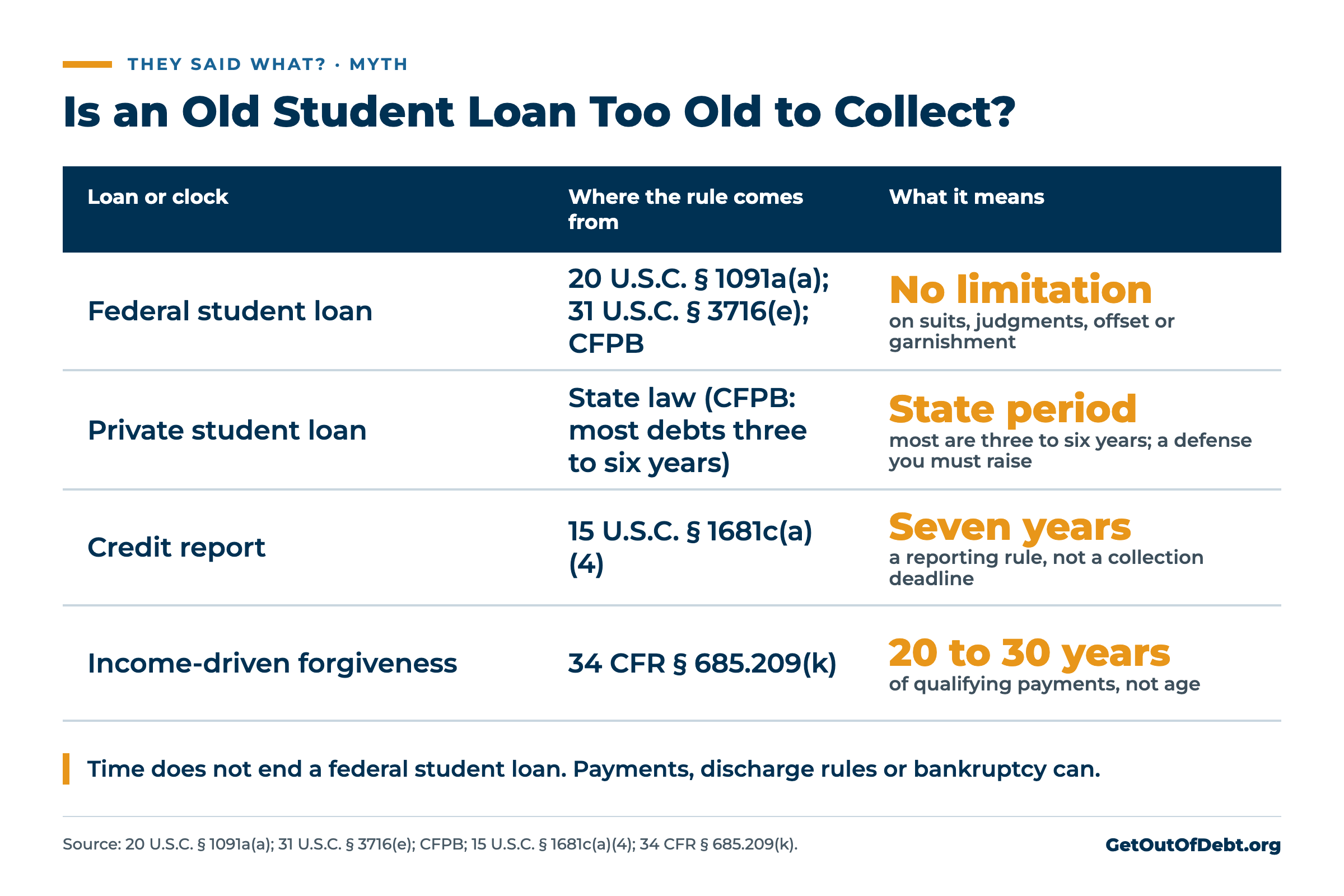
Three different clocks get tangled together in this belief, and only one of them is a collection deadline. The first is the state statute of limitations on suing over a debt, which does not stop these federal collectors. The second is the credit-reporting clock, which controls how long something can appear on a credit report and says nothing about whether you owe it. The third is the forgiveness timeline built into income-driven repayment plans, which does end a balance, but only if you have made the payments, not because the loan got old.
My federal student loans are old, past the statute of limitations (or seven years), so they can’t sue me, garnish me or come after me anymore.
Under 20 U.S.C. § 1091a(a), federal student loan collection is to proceed “without regard to any Federal or State statutory, regulatory, or administrative limitation on the period within which debts may be enforced,” and no limitation ends the time to sue, to enforce a judgment, or to use an offset or garnishment. Age alone does not release a federal student loan. If your loans are Direct Loans, see my note above on how the statute’s list is worded. The seven-year figure people cite is a credit-reporting rule, not a collection deadline.
After seven years the student loan falls off my credit report, so it’s gone.
Credit reports do have a time limit. The Fair Credit Reporting Act bars a consumer reporting agency from reporting “accounts placed for collection or charged to profit and loss which antedate the report by more than seven years,” and that seven-year period starts after a 180-day period that begins with the delinquency (15 U.S.C. § 1681c(a)(4), (c)(1)). The student loan statute has its own reporting rule for defaulted accounts on guaranteed loans (20 U.S.C. § 1080a(f)), so I can’t give you one date that fits every file. For Perkins loans the law lets a consumer reporting agency report the status of the account until the loan is paid in full (20 U.S.C. § 1087cc(c)(3)). What none of these rules says is that the debt stops being owed. A loan can disappear from a report and still be collectible.
Student loans never expire, private ones included, so there is no time limit on anyone suing me over my private loans either.
The no-limitation rule is in the federal student assistance statute, and the CFPB’s own wording is about “federal student loans.” Private student loans are ordinary contracts with state-law limitation periods. The CFPB says: “Most states or jurisdictions have statutes of limitations between three and six years for debts, but some may be longer.” The period can depend on the type of debt, your state, and the state law named in your agreement. An expired period is a defense to a lawsuit, not an erasure of the debt, and the CFPB says it is ordinarily “the responsibility of the person being sued to point out that the statute of limitations has expired.”
Free Tool — Statute of Limitations Checker: Dealing with old debt? The free Statute of Limitations Checker tells you if the collection clock has expired in your state — including the zombie debt and clock-restarting traps collectors use. Check My Status →
What This Does Not Mean
I want to be careful here, because there is a difference between what a collector is allowed to do and what is happening to you today. This post is about legal authority. It is not a prediction that anyone is about to garnish your pay.
On January 16, 2026, the Education Department announced it “will delay the implementation of involuntary collections on federal student loans, including Administrative Wage Garnishment (AWG) and the Treasury Offset Program (TOP),” calling it a “temporary delay” that would let it put new repayment options in place (Education Department press release). The release I read gives no restart date, and I could not confirm from a primary source whether those collections are running today, so check before you assume either way, especially if an older FFEL loan is held by a guaranty agency rather than the Education Department. A delay is a decision about timing. It is not a statute of limitations, and the same release says, “The Department reports student loan defaults to credit reporting agencies, which may adversely impact borrower credit reports.”
Free Tool — Wage Garnishment Calculator: Worried about your paycheck being seized? The free Wage Garnishment Calculator shows exactly how much creditors can legally take in your state — and some states prohibit garnishment entirely. Calculate My Risk →
Why You Were Told This
The belief is not made up out of nowhere. It is a true statement about other debts, carried onto a debt where it does not hold. State limitation periods on credit cards and many other debts are real, and the CFPB page I quoted above says most are three to six years. Seven years is real too, for credit reports. And on this site I have written about the statute of limitations on private student loans for years, which is the right advice for private loans and the wrong advice if someone carries it over to a federal one.
There is also a quieter reason. When nobody has contacted you in years, silence feels like expiration. It isn’t one. For a federal student loan the statute is built so that the passage of time does not remove the right to collect, and the same section says a borrower who has defaulted “shall be required to pay, in addition to other charges specified in this subchapter reasonable collection costs” (§ 1091a(b)(1)). I don’t see a villain here. I see a lot of people hoping the math will go away.
What to Actually Do
- Find out whether each loan is federal or private. Many borrowers have both. The Education Department says to find your loan servicer by logging in to StudentAid.gov and reviewing your “My Aid” page, and your old promissory notes name the lender. Treat each loan separately, because the rules in this post split by loan type. A federal loan can be held or serviced by a private company and is still federal, while a federal loan you refinanced with a private lender became a private loan.
- If it is federal, stop planning around the loan aging out. Look at the exits that actually exist. The Education Department’s default FAQ lists options including consolidating, completing a rehabilitation agreement, or completing a repayment agreement, and says most of those options “prevent 15% of your earned wages from being garnished” and “prevent Treasury offset of your federal tax refund.” Those protections last only while you keep up the agreement or plan, and the statute measures the 15 percent against disposable pay, not gross wages. My step-by-step is in My Student Loans Are in Default. Here’s What to Do Right Now.
- Know how payments, not age, can end a federal balance. The Direct Loan regulation forgives the remaining balance on income-driven plans after a set number of qualifying payments: for IBR, 300 payments over at least 25 years for a borrower who is not a new borrower, or 240 payments over at least 20 years for a new borrower (for IBR, roughly someone who had no federal loan balance before July 1, 2014, so most people with old loans are on the 25-year track), and 360 payments over at least 30 years under the Repayment Assistance Plan (34 CFR § 685.209(k)(1), (2) and (7)). Public Service Loan Forgiveness is another payment-count path, after 120 qualifying payments while working for a qualifying employer (34 CFR § 685.219). Both are earned by making payments, which is the opposite of waiting. If your loan is in default, don’t assume a payment to a collector is running one of those clocks. The rules let a defaulted loan be repaid under IBR or the Repayment Assistance Plan, and for IBR only they count certain payments, and some garnishment or Treasury offset collections, made while the loan is in default, within limits the rule sets (34 CFR § 685.209(c)(1), (d)(2), (d)(4) and (k)(5)). Public Service Loan Forgiveness counts full scheduled payments under a qualifying repayment plan and requires that the loan not be in default when you ask for forgiveness (34 CFR § 685.219(c)). Ask your servicer or the collector, in writing, which plan your payments are under and whether they count. Plan for taxes, too: forgiveness at the end of an income-driven plan can be taxable income, because the federal exclusion in 26 U.S.C. § 108(f)(5) now covers discharges for death or total and permanent disability, while PSLF forgiveness is generally treated under a separate exclusion for working a set time in certain professions, § 108(f)(1) (26 U.S.C. § 108(f)). If you are insolvent when a balance is forgiven, the insolvency exclusion in § 108(a)(1)(B) can reduce or erase that income, and state tax rules differ, so check with a tax preparer before the year it happens.
- Read every notice and answer it. If the government goes after your pay through wage garnishment, the statute requires written notice at least 30 days before proceedings start, an opportunity to inspect the records, a chance to enter a repayment agreement, and an opportunity for a hearing, and caps the deduction at 15 percent of disposable pay unless you consent in writing to more (20 U.S.C. § 1095a(a)). Timing matters: to get a hearing before any garnishment order is issued, you have to ask for it within 15 days after the notice is mailed (§ 1095a(b)). Ask later and you still get a hearing, but the garnishment can start first. Follow the deadline printed on your notice, too. If it has already started, read My Paycheck Is Being Garnished for a Defaulted Student Loan.
- If it is private, run the clock honestly before you do anything. Find the date of your last payment and your state’s period. The CFPB warns that “making a partial payment or acknowledging you owe an old debt, even after the statute of limitations expired, may restart the time period,” so don’t send money or sign anything on an old private loan until you know where you stand. If you are sued, show up and raise the defense; the CFPB says a court may still enter a judgment if you don’t. I wrote more in A Private Student Loan Company Is Suing Me.
- Remember that student loans can be discharged in bankruptcy. It is harder than for most debts, not impossible. The bankruptcy code excepts certain educational loans from discharge “unless excepting such debt from discharge under this paragraph would impose an undue hardship on the debtor and the debtor’s dependents” (11 U.S.C. § 523(a)(8)). For federal loans where the government is the creditor and the Justice Department handles the case, a November 17, 2022 Justice Department guidance tells its attorneys to stipulate to the facts showing undue hardship and recommend discharge when three conditions are met. It is internal Justice Department policy: it does not bind a private lender, it creates no enforceable rights, and the guidance itself says the government’s position is not binding on the bankruptcy court (DOJ guidance). The guidance was still posted on justice.gov when I checked on October 22, 2026, but I could not confirm from a primary source whether it has been changed since, so ask a bankruptcy attorney whether it still applies to your case. Some private loans may not fall under that exception at all, which I explain in this post and this one. Whether yours does is a question for a bankruptcy attorney who has read the loan documents.
Steve’s Take
I filed bankruptcy in 1990, and the lesson I took from it is the one I still give people: deal with it and look to the future rather than spend five years repairing the past. With an old federal student loan, the worst plan is the quiet one where you wait for it to expire, because the law is written so that it doesn’t. The better plan is dull and works: find out which loans are federal, get out of default if you are in it, pick a payment you can actually make, and keep bankruptcy on the table if the math says the loan will never be repaid. You are not your debt, and you don’t have to settle for hoping it goes away.
Frequently Asked Questions
I defaulted on a federal student loan many years ago and haven’t heard anything. Can they still collect?
Legally, yes. 20 U.S.C. § 1091a(a)(2) says no limitation ends the period to file suit, enforce a judgment, or take an offset or garnishment action by the holders it names (statute). If yours are Direct Loans, read my note in the post on how that list is worded; I found no court ruling on that point either way. Whether anyone is actively collecting from you right now is a separate question, and in January 2026 the Education Department announced a temporary delay in wage garnishment and Treasury offset (press release). The release gives no restart date, and I could not confirm from a primary source whether those collections are running today. Log in to StudentAid.gov to see where your loans stand.
Does the seven-year credit reporting rule make my federal student loan go away?
No. The seven-year rule in the Fair Credit Reporting Act limits how long certain items can appear on a credit report (15 U.S.C. § 1681c(a)). It does not say the debt stops being owed, and the federal student loan statute says collection proceeds without regard to any limitation on the period within which debts may be enforced.
Do private student loans have a statute of limitations?
Yes, a state one. The CFPB says most states have limitation periods between three and six years for debts, some longer, depending on the type of debt, your state, and the state law in your agreement. A partial payment or acknowledging the debt may restart the clock, and you generally have to raise the defense yourself if you are sued (CFPB). Because it varies, a lawyer in your state is worth a call before you decide anything.
Can a federal student loan ever just end because of time?
Not because it got old. A balance can end through the rules attached to specific programs, such as income-driven plan forgiveness after 240, 300 or 360 qualifying monthly payments, over at least 20, 25 or 30 years depending on the plan (34 CFR § 685.209(k)), or through the Direct Loan discharge provisions, which include death and disability, closed school and false certification (34 CFR part 685, subpart B). Each has its own requirements. My post on what happens to student loans at death covers one of them.
Can the government garnish my wages for a student loan without suing me first?
The wage garnishment statute lays out an administrative process rather than a court case. It requires a written notice at least 30 days before proceedings begin, a chance to inspect your records and enter a repayment agreement, and an opportunity for a hearing, and it caps the deduction at 15 percent of disposable pay unless you consent in writing to more (20 U.S.C. § 1095a(a)). It lets a guaranty agency, or the Secretary for loans held by the Secretary, garnish disposable pay if you are not currently making required repayment under a repayment agreement. That administrative path is for federal student loans. A private student lender is not a government agency, and the CFPB says most creditors can garnish wages only “after a court issues a judgment saying that you owe the debt” (CFPB). So if a private lender sues you, answer the lawsuit rather than ignore it.
Can I discharge a student loan in bankruptcy?
Yes, though the standard is undue hardship for most student loans (11 U.S.C. § 523(a)(8)). For federal loans where the government is the party, a 2022 Justice Department guidance describes when its attorneys will recommend discharge, but it does not bind a private lender or the bankruptcy court (DOJ guidance). I could not confirm whether it is still in effect today, so ask a bankruptcy attorney. Some private loans may fall outside the exception, so see this post and talk to a bankruptcy attorney.
This is one informed perspective from someone who has watched how this plays out since 1994 — not legal, tax or financial advice for your case. Only you can decide what’s right for your situation, and an attorney who has read your loan documents can tell you where you actually stand. Take this as input, not instruction, and make the call that serves your future.
The bottom line: A federal student loan does not age out. Federal law says no limitation stops suits, judgments, offsets or garnishment by the collectors it lists, the CFPB says federal student loans don’t have a statute of limitations, and if yours are Direct Loans, read my note above on how that list is worded. The seven-year credit-report rule is a different clock. Private student loans do have state statutes of limitations. If someone you know still believes an old federal loan is too old to collect, send them this page.
Dealing With Debt? Understanding your options is the first step. See how all your debt relief options compare — including ones most sites won’t tell you about. The Find Your Path quiz gives a recommendation based on your actual numbers, and the Scam-O-Meter checks any company’s complaint history before you sign. Federal Reserve Bank of New York research shows bankruptcy filers recover faster than those who don’t file.



