

Quick Answer: At the Federal Trade Commission’s request, a federal court in Arizona has permanently banned the seven companies and the three individual defendants in the Accelerated Debt Settlement case from selling debt relief and from telemarketing (Robert Knechtel’s telemarketing ban has one exception: if he is licensed to practice law, it does not stop him from directly providing routine legal services to clients with whom he has an attorney-client relationship). The FTC alleged the operation posed as people’s banks, credit card companies and government agencies, claimed it could cut their debt by as much as 75% or more, and collected illegal upfront fees. Seven companies lost by default on October 14, 2026 because they never answered the case, and the three individuals settled in March 2026 without admitting or denying the allegations. As of October 22, 2026 the FTC has not announced a refund program. If one is ever created, it will be announced by the FTC, and the FTC says it will never demand money from you. This order does not cancel your own credit card debt, and it does not stop your real card company or a collector from collecting it or suing you over it.
Primary Sources: Default Judgment and Order for Permanent Injunction as to the seven corporate defendants (PDF), October 14, 2026 · Stipulated orders as to Jeffrey Lakes, Robert Knechtel and Elizabeth Reaney (PDFs), March 27, 2026 · FTC case page: Accelerated Debt Settlement. FTC v. Accelerated Debt Settlement Incorporated, et al., No. CV-25-02443-PHX-SMB, U.S. District Court for the District of Arizona.
Expert Context: I have been watching debt relief companies since 1994, when I founded Debt Counselors of America, the nonprofit credit counseling organization later renamed Myvesta, so I have seen this industry from the inside. The pitch in this case is one I know by heart: a friendly voice who sounds official, a promise to make most of your debt disappear, and a fee up front. The names on the door change all the time. The federal rule that makes the upfront-fee version illegal for telemarketed debt relief has been on the books since 2010.
If you got a call from someone who said they were from your credit card company, or the government, and then pitched you a way to wipe out most of your credit card debt for a fee, I want you to read this one carefully. On October 22, 2026, the FTC announced that a federal court had permanently shut down an operation that, the agency says, did exactly that to older people and veterans.
Each weekday I send one short email: one story that caught my attention, why it might matter to you, and one manageable thing you can do with it. A couple of minutes, and a dad joke.
In the latest issue (Nov 6): Owed money on an Amazon return? Check by Dec. 1
Free. I sell nothing. Unsubscribe any time.
The case is FTC v. Accelerated Debt Settlement Incorporated, and the FTC and the court name the defendants as seven companies (Accelerated Debt Settlement Inc., ADS Resolve LLC, Financial Solutions Group LLC, Unified Capital Services LLC, Mediwerks, Resolution Specialists LLC and Futura Capital, LLC) and three people (Jeffrey Lakes, Robert Knechtel and Elizabeth Reaney). I am going to tell you what the government said happened, exactly what the court ordered, what it means for your money, and the one rule that lets you spot the next outfit that tries this, whatever name it uses.
If you have read my guide to checking out Accelerated Debt Settlement, this is the court record that has come in since.
What the FTC Said Happened
The FTC filed its case on July 14, 2025, and that same day the court entered a temporary restraining order that froze assets and put a court-appointed receiver in charge of the companies. On August 8, 2025, the court entered a stipulated preliminary injunction.
According to the FTC, the operation reached people through telemarketing calls and through inbound calls that came in response to its direct-mail and online ads. The complaint alleged that the callers falsely claimed to be banks and government entities and said they could reduce people’s debt by as much as 75% or more, and that the operation collected illegal advance fees.
The default judgment against the companies lays out what the complaint described in more detail. It says the companies posed first as consumers’ credit card issuers and then as federal government agencies or consumer reporting agencies, including by posing as Experian, and “told consumers that their credit cards had been compromised and needed to be closed.” The specific agencies named in the judgment are the Social Security Administration and the Consumer Financial Protection Bureau. From there, according to the judgment, the companies marketed a service to reduce credit card debt, told people the upfront fee charged to their credit card was part of the debt that would be reduced or eliminated, and told them any hit to their credit score was temporary. The judgment says people who paid “often found themselves deeper in debt and with worsened credit scores.”
The judgment also lists other violations: using information from people’s credit reports without a legal reason to convince them the caller was their card issuer, a government agency or a credit bureau; calling numbers on the National Do Not Call Registry; calls that did not send the seller’s name and number to caller ID; not clearly telling people that a plan that had them stop paying their credit cards would likely hurt their credit; and using false statements to get people’s bank account and routing numbers.
In the FTC’s announcement, Christopher Mufarrige, Director of the FTC’s Bureau of Consumer Protection, said: “Targeting seniors and veterans, pretending to be entities they know and trust, and then robbing them of their hard-earned money is egregious behavior.”
Free Tool — I'm Being Sued for Debt Guide: Being sued by a creditor or debt collector? The free I'm Being Sued Guide gives you a personalized action plan — deadlines, defenses, and options based on your state. Most states require a response within 20–30 days. Get My Action Plan →
What a Default Judgment Means, and What It Doesn’t
I want to be precise here, because precision is the whole point.
The seven companies never showed up to defend themselves. The court’s order says each of them waived service of the complaint on September 8, 2025, none of them filed an answer, and the Clerk of Court entered their default on February 20, 2026. Under the October 14, 2026 order, “Because of Defaulting Defendants’ default, the allegations in the Complaint filed in this action are taken as true.” The court then made findings against the companies on that basis and on the evidence the FTC had filed. The companies never admitted anything in their own words, but because they did not respond, the court treated the complaint’s allegations as established against them. That is not a verdict after a trial. It is what a court does when a defendant does not contest the case at all.
The three individuals settled. Jeffrey Lakes, Robert Knechtel and Elizabeth Reaney each agreed to a stipulated order that the court signed on March 27, 2026. Each order says the person “neither admits nor denies any of the allegations in the Complaint,” except as specifically stated in the order, and admits only the facts needed to establish the court’s jurisdiction. So none of the three orders contains a finding, after a trial or a hearing, that any of them did what the FTC alleged. The FTC’s release says the Commission voted 2-0 to approve each of the three orders.
Here is what all ten defendants now face. The companies are permanently banned from advertising, marketing, promoting, offering for sale or selling any debt relief product or service, from helping anyone else do it, and from telemarketing. The three individual orders contain the same debt relief and telemarketing bans, with one difference I found when I read them: Robert Knechtel’s telemarketing ban does not stop him, if he is licensed to practice law, from directly providing routine legal services to clients with whom he has an attorney-client relationship. On top of the bans, the orders prohibit impersonating any government entity, business or person, misrepresenting things like refund policies, a person’s expertise, the ability to improve someone’s credit or that a consumer will save money, and using anyone’s credit report without a permissible purpose.
Who Owes What, and Why You Shouldn’t Add It Up
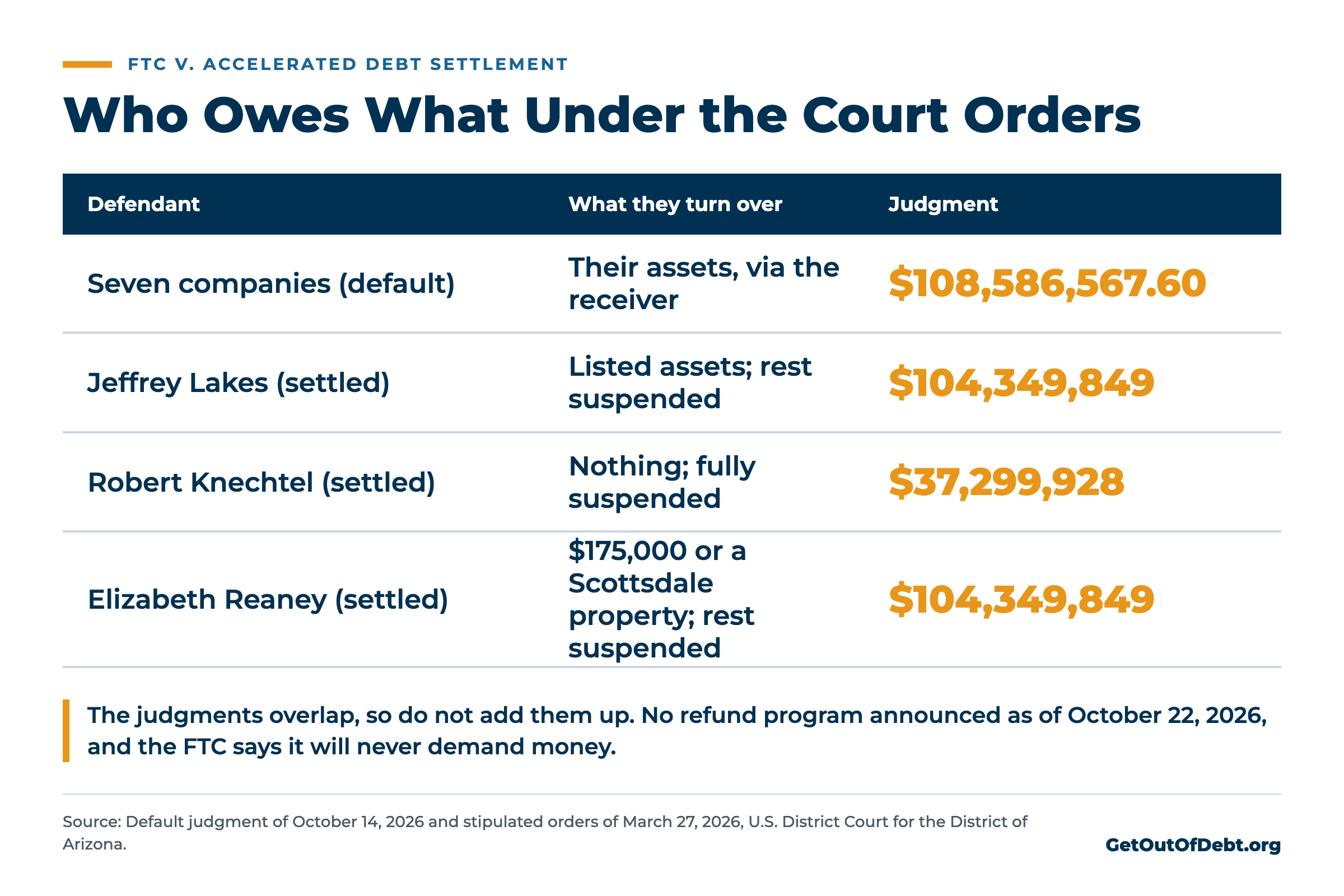
This is where press coverage tends to get sloppy, so I read the four orders line by line. Every judgment below is entered “jointly and severally” with the other defendants, which means it overlaps with the others. They are overlapping judgments for related harm to consumers, not separate pots of money stacked on top of each other, so don’t add them up. And these are amounts the defendants owe. None of it is anything you owe, and none of it guarantees you a dollar back. The big numbers are also mostly not what anyone is actually paying.
| Defendant | Judgment in the order | What the order actually requires them to turn over |
|---|---|---|
| The seven companies (default judgment, October 14, 2026) | $108,586,567.60 | Their assets. The court-appointed receiver, Thomas McNamara, is directed to wind the companies up and liquidate their assets within 365 days and then turn what is left over to the FTC. The order also directs a related entity named in it, which is not a defendant, to turn over real estate in Idaho, a truck and a boat to the receiver. |
| Jeffrey Lakes (stipulated order, March 27, 2026) | $104,349,849 | The contents of listed financial accounts, a list of coins, and for each of several items either cash or the item itself: $250,000 or a Scottsdale, Arizona property; $420,000 or Louisiana real estate; $270,000 or a 2024 Porsche 911 GT3; $95,000 or a 2025 Mercedes SUV; $31,000 or Patek Philippe and Rolex watches. Once those transfers are complete, the rest of the judgment is suspended. The FTC’s press release values what he turns over at approximately $12.6 million; that is a press-release figure, and the order itself does not state a total. |
| Robert Knechtel (stipulated order, March 27, 2026) | $37,299,928 | Nothing right now. The whole judgment is suspended, based on the sworn financial statement he gave the FTC. |
| Elizabeth Reaney (stipulated order, March 27, 2026) | $104,349,849 | Within 180 days, either $175,000 or the title to a Scottsdale, Arizona property the FTC describes as her home. Once that transfer is complete, the rest of the judgment is suspended. |
Two numbers in the FTC’s press release don’t match the signed orders, and I went with the orders. The release describes the default judgment against the companies as $106.8 million; the order says $108,586,567.60, and its findings say the evidence showed $108,586,567.60 in consumer harm in the three years before the FTC filed the case. The release gives Knechtel’s judgment as $37,299,828; his order says $37,299,928, in both words and numerals. The release also does not mention that Elizabeth Reaney’s order contains a $104,349,849 judgment; it does.
A suspended judgment is not a forgiven judgment. Each individual order says the suspension will be lifted if the court finds the person failed to disclose a material asset, materially misstated the value of an asset, or made another material misstatement or omission in the sworn financial statements given to the FTC. If that happens, the full judgment becomes immediately due, less what was already paid, plus interest. Each of the three individual orders also looks ahead to bankruptcy. It says the facts in the complaint “will be taken as true, without further proof,” in any later FTC case, “such as a nondischargeability complaint in any bankruptcy case,” and that those facts “establish all elements necessary to sustain an action by the FTC” under the Bankruptcy Code’s fraud exception, 11 U.S.C. § 523(a)(2)(A). That is how “neither admits nor denies” and “taken as true” sit in the same order: the three did not admit the allegations in this case, but they agreed those facts would be treated as true in that kind of later case. In plain English, the individual orders were written to make it much harder to wipe these judgments out in a later bankruptcy. I found no bankruptcy court ruling on it.
Is There a Refund? Not Yet.
I know this is the question if you paid. Here is the honest answer: as of October 22, 2026 the FTC has not announced a refund program, claim form or deadline for this case.
What the orders say is that money the FTC receives “may be deposited into a fund administered by the FTC or its designee to be used for Consumer relief, such as redress.” The FTC’s release says all money collected from the individual defendants “would become available to provide redress to defrauded consumers.” The orders also say that if the FTC decides direct payments to consumers are impracticable, or money is left over, it can use the money for other relief related to the practices in the complaint, and the individual orders say anything not used goes to the U.S. Treasury. So a refund is possible. It is not promised, and nobody can tell you today how much it would be.
If the FTC does run a refund program, look for it on the FTC’s refunds page at ftc.gov/refunds. That is where I would check, by typing the address in myself, not by clicking a link in an email or text. And keep this line from the FTC’s own release in your back pocket: “The FTC will never demand money, make threats, tell you to transfer money, or promise you a prize.” I walked through how to tell a real FTC payment from a fake one in this post about a recent FTC refund program.
The second scam is coming. When a case like this makes the news, the people who were already taken once start getting calls from “recovery” outfits that promise to get their money back for a fee. Anyone who asks you to pay to get your money back from this case is not the FTC.
The One Rule That Would Have Stopped This
If you remember one thing from this post, make it this. Under the FTC’s Telemarketing Sales Rule, a company selling debt relief by telemarketing cannot ask for or take any fee “until and unless” it has actually renegotiated, settled, reduced or otherwise changed the terms of at least one of your debts under an agreement you signed, and you have made at least one payment under that agreement. That’s 16 C.F.R. § 310.4(a)(5)(i). Even then, the fee has to be tied to the debt that was changed: either the same share of the total fee that debt is of all the debt you enrolled, or a percentage of what you actually saved on it. It can’t be the fee for the whole program. No changed debt, and no payment by you under the new deal, means no fee.
And here’s the part people miss. The rule still applies if you dialed because of a debt relief ad or mailer. The Telemarketing Sales Rule exempts some calls that consumers make in response to ads and direct mail, but 16 C.F.R. § 310.6(b)(5) and (b)(6) carve debt relief services out of those exemptions. So a mailer that gets you to call them does not get a debt relief company out of the upfront-fee ban.
The court found, as part of the default judgment, that the seven companies broke this exact rule. I wrote about this rule when it was new in my review of the Telemarketing Sales Rule for debt relief services.
The Red Flags From This Case
Every one of these comes straight from what the FTC alleged and what the court accepted as true against the companies on default:
- The caller says they are your bank, your card company, Social Security, the CFPB or a credit bureau. Your real card company is not going to cold-call you to sell a debt reduction program. I’ve written more about bank impersonation scams and about the payment demands impersonation scams have in common.
- They tell you your cards have been compromised and need to be closed. Fear first, then the pitch.
- They promise to cut your debt by 75% or more.
- They charge a fee to your credit card up front and say you won’t really have to pay it because it becomes part of the debt they’ll get rid of.
- They tell you the damage to your credit is only temporary.
- They want your bank account and routing numbers.
- Caller ID is blank, or they called even though your number is on the Do Not Call Registry.
If you want the broader list, my debt relief scams guide walks through the red flags I see most often.
If You Paid, Here’s What I Would Do Now
- Report it at ReportFraud.ftc.gov. Write down every charge with the date and amount, every name you were given and every phone number that called you. It puts your loss on record. Reporting does not sign you up for a refund, though, and anyone who says they will “file your claim” for a fee is running the second scam.
- If you paid by credit card, put it in writing to your real card issuer. A charge for services that were not delivered as agreed may count as a billing error under 12 C.F.R. § 1026.13, but a phone call alone does not start that federal process. The rule needs written notice, received at the billing-error address on your statement, no later than 60 days after the issuer sent the first statement that showed the charge. Be honest with yourself about the date: the court froze this operation on July 14, 2025, so for most people that 60-day window has already closed. You can still call the number on the back of your card and ask them to dispute it. It may become a request rather than a right. One exception: if you still owe that charge on your card, a separate rule, 12 C.F.R. § 1026.12(c), may let you raise the dispute with the card issuer and hold back the unpaid amount. It applies only if you made a good-faith attempt to resolve it with the seller, the charge was over $50, and the sale happened in your state or within 100 miles of your address, and the federal rule leaves it to state law to say where a phone sale happens, so ask the issuer. The worst they can say is no.
- If you gave them your bank account and routing numbers, call the bank that was debited. The credit card billing-error rule does not cover money pulled straight from a bank account. Tell the bank what happened, ask what it can do about those debits, and ask whether you should close or change the account. Watch your statements for anything you don’t recognize.
- Pull your credit reports and look at what actually happened to your accounts. The default judgment treats as true the allegation that the sellers told people to stop paying their credit cards. If you did, find out where each account stands now: late, charged off or sent to a collector. Charged off is an accounting step on the lender’s books, not forgiveness. The debt is still owed.
- If you get court papers about one of these debts, don’t ignore them. Answer by the deadline on the summons. Ignore it and you lose by default, the same way these companies did.
- Don’t pay anyone who offers to get your money back. If there is ever a refund, the FTC will announce it, and the FTC says it will never demand money.
The Part Nobody Says Out Loud
If you were taken by this, I need you to hear something. You were not stupid. According to the FTC, these callers used information from people’s own credit reports to sound like the bank they trusted. The FTC described a scheme built to sound like the people you trust, and it says the operation targeted seniors and veterans. Being fooled is not a character flaw. You are not your debt, and you are not the mistake of picking up that phone.
But the debt the caller promised to make disappear is probably still there, and maybe bigger. So let’s deal with the math. Debt is math wrapped in emotion, and the math has real options: paying it down on your own, a consolidation loan, a nonprofit debt management plan, settlement done legally, or bankruptcy. Each one has a real cost. The one I watch for most is people draining or borrowing against their retirement accounts to pay credit card debt, because retirement savings are generally protected in bankruptcy, and money pulled out of them to pay a card company is gone for good. I filed bankruptcy myself in 1990, and I can tell you it was the beginning of my recovery, not the end of my life. On credit, a CFPB report built on a sample of about five million de-identified credit records found that, “On the whole, median credit scores rise steeply for Chapter 7 filers in the first few years after filing, in contrast to scores for Chapter 13 filers.” Its credit-score analysis tracked filers over time; it did not compare them with people who never filed. You can read the CFPB report here.
No sense wasting a perfectly good mistake. Use this one to look at your whole situation honestly, then deal with it and look to the future rather than spend five years repairing the past.
Frequently Asked Questions
Has the Accelerated Debt Settlement operation been shut down permanently?
Yes. On October 14, 2026, the U.S. District Court for the District of Arizona entered a default judgment that permanently bans the seven corporate defendants from selling debt relief and from telemarketing. The three individual defendants, Jeffrey Lakes, Robert Knechtel and Elizabeth Reaney, agreed to stipulated orders, signed March 27, 2026, that contain the same debt relief and telemarketing bans. One exception: Knechtel’s telemarketing ban does not stop him, if he is licensed to practice law, from directly providing routine legal services to clients he has an attorney-client relationship with.
Can I get my money back from Accelerated Debt Settlement?
Not yet. As of October 22, 2026, the FTC has not announced a refund program, claim form or deadline for this case. The court orders say money the FTC receives may be deposited into a fund used for consumer relief such as redress, and the FTC says money collected from the individuals would become available for redress. If a program is created, look for it on the FTC’s refunds page at ftc.gov/refunds. Report your loss at ReportFraud.ftc.gov, and never pay anyone who offers to recover your money.
Did the defendants admit wrongdoing?
No. Each of the three individuals’ orders says he or she neither admits nor denies the allegations in the complaint, except as specifically stated in the order. The seven companies did not answer the case at all; the court entered a default judgment and, because of the default, treated the allegations in the complaint as true. The companies never admitted anything in their own words, but because they did not respond, the law treats the complaint’s allegations as established against them. That is not a verdict after a trial.
Is it legal for a debt relief company to charge an upfront fee?
Not when it sells debt relief by telemarketing, including calls you make in response to its ads or mailers. The FTC’s Telemarketing Sales Rule, 16 C.F.R. § 310.4(a)(5)(i), bars a seller or telemarketer from asking for or taking any fee for debt relief until it has renegotiated, settled, reduced or otherwise changed the terms of at least one debt under an agreement you signed and you have made at least one payment under that agreement, and even then the fee has to be tied to that debt, not the whole program. Under 16 C.F.R. § 310.6, the rule still applies when you call the company in response to an ad or a mailer about debt relief.
How can I tell if a caller is really from my bank or credit card company?
Hang up and call the number printed on the back of your card or on your statement. Do not use a number the caller gives you. In this case, the FTC alleged the callers used information from consumers’ credit reports to sound like their card issuer, so a caller knowing details about your account does not prove anything.
Why are the judgments so much bigger than what the defendants are paying?
Because most of each individual judgment is suspended. Robert Knechtel’s $37,299,928 judgment is fully suspended based on his sworn financial statement. Jeffrey Lakes and Elizabeth Reaney each have a $104,349,849 judgment that is suspended once they turn over the assets their orders list. If the court later finds any of them misrepresented their finances to the FTC, the full judgment becomes immediately due. The judgments are entered jointly and severally, so they overlap and should not be added together.
One last thing from me: I sell nothing and get no referral fee for anything I’ve told you here. This is what I’m telling friends like you over coffee, and it’s input, not instruction. You know your situation better than I ever will, so you do you. If you know someone who got one of these calls, especially an older parent or a veteran, send this to them. It might be the thing that keeps them from paying the next caller.
Dealing With Debt? Understanding your options is the first step. See how all your debt relief options compare — including ones most sites won’t tell you about. The Find Your Path quiz gives a recommendation based on your actual numbers, and the Scam-O-Meter checks any company’s complaint history before you sign. Federal Reserve Bank of New York research shows bankruptcy filers recover faster than those who don’t file.



