

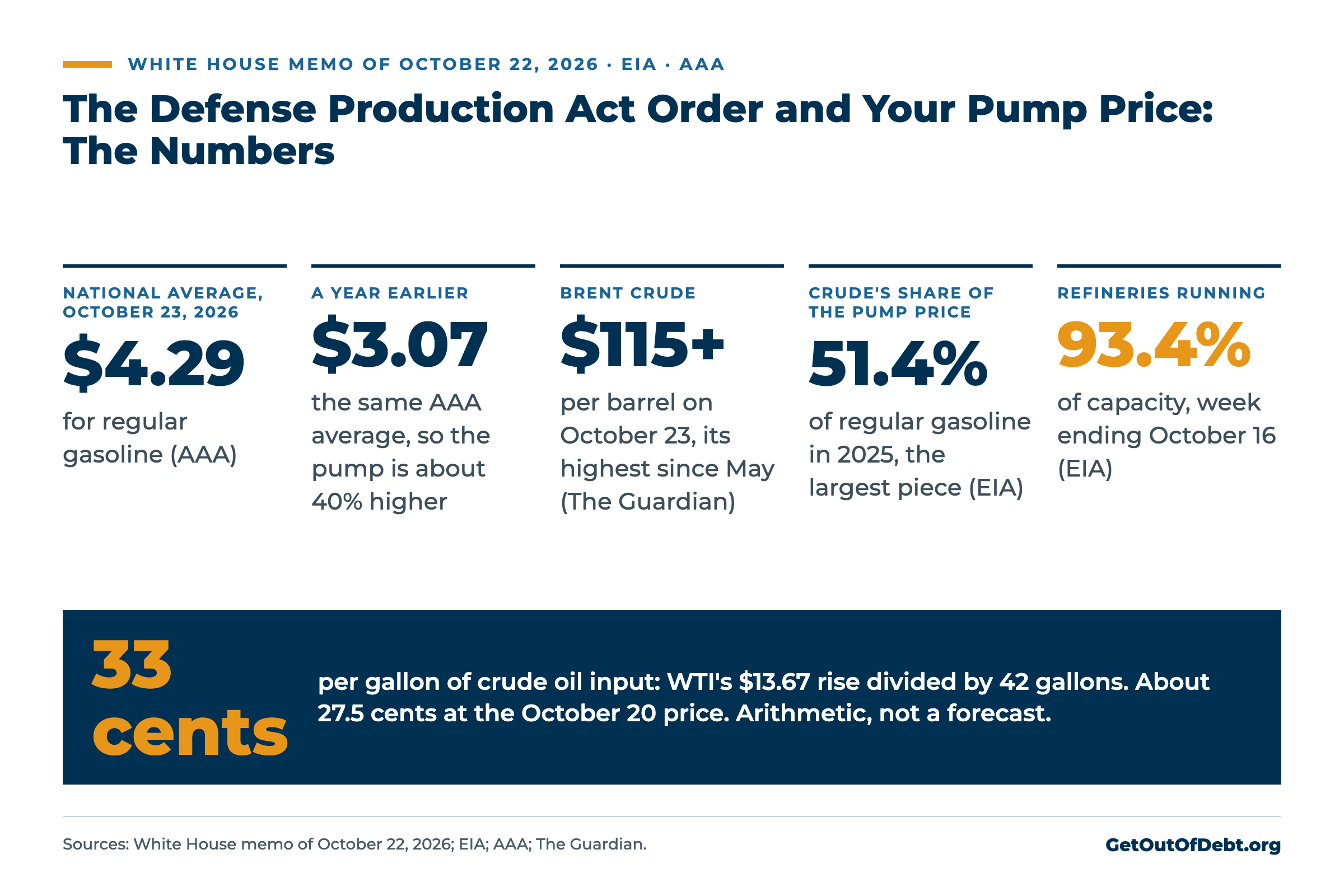
Quick Answer: The Defense Production Act order the White House published on October 22, 2026 is a funding authority for petroleum production, refining, pipeline, storage and terminal projects, not a price cut, and nothing in its text sets or lowers a pump price. The memo directs the Secretary of War to use purchases, purchase commitments and financial instruments to enable those projects, and it never mentions gasoline, a price or a gallon (White House memo, October 22, 2026). Meanwhile Brent crude rose above $115 a barrel on October 23 (The Guardian), crude oil was about half of what you paid for a gallon in 2025 (EIA), and the national average for regular was $4.29 on October 23 (AAA). That national number is only a backdrop, because your price is the one on your own receipt, and AAA’s state page shows your state’s average. My advice is to plan this week’s holiday travel, car shopping and budget around the price you actually pay, not around hoped-for relief.
Expert Context: I am not an energy analyst and I will not pretend to be one, so every energy fact in this post comes from the White House memo itself, the U.S. Energy Information Administration (EIA), AAA or The Guardian, and I link each one. What I do have is more than thirty years of watching what happens to a household budget when a price promise does not arrive on schedule. I started helping people with debt in 1994, and the pattern I know best is this one: families plan around the relief in the headline, the relief is late, and the gap lands on a credit card.
The headline sounds like help is on the way for your gas bill. The document itself is about building oil and refining capacity over time, and that is a different thing from a lower price this week.
What You Need to Know
On October 22, 2026 the White House published a presidential determination under Section 303 of the Defense Production Act of 1950 on “Domestic Petroleum Production, Refining, and Logistics Capacity.” Here is what the memo says, and what it does not say.
Each weekday I send one short email: one story that caught my attention, why it might matter to you, and one manageable thing you can do with it. A couple of minutes, and a dad joke.
In the latest issue (Nov 6): Owed money on an Amazon return? Check by Dec. 1
Free. I sell nothing. Unsubscribe any time.
- What it says: it finds that domestic petroleum production, refining and logistics capacity are “essential to the national defense,” that industry cannot reasonably be expected to provide them in a timely manner because of “constrained financing, long lead times, permitting and infrastructure bottlenecks, and supply chain limitations,” and that purchases, purchase commitments and financial support are “the most cost-effective, expedient, and practical alternative methods” for meeting the need.
- What it directs: the memo tells the Secretary of War, “You are authorized and directed to implement this determination, including making necessary purchases, commitments, and financial instruments to enable these projects, and to publish this determination in the Federal Register.”
- What it does not say: the memo never uses the word gasoline, never sets or targets a price, and never mentions a gallon or a barrel. It does not order a company to produce a set amount.
- It is not a brand-new action: the White House published a determination with the same title on April 20, 2026. When I compared the two texts, the October memo is almost word for word the same. The differences I found are that the October memo is addressed to the Secretary of War instead of the Secretary of Energy, a few words were changed, and it adds one sentence saying any inconsistent earlier memoranda, proclamations and orders are superseded. The memo does not explain why it was reissued, and I am not going to guess.
Key Terms Defined
Defense Production Act (DPA) Section 303: the part of the 1950 law that lets the President support industrial capacity the government considers essential to national defense through purchases, commitments to purchase and other financial incentives. It is a spending and financing authority (50 U.S.C. § 4533). The memo itself notes that it uses the emergency waiver in section 303(a)(7).
Refinery utilization: the share of a refinery’s operable capacity that is actually being used in a given week.
Now the other half of the picture. EIA reported on October 22 that U.S. refineries have been running at very high rates in 2026: utilization averaged above 95% of capacity from May through September, the highest for those months since 1998, and refining capacity has fallen 4% since 2019. In the first three weeks of October utilization eased from its summer highs but stayed above the 2021-2025 seasonal average. EIA’s weekly data put it at 93.4% for the week ending October 16, down from 98.0% in the week ending August 28.
And the price of the thing refineries start with moved the wrong way for drivers this month. EIA’s daily spot price for U.S. benchmark WTI crude went from $96.34 a barrel on October 14 to $110.01 on October 19. The Guardian reported on October 23 that Brent, the international benchmark, rose above $115 a barrel, its highest level since May, after Iran said it would attack oil facilities in the Gulf if a new US-Israeli offensive were launched. The same article says oil traded at about $72 in February, before the Iran war began, and reached $126 by the end of April.
Why You Need to Know It
Debt is math wrapped in emotion, and a headline about emergency powers is built to deliver the emotion first. When the President invokes a 1950 law and the word “fuel” is anywhere nearby, it is natural to feel that someone is handling your gas bill. I understand that feeling, and I would like it to be true.
The Assumption: An emergency order about petroleum production means gasoline will get cheaper soon.
The Reality: The memo supports projects through purchases, commitments and financing, and by its own account those projects face “long lead times, permitting and infrastructure bottlenecks.” Nothing in it sets a pump price. Meanwhile crude oil, the largest piece of what you pay, rose over the past week and a half (WTI from $96.34 on October 14 to $110.01 on October 19), although EIA’s October 20 print eased to $107.89.
Why this matters for a household and not just a trader: about half of the price you paid at the pump in 2025 was the price of crude. EIA says crude oil made up about 51.4% of the retail price of regular gasoline in 2025, the largest single component, ahead of refining, distribution and marketing, and taxes. In my read, the global crude price is driven more by supply fears in the Middle East than by a memo in Washington, and nothing in the memo addresses crude supply abroad.
I have seen this movie. When gas ran up this spring, I wrote about how a $4.39 gallon turned into a credit card trap. After it dipped in June, I wrote about capturing the difference before it disappeared. The thread through both is the same: the families who get hurt are not the ones who pay more for gas, they are the ones who budget for the price they hoped for and then cover the difference on a card.
Things to Consider
- The pump is lower than a month ago, while crude rose over the past week and a half. AAA’s national average was $4.2926 on October 23, against $4.3271 a week earlier and $4.4744 a month earlier. EIA’s weekly series shows the same slide from $4.478 on September 21 to $4.284 on October 19. But AAA’s average ticked up from $4.2701 on October 22 to $4.2926 on October 23, so the crude jump may be starting to show. I would not read the recent dip as a trend.
- Here is the arithmetic, not a forecast. EIA’s barrel FAQ says a barrel of crude oil is 42 gallons, and that U.S. refineries make about 19 to 20 gallons of motor gasoline from one, so a barrel does not become 42 gallons of gasoline: the same barrel also yields about 11 to 13 gallons of ultra-low sulfur distillate fuel oil, most of which is sold as diesel, and many other petroleum products. Still, dividing by 42 gives a sense of scale: WTI rising $13.67 a barrel, from $96.34 on October 14 to $110.01 on October 19, is about 33 cents per gallon of crude oil input, and at the October 20 price of $107.89 the rise is $11.55, or about 27.5 cents. That is division, not EIA’s estimate of your pump price. Refining costs, margins and other costs move too, none of it passes through on a schedule, and crude could fall.
- Refineries are not sitting idle waiting for an order. They averaged above 95% of capacity from May through September and were still at 93.4% in mid-October. EIA says that although utilization was the highest since 1998, “total U.S. refinery output was only the highest since 2019 because refining capacity has decreased by 4% since then.” In other words, the plants are running harder, but total U.S. refining capacity is 4% lower than in 2019. I would not expect a funding authority for new projects to change that quickly, because the memo itself describes the constraints as long lead times and permitting bottlenecks.
- I cannot tell you what happens next, and neither can anyone else. Oil moves on events. Today’s fear is a renewed strike on Iran, and that can turn around in either direction in a day. That is exactly why I would not build a budget on a hoped-for price.
- It is not only gasoline. If you heat with oil, I wrote about what to read before you prepay an oil dealer this winter. The cents-per-gallon arithmetic above is about crude oil going into gasoline, not a reason to prepay heating oil, and before you sign any prepay contract, read its cancellation terms first.
A quick example (hypothetical numbers, real prices): Say you drive a 600-mile round trip for Thanksgiving in a car that gets 25 miles per gallon. That is 24 gallons. At the $4.29 national average from AAA, the fuel costs about $103. At last year’s $3.07 national average it would have been about $74, so at national prices you are paying roughly $29 more for the same trip. If the 27.5 to 33 cents per gallon of crude-input arithmetic above did show up at the pump, which it may not, 24 gallons would cost roughly $6.60 to $7.80 more again. Swap in your own pump price as well as your own miles and your own mpg, because your numbers are the only ones that matter.
Free Tool — Contract Decoder: Have a contract from a debt relief company? The free Contract Decoder analyzes it for red flags, hidden fees, and problematic terms — before you sign anything. Decode My Contract →
What to Think About Doing
You have options here, and the right one depends on your cash, your commute and your calendar. Here is how I would think about it, and what I would tell my own family.
- Budget at the price you actually pay. Use the price on your own receipt, or your state’s average on AAA’s state page, not the national number. Set your gas line to the higher of the per-gallon price on your last receipt and your three-month average price per gallon, times the gallons you actually use in a month, and do not lower it until the price at your pump has actually fallen. When it does fall, treat the difference as found money and send it to your highest-interest balance.
- Fund the higher gas line by trimming something else, not by borrowing. The Federal Reserve’s most recent G.19 report puts the interest rate on credit card accounts that are assessed interest at 22.15% for the second quarter of 2026 (the release marks it revised) and 22.36% for August 2026 (the release marks it preliminary). At about 22%, every $100 you carry on a card for a year costs roughly $22 or more in interest, and it stays long after the price spike is over.
- Holiday travel: Thanksgiving is November 26. Price driving and flying for your actual route using the gas price where you fill up and today’s fares, then book or commit while the comparison still holds. Check the change fee and whether the fare is refundable before you commit, so a comparison that flips does not become a second bill. The fueleconomy.gov trip calculator will do the fuel math for your car, and you can set the gas price yourself, so use your own.
- Car shopping: run the total cost of ownership at the gas price where you fill up, not at the price you hope for. The IRS says the new clean vehicle credit is not available for vehicles acquired after September 30, 2025, so a comparison between a gas car, a hybrid and an electric car should not assume a federal credit; check your state and your electric utility for any incentive that still applies. The fueleconomy.gov fuel cost calculator compares two vehicles using prices you enter. Do not stretch for a thirstier vehicle on the assumption that fuel will get cheap, and read what always having a car payment costs over a lifetime before you sign.
- If it is already tight: a budget that works only at the best-case price is not a budget. My post on watching what is left at the end of the month is a simple way to see where you actually stand, and the Find Your Path quiz will show how your own numbers compare across your options.
- Do not put your holiday gas and travel on a card because you assume prices will fall before the bill arrives.
- Do not skip a minimum payment to cover gas. Late fees and credit damage can outlast any price spike.
- Do not raid retirement savings to cover a price spike. That math almost never works in your favor.
Key Takeaways
- The October 22, 2026 Defense Production Act memo supports petroleum production, refining and logistics projects with purchases, commitments and financing. It does not set a price and does not mention gasoline.
- It is almost identical to a memo with the same title published on April 20, 2026.
- Crude oil was about half the pump price in 2025, and crude rose over the past week and a half: WTI went from $96.34 on October 14 to $110.01 on October 19, though EIA’s October 20 print eased to $107.89, and Brent rose above $115 on October 23.
- Pump prices are lower than a month ago, at a $4.29 national average, but crude rose sharply over the past week and a half, so plan on the price you actually pay, not a lower one.
The Bottom Line
If you read the headline and felt a little hope, or felt a knot in your stomach because your holiday plans depend on a gas price you cannot control, you are not being naive. You are being a person with a budget. The reframe is simple: a memo can change what gets built over time, but your October and November are decided by the price at your pump, so budget for the price you actually pay. I filed bankruptcy in 1990 and rebuilt, and what got me through was never a headline, it was dealing with the real numbers in front of me. Do that now, keep the gas on cash and not on a card, and a bad price month stays a bad price month instead of becoming a debt that follows you into spring.
Frequently Asked Questions
What did the Defense Production Act order on October 22, 2026 actually do?
The White House published a presidential determination under Section 303 of the Defense Production Act on domestic petroleum production, refining and logistics capacity. It finds those capacities essential to national defense and directs the Secretary of War to implement the determination, including making purchases, commitments and financial instruments to enable projects. It never mentions gasoline or sets a price, and its text is almost identical to a determination with the same title published April 20, 2026.
Will the Defense Production Act lower gas prices?
Nothing in the October 22 memo sets a price or orders anyone to produce a set amount, and the memo itself says the projects face long lead times and permitting bottlenecks, so I would not expect it to lower the pump price this week. Crude oil was about 51.4% of the retail price of regular gasoline in 2025 according to EIA, and crude rose over the past week and a half, with WTI going from $96.34 on October 14 to $110.01 on October 19 (EIA’s October 20 print was $107.89) and Brent rising above $115 on October 23. Nobody can promise where prices go next.
Why is crude such a big part of the gas price?
Because crude oil is the biggest piece of what you pay. EIA says it was about 51.4% of the retail price of regular gasoline in 2025, ahead of refining, distribution and marketing, and taxes. A barrel is 42 gallons, so each $1 change in a barrel works out to roughly 2.4 cents per gallon of crude oil input, which is division and not EIA’s estimate of your pump price, because refining costs, margins and other costs move too.
Are U.S. refineries already running at full capacity?
They have been running very hard. EIA says utilization averaged above 95% from May through September, the highest for those months since 1998, and its weekly data show 93.4% in the week ending October 16, which is below the August peak of 98.0% but above the 2021-2025 seasonal average. U.S. refining capacity has also fallen 4% since 2019.
How should I budget for gas this holiday season?
Budget at the price you actually pay, not the national number, which was $4.29 a gallon on October 23 according to AAA. Check your own receipt or your state’s average on AAA’s state page, set your gas line to the higher of the per-gallon price on your last receipt and your three-month average price per gallon, times the gallons you actually use in a month, and treat any drop as a bonus rather than a plan. Price your driving and flying options for your actual route now, fund the higher gas line by trimming another expense instead of using a credit card, and use your own miles and mpg for the math.
If you know someone who is planning holiday travel or shopping for a car this week, send them this before they build a budget around a headline. A little warning now can save a lot of interest later.
This is what I would tell my own family after thirty years of helping people with debt. Take it as one informed perspective, and use it as input for your decision, not as a directive. Only you know your full situation, and nobody gets to tell you what to do with your money, not a headline and not me.
Dealing With Debt? Understanding your options is the first step. See how all your debt relief options compare — including ones most sites won’t tell you about. The Find Your Path quiz gives a recommendation based on your actual numbers, and the Scam-O-Meter checks any company’s complaint history before you sign. Federal Reserve Bank of New York research shows bankruptcy filers recover faster than those who don’t file.



