

Quick answer: The Oct. 22, 2026 plunge in Treasury yields isn’t, by itself, a sign that your bank is about to cut your savings or CD rate this week. Treasury’s own par yield curve shows the 10-year yield fell from 5.13% to 4.96% in one day, and the 1-year, a common CD length, fell from 4.52% to 4.41%. A bank can change the rate on a variable-rate savings account without sending you a notice (12 CFR 1030.5(a)(2)(i)), so the only way to know what you’re earning is to look. I’d write down your current rate today, keep your emergency fund somewhere liquid and federally insured, and compare terms and early-withdrawal penalties before locking any money you won’t need soon. This is a reason to look, not a reason to rush.
Expert Context: I’ve been helping people with debt since 1994, and I’ve watched the same thing happen after almost every scary or exciting market headline: people either freeze or rush, and neither one is a plan. I filed bankruptcy myself in 1990, so none of this is academic to me, and it’s why I care more about your cushion than about squeezing out the last tenth of a percent.
Debt is math wrapped in emotion, and a bond-market plunge is a lot of emotion. So here is the math: what moved, what didn’t, and what I’d check this week.
What You Need to Know
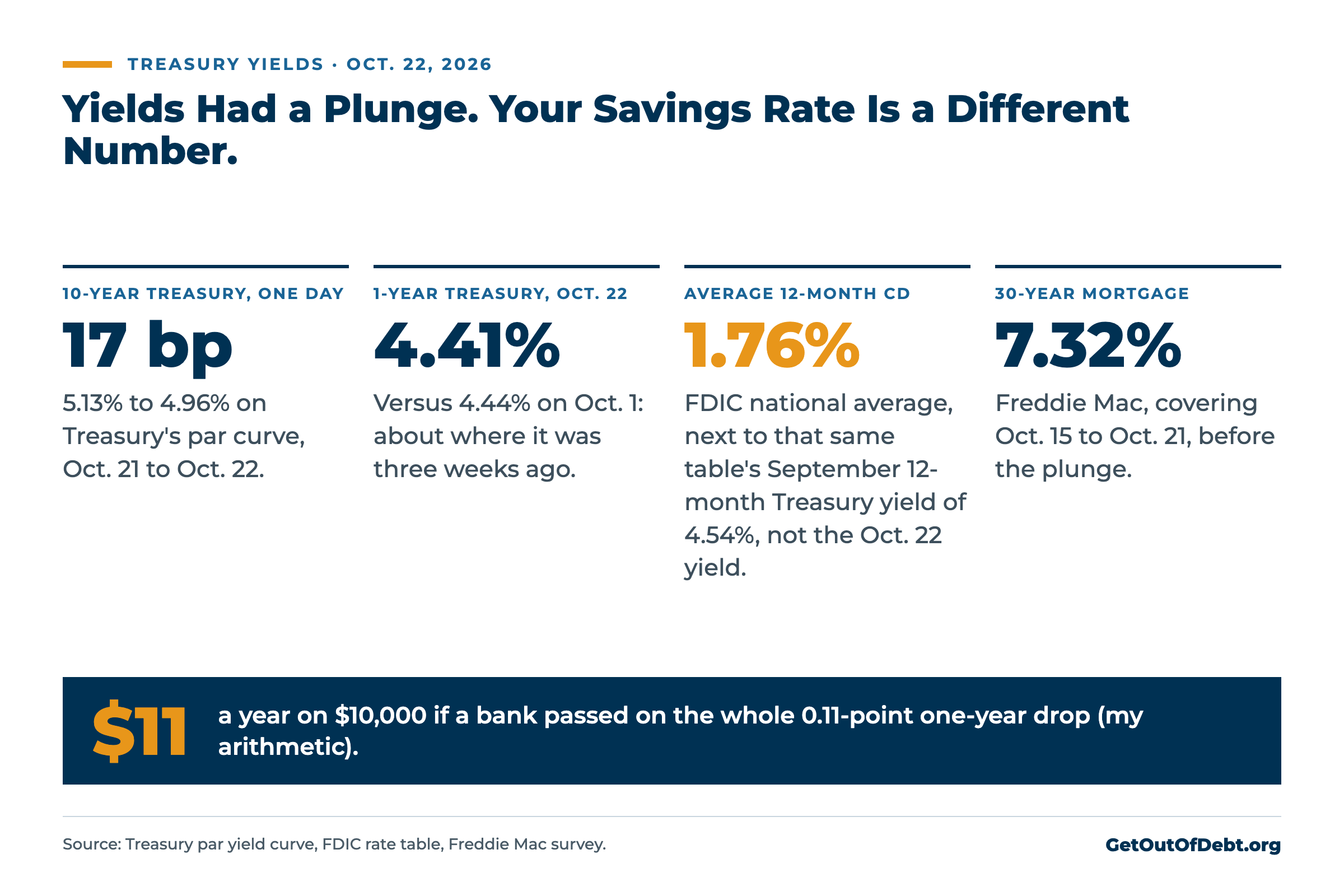
The move. Treasury yields fell hard on Thursday, Oct. 22. On the Treasury Department’s official daily par yield curve, the 10-year went from 5.13% on Oct. 21 to 4.96% on Oct. 22, a drop of 17 basis points (a basis point is one hundredth of a percentage point). The 2-year fell from 4.81% to 4.65%, the 1-year from 4.52% to 4.41%, and the 6-month from 4.35% to 4.29%.
Each weekday I send one short email: one story that caught my attention, why it might matter to you, and one manageable thing you can do with it. A couple of minutes, and a dad joke.
In the latest issue (Nov 6): Owed money on an Amazon return? Check by Dec. 1
Free. I sell nothing. Unsubscribe any time.
The headline. Reuters reported, in a story published by The Globe and Mail, that the 10-year yield fell 19.3 basis points to 4.953% in market trading and “was on track for its biggest daily drop since March 10, 2023” — a reading taken before the final close, on a different yardstick than Treasury’s par curve. On the par curve alone, two days since then, Nov. 14, 2023 and Aug. 2, 2024, each show a 19-basis-point drop, so I wouldn’t repeat a biggest-drop-since-the-banking-crisis line as if it’s settled. It was a big, fast move either way.
The cause. Reuters tied it to worries about the AI boom and a rush to the safety of government bonds, not to a move by the Fed. Stocks sold off on renewed worries about the AI spending boom: the Nasdaq fell more than 2% and Meta lost nearly 8% after its earnings report, and investors moved into the safety of government bonds. Reuters also noted that yields had been falling in recent days even though the economic data showed persistent inflation pressure. The 10-year had reached 5.3645% on Oct. 7, its highest since April 2002.
The Fed. This was not a rate-cut story. The Federal Reserve raised its target range by a quarter point to 3¾–4 percent on Sept. 16, 2026, and its next meetings are Oct. 27–28 and Dec. 8–9. Reuters said the market-implied chance of a hike at the October meeting had shrunk to 7.2%, from 27.7% a week earlier and 55.4% a month earlier (CME FedWatch). 24/7 Wall St. reported that the odds of a December hike were still about 78% late Thursday. Traders’ bets change fast — none of these odds is a promise.
The Fed met Oct. 27–28 and held; I broke down what the hold and the two votes to raise mean for your card and your savings.
Key Terms Defined
Par yield curve: The Treasury Department’s daily table of what Treasury securities of each length yield, from 1 month to 30 years. It is Treasury’s official daily record, based on market quotes taken near 3:30 p.m., so it can differ slightly from numbers quoted during trading.
APY (annual percentage yield): What a deposit account actually earns over a year, including compounding. It is the number to compare between banks.
Variable-rate account: An account whose rate the bank can change. Savings accounts are typically variable-rate. A typical CD is different: the rate is set for the term, which is exactly why timing matters when you open one.
Why You Need to Know It
The Claim: When Treasury yields drop, your bank cuts your savings and CD rates within days, with no warning.
The Reality: I couldn’t find a source that puts a speed like “within days” on it. What researchers at the New York Fed describe is deposit rates that follow the Fed’s overnight rate but are “typically lower,” and they note that prior research has found banks pass along less of a rise than of a fall (Liberty Street Economics). In plain terms, when deposit rates do move, the research suggests they come down more readily than they went up, which is one more reason to check your own rate. That research covers the banking system as a whole, not your bank, and it ties deposit rates to the Fed’s rate, not to one day’s Treasury move. The part of the claim that is true is the “no warning” part, for savings accounts, below.
The quiet part is real. Under the federal Truth in Savings rule, a bank has to give you 30 days’ advance notice of many adverse changes, but 12 CFR 1030.5(a)(2)(i) says no notice is required for “changes in the interest rate and corresponding changes in the annual percentage yield in variable-rate accounts.” So if your savings rate drops, nobody has to tell you. (Credit unions follow a parallel NCUA rule with the same exception, 12 CFR 707.5(a)(2)(i).) A typical CD is different: its rate is fixed for the term, and an automatically renewing CD longer than a month comes with disclosures before it matures (1030.5(b)). That notice is your cue to shop. If you do nothing, an automatically renewing CD rolls into a new term, and taking the money out after any grace period ends can bring the early-withdrawal penalty. The bank must also state whether it gives a grace period and how long it is (1030.4(b)(6)(iv)), so note that date.
The bigger leak may already be in your account. The FDIC’s national rates table (published Oct. 19, based on month-end September data) lists the national average savings rate at 0.38% and the average 12-month CD at 1.76%. Those are averages weighted by each institution’s share of domestic deposits, so they show where balances sit, not the best insured, liquid savings rate you could open today. The 4.54% in the same table is the 12-month Treasury yield for that September data, not the Oct. 22 1-year yield of 4.41%. On $10,000, 0.38% earns about $38 a year (my arithmetic, simple interest). The deposit-weighted national average wasn’t tracking the Treasury curve before this week, so a one-day bond move isn’t the thing to fear; whether you’re earning the average rate is the thing to check. Before locking a CD or buying a bill, get one insured, liquid savings quote to compare it against.
Things to Consider
1. The 1-year yield is about where it was three weeks ago. The 2-year fell 16 basis points on Oct. 22, nearly as much as the 10-year, but the 1-year was 4.44% on Oct. 1, 4.42% on Oct. 7, 4.44% on Oct. 8, and 4.41% on Oct. 22 (Treasury). It reached 4.59% on Sept. 28, but from Oct. 1 through Oct. 21 it stayed between 4.42% and 4.53%. Here is the scale in plain dollars: the 1-year yield fell about 0.11 percentage point on Oct. 22, and on $10,000 that is about $11 a year, even if a bank passed on every bit of it (my arithmetic, simple interest). This is not a cliff.
2. Locking in cuts both ways. A CD gives you certainty, and you give up the chance to earn more if rates rise. With the Fed having just raised rates and December hike odds still high, that is a real trade-off, not a footnote. In market trading the 10-year went from 5.3645% on Oct. 7 to 4.953% on Oct. 22 (Reuters); a fear-driven rally can reverse as quickly as it came. And if you need the money early, the CD’s early-withdrawal penalty, which the bank must disclose along with how it is calculated, can cost more than the interest you have earned so far. The rule’s official interpretation gives examples of how a penalty can be stated, such as a flat “$10.00” or “seven days’ interest plus accrued but uncredited interest.” Those are illustrations, not a cap or a typical amount. Your bank’s penalty can be much larger, so read its disclosure before you open the CD.
3. The mortgage number is old news. Freddie Mac’s weekly survey put the 30-year fixed rate at 7.32% as of Oct. 22, down from 7.40% the week before, versus 6.19% a year ago. It’s the first weekly decline since the reading dated Aug. 20 (6.65%). But Freddie says each reading averages rates from the prior Thursday through Wednesday, so the Oct. 22 number covers Oct. 15 to Oct. 21 and doesn’t include this plunge at all. Mortgage rates depend on the expected path of the Fed’s rate, the term premium in longer-term Treasury yields and risk spreads, as Fed Governor Bowman put it in a March 2025 speech, so they don’t move one-for-one with one day’s 10-year yield. I walked through the run-up in my look at mortgage rates rising six weeks in a row and in the one-year high before it.
4. The interest you pay is usually the bigger number. A $5,000 balance at 22% costs about $1,100 a year in interest, while $5,000 earning 4.41% (about what a 1-year Treasury yielded on Oct. 22) makes about $220, and at the 0.38% national average savings rate the same $5,000 makes about $19 (my arithmetic, simple interest, an example). If you carry card debt, the interest you pay is almost always the bigger number, which is why I wrote about weighing an emergency fund against debt. I don’t want you draining your cushion to do it, and I’d never touch retirement money for it.
Things You Might Want to Think About Doing
These are options, not instructions. Only you know your timeline and your budget.
- Look at your APY today. Open your savings account, write down the rate, and look again in a week or two. That’s the only way you’ll catch a quiet change. If you hold a CD that renews automatically, check when it matures and watch for the pre-maturity notice.
- Keep your emergency fund where you can reach it this week. Money you might need within months belongs in an account without a penalty for withdrawing it, at a bank or credit union covered by federal deposit insurance: the FDIC covers $250,000 per depositor, per insured bank, for each ownership category, and the NCUA covers up to $250,000 at federally insured credit unions. I wouldn’t lock the cushion in a CD.
- Money you truly won’t need for a year or two is a different question. If you’re considering a CD for that slice, compare insured banks and credit unions yourself, look at the term, the early-withdrawal penalty, and whether the bank can call (end) the CD early. A “no-penalty” CD trades some rate for flexibility. Splitting the money across a few different end dates is another way to avoid betting on one day’s rate. I won’t name a bank or quote a “best rate” here, because rates change daily and the right answer depends on your situation.
- Know the other option, and its trade-offs. TreasuryDirect sells Treasury bills for terms from four to 52 weeks, with the interest rate fixed at auction, so what you get is the auction result, not the par-curve yield quoted above. TreasuryDirect says all Treasury marketable securities are backed by the full faith and credit of the United States government, but they are not bank deposits, and the FDIC lists “U.S. Treasury bills, bonds, or notes” as not covered by deposit insurance. You can sell a bill before it matures, but TreasuryDirect says “you must work through a bank, broker, or dealer” to do it, and a security you buy in TreasuryDirect must be held there “for 45 days before selling or transferring it” (Selling a Treasury Marketable Security), so a 4-week bill bought in TreasuryDirect can’t be sold or transferred before it matures. That makes bills a fit for money you can leave alone until maturity, not for your emergency fund. The interest is subject to federal tax but not state or local tax, and that break is worth nothing if your state has no income tax.
- If you’re behind on bills, this isn’t your lever. A savings rate won’t fix a debt problem. You have more than one option, and the right one depends on your numbers; the Find Your Path quiz can help you compare them. Bankruptcy is one of them, and in my view it’s the one that works best for many people. That’s my opinion, and it won’t fit everyone.
- If you’re shopping for a mortgage, don’t plan around one day’s headline. Ask your lender how and when a rate can be locked, and what it costs to lock.
I’ve written about the same pattern before: a market move makes a dramatic headline, and the useful question is always what it means for your own numbers. After the weak jobs report I looked at what it meant for your card rate and your savings, and after the Fed’s September hike I covered how card APRs reset.
Key Takeaways
- Treasury’s par curve shows the 10-year at 4.96% on Oct. 22, down 17 basis points in a day, with fear about AI spending behind it (Reuters).
- The 1-year yield was 4.41%, about where it sat on Oct. 1 (4.44%), even though the 2-year fell 16 basis points that day.
- A bank can change a variable-rate savings rate with no notice, so check your own APY.
- Keep the emergency fund liquid and insured; compare terms and early-withdrawal penalties before locking anything.
The Bottom Line: If the bond-market headlines made you feel like you’re about to miss something, that’s normal; headlines are built to do that. But the numbers are calmer than the noise: the one-year yield moved about 0.11 point, and a bank passing on all of it would cost you roughly $11 a year per $10,000. What matters more is what you’re earning today and whether your cushion is safe and within reach. You don’t have to out-guess the bond market. You just have to look at your own account this week, and you can do that in five minutes.
Frequently Asked Questions
Will CD rates go down after Treasury yields drop?
Not automatically, and not on a schedule I can cite. Treasury’s par curve shows the 1-year yield fell from 4.52% to 4.41% on Oct. 22, 2026, after staying between 4.42% and 4.53% from Oct. 1 through Oct. 21. Banks set CD rates based on their own funding needs and competition, and the FDIC’s October table put the national average 12-month CD at 1.76% against that same table’s September 12-month Treasury yield of 4.54% (not the Oct. 22 yield), so the deposit-weighted national average wasn’t tracking the curve closely to begin with. Rates vary widely by bank, so compare your own options.
Should I lock in a CD rate right now?
That depends on how soon you need the money, and I can’t make that call for you. Money you might need within months should stay liquid and federally insured. For money you won’t need for a year or two, a CD gives you a fixed rate but you give up the chance to earn more if rates rise, and early withdrawal brings a penalty that can cost more than the interest you’ve earned so far. With the Fed having raised rates on Sept. 16, locking in is a trade-off, not a sure thing. As one snapshot, 24/7 Wall St. put the chance of a December rate hike near 78% late on Oct. 22, while Reuters, citing CME FedWatch, put the chance of a hike of at least a quarter point at the Oct. 27–28 meeting at 7.2%. Those answer different questions about different meetings and move daily, so I wouldn’t lock, or refuse to lock, because of either number.
Does my bank have to tell me if it lowers my savings rate?
Not for a variable-rate account. Under 12 CFR 1030.5(a)(2)(i), no advance notice is required for changes in the interest rate and corresponding APY on variable-rate accounts. A typical CD’s rate is fixed for its term, and an automatically renewing CD longer than a month must come with disclosures before it matures. The practical answer is to check your own rate every so often.
Will mortgage rates fall now that Treasury yields dropped?
Possibly over time, but not automatically. Freddie Mac’s survey showed the 30-year fixed rate at 7.32% as of Oct. 22, down from 7.40%, but that number averages rates from Oct. 15 to Oct. 21 and doesn’t include the Oct. 22 yield plunge. Mortgage rates depend on the expected path of the Fed’s rate, the term premium in longer-term Treasury yields and risk spreads, as a Fed governor has described, so one day’s move doesn’t pass through one-for-one.
Is the money in a CD safe?
If the CD is at an FDIC-insured bank, deposits are insured up to $250,000 per depositor, per insured bank, for each account ownership category, according to the FDIC. At a federally insured credit union, the NCUA’s share insurance covers up to $250,000. Check that the institution is actually insured before you deposit, and look at the early-withdrawal terms before you lock anything in.
This is what I see in the numbers right now and what I’d tell my own family. Take it as input, not instruction: you know your paycheck, your budget and your timeline better than any article or news cycle does, and only you can decide what’s right for your situation. Don’t let me, or anyone else, tell you what to do with your money.
If this helped you slow down, send it to someone who’s been watching the headlines and wondering whether to move their savings. A calm look at the real numbers is worth passing along before they make a money decision based on a one-day move.
Dealing With Debt? Understanding your options is the first step. See how all your debt relief options compare — including ones most sites won’t tell you about. The Find Your Path quiz gives a recommendation based on your actual numbers, and the Scam-O-Meter checks any company’s complaint history before you sign. Federal Reserve Bank of New York research shows bankruptcy filers recover faster than those who don’t file.



