

Quick Answer: Shrinkflation is when a package gets smaller and the price stays the same, so you pay more for every ounce, sheet or piece without seeing a higher price. You catch it with the small number on the shelf tag, the unit price, not the big one. The small number won’t tell you a box shrank all by itself. It tells you what you pay per ounce, sheet or piece today, so you can compare packages side by side, and against what you paid last time if you snapped a photo. Shrinkflation is real, but the Government Accountability Office found it was a tiny slice of the rise in overall consumer prices from 2019 to 2024: less than a tenth of a percentage point of a 34.5 percent increase. Where it did happen, it hit hard. On downsized coffee, the average per-unit price increase was 32.4 percent.
Expert Context: I’m not an economist, and I didn’t measure any store shelf myself. I’ve been helping people with debt since 1994. For this post I read the Bureau of Labor Statistics’ own explanation of how it counts smaller packages, the Government Accountability Office’s 2025 report on shrinking product sizes, the National Institute of Standards and Technology’s guidance on unit pricing, and the Federal Reserve’s 2025 survey of household finances. I name the source next to each number.
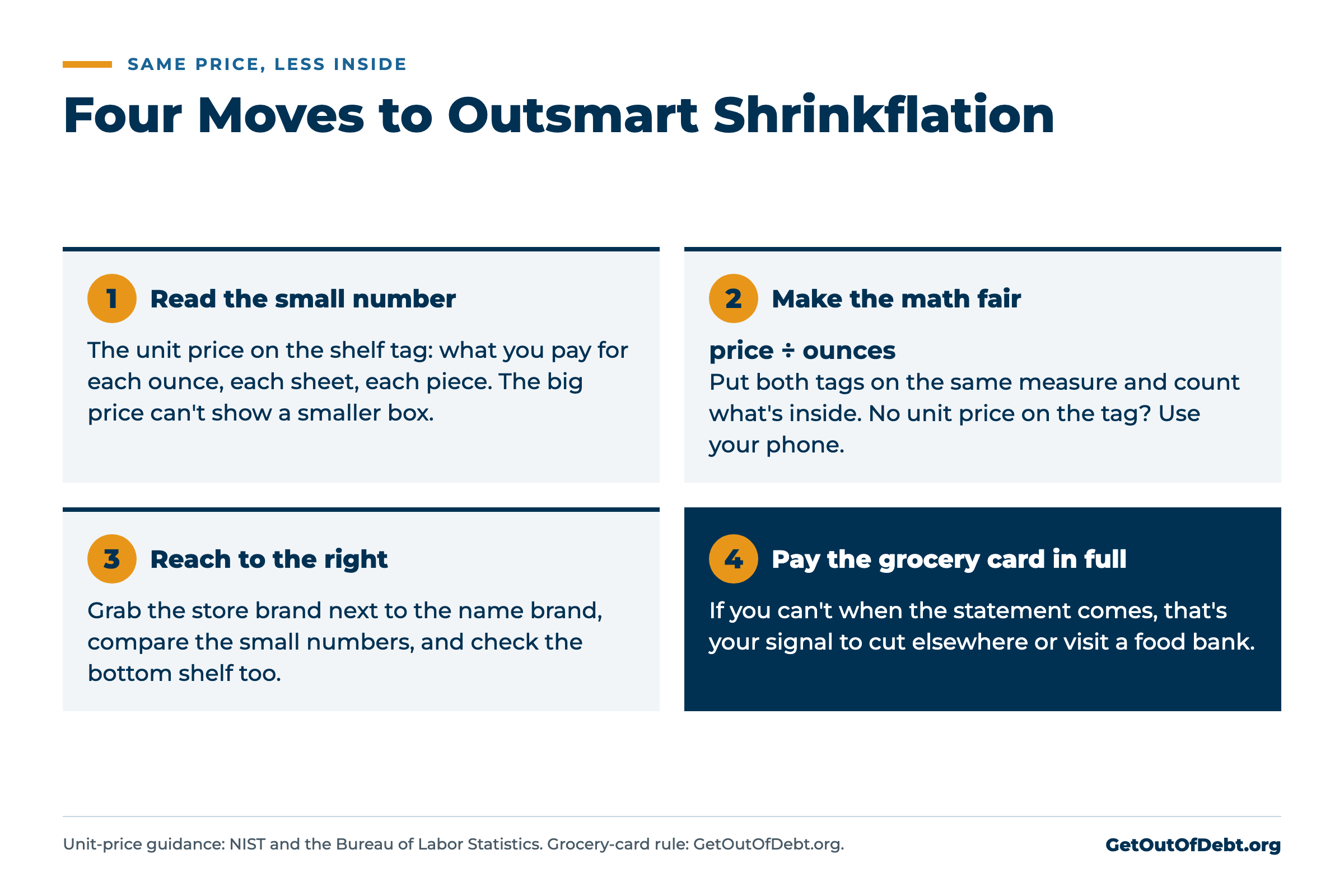
Same price, less inside. You can’t stop a company from shrinking the box, but you can catch it in about a second at the shelf. This post walks through the four moves from my video: three in the aisle, and one when the bill comes. It also covers the part almost nobody believes, and what to know before you split a grocery bill into four payments.
Key Terms Defined
Shrinkflation (downsizing): A product gets smaller, or holds fewer pieces, while the price stays the same or goes up. The government reports call it downsizing.
Each weekday I send one short email: one story that caught my attention, why it might matter to you, and one manageable thing you can do with it. A couple of minutes, and a dad joke.
In the latest issue (Nov 13): The shelf price isn't always what you pay
Free. I sell nothing. Unsubscribe any time.
Unit price: The price for one unit of what is inside: one ounce, one pound, one sheet, one count. It is usually the smaller number on the shelf tag.
Buy now, pay later (BNPL): A plan that splits a purchase into a few payments, often four. The Federal Reserve tracks it in its yearly survey of household finances.
What Shrinkflation Is, and How the Government Counts It
Here is the government’s own example. A roll of toilet paper goes from 220 sheets to 200 sheets at the same price. The Bureau of Labor Statistics records that as a 10 percent price increase per sheet. You paid the same at the register. You got less.
The same BLS article gives a second example: a 64-ounce half-gallon of ice cream at $5.99 shrinks to 60 ounces, still at $5.99. That is a 6.7 percent rise in the price per ounce. For items where the size is reported, BLS says, “An effective price per standard size, usually a price per ounce, is calculated.”
The Claim: The government’s inflation numbers ignore shrinking packages, so the real price rise is hidden.
The Reality: The Consumer Price Index records a size change as a price change where size is reported. Back in 2012 BLS wrote that “Many consumers observe that price increases are sometimes hidden in the form of quantity or size decreases” and that “they incorrectly presume that the CPI fails to capture this phenomenon.” Its example was a candy bar going from 2.0 ounces to 1.8 ounces at the same price, recorded as an increase of about 11 percent.
So the counting happens. The problem is at the shelf, where you’re looking at the box and the big price, and neither one tells you.
Move One: Read the Small Number on the Shelf Tag
Most shelf tags have two prices. The big number is what you pay for the package. The small number is the unit price: what you pay for each ounce, each sheet, each piece.
Go back to the ice cream. The big number stayed at $5.99. By my arithmetic from the BLS example, the small number went from about 9.4 cents an ounce to about 10 cents an ounce. The big number never moved. The small number shows it, if you know what it was last time.
The National Institute of Standards and Technology puts it plainly: “Unit pricing is the best tool a consumer has when shopping.” There’s a catch. No federal law requires stores to post it. NIST’s model unit-pricing rule “applies only when stores voluntarily provide unit pricing information.” NIST and GAO give different counts of the states with unit-pricing rules, so I won’t give you an exact number. The safe way to say it: only about a dozen states require stores to post a unit price, and in most of the country it’s voluntary.
So before something goes in the cart, find the small number. It takes about a second. And if the register ever charges you more than the shelf tag showed, that’s a different problem, and I wrote about what to do in Dollar General Charged Me More Than the Shelf Price. Can I Get My Money Back?
Move Two: Make the Math Fair
The small number can still fool you if the two tags aren’t measuring the same thing.
How to Read a Unit-Price Tag When the Units Don’t Match
Check that both tags use the same unit. A tub sold by the fluid ounce and a block sold by weight can’t be compared directly.
Using the BLS ice cream example again, by my arithmetic: the 64-ounce tub works out to about 9.4 cents an ounce and the 60-ounce tub to about 10 cents an ounce. Put on the same measure, the smaller tub is the more expensive one.
Paper goods are trickier. One tag may say per roll, another per 100 sheets, another per count. A roll isn’t a unit. Rolls come in different sizes, and words like “double” and “mega” are just words on a label. Count what’s inside. The sheet count is printed on the package. That’s the measure the government uses too, which is how it got 10 percent out of 220 sheets becoming 200.
No Unit Price on the Tag? Use Your Phone
Some stores don’t post the small number at all. You can make your own. Take the total price and divide by the total amount inside: ounces for a food, sheets for paper goods, pieces for anything sold by count. Do the same for the package next to it, using the same measure, and compare. It takes about five seconds on your phone’s calculator.
And don’t assume the bigger package is the better deal. Check both.
One Reason Companies May Shrink the Box
Here’s the likely logic: you notice when a price goes up. You often don’t notice a smaller box.
The GAO report cites a study that found “a 1 percent increase in the total price of an item led to a 1.95 percent decline in sales on average, whereas a 1 percent size decrease led to a slight increase (0.76 percent) in the number of packages sold.” Read that again. In that study, when the price went up, people bought less. When the size went down, they bought slightly more packages, each with less inside.
GAO’s blog post on the report says “Downsizing is not typically disclosed on packaging,” and that shoppers “may not remember unit prices or notice small changes in sizes.” If you never noticed, you’re not careless. The package isn’t telling you.
Is Shrinkflation Illegal?
I’m not a lawyer. According to GAO, the Federal Trade Commission “has not issued rules defining product downsizing as an unfair or deceptive act or practice,” and FTC officials said “not all downsizing is deceptive.” So there’s no federal rule that specifically bans downsizing.
Some lawmakers want the old size and the new size printed on the front. H.R. 5226, the Deceptive Downsizing Prohibition Act of 2025, was introduced on September 9, 2025. Congress’s records, checked on October 23, 2026, showed its latest action was on the day it was introduced: “Referred to the House Committee on Energy and Commerce.” The sponsor’s press release says it would bar selling a smaller product in the same or a substantially similar package unless a conspicuous notice on the front states the old and new sizes. Two 2024 bills, the Shrinkflation Prevention Act in the Senate (S. 3819) and its House companion (H.R. 7825), died with the last Congress.
Other countries have moved. GAO reports that disclosure rules took effect in France in July 2024 and in South Korea in August 2024. In Connecticut, Attorney General Tong’s 2025 shrinkflation notice bill, HB 6856, stalled. Its last action was March 31, 2025, and I found no sign it became law that year.
For food there is one older rule worth knowing. An FDA regulation says a food container you can’t fully see into is misleading “if it contains nonfunctional slack-fill,” meaning empty space that serves no purpose. It has exceptions, and the first is “Protection of the contents of the package.” That is why the air in a chip bag can be allowed. It doesn’t ban a smaller package. But if a company keeps the same container and fills less of it, the empty space can count as slack-fill.
So for now, the small number on the shelf tag is your label.
Shrinkflation Is a Tiny Slice of Higher Prices. Here Are the Numbers.
Groceries really do cost a lot more. The BLS index for food at home (not seasonally adjusted) was 243.110 in January 2020 and 321.758 in September 2026. That’s up 32.4 percent. It’s easy to blame shrinking boxes. The numbers say something else.
GAO looked at store scanner data for 2021 through 2023 in seven categories: coffee, cereal, paper towels, toilet paper, laundry detergent, toothpaste and pain relievers. Snacks were not included. It found that “less than 5 percent of items in each category were downsized.”
Then GAO looked at the whole economy. From 2019 to 2024, downsizing “accounted for less than 1/10 of a percentage point of the 34.5 percent increase in overall consumer prices.” That figure covers all consumer prices, not groceries alone. BLS found the same kind of thing for 2015 through 2019: downsizing moved its all-items index by only about 0.01 percent a year.
But where it happened, it hit hard. On products that were downsized, GAO found the average per-unit price increase “ranged from 11.6 percent in the paper towel product category to 32.4 percent in the coffee product category.” GAO published only those two ends of the range. GAO also ran a second analysis on the Consumer Price Index itself, separate from the seven scanner categories above. In the five CPI categories GAO highlighted, it added from 1.6 percentage points for cereal to 3.0 percentage points for household paper products to that category’s own price index, from December 2019 to December 2024.
Two numbers here look alike, so don’t connect them. Grocery prices up 32.4 percent since January 2020 and downsized coffee up 32.4 percent per unit are different measurements of different things. The match is a coincidence.
In the categories GAO checked
Most items in those categories were not downsized. GAO found less than 5 percent of items in each category it checked were downsized, and across all consumer prices, downsizing was less than a tenth of a percentage point of a 34.5 percent rise.
On the boxes that did shrink
You paid a lot more for what was inside: 11.6 percent more per unit on downsized paper towels, and 32.4 percent more on downsized coffee.
So shrinkflation can feel big in your cart even when it’s small across the country. If the coffee or paper towels you buy were among the packages that shrank, you feel it more than the national number suggests. Most items in those categories were not downsized. And here’s the good news. Comparing the small number with last time catches a smaller box and a plain old price hike. One habit, both problems.
Move Three: Reach to the Right for the Store Brand
This is my move. When I’m standing in front of the name brand, I reach to the right and grab the store brand sitting next to it. I hold the two side by side and compare the small numbers. Then I check the bottom shelf too.
Sometimes it’s close. Sometimes it’s a lot less. The small number tells you which. Then decide if your favorite brand is worth the difference. Sometimes it is.
I want to be clear about one thing. I have no measured source showing that store brands shrink less often than name brands, so I’m not telling you they do. The point of this move is the comparison, not the label on the box.
Here’s which boxes deserve the hardest look. In cereal, GAO found downsizing hit the big sellers: 1.1 percent of items were downsized, but those items made up 8.6 percent of sales. So the box you grab without looking is the one to look at. BLS data for 2015 through 2021 show which categories had the highest share of downsized price observations: household paper products (1.79 percent), snacks (0.54 percent), sweetrolls, coffee cakes and donuts (0.37 percent), tea (0.27 percent), infant and toddler diapers (0.25 percent), coffee (0.20 percent), and candy and chewing gum (0.18 percent). Even at the top of that list, it was a small share.
In October I wrote about snack prices, and that post ends with the same move: compare the unit price of the brand name with the store brand beside it.
Move Four: Pay the Grocery Card in Full When the Statement Comes
The aisle moves save a little on every item. This one doesn’t happen in the store, and it protects the whole budget.
“If you can’t pay the grocery bill in full when the statement comes, that’s your signal to cut elsewhere or visit a food bank before you create revolving debt on necessities.”
That’s the grocery credit card rule I wrote in April 2026, and I still mean every word. A smaller box that goes on a card you can’t pay off costs you twice: once at the shelf and again in interest. Going to a food bank isn’t failing. It can keep food off a credit card. You can find a food pantry near you by calling 211 or using Feeding America’s food bank locator. And the rule never means skipping meals. If you need food today and can’t get to a food bank, buy the food. The rule is about not making a habit of carrying a grocery balance.
Debt is math wrapped in emotion, and groceries carry plenty of both.
Buying Groceries With Buy Now, Pay Later
Maybe you don’t use a card. Maybe you split the grocery bill into four payments on your phone. Plenty of people do, though it’s a minority of shoppers.
The Federal Reserve’s survey of household finances in 2025, fielded in October 2025 with nearly 13,000 adults and published in May 2026, found:
- 16 percent of adults used buy now, pay later in the prior 12 months, up from 10 percent in 2021.
- “One in five BNPL users used the product to pay for groceries or food delivery in the prior year.”
- “Forty-five percent of those who used BNPL for grocery or food delivery purchases said that the main reason for using BNPL is that it was the only way that they could afford a purchase.”
- “Slightly more than one-fourth of BNPL users were late making a payment,” and 17 percent of all BNPL users were charged extra for being late. Those two figures are for all users, not only the ones buying food.
A private survey shows the grocery use climbing. LendingTree, which surveyed 2,049 U.S. consumers in March 2026, reports that 29 percent of BNPL users have used it for groceries, up from 25 percent a year earlier and 14 percent two years earlier. A separate LendingTree survey of 2,060 U.S. consumers ages 18 to 80, taken March 17-23, 2026, found that 47 percent of its BNPL users said they had paid late in the past year, up from 41 percent in 2025. Both are private online surveys with their own samples and questions, so neither is the Fed’s number.
Here’s how I said it in February, when I wrote about buy now, pay later for groceries:
“If you’re taking out an installment loan for food and then falling behind on that installment loan, you’ve paid a premium — late fees plus stress — for groceries you already consumed.”
The food’s gone in a week. The payments aren’t. So it’s the same signal as the card. If groceries are going into four payments because there’s no other way to cover them, that’s the sign to cut somewhere else first, or get to a food bank. If you want to know what happens when a payment is missed, I walked through what a missed pay-in-four payment can cost, including late fees. And if you’ve heard these plans aren’t real debt, I took that on in They Said Buy Now, Pay Later Isn’t Real Debt.
If a card or those payments already carry a balance, you can ask me about it in the Ask Steve chat. It’s free and anonymous. Yes, it’s AI, and it’s built on my 30-plus years of answers.
Where BLS Keeps Its Size-Adjusted Research Index
If you want to dig deeper, BLS publishes a research version of the Consumer Price Index with size changes taken out, called R-CPI-SC, going back to December 2014. It lives on the BLS research series page, and the numbers are in spreadsheet files you can download there. I haven’t pulled a figure from those files for this post, so I’m not quoting one. It’s a research series, not the official CPI.
What I Could Not Confirm
- Whether store brands shrink less often than name brands. I found no measured source either way.
- Any other 2025 or 2026 federal shrinkflation bill besides H.R. 5226. I could not search every bill title, so this is a gap in my search, not proof there are none.
- Any state attorney general lawsuit or settlement over shrinkflation. I found none, and that is not the same as none existing.
- “Skimpflation,” where a product swaps in cheaper ingredients. The BLS and GAO work I read covers size only.
Key Takeaways
- Shrinkflation means less inside for the same price. The big price on the tag can’t show it. The small number, the unit price, shows what you really pay, and comparing it with last time shows the change.
- Make the math fair: same measure on both tags, count what’s inside, and if there’s no unit price, divide the price by the amount on your phone.
- Reach to the right for the store brand and compare the small numbers. Then decide if the name brand is worth it.
- GAO found downsizing was less than a tenth of a percentage point of a 34.5 percent rise in overall consumer prices from 2019 to 2024, but on downsized coffee the per-unit increase averaged 32.4 percent.
- Pay the grocery card in full when the statement comes. If you can’t, or if groceries are going into four payments, that’s the signal to cut elsewhere or visit a food bank.
The Bottom Line
If you missed a smaller box, you’re not bad at shopping. The change usually isn’t flagged on the package. Now you know where to look: the small number on the tag, the store brand to the right, and a grocery bill you pay in full when the statement comes. Shrinkflation is a small slice of why things cost more, and one habit, checking the unit price and comparing it with last time, catches it along with a plain price hike. You are not your debt, and you are not your grocery bill.
Frequently Asked Questions
What is shrinkflation?
Shrinkflation is when a product gets smaller, or holds fewer pieces, while the price stays the same. The Bureau of Labor Statistics’ example is a roll of toilet paper going from 220 sheets to 200 sheets at the same price, which it records as a 10 percent price increase per sheet.
Does the inflation rate count shrinkflation?
Yes, where size is reported. The Consumer Price Index records a size change as a price change by calculating a price per standard size, usually per ounce. BLS wrote in 2012 that consumers “incorrectly presume that the CPI fails to capture this phenomenon.”
How much of inflation is shrinkflation?
Very little. The Government Accountability Office found that from 2019 to 2024, downsizing accounted for less than a tenth of a percentage point of the 34.5 percent increase in overall consumer prices. On the products that were downsized, though, the average per-unit price increase ranged from 11.6 percent for paper towels to 32.4 percent for coffee.
Is shrinkflation illegal?
There is no federal rule that specifically bans downsizing. According to GAO, the Federal Trade Commission has not issued rules defining product downsizing as an unfair or deceptive practice. A 2025 House bill, H.R. 5226, would require a front-of-package notice of the old and new sizes, but its latest recorded action was referral to committee on the day it was introduced.
How do I spot shrinkflation at the store?
Read the unit price, the small number on the shelf tag, instead of the package price. Make sure both tags use the same measure, count what is inside rather than trusting words like “mega,” and if there is no unit price, divide the total price by the total ounces or sheets on your phone.
Should I use buy now, pay later for groceries?
That’s your call, and here is what I’d weigh. The Federal Reserve found one in five buy now, pay later users used it for groceries or food delivery, 45 percent of those grocery users said the main reason they used it was that it was the only way they could afford a purchase, and slightly more than one in four of all users paid late. If groceries are going into four payments because there is no other way to cover them, I’d treat that the same as a grocery card you can’t pay in full: a signal to cut elsewhere or visit a food bank.
This is what I’m telling friends like you over coffee. Take it as input, not instruction, and remember, you do you.
If this helped, send it to someone who does the grocery shopping on a tight budget. The small number on the tag is worth passing along.
Dealing With Debt? Understanding your options is the first step. See how all your debt relief options compare — including ones most sites won’t tell you about. The Find Your Path quiz gives a recommendation based on your actual numbers, and the Scam-O-Meter checks any company’s complaint history before you sign. Federal Reserve Bank of New York research shows bankruptcy filers recover faster than those who don’t file.



