

Quick Answer: Deciding whether to buy Anthropic stock at the IPO starts with two questions that have nothing to do with the stock: will an index fund you already own in your 401(k) or IRA buy a slice after the stock actually starts trading, and where would the money to buy more come from? Anthropic made its S-1 public on October 26, 2026. It shows an $80.7 billion net loss for the first half of 2026 and no price yet. I will not predict what the stock does, and I will not tell you to buy it or skip it. I will show you the order I would check things in.
Part of a series: This post is part of my Should You Invest or Pay Off Debt? research hub — where I cover the math, psychology, and scams around investing while in debt.
Expert Context: I have been helping people with debt since 1994, and I filed bankruptcy myself in 1990 after my real estate business collapsed. When a hot investment hits the headlines, the mistake I keep seeing in debt is rarely the investment itself. It is the money used to buy it, because a borrowed dollar does not care whether the stock goes up. It still has to be paid back.
Anthropic’s IPO paperwork went public on October 26, and the headline number is a gut punch: an $80.7 billion loss in six months. Before you decide whether to buy a single share, I want you to look at two things the headlines skip: which index fund you already own, and what money you would use.
Each weekday I send one short email: one story that caught my attention, why it might matter to you, and one manageable thing you can do with it. A couple of minutes, and a dad joke.
In the latest issue (Nov 9): Check your power bank and your French press
Free. I sell nothing. Unsubscribe any time.
What Anthropic’s Filing Actually Says (and What It Doesn’t)
On October 26, 2026, Anthropic, PBC made its Form S-1 registration statement public on the SEC’s EDGAR system, the same document CNBC is walking through in its live coverage of the filing. Here is what matters if you are thinking about buying:
- Anthropic says it has applied to list its Class A common stock on the Nasdaq Global Select Market under the symbol “ANT.” Applied is not approved, and nothing is trading yet.
- The October 26 filing leaves the price range blank (“between $ and $”), and the filing leaves the number of shares offered blank too.
- I found no pricing date in the filing. Press reports, including Al Jazeera’s summary of the Wall Street Journal’s reporting, point to a November share sale, but that is reporting, not the prospectus. If you have seen “the IPO is this week,” the document does not say that.
Now the loss. The S-1 reports a net loss of $80.7 billion for the six months ended June 30, 2026. Read the next line before you panic or cheer. The filing says that included a $72.4 billion change in the fair value of convertible notes, derivative liabilities and SAFEs, “primarily driven by an increase in the fair value of our outstanding convertible promissory notes resulting from an increase in our enterprise valuation during each of the respective periods.” The same six months show an operating loss of $693 million on $16.3 billion of revenue, a further $8.8 billion of other expense, net, and, in the filing’s own words, “cash provided by operating activities was $3.9 billion.”
What that does and does not mean: Going by the filing, most of the $80.7 billion is a valuation accounting entry, not $80.7 billion of cash walking out the door. It also does not mean Anthropic is profitable. The same filing says the company has had net losses in every year since its founding and may not achieve or sustain profitability. I am not here to grade the business. I am here to tell you the number does two different jobs, and one of them decides whether a popular index fund can hold the stock.
A loss that is mostly on paper is not a reason to buy, and it is not a reason to borrow to buy.
Will Anthropic End Up in Your 401(k)? It Depends on Which Fund You Own
Index funds do not pick stocks. They follow rulebooks. So whether you will end up owning a piece of Anthropic without lifting a finger depends on whose rulebook your fund follows, and I suspect most people have never looked. Here is what I could verify:
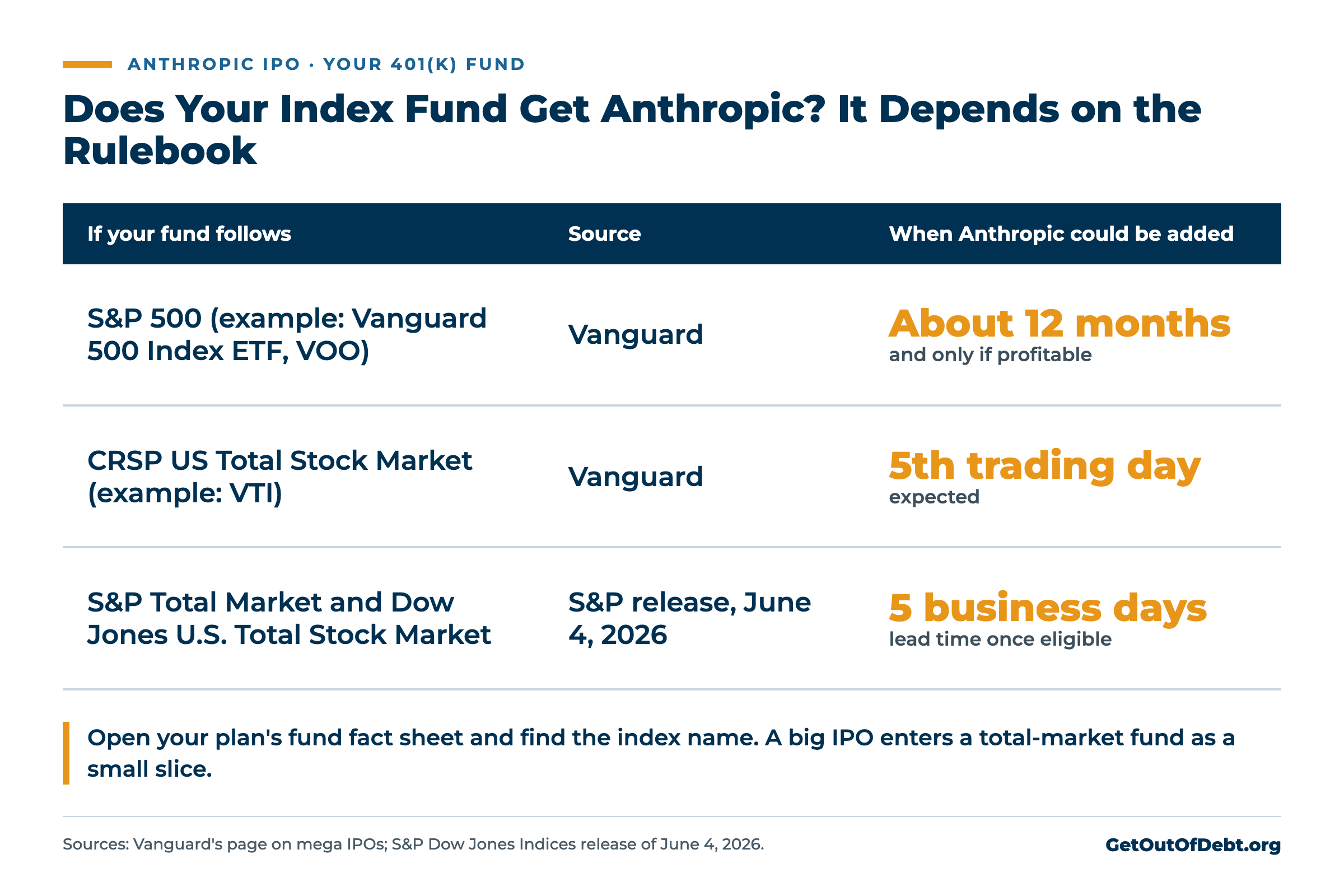
S&P 500 funds. Vanguard’s 500 Index ETF (VOO) is the example Vanguard lists. On Vanguard’s page on the mega IPOs, S&P 500 inclusion is listed as “Slow inclusion: approximately 12 months wait time (subject to profitability screen),” and Vanguard describes S&P’s rule as requiring a company “to be profitable in its most recent quarter as well as for the sum of its most recent four quarters.” On June 4, 2026, S&P Dow Jones Indices announced it was keeping those rules for the S&P 500, saying exceptions “should not be granted solely based on market capitalization.” The S-1’s quarterly table shows a net loss in each of the last four quarters, including $66.3 billion for the quarter ended June 30, 2026 (about $59.6 billion of that is a change in the fair value of its convertible notes and related instruments, an accounting entry rather than cash spent), and the filing says net losses in every year since founding, so its reported net results do not show the profit that test asks for, and I am not going to guess whether a later report will pass.
Total-market funds. Vanguard’s Total Stock Market ETF (VTI) follows the CRSP US Total Stock Market Index, and Vanguard’s table says “Fast inclusion: expected after close of the 5th trading day after IPO.” S&P’s own total-market indexes, the S&P Total Market Index and the Dow Jones U.S. Total Stock Market Index, have an IPO fast track too. Its June 4 release says a qualifying IPO is added “with five business days’ lead time” once S&P announces it is eligible. Each provider has its own conditions, so “expected” is the honest word until the stock actually starts trading.
How big a slice? Smaller than you would think. Index funds weight a company by the shares the public can actually buy, not by its headline valuation. Vanguard puts it this way: “for most index-based portfolios, the impact of SpaceX, Anthropic, OpenAI, or any hot IPO may initially be modest.” So if you hold a total-market fund, you may soon own a sliver of Anthropic whether you decide to or not, and that is one reason I would not buy a second helping in a panic.
Two cautions. A target-date fund is a fund made of other funds, so open its holdings page and look at what is inside. And your plan may use a different share class or a different index than the retail version of the same fund, so use your own plan’s fact sheet, not my example funds. I cannot see what is in your plan.
Can You Even Buy at the IPO Price?
This is the piece that gets lost. The SEC’s investor education site says underwriters and dealers often distribute most of the shares in an IPO to institutional and high net-worth clients such as mutual funds, hedge funds, pension funds and insurance companies. The other way in, “which is more common in the case of individual investors,” is buying when the shares are resold in the public market in the days after the IPO, through an order with your broker. The same bulletin warns that the closing price shortly after an IPO can be well above or well below the offering price.
Anthropic’s S-1 does leave a door open: it says the representatives of the underwriters “may agree to allocate a number of shares” to underwriters for sale to their online brokerage account holders. That is discretionary, and it does not promise anyone an allocation. So the picture most people have in their heads, “I click buy on day one at the IPO price,” is not the usual one. I have no idea where this stock will trade. The honest point is that you do not control the price you get, and that matters when the money you use is borrowed.
How People Pay for a Bet Like This (and What Each Way Costs)
You asked about a stock, but my lane is the debt side, and this is where I watch people get hurt. There are four ways I see money get lined up for a hot IPO. Here is what the primary sources say about each.
Borrowed or risky sources
- A 401(k) loan. The IRS says a plan may, but is not required to, offer loans. The most it can allow is the lesser of $50,000 or the greater of $10,000 or 50% of your vested balance. You generally repay within 5 years in substantially equal payments at least quarterly. A loan in default is generally treated as a taxable distribution of the outstanding balance, and if you leave the job, the unpaid balance can be offset against your account. If the offset is eligible, the IRS says you have until your tax-return due date, including extensions, to roll it over. Meanwhile the money is out of the market while you chase one stock.
- A credit card cash advance. The CFPB says the issuer may charge a flat fee or a percentage, you will commonly pay a higher interest rate than on purchases, and unlike purchases there is no wait: “interest on a cash advance starts as soon as you withdraw your money.” I wrote about why cash advances are a trap.
- Margin. Borrowing from your broker is what the SEC calls buying on margin. If the price falls, your broker can sell your shares without notifying you, you cannot choose which securities it sells, and you are not entitled to more time on a margin call. If the stock falls far enough, you can lose more than you put in and still owe the broker the rest of the loan.
- The emergency fund or the down payment. It is your money, so nobody is lending it to you, but you are borrowing from your future self. If the stock drops the same month the car dies, there is no cushion. I walk through how to decide what is safe to use.
What I would put first
- Credit card balances that are still costing you interest every month
- An emergency cushion that survives a bad month
- The 401(k) you already have, left alone (I explain what pulling retirement money really costs)
- Only then, money you will not need for five years (my own rule of thumb, not a regulator’s rule)
If you are already underwater and your debts are the real problem, the Find Your Path quiz will show you the options in a few minutes, bankruptcy included.
And if what you really want is the thrill of picking the winner, I get it. I ran my own small trading experiment with an AI and $1,000 of my own money so you did not have to risk yours, and I wrote up why even the pros struggle to beat the index and what the research says about day trading.
The Move: What I Would Do Before Clicking Buy
- Find out what you already own. Log in to your 401(k) and IRA, list every fund, and open each fund’s fact sheet. Look for the line that names its index. If it says S&P 500, Vanguard describes S&P 500 inclusion as taking “approximately 12 months,” and only if the profitability test is met. If it is Vanguard’s VTI, Vanguard says inclusion is expected after the close of the 5th trading day. If another company’s fund tracks that index, check that fund’s own fact sheet. If it says an S&P total-market index, it is added after S&P announces it, not on the first trade. If it is a target-date fund, open its holdings.
- Pay the bills that cost you money first. If you carry a credit card balance, that is the first investment decision, and it comes before any stock.
- Do not touch the emergency fund or the house money. Those dollars have a job already.
- Do not borrow to buy it. No 401(k) loan, no cash advance, no margin.
- Set the number before the ticker is live. If you still want a position, cap it at money you will not need for five years, write the number down, and do not change it after you watch the first day of trading.
- Remember you do not have to be first. There is no prize for buying in the opening minutes. Waiting for a prospectus with a price can mean missing a price that does not come back, or not paying more than the offering price. You do not control which one you get, so do not borrow to find out.
Key Takeaways
- Anthropic’s S-1 was made public on October 26, 2026. It lists “ANT” on Nasdaq as applied for, with no price range, share count, or IPO pricing or trading date, as of the October 26 filing.
- The $80.7 billion first-half loss includes a $72.4 billion fair-value change on convertible notes, derivative liabilities and SAFEs. Operating loss was $693 million on $16.3 billion of revenue.
- S&P 500 funds keep a profitability test and about a 12-month wait. Some total-market funds expect fast inclusion after the 5th trading day.
- Often, most IPO shares go to institutional and high net-worth clients first, so individuals usually buy after trading begins.
- Check your funds, clear the costly debt, protect the cushion, and never fund it with a 401(k) loan, a cash advance or margin.
The Bottom Line
If you are staring at an IPO headline and feeling the pull to get in before you miss out, that feeling is normal and it is not a character flaw. What changes the outcome is not whether you buy this stock. It is what you used to pay for it. Once trading starts and the index adds it, a total-market fund may give you a small slice. Do not assume your fund holds it yet. Vanguard describes S&P 500 inclusion as taking “approximately 12 months,” and only if the profitability test is met. And you do not have to be first to do well. I filed bankruptcy in 1990, and what moved me forward was dealing with it and looking to the future rather than spending years repairing the past. The money you leave alone today is the money that is still there for the life you are actually trying to build.
Frequently Asked Questions
Should I buy Anthropic stock at the IPO?
I will not tell you to buy or skip it, and I cannot predict where it trades. What I can tell you is the order I would check things in: see which index funds in your 401(k) or IRA would add a slice once it trades, clear costly credit card debt, protect your emergency fund and house money, and never use a 401(k) loan, a cash advance or margin to pay for it. If you still want a position, cap it at money you will not need for five years and decide that number before trading starts.
What is Anthropic’s ticker and when does the IPO happen?
Anthropic’s S-1, made public October 26, 2026, says it has applied to list its Class A common stock on the Nasdaq Global Select Market under the symbol “ANT.” The filing leaves the price range and share count blank and I found no pricing date in it. Press reports have pointed to a November share sale, but that is reporting rather than the prospectus.
Did Anthropic really lose $80.7 billion?
The S-1 reports a net loss of $80.7 billion for the six months ended June 30, 2026. It includes a $72.4 billion change in the fair value of convertible notes, derivative liabilities and SAFEs, which the filing says was primarily driven by a rise in Anthropic’s enterprise valuation. Operating loss for the same six months was $693 million on $16.3 billion of revenue. The filing also says the company has had net losses in every year since its founding.
Will my S&P 500 index fund own Anthropic?
Not soon. Vanguard’s page lists S&P 500 inclusion as a slow process of approximately 12 months after the IPO, subject to a profitability screen, and S&P Dow Jones Indices said on June 4, 2026 that it was making no changes to those requirements for the S&P 500. The S-1’s quarterly table shows a net loss in each of the last four quarters, including the quarter ended June 30, 2026, and the filing says net losses in every year since founding, so its reported net results do not show the profit that test asks for.
Can I borrow from my 401(k) to buy Anthropic stock?
If your plan offers loans, the IRS limits the amount to the lesser of $50,000 or the greater of $10,000 or 50% of your vested balance, generally repaid within 5 years. Your plan decides whether it offers loans at all. I would not do it: you would be borrowing against your retirement to chase one stock, and a missed payment can turn the loan into a taxable distribution, and if you leave your job, the unpaid balance can be offset against your account and taxed unless you roll it over by your tax-return due date, including extensions.
This is what I am seeing and what I would tell my own family, but it is one informed perspective, not financial advice for your situation. Only you can decide what is right for you. Take my advice as input, not instruction, and don’t let anyone, including me, tell you what to do with your money.
If this helped, share this with someone who is tempted to borrow for the next hot IPO. A five-minute fund check now can save them from a mistake that takes years to repair, and there is no sense wasting a perfectly good mistake, even when it is someone else’s.
Dealing With Debt? Understanding your options is the first step. See how all your debt relief options compare — including ones most sites won’t tell you about. The Find Your Path quiz gives a recommendation based on your actual numbers, and the Scam-O-Meter checks any company’s complaint history before you sign. Federal Reserve Bank of New York research shows bankruptcy filers recover faster than those who don’t file.



