

Quick Answer: Microsoft said on October 26, 2026 that it is making a voluntary exit offer to about 60,000 employees (Reuters and CBS called them buyouts; Microsoft told The Register it is not classifying the deal as a buyout). Whether taking it costs you unemployment benefits depends on your state and on how the offer is papered. Washington’s 2026 law, for example, treats a worker who volunteers to be included in a layoff the employer announced in writing as unemployed through no fault of their own, when three conditions are met, while a New York appeals court upheld a denial for a worker who took a voluntary package when work was still available. Ask your state agency, and get the offer terms in writing, before you sign. If the agency can’t give you a written answer in time, weigh the offer as if you might not qualify.
Expert Context: I’ve watched job searches run long for 30 years, and a lump sum can look like safety right up until the day it runs out. The word “voluntary” feels harmless. It’s the word I’d slow down on, because it can change what the state calls your separation. Debt is math wrapped in emotion, and an exit offer like this is a perfect example of both showing up in the same email.
Microsoft said Monday it is making a voluntary exit offer to about 60,000 employees, which Reuters reports is more than a quarter of its global workforce. Reuters and CBS called them buyouts, but The Register reported that Microsoft told it the deal isn’t classified as a buyout “since no one is being incentivized to leave,” and reported being told the offer is akin to a standard severance deal. If you got that email, or someone you love did, this post is about one question that gets lost while everyone stares at the lump sum: if you accept a “voluntary” exit, can you still collect unemployment if the next job takes longer than you planned?
The honest answer is that it depends on your state, and I’m going to show you how to ask for yours before you sign. I’m not going to tell you whether to take the offer. I don’t know what it pays, and as of October 27 the reports I read hadn’t published dollar amounts or weeks of pay.
Each weekday I send one short email: one story that caught my attention, why it might matter to you, and one manageable thing you can do with it. A couple of minutes, and a dad joke.
In the latest issue (Nov 6): Owed money on an Amazon return? Check by Dec. 1
Free. I sell nothing. Unsubscribe any time.
What Microsoft Announced, and What Hasn’t Been Published
Here is what the reporting says, with links so you can read the sources yourself:
- The size: Microsoft said it is making a voluntary exit offer to about 60,000 employees, according to Reuters, which called them buyouts. Microsoft had 223,000 full-time employees worldwide as of June 30, 2026, according to its annual filing.
- Who is eligible: Microsoft said the offer is open to eligible employees in participating teams in Canada, India, the United Kingdom and the United States at level 70 and below, and described it as a time-limited, voluntary program. CBS News and Reuters report that some business units are not eligible, but their descriptions of which units differ, so check your own email from Microsoft rather than any news list. Microsoft’s announcement itself says some organizations are providing the offer and some are not.
- The company’s stated reason: In a staff memo, Chief People Officer Amy Coleman called it a way for employees who may be considering a future outside the company to make that transition now “with support,” and that it “gives participating organizations another way to adapt their workforce to changing needs,” as CBC News reported and as Microsoft’s own announcement says. Reuters reported the company is looking to contain costs and help fund its AI investments. That is Reuters’ framing, not a motive I’m assigning to anyone.
- The history: Earlier this year Microsoft offered what it calls its Voluntary Retirement Program to about 7% of its U.S. workforce (Reuters called it a buyout), and in July it announced 4,800 job cuts, per Reuters. I covered the July cuts in my first-week playbook for the Xbox layoffs.
- What I could not find: the package terms. As of October 27, none of the reports I read published dollar amounts or weeks of pay, so I won’t guess at them. The Register reported that some employees will also be given the option for extended healthcare and stock shares. Ask HR exactly what yours includes. The Register also reported that the window closes on December 31; check the deadline in your own offer email, because that report doesn’t say whether December 31 is the date to decide or the date you leave.
The Question Nobody Puts in the Email: Does “Voluntary” Count as Quitting?
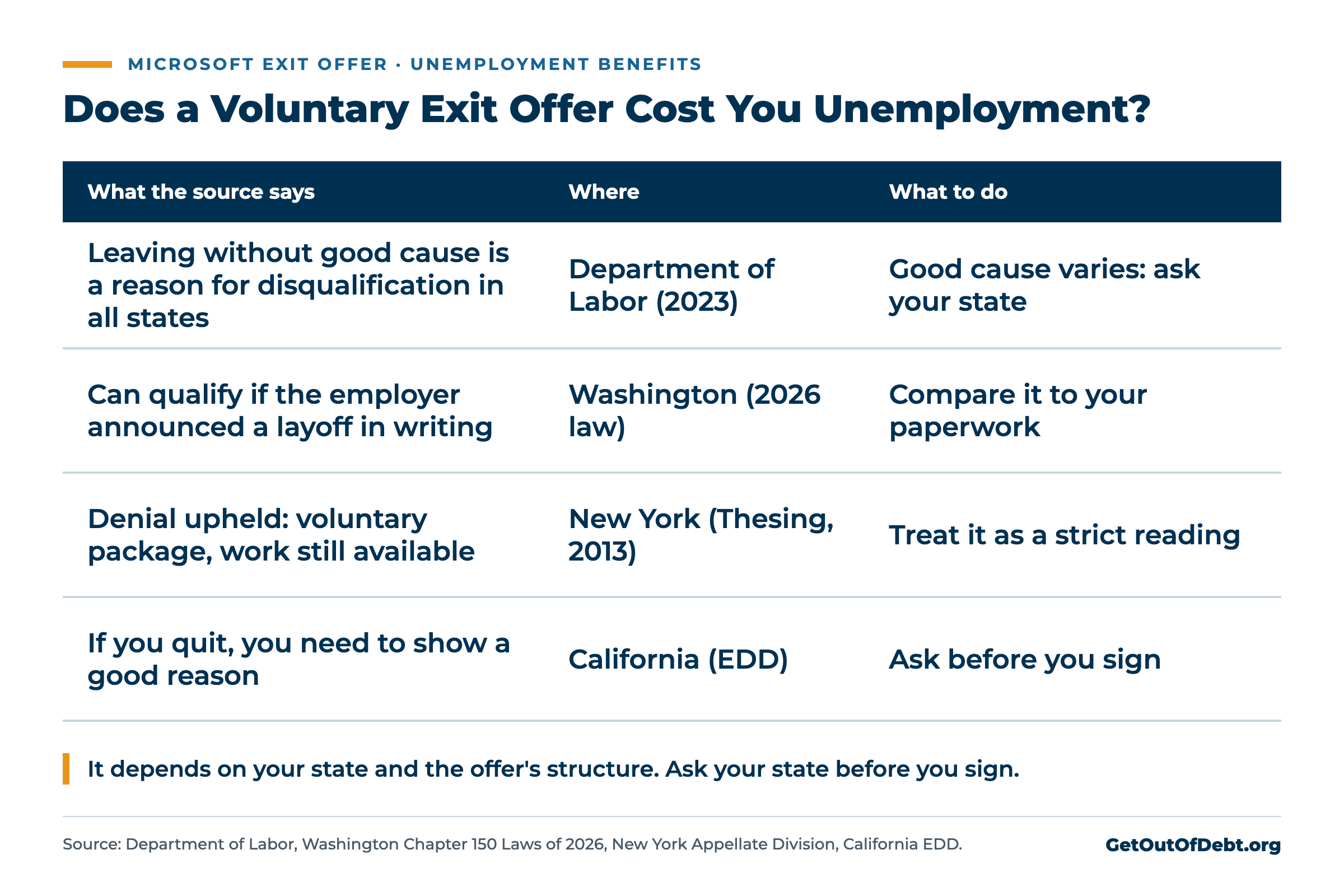
Unemployment insurance is run by each state, not by your employer. The U.S. Department of Labor’s Comparison of State Unemployment Insurance Laws (the edition the Department lists as its most recent, reflecting laws as of January 1, 2023) says voluntarily leaving work without good cause is a reason for disqualification under all states’ laws, though the definition of good cause varies by state. The same document lists “accepting a voluntary lay off when an employer announces a planned layoff” among the examples that some states treat as good cause.
Read that carefully. It doesn’t say a voluntary exit offer disqualifies you, and it doesn’t say it protects you. It says the state decides, and states decide differently. Here are three examples I verified against primary sources. This section is about U.S. state law; if you work in Canada, India or the UK, check your own country’s rules.
Washington: a 2026 law may help, if the paperwork fits
Washington’s rule matters if you work in Washington; other states use their own rules. In March 2026 Washington enacted House Bill 2264 (Chapter 150, Laws of 2026), now codified as RCW 50.20.055. For people separated on or after June 14, 2026, it deems you unemployed through no fault of your own if the state finds three things: your employer took the first step by announcing in writing that it planned to reduce its workforce through a layoff or reduction in force and that employees could offer to be among those included; you offered to be included; and your employer then terminated your employment as a result of those plans. The law lets an employer give employees the option to take back their offer, and says having that option doesn’t disqualify anyone from benefits as long as the three conditions are met. It also says it does not apply when an employer encourages early retirement or early separation and the employer and employee don’t follow those three steps.
The Employment Security Department says the law codifies an earlier ESD rule on employer-initiated layoffs, with some changes. Washington’s ordinary quit rule is narrower: RCW 50.20.050 limits good cause to a list of reasons, and I did not find a buyout on that list.
Whether Microsoft’s program meets those three conditions turns on documents I have not seen. The public version of Microsoft’s written announcement calls it a “Voluntary Exit Offer” and, in the text I read, does not use the words “layoff” or “reduction in force.” Whether the documents you receive say otherwise, and whether Microsoft terminates you under a layoff plan, is what the state will look at. I am not saying the offer meets the three conditions, and I am not saying it doesn’t. That is a question for the state, not for me.
New York: a court upheld a denial
New York shows a strict reading. In Matter of Thesing (Eastman Kodak Co.—Commissioner of Labor), decided November 7, 2013, the Appellate Division, Third Department, affirmed a denial of benefits for a 35-year employee who accepted a voluntary separation package while the employer was downsizing the claimant’s department. The claimant had been told that if enough employees didn’t accept, the rest of the reduction would be done through involuntary separations, and that those laid off would receive the same benefit package. The court, quoting its earlier decision in Matter of Willis, wrote that “Voluntary separation from employment in order to accept an early retirement or separation incentive package when, as here, continuing work is available has been held not to constitute good cause for leaving employment,” and that leaving in anticipation of losing one’s job in the future is not good cause.
That’s one worker’s facts, in one state, in 2013. I’m showing it as an example of how a state can read “voluntary,” not as a prediction for any Microsoft employee in New York. That decision involved an early retirement or separation incentive package. Microsoft told The Register no one is being incentivized to leave, but how a package is treated is the state’s call, not the label’s, so ask HR in writing exactly what you receive for accepting, and give that to the state.
California: you may have to show a good reason
California’s Employment Development Department says that if you quit, you need to show that you had a good reason, and that it checks eligibility with a questionnaire or an interview. The page doesn’t address buyouts, so the question still has to be asked.
The one move I’d make first: Before you sign, call or message your state unemployment agency and ask a question like this, reading them the wording from your email: “My employer is offering a time-limited Voluntary Exit Offer. If I accept, am I eligible for benefits?” Bring the offer email and any separation paperwork. Washington’s ESD says it reviews your situation to decide whether you qualify, and California’s EDD says it checks eligibility once you file, so a general phone answer isn’t the same as a decision on your claim. Agencies may not rule on your case until you have separated and filed a claim, so you may not get a written answer in time. If no written answer comes before your deadline, write down who said what and when, the deadline and any window to change your mind, weigh the offer as if you might not qualify, and do not miss the deadline waiting for a letter.
Free Tool — Contract Decoder: Have a contract from a debt relief company? The free Contract Decoder analyzes it for red flags, hidden fees, and problematic terms — before you sign anything. Decode My Contract →
Where the Lump Sum Really Goes
Even if unemployment works out, the headline number isn’t what lands in your account. Here is what I verified:
- Taxes: The IRS’s Publication 15 lists severance pay as a supplemental wage. An employer can withhold a flat 22% in some situations, or combine it with regular wages and figure withholding on the total, and it must withhold 37% on the part of a year’s supplemental wages that goes over $1 million. Severance payments are also subject to Social Security and Medicare taxes. Withholding is a down payment on your tax bill, not the bill. On a hypothetical $60,000 payment, the flat 22% option would withhold $13,200 for federal income tax alone, before Social Security, Medicare and any state tax. If your real rate is higher, you could owe more in April.
- Unemployment can be reduced or delayed: The Department of Labor’s comparison says many states treat wages in lieu of notice and dismissal payments, which they may call severance payments, as deductible income, and a person receiving such payments may be considered not unemployed for those weeks. Other states exclude dismissal payments the employer isn’t legally required to make, and some don’t treat them as deductible income at all. File your claim, report the lump sum wherever the claim asks about severance or other payments, and let the state decide how it is treated. Unemployment benefits are also generally taxable income.
- Health insurance: Under COBRA, per the Department of Labor, voluntary or involuntary job loss can qualify you to keep group health coverage. Coverage for termination of employment (other than gross misconduct) is required for 18 months. You get at least 60 days to elect it and at least 45 days after electing to make the first payment, but the plan can charge up to 102% of its cost, so you may pay the whole premium. Being offered COBRA doesn’t make you ineligible for Marketplace coverage, and you have 60 days before or after losing job-based coverage to special enroll. COBRA applies to covered U.S. group health plans. If you work outside the U.S., ask HR which plan you are on and what continuation it offers.
- Retirement and stock: The IRS’s vesting guidance says your own 401(k) contributions are always 100% yours, but employer contributions follow the plan’s vesting schedule, and amounts that aren’t vested may be forfeited when you leave. I have no primary source on how any specific stock award is treated, so ask HR in writing what you would forfeit.
The Money Side: Don’t Turn a Lump Sum Into a Debt Spiral
A big deposit makes paying off every card feel like the smart move. In my experience, the people who get hurt after a job change are the ones who drain the lump sum to hit zero balances and then have nothing when the search runs longer than they expected. Cash on hand protects you better than a zero balance while you’re between paychecks.
So do the math before you decide. Take what you’d actually net after taxes, then divide it by your real monthly bills. As a hypothetical, if you net $40,000 and your bills run $4,000 a month, that’s ten months on paper, before you add a health plan and before you assume the next job takes twice as long as you think. If you’d have to burn through retirement savings or pile on new high-interest debt to stay afloat, that is a sign to stop and run the numbers differently, not a sign to take a leap.
If you’re already behind on bills, the Find Your Path quiz looks at your actual numbers. You can also read my guide for when you’ve lost your job and can’t pay your debts. And if you want to talk it through with a person, Damon Day is an independent debt coach and my co-host on the Get Out of Debt Guy podcast. I want you to know that before you decide anything, and I receive no payment for this referral. The consultation is free, and the only time money changes hands is if you decide to hire him as a consultant. Schedule through his page, because he doesn’t cold-call anybody, and neither do I.
Before You Sign: Five Questions, and Who to Ask
Question 1 is for your state unemployment agency, not HR. Questions 2 through 4 are for HR or the benefits administrator, and question 5 is for a tax preparer. Get the HR answers in writing.
- Ask your state unemployment agency, not HR: will you treat this separation as voluntary or as a layoff? A phone answer is not a ruling on your claim.
- What is the deadline to decide, and is there a window to change my mind after I accept? Will you put in writing whether this is a layoff or reduction in force, and whether you will terminate my employment under it? How will my separation be described in my paperwork?
- What is my monthly COBRA premium, and does the package cover any of it?
- What would I forfeit in unvested 401(k) employer contributions and stock?
- After withholding, what will I actually net, and could I owe more at tax time?
Key Takeaways
- Microsoft said it is making a voluntary exit offer to about 60,000 employees (Reuters and CBS called them buyouts; Microsoft told The Register it is not classifying the deal as a buyout), and as of October 27 the reports I read hadn’t published dollar amounts or weeks of pay.
- Voluntarily leaving work without good cause is a reason for disqualification in every state in the Department’s 2023 comparison, but states differ on what counts as good cause, and some treat accepting a voluntary layoff, when an employer announces a planned layoff, as good cause.
- Washington’s 2026 law and a 2013 New York court decision point in different directions, so ask your state first, and if you can’t get a written answer before the deadline, weigh the offer as if you might not qualify.
- Severance is taxed as a supplemental wage, COBRA can cost the full premium plus up to 2%, and unvested employer contributions may be forfeited.
- Keep a cushion. Don’t empty the lump sum to zero out debt before you have a new paycheck.
The Bottom Line
You are not your debt, and you are not a number in a headline about 60,000 people. You’re one person with a mortgage or rent, a family and a decision to make. The thing most likely to cost you real money here isn’t the offer itself. It’s signing before you know how your state reads the word “voluntary.” Make the call, ask for the answer in writing, run the net-of-tax math, and keep a cushion. If the answer isn’t clear by your deadline, weigh the offer as if you might not qualify for unemployment, and don’t miss the deadline waiting for a letter. Decide with the facts and look to the future rather than spending five years repairing the past.
Frequently Asked Questions
Will accepting Microsoft’s voluntary exit offer make me ineligible for unemployment?
It depends on your state and on how the offer is structured. The Department of Labor’s 2023 comparison says voluntarily leaving work without good cause is a reason for disqualification in all states, but the definition of good cause varies, and some states treat accepting a voluntary layoff as good cause when the employer has announced a planned layoff. Washington’s 2026 law can treat a worker as unemployed through no fault of their own if all three of these are true: the employer announced in writing a planned layoff or reduction in force that employees could volunteer to be included in; the worker volunteered; and the employer terminated the worker as part of that plan. It does not apply when an employer merely encourages early separation without those three steps being followed. The public version of Microsoft’s written announcement calls its offer a “Voluntary Exit Offer” and, in the text I read, does not use the words “layoff” or “reduction in force,” so check your own paperwork. A 2013 New York appeals decision upheld a denial for a worker who took a voluntary package while work was available. Ask your state agency before you sign, and if you can’t get a written answer before the deadline, weigh the offer as if you might not qualify.
If I take the offer, is severance pay taxed like a regular paycheck?
Mostly yes. The IRS treats severance pay as a supplemental wage subject to income tax withholding, Social Security and Medicare taxes. An employer may use a flat 22% withholding option in some situations, and 37% applies to the part of a year’s supplemental wages above $1 million. Withholding is not your final tax bill, so you could owe more at tax time, which is worth a quick call to a tax preparer.
Can I get COBRA health coverage if I accept a voluntary exit offer?
Under the Department of Labor’s COBRA guidance, voluntary or involuntary job loss can qualify you, and coverage for termination of employment other than gross misconduct is required for 18 months. The plan can charge up to 102% of its cost, so you may pay the entire premium. You can also look at Marketplace coverage, which you can special enroll in within 60 days before or after losing job-based coverage. COBRA applies to covered U.S. group health plans. If you work outside the U.S., ask HR which plan you are on and what continuation it offers.
What happens to my unvested 401(k) match or stock if I accept?
The IRS says your own contributions are always 100% vested, while employer contributions follow the plan’s vesting schedule and unvested amounts may be forfeited when you leave. I don’t have a primary source on how a particular stock award is handled, so ask HR in writing what you would forfeit and what happens to it.
Should I use a lump sum from the offer to pay off my credit cards?
Not all of it, and not before you have a new paycheck. A zero balance with no cash leaves you exposed if the job search runs long. Keep a cushion sized to your real monthly bills, assume the search may take longer than you expect, and look at the high-interest balances after you’ve protected rent or mortgage, utilities, food and health coverage.
This is what I’m seeing after 30 years of helping people through financial shocks, and an exit offer is one of the stranger ones because it looks like good news. Take it as one informed perspective. Only you know your full situation, and only you can decide what’s right. Use this as input, not instruction. Nobody gets to tell you what to do with your money, not your employer, not a state agency, not me. If this helped, send it to someone you know who just got that Microsoft email, because this is a question that’s much easier to answer before the signature than after.
Two more places to look if you’re planning for a gap between paychecks: my breakdown of what to check before signing a severance agreement, which covers the release you may be asked to sign, and smart first moves to protect your finances after a layoff. If you’re weighing the odds of a quick re-hire, my 30-day plan from the Oracle layoffs works the same way for any large tech cut.
Dealing With Debt? Understanding your options is the first step. See how all your debt relief options compare — including ones most sites won’t tell you about. The Find Your Path quiz gives a recommendation based on your actual numbers, and the Scam-O-Meter checks any company’s complaint history before you sign. Federal Reserve Bank of New York research shows bankruptcy filers recover faster than those who don’t file.



