

Written by Steve Rhode, consumer debt expert since 1994 • Last updated October 27, 2026
Quick Answer: A missing return doesn’t expire: when no return was filed, the IRS can assess the tax at any time (26 U.S.C. § 6501(c)(3)), and it can build a “substitute” return from the income reports it already holds, which might not give you credit for deductions you’re owed. The fastest fix is to file your own returns, which an offer in compromise and the IRS’s online long-term payment plan both require. If your notice is a CP3219N, you have 90 days from the notice date (150 days if you are outside the United States) to petition the Tax Court, and filing your own return doesn’t extend that deadline. Don’t ignore it.
What Just Happened With Your Tax Returns
Employers, banks and other payers send the IRS copies of your W-2s and 1099s. When the IRS sees income for a year and no return to match it, a series of notices starts. The early ones are reminders. A CP59 says the IRS has no record that you filed your prior-year return. A CP515 is a reminder, and a CP518 is the IRS’s “final reminder,” which warns that “we may determine your tax for you.” Each one asks you to file, or to explain why you don’t have to, using Form 15103.
If those go unanswered, the IRS can do the filing itself. Under 26 U.S.C. § 6020(b), when someone fails to file, the IRS “shall make such return from his own knowledge and from such information as he can obtain.” A CP2566 says the IRS has already calculated your tax, penalty and interest from income reported to it, and gives you a date to either file your return or accept and pay its number. A CP3219N is a Notice of Deficiency, the “90-day letter.” Not every case hits every step in that order, so go by the notice number printed on yours.
Here is the part that surprises people. The IRS normally has three years after a return is filed to assess more tax, but 26 U.S.C. § 6501(c)(3) says that when no return is filed, the tax may be assessed “at any time.” Filing starts the IRS’s three-year clock to assess more tax, while your refund clock and the bankruptcy three-year clock run from each return’s due date. The bankruptcy two-year clock, by contrast, runs from the day you file the return, not its due date, so filing the returns does not make the tax dischargeable next month. “They’ll never come after me” is not a plan, and a lot of people have been living with exactly that dread. It isn’t a character flaw. It is a stack of envelopes you stopped opening because every one made the stack scarier.
The Mistake You’re About to Make: Waiting to file until you can pay, or paying a “tax resolution” company before a single return is filed. Not filing is the expensive way to not pay: the failure-to-file penalty is 5% of the tax due for each month a return is late (up to 25%), while the failure-to-pay penalty is 0.5% a month, so filing without paying costs less than not filing at all. And the IRS makes filing every required return a condition of an offer in compromise and of its online long-term payment plan, so a company that charges a resolution fee before any return is filed is selling a step the IRS won’t process yet. Paying a preparer, a clinic or an attorney to get the returns filed is the step, not the skip. Read your options first.
Your Options Right Now
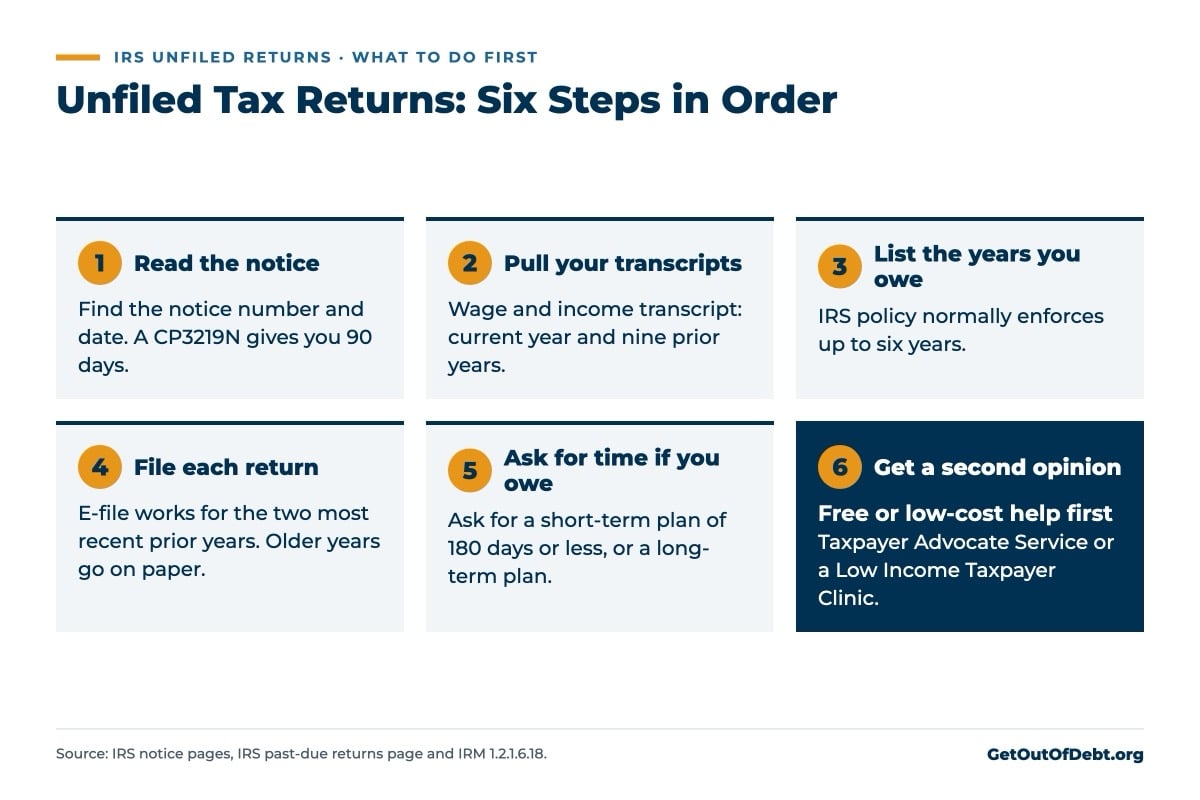
What to Do in the Next 48 Hours
- Read the notice and write down the date and the deadline. Find the notice number (CP59, CP515, CP518, CP2566, CP3219N or something else) and the date printed on it. For a CP59, CP515, CP518 or CP2566, respond by the date on the notice. For a CP3219N, you have 90 days from the date on the notice (150 days if you’re outside the U.S.) to file a petition with the U.S. Tax Court if you want to challenge the proposed tax, and the IRS says you cannot request an extension to file after receiving one. Filing your own return does not extend the Tax Court deadline. And if the 90 days have already passed, file anyway: the IRS says it will still accept your past-due return, though processing may be significantly delayed. Notice date ______ + 90 days = ______. Circle it.
- Pull what the IRS already has on you, for free. Sign in to your IRS Online Account and download your wage and income transcript, which covers the current year and nine prior years, plus your account transcript for each year. A verification of non-filing letter is available anytime for the prior three tax years; older years need Form 4506-T. If you can’t use the online account, you can order account transcripts for the current and three prior years by mail or by phone at 800-908-9946; wage and income transcripts by mail come through Form 4506-T. The wage and income transcript shows only documents the payer filed with the IRS and is limited to about 85 income documents, so gather your own pay stubs and 1099s too.
- List every year you owe a return, then ask how far back the IRS will push. The IRS says to file all returns that are due, whether or not you can pay. Its own policy statement says that, normally, enforcement of delinquent-return procedures reaches back no more than six years, and going further “will not be undertaken without prior managerial approval” (IRM 1.2.1.6.18, Policy Statement 5-133). That is an enforcement policy, not a statute of limitations. It lists factors such as prior noncompliance, anticipated revenue and collectibility, it sends cases with signs of willfulness or fraud to special procedures, and it doesn’t make an older year disappear. With more than six unfiled years, or a lot of income, talk to a tax professional or a clinic (step 6) before you file, so you don’t skip a year the IRS can still assess or a year that may still have a refund. The six-year line is an enforcement policy, not permission to leave a year unfiled.
- File the returns, one signed return per year. Get each year’s forms and instructions from the IRS prior-year forms page. The IRS accepts e-filed returns only for the two most recent prior years, and you need an e-file provider that handles them. Older years go on paper. If you received a notice, mail the signed, dated return (with Form 15103 or the response form from your notice, if it came with one) to the address on the notice. If your notice is a CP3219N, the IRS accepts a mailed return as a response, but it is not a Tax Court petition and does not extend the 90-day deadline; if you want the Tax Court able to review the IRS’s number, petition within the 90 days even if you mailed the return. If the income on a substitute return is wrong, the IRS says to call 866-681-4271 or ask the payer for a corrected W-2 or 1099. The IRS says it takes about 6 weeks to process an accurately completed past-due return. Need free help preparing it? Try VITA or Tax Counseling for the Elderly.
- If you’ll owe more than you can pay, file anyway, then ask for time. You can ask for a short-term payment plan, which pays what you owe in 180 days or less (the IRS lists a $0 setup fee when you apply by phone, mail or in person), or a long-term plan (path 4), through the IRS payment plan page. If paying would leave you short on basics, read my guide on Currently Not Collectible status, and ask for penalty relief (path 3 below).
- Get a second set of eyes before you file if the stakes are high. A Low Income Taxpayer Clinic can represent you in collection matters for free or a small fee if your income qualifies (the amount in dispute is usually under $50,000), the Taxpayer Advocate Service is free (877-777-4778), and a tax attorney is worth it when a lot of income or an IRS Criminal Investigation contact is involved. If you had large unreported income, including cash income, talk to a tax attorney before you file, not only a preparer; if cost is the barrier, start with a Low Income Taxpayer Clinic. That conversation does not extend a notice deadline, so with a CP3219N get the petition question in front of them before the deadline. Then schedule a free consultation with Damon Day, an independent debt coach (not an attorney) and my podcast co-host, to look at your whole financial picture. I receive no payment for this referral.
Free Tool — Statute of Limitations Checker: Dealing with old debt? The free Statute of Limitations Checker tells you if the collection clock has expired in your state — including the zombie debt and clock-restarting traps collectors use. Check My Status →
How to Actually Resolve It — Your 5 Paths
- 1. File the returns. Every other path starts here. Your own return replaces the IRS’s guess. The IRS says that if it files a substitute return, it is still in your best interest to file your own to take advantage of the exemptions, credits and deductions you’re entitled to, and that it will generally adjust your account to the correct figures. The IRS says self-employment income on an unfiled return isn’t reported to the Social Security Administration, so filing is how those earnings get credited toward your benefits; ask SSA whether older years can still be added. Filing also releases the refunds the IRS holds while a return is past due (a released refund can be applied to other IRS tax, an amount owed to a state tax agency, child support, or other past-due federal debts). If you want the full picture of tax debt after you file, see my tax debt guide and my guide for when the IRS says you owe back taxes on a return you did file.
- 2. Fight a substitute-return number. If a CP3219N is the problem, you can file your own return by the date on the notice and, separately, petition the Tax Court within 90 days. The return is not a petition and does not extend that deadline, so if you want the Tax Court able to review the IRS’s number, petition within the deadline even if you mailed the return. The Tax Court has simplified small-case procedures when the amount in dispute, penalties included, is $50,000 or less per tax year. A Form 2848 lets a representative (an accountant, an attorney, a clinic) deal with the IRS for you.
- 3. Ask for penalty relief. The IRS can waive penalties for reasonable cause (a death or serious illness in your immediate family, records lost in a disaster, not receiving necessary financial information, or not knowing you had to file despite trying to find out) or under first-time penalty abatement, which requires a clean three-year history, all currently required returns filed and the tax paid or arranged. The IRS’s own manual says first-time abatement applies to a single tax period, and only if the three years before it were filed without penalties, so in a run of unfiled years it covers the first year at most (IRM 20.1.1.3.3.2.1); reasonable cause matters for the rest. I explain how to ask in IRS Penalty Abatement Is a Free Phone Call.
- 4. Pay over time, pause, or settle. Once the returns are filed, the IRS says you may qualify to apply online for a long-term payment plan if you owe $50,000 or less in combined tax, penalties and interest and have filed all required returns, or a short-term plan (180 days or less) if you owe less than $100,000. One catch: the reduced 0.25% failure-to-pay rate during a payment plan is, per the IRS, for people who filed their return on time, so late filers pay the regular rate. Hardship status is covered in my Currently Not Collectible guide, and an offer in compromise in the real IRS acceptance rate. If a levy is already hitting your pay, start with my paycheck-levy guide.
- 5. Bankruptcy, but only if the tax is old enough and the returns exist. Normally I put bankruptcy first, because it wins on credit, collections, speed and retirement. Here it can’t lead, for one reason: tax for a year with no return filed is not dischargeable (11 U.S.C. § 523(a)(1)(B)(i)), and a substitute return the IRS prepares under § 6020(b) doesn’t count as your return. After you file, income tax can be discharged only if the return was due more than three years before you file bankruptcy, you filed it more than two years before, the tax was assessed more than 240 days before, and there was no fraud or willful evasion (§ 507(a)(8) and § 523(a)(1)). The three-year clock runs from the due date, including any extension. The 240-day clock is extended by the time an offer in compromise was pending (plus 30 days) and by time a stay was in effect in a prior bankruptcy case (plus 90 days). The statute also suspends both the three-year and the 240-day periods during a collection-hearing appeal, plus 90 days, and for any time a stay was in effect in a prior bankruptcy case or collection was precluded by a confirmed plan, plus 90 days. Get the dates checked before you file. Those are the rules, not a guarantee, and I never say tax debt can’t be erased. Courts also disagree on whether a return filed even one day late is a “return” at all: the Eleventh Circuit described the First, Fifth and Tenth Circuits as reading the statute to exclude late-filed returns and disagreed with them in 2020 (In re Shek). A bankruptcy attorney who handles tax is worth the consult. More in Can Bankruptcy Erase Tax Debt? and the tax-debt discharge myth.
What You Need to Know About the Clocks and the Penalties
5% a month
The failure-to-file penalty, up to 25%, on the tax you owe. When the failure-to-pay penalty applies in the same month, the filing penalty drops to 4.5% and the monthly total stays 5% (IRS).
0.5% a month
The failure-to-pay penalty, up to 25%. It rises to 1% a month if you still haven’t paid 10 days after a notice of intent to levy (IRS).
7%
The IRS underpayment interest rate for October through December 2026. It changes quarterly and is charged on penalties too (IRS rates).
90 days
Your window to petition the Tax Court after a CP3219N (150 days outside the U.S.), counted from the date on the notice (IRS).
If a return is more than 60 days late, there is also a minimum failure-to-file penalty: $525 or 100% of the tax, whichever is less, for returns due after December 31, 2025 (lower amounts for older years). My arithmetic from the IRS rates: on $10,000 of unpaid tax and a return five months late, the combined penalties come to about $2,500 before interest. Once an assessment is on the books, the IRS generally has 10 years to collect it, and that clock stops more often than people think (see how).
| The clock | What the law or the IRS says | Source |
|---|---|---|
| IRS time to assess a year with no return | At any time | 26 U.S.C. § 6501(c)(3) |
| How far back the IRS normally enforces filing | Normally not more than 6 years; going further needs managerial approval. Cases with signs of willfulness or fraud get special procedures | IRM 1.2.1.6.18 |
| Claiming a refund for withholding or estimated tax | Within 3 years of the return’s due date. As of October 2026 that means tax year 2023 (due April 15, 2024) is the oldest year still open, until April 15, 2027 (my arithmetic; disaster postponements or financial disability can change it). Later claims are forfeited by law | TAS, IRS news release, IRS past-due page |
| Challenging a substitute return in Tax Court | 90 days from the date on the CP3219N (150 outside the U.S.) | IRS |
| Discharging income tax in bankruptcy | A return actually filed; due more than 3 years before filing; filed more than 2 years before; assessed more than 240 days before; no fraud | § 523, § 507 |
Refunds are the quiet reason to file. If you had tax withheld or made estimated payments, the money is only yours if you claim it in time. The National Taxpayer Advocate urged some people to consider filing protective claims by July 10, 2026, based on one court’s reading of the COVID disaster-relief rules (the Kwong case); I explained it in The IRS “July 10” Tax Refund Deadline. That date has passed, the law was unsettled when I wrote that post, and the Advocate said to assume the IRS will not automatically allow such claims, so don’t count on it. If you already filed a claim, don’t withdraw it on your own; ask a tax professional before you withdraw anything, and take any IRS letter denying it to them promptly. If you think a different date applies to you, ask a tax professional too.
If you live in a state with an income tax — your state tax agency has its own filing rules, notices and penalties, and they don’t automatically follow the IRS’s. A state return can be a separate problem, so check with your state department of revenue. This guide covers federal returns. See the complete Crisis Guides hub for related emergencies.
If a tax-relief company misrepresented what it could do for you or took a fee and did nothing, file a complaint with the CFPB, the FTC and your state attorney general. If IRS collection is causing real financial hardship, send Form 911 to the Taxpayer Advocate Service — it’s free. If you need legal help but can’t afford an attorney, find free legal aid through LSC.gov, or see whether a Low Income Taxpayer Clinic can help.
Steve’s Take
I filed bankruptcy in 1990, so I know why people stop opening the mail. One year goes unfiled, the next feels worse, and soon the envelope itself is the problem. Not filing doesn’t make you a bad person. Debt is math wrapped in emotion, so take the emotion out: find the years, file the returns, see the real number, then pick the exit. Sometimes that number is smaller than the one in your head, and sometimes it’s a refund. No sense wasting a perfectly good mistake. The people who did better were the ones who filed.
Frequently Asked Questions
I haven’t filed my taxes in years — can I still fix it, and how many years do I have to go back?
Yes. The IRS’s policy statement says all delinquent returns will be accepted, whether you file on your own initiative or at the IRS’s request, and signs of willfulness or fraud trigger special procedures (IRM 1.2.1.6.18). Enforcement of delinquency procedures normally reaches back no more than six years, and going further needs managerial approval. That is a policy, not a law, and an unfiled year can still be assessed at any time under § 6501(c)(3), so with more than six years or a lot of income, get a professional to help you decide how far back to go.
The IRS filed a return for me — do I have to accept it?
No. If you got a CP3219N, you have 90 days from the date on the notice (150 outside the U.S.) to file your own return or petition the Tax Court, and the IRS says it generally adjusts your account to the correct figures when you file. If you do neither, the IRS proceeds with its proposed assessment (IRS). Filing your return is a response the IRS accepts, but it is not a Tax Court petition and does not extend the deadline; to keep the Tax Court able to review the IRS’s number, petition within the 90 days even if you mailed the return. If the 90 days have passed, file anyway, because the IRS says it will accept a past-due return, though processing may be significantly delayed. Don’t wait for the last day.
I can’t pay what I’ll owe — should I still file?
Yes, file anyway. The failure-to-file penalty is 5% a month and the failure-to-pay penalty is 0.5% a month, and the IRS says to file whether or not you can pay in full (IRS). I break down that math in They Said If I Can’t Pay the IRS, I Shouldn’t File. Once the return is in, you can ask for a payment plan, hardship status or penalty relief.
Can I still get a refund for the years I didn’t file?
Maybe. If you had tax withheld or made estimated payments, you generally must file within three years of the return’s due date; after that, the IRS says, the money becomes the property of the U.S. Treasury. As of October 2026, the oldest year that still qualifies for most people is tax year 2023, until April 15, 2027 (my arithmetic). Disaster postponements can extend that window, and so can “financial disability,” which the IRS describes as a medically determinable physical or mental impairment that kept you from managing your financial affairs, that has lasted or is expected to last at least 12 months or to result in death, and while no one else was authorized to act for you in financial matters. You generally need a physician’s signed statement (IRS Publication 556). Ask a professional before you write off an older year. The IRS also holds refunds while a return is past due, so filing is what lets the money out, though it can apply the refund to other IRS tax, an amount owed to a state tax agency, child support, or other past-due federal debts.
Can I go to jail for not filing my taxes?
Willfully failing to file is a misdemeanor under 26 U.S.C. § 7203, punishable by up to one year in prison and a fine, and the IRS says repeatedly not filing can lead to criminal prosecution. The key word is “willfully,” and how it applies to you is a question for a tax attorney. If an IRS Criminal Investigation agent contacts you, talk to a tax attorney before you answer questions. For the real-world risk, read my fact-check on the IRS and jail.
Can bankruptcy erase taxes for years I never filed?
Not while the return is unfiled. Tax for a year with no return filed is not dischargeable under 11 U.S.C. § 523(a)(1)(B)(i), and a substitute return prepared by the IRS isn’t your return. After you file, the usual tests are a return due more than three years before bankruptcy, filed more than two years before, assessed more than 240 days before, and no fraud. Courts disagree about whether a late return counts at all: in 2020 the Eleventh Circuit rejected the view, which it said the First, Fifth and Tenth Circuits hold, that a late-filed return can never count, and I haven’t found a settled answer for other circuits in the sources I used. File the return now either way, and ask a bankruptcy attorney where you live before you file bankruptcy, and tell the attorney if the IRS assessed the tax before you filed your return. In a Chapter 13, § 1308 requires every return for the four years before you file to be on file before the creditors’ meeting.
I filed bankruptcy — how fast does it stop IRS collection?
The automatic stay takes effect the moment you file (11 U.S.C. § 362(a)) and stops most collection activity, including levies. It doesn’t stop everything: § 362(b)(9) lets the IRS keep auditing, demand tax returns, issue a notice of deficiency and make an assessment. So the stay can protect your paycheck and bank account while the unfiled-return problem still needs to be solved.
Does it matter which state I live in?
Not for the IRS. Federal filing rules, penalties and notices work the same everywhere. Your state tax agency separately runs its own filing rules, notices and penalties, so check with your state department of revenue about any state returns you also missed. (Disaster postponements depend on where you live, and if you are considering bankruptcy, your circuit can change whether a late return counts.)
One more thing — everything I share here is based on 30 years of helping people through exactly this. But my advice is input for your decision, not the decision itself. Only you know your full situation. Talk to an attorney, look at your numbers, and make the choice that serves your future.
Important: This guide is for informational purposes only and is not legal or tax advice. Laws vary by state, and your situation may have details that change what options are available to you. For legal advice specific to your case, consult an attorney licensed in your state. NACBA can help you find a bankruptcy attorney, NACA can connect you with a consumer attorney, or schedule a free consultation with Damon Day, an independent debt coach and my podcast co-host — I receive no payment for this referral.
Key Takeaway: Unfiled returns are serious but not permanent, and filing is the step that makes every other fix possible. Write down the date on your notice, pull your transcripts, and get the returns filed, then use my debt options calculator to see what comes next. Talk to a tax professional or clinic this week if you have more than six years or a CP3219N. The longer you wait, the more penalties and interest pile up and the more the IRS’s guess stands in for the truth.
The Bottom Line
Not filing for years doesn’t make you bad with money. Fear and shame made the envelopes harder to open, and the tax system is built to keep adding to the number while you hide from it. The way out is dull and doable: file, see the real balance, then use the payment, hardship, penalty-relief or bankruptcy option that fits. Deal with it and look to the future rather than spend 5 years repairing the past. If someone you know has stopped opening IRS mail, send them this page — knowing the notice has a deadline and a fix can get them to open the next envelope. See the complete Crisis Guides hub or take the Find Your Path quiz for a recommendation based on your actual numbers.
Dealing With Debt? Understanding your options is the first step. See how all your debt relief options compare — including ones most sites won’t tell you about. The Find Your Path quiz gives a recommendation based on your actual numbers, and the Scam-O-Meter checks any company’s complaint history before you sign. Federal Reserve Bank of New York research shows bankruptcy filers recover faster than those who don’t file.
Right now you are dealing with the thing in front of you, and that is exactly where your attention belongs. When it is handled — and it will be — there is a next stage, and it is the one I most enjoy writing about.
In the latest issue (Nov 9): Check your power bank and your French press
Each weekday I send one short email: one story that caught my attention, why it might matter to you, and one manageable thing you can do with it. It is free, I sell nothing, and I take no money from any company I write about.



