

Fact-checked by Steve Rhode, consumer debt expert since 1994 • Last reviewed October 27, 2026 • Every legal claim below links to the statute, the regulation, the bill or the agency’s own announcement.
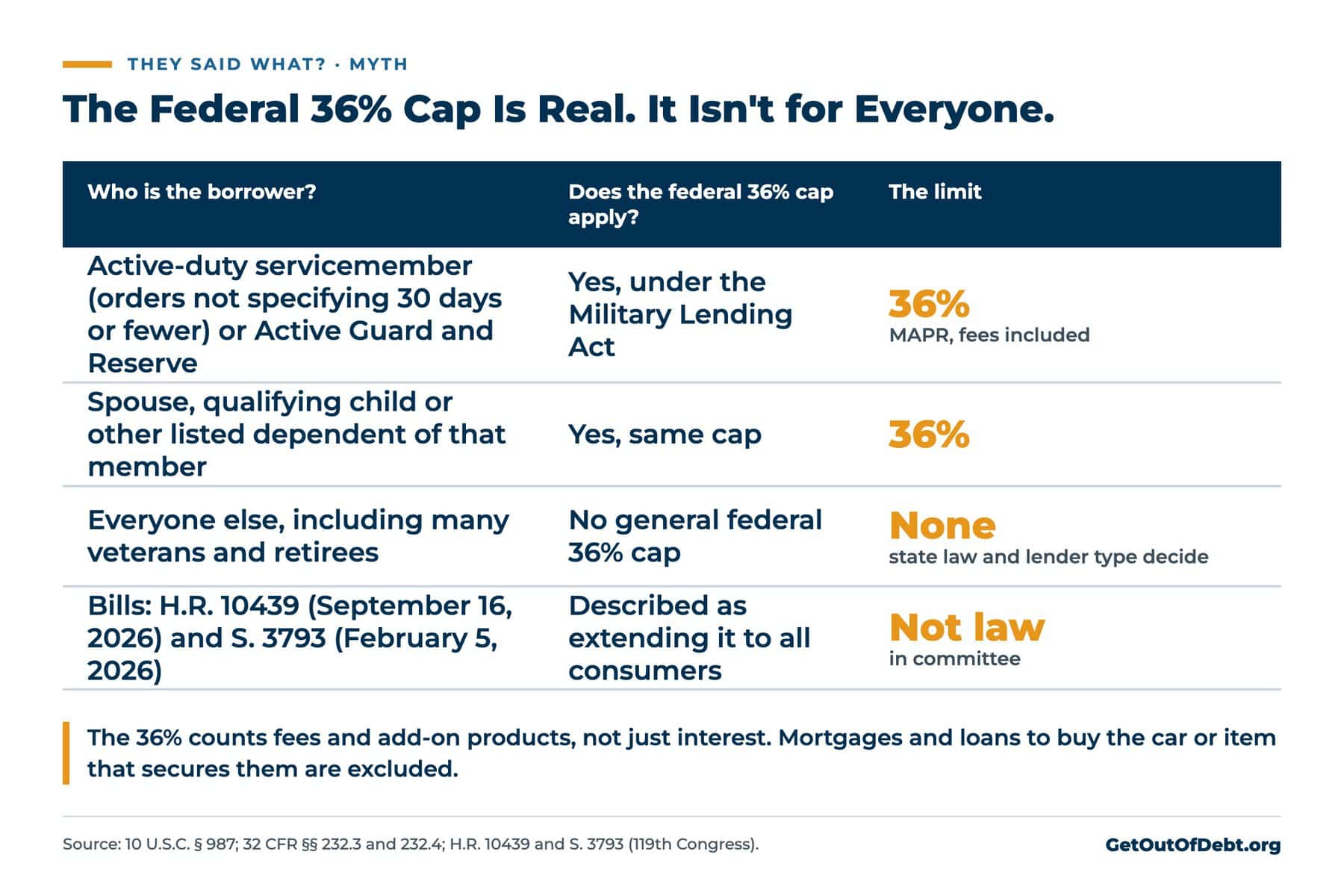
The verdict: Myth. The federal 36% cap is real, but it protects only “covered borrowers” — active-duty servicemembers (and Active Guard and Reserve members) and their listed dependents — not the general public. For a borrower outside the covered group there is no general federal 36% cap on consumer loans; bills introduced in the House on September 16, 2026 and in the Senate on February 5, 2026 are described as creating one, and each one’s latest recorded action is a committee referral. 10 U.S.C. § 987 and 32 CFR § 232.4(b) confirm the limit and who it covers.
I have to tell you about this. On September 16, 2026, two House members introduced a bill called the Veterans and Consumers Fair Credit Act, and any story about a 36% cap lands on top of a belief I keep running into. It isn’t a quote from anyone in particular, so I’m putting it in my own words: the belief is that federal law already caps the interest on any consumer loan at 36%, so a lender that charges more must be breaking the law.
Each weekday I send one short email: one story that caught my attention, why it might matter to you, and one manageable thing you can do with it. A couple of minutes, and a dad joke.
In the latest issue (Nov 12): A 10% cap on your credit card rate? Here's what's real.
Free. I sell nothing. Unsubscribe any time.
I couldn’t let that sit, because the number is real and the belief is wrong, and the gap between those two things is where people get hurt. If you believed it — and a lot of people do — let me walk you through what the law actually says.
Well, Actually…
Let me start with what’s true, because the myth works precisely because it’s built on a true thing. Congress put the 36% number in the Military Lending Act, now 10 U.S.C. § 987. Subsection (b) says a creditor “may not impose an annual percentage rate of interest greater than 36 percent with respect to the consumer credit extended to a covered member or a dependent of a covered member.” Read who that sentence protects: a covered member, or a dependent of one. It does not say “a consumer.” The Defense Department’s rule repeats the limit in 32 CFR § 232.4(b) — a creditor “may not impose an MAPR greater than 36 percent,” MAPR being the Military Annual Percentage Rate — and the definition of a covered borrower in § 232.3(g) is what decides who gets it.
So who’s covered? A covered member is a member of the armed forces serving on active duty under title 10, 14 or 32 orders that do not specify a period of 30 days or fewer, or on Active Guard and Reserve duty. A dependent is someone described in four parts of 10 U.S.C. § 1072(2): in plain terms, the member’s spouse, a qualifying child, a parent or parent-in-law who depends on the member for more than half of their support and lives in the member’s household, and certain unmarried people, usually children, placed in the member’s legal custody by a court order for at least 12 months who live with and depend on the member. Nobody else is a covered borrower, and the rule adds that a person who is no longer a covered member or dependent is not covered either.
Two more details that change real outcomes. First, the cap is on the all-in cost, not just the line labeled “interest” (credit cards get a narrow exclusion for reasonable bona fide fees under § 232.4(d)). The MAPR counts finance charges, credit insurance premiums, debt cancellation and suspension fees, fees for add-on products sold with the loan and, with limited exceptions, application and participation fees (§ 232.4(c)). Second, even for a covered borrower the rule doesn’t reach every loan. Section 232.3(f) defines consumer credit as credit offered primarily for personal, family or household purposes that carries a finance charge or is payable in more than four installments — a definition broad enough to take in payday loans, installment loans and credit cards — and then carves out residential mortgages and a loan expressly made to buy a car or other personal property when it’s secured by the thing being bought, along with a few narrower exclusions.
For everyone else, I looked for a general federal 36% cap — in the 2024 edition of the U.S. Code published by GPO, the current Defense Department rule, the bank-rate statutes, the NCUA ceiling and the enacted FY2026 defense authorization act (Public Law 119-60, which never mentions section 987) — and found none. H.R. 10439‘s own description is written as an extension to people the current cap does not cover. That is the drafters’ premise, not a search of every federal rule. The description reads: “To amend the Truth in Lending Act to extend the consumer credit protections provided to members of the Armed Forces and their dependents under title 10, United States Code, to all consumers.” Nobody writes a bill to extend a protection to all consumers if it already covers all consumers. Reps. Glenn Grothman (R-WI) and Jesús “Chuy” García (D-IL) introduced it, and as of my check on October 27, 2026, the latest action in its GovInfo bill status record is the September 16 referral to the House Committee on Financial Services. A Senate bill with the same official description, S. 3793, the “Predatory Lending Elimination Act,” was introduced by Sen. Jack Reed (D-RI) on February 5, 2026, and its latest recorded action is also a committee referral, to Senate Banking. Earlier bills titled the “Veterans and Consumers Fair Credit Act” were introduced in 2019 (H.R. 5050) and 2021 (S. 2508), and the cap is still limited to covered borrowers. A bill is a proposal, not a law, and I’d treat it that way until it passes both chambers and is signed.
So what does limit the rate for everyone else? A patchwork. A national bank may charge the rate allowed by the state where the bank is located, or a rate one point above the discount rate on 90-day commercial paper at the bank’s regional Federal Reserve Bank, whichever is greater (12 U.S.C. § 85), and state-chartered insured banks get a parallel rule in 12 U.S.C. § 1831d — which means that if your card issuer is a national bank or a state-chartered insured bank, the limit of the state where that bank is located may govern instead of the limit where you live. Federal credit unions have a separate federal ceiling, currently a temporary 18% through September 10, 2027, according to NCUA’s February 6, 2026 release; I walked through it in a separate They Said What? post. Beyond that, what applies to your loan depends on your state’s law and on who the lender is, and I haven’t verified any particular state’s limits for this post, so check yours.
One more federal number gets mixed up with this one. Under the Servicemembers Civil Relief Act, 50 U.S.C. § 3937, a debt you took on before entering military service can’t bear interest above 6% during your service (and for a year afterward in the case of a mortgage), and the excess interest is forgiven — but you have to send the creditor written notice and a copy of your orders no later than 180 days after you leave service; a creditor may check Defense Manpower Data Center records instead, but it doesn’t have to, so send the notice. Different law, different rate, different paperwork. I explained how that letter works in my post on a recent Justice Department servicemember case.
Federal law caps the interest rate on any consumer loan at 36%, so a lender charging more must be breaking the law.
The federal 36% cap applies only to a “covered borrower”: an active-duty servicemember (on orders that do not specify 30 days or fewer, or on Active Guard and Reserve duty) or one of the dependents the rule lists. For anyone outside that covered group there is no general federal 36% cap (many veterans and retirees are outside it; a veteran or retiree is covered only if back on qualifying active duty or Active Guard and Reserve duty, or a listed dependent of a covered member), so a loan priced above 36% is not automatically a federal violation — whether it breaks any law depends on your state’s law, the type of lender and the loan’s terms. Bills described as extending the cap to all consumers were introduced in 2026 (H.R. 10439 on September 16 and S. 3793 on February 5), and both were in committee at last check.
The 36% cap is a military thing, so it can’t apply to my family.
It’s a military-status rule, but it reaches the family: a dependent of a covered member is a covered borrower too. The rule tests your status “at the time the consumer becomes obligated” on the credit or opens the account, and it also says you stop being a covered borrower once you are no longer a covered member or dependent. If a loan was made while you were covered and you have since left, ask a military legal assistance office or a consumer attorney how that affects it.
The 36% cap only counts the interest rate on the loan, so the fees don’t matter.
For a covered borrower, the 36% limit is applied to the Military Annual Percentage Rate, which counts finance charges, credit insurance premiums, debt cancellation and suspension fees, charges for add-on products sold with the loan and, with limited exceptions, application and participation fees — not only the interest line, though credit card accounts have a narrow exclusion for reasonable bona fide fees. The statute makes the same point: “interest” includes fees, service charges, renewal charges, credit insurance premiums and ancillary products. Residential mortgages and purchase-money car or personal-property loans secured by the item bought are outside the definition.
Why You Were Told This
Part of it is that the 36% figure gets repeated in the news every time someone proposes widening it — the September 16 bill is the latest, and earlier bills titled the “Veterans and Consumers Fair Credit Act” were introduced in 2019 and 2021 — and a headline about a proposed cap is easy to read as a headline about an existing one. Part of it is that the real cap is real: the Military Lending Act does exactly what it says for the people it covers, which makes “there’s a federal 36% cap” a sentence that is completely true and badly incomplete. And part of it is that nobody advertises where the line sits. “This protection exists, and you aren’t on the protected side of it” is not a sentence anyone puts in an ad.
On the subject of proposals, two separate bills, S. 381 (introduced February 4, 2025) and its House companion H.R. 1944 (introduced March 6, 2025), carry the title “10 Percent Credit Card Interest Rate Cap Act.” They would reach credit card rates only, and each shows a committee referral as its latest recorded action in the GovInfo status records. I’ve written about what a 10% card cap could change. I covered an earlier fight over how the Military Lending Act applies to car loans in Military Lending Act: What Weakening Means.
What to Actually Do
- Find out which side of the line you’re on. You’re covered if you are on active duty on orders that do not specify 30 days or fewer, or on Active Guard and Reserve duty, or you are one of the dependents listed in 10 U.S.C. § 1072(2) as the rule uses it. If you’re not sure whether you qualify, a military legal assistance office can tell you.
- If you’re covered and the all-in rate (fees and add-on products included) is above 36%, don’t assume you have to live with it, and don’t stop paying on your own: take the loan papers to a military legal assistance office or a consumer attorney first. Under 10 U.S.C. § 987(f), a credit agreement that violates the section is void from the inception of the contract, and a creditor that violates it can, in a successful lawsuit, be held liable for actual damages of not less than $500 per violation, plus appropriate punitive damages, and for costs and reasonable attorney fees as the court determines. That is the statute’s wording, not a ruling on your loan, so have one of them look at it before you act on it. The deadline to sue is the earlier of two years after you discover the violation or five years after it occurs, and a creditor can escape civil liability by proving an unintentional bona fide error, such as a clerical or calculation mistake, despite procedures meant to prevent it (a mistaken view of the law doesn’t count), and that defense does not apply to the criminal charge, so keep every document. My guide to what to do when a creditor violates your rights while you’re deployed is a good first read.
- If you’re outside the covered group, don’t assume a rate over 36% is illegal — or legal. Pull the actual APR with every fee in it (how APR actually works), find out whether the lender is a bank, a federal credit union or a licensed non-bank lender, and ask your state’s financial regulator or attorney general what limit applies to that kind of lender.
- Add a federal credit union to your comparison. Federal credit unions have a separate federal ceiling, and the details, including the small-loan option, are in my credit union rate cap post.
- If you’re already underwater on a loan priced far above 36%, a bill in committee won’t help you this month. Start with the payday loan trap guide or, if a car is on the line, what to do when a title loan company takes your car.
- Treat H.R. 10439 as news, not a plan. As introduced, it would apply only to credit extended after the earlier of the date new CFPB rules require compliance or 18 months after enactment, so even if it passed, it would not reach a loan made before that date.
Steve’s Take
Debt is math wrapped in emotion, and a rate cap is one piece of the math. The 36% cap is a real protection for the servicemembers and families it covers. But it’s easy to hold onto “there must be a law that covers this” while a loan keeps compounding, because the idea that someone must have capped it feels safer than the truth. It’s a law for you only if you’re in the covered group, and it isn’t a law for anyone else yet. So work with the rules that exist today: know your real APR, know who your lender is, and if the numbers can’t work, know all of your options, including bankruptcy, before the loan decides for you. A bill that might pass later is not a plan for the payment due next week.
Frequently Asked Questions
Does federal law cap interest at 36% on every consumer loan?
No. The 36% federal cap in 10 U.S.C. § 987(b) applies to consumer credit extended to a covered member of the armed forces or a dependent of one. Bills described as extending it to all consumers, H.R. 10439 (introduced September 16, 2026) and S. 3793 (introduced February 5, 2026), are pending, and the latest recorded action on each is a committee referral.
Who counts as a covered borrower under the Military Lending Act?
A servicemember on active duty under a call or order that does not specify a period of 30 days or fewer, or on Active Guard and Reserve duty, and that servicemember’s dependents as 32 CFR § 232.3(g) defines them — the spouse, a qualifying child, a dependent parent or parent-in-law living in the household and an unmarried person placed in the member’s legal custody by a court order for at least 12 months who lives with and depends on the member, including some people past college age who are incapable of self-support (10 U.S.C. § 1072(2)).
Does the 36% include fees, or just interest?
It includes fees. The Military Annual Percentage Rate counts finance charges, credit insurance premiums, debt cancellation and suspension fees, add-on product charges and, with limited exceptions, application and participation fees under 32 CFR § 232.4(c). Credit card accounts have a separate “bona fide fee” exclusion in § 232.4(d).
Which loans does the Military Lending Act not cover?
Under 32 CFR § 232.3(f)(2), consumer credit does not include a residential mortgage, a transaction expressly intended to finance the purchase of a motor vehicle when the credit is secured by that vehicle, or one expressly intended to finance the purchase of personal property when the credit is secured by that property, among a few narrower exclusions.
What happens to a lender that charges a covered borrower more than 36%?
Under 10 U.S.C. § 987(f), the agreement is void from the inception of the contract, the creditor can, in a successful lawsuit, be held liable for actual damages of not less than $500 per violation, plus appropriate punitive damages, and for costs and reasonable attorney fees as the court determines, and a creditor who knowingly violates the section can face a fine, up to one year in prison, or both. Against the civil claim, a creditor has a defense if it proves the violation was unintentional and resulted from a bona fide error, such as a clerical or calculation mistake, despite procedures meant to prevent it; a mistaken legal judgment doesn’t count. That defense applies to the civil claim, not the criminal charge. The deadline to sue is the earlier of two years after discovery or five years after the violation.
If I’m not in the covered group and a lender charges me more than 36%, is that illegal?
Not automatically. There is no general federal 36% cap for borrowers outside the covered group, so it depends on your state’s law, the kind of lender and the loan’s terms. A national bank can charge the rate allowed in the state where it is located under 12 U.S.C. § 85, and federal credit unions follow their own federal ceiling. Check the limit that applies to your lender with your state’s financial regulator or attorney general.
Is there a separate 6% cap for servicemembers?
Yes, for debts incurred before military service. 50 U.S.C. § 3937 limits interest on those debts to 6% during military service (and one year after for a mortgage), forgives the excess, and requires written notice and a copy of your orders (or other proof of service, such as a commanding officer’s letter) no later than 180 days after you leave service; a creditor may use Defense Manpower Data Center records instead, but sending the notice is the safe course.
One more thing — everything here is based on more than three decades of helping people sort out exactly this kind of question, but my advice is input for your decision, not the decision itself. Only you know your full financial picture, and whether the Military Lending Act covers a particular loan can turn on facts, like your orders and the loan’s purpose, that I can’t see. If real money is at stake, talk to a military legal assistance office or a consumer attorney.
The bottom line: The federal 36% interest cap is real, but it protects only active-duty servicemembers and their listed dependents — bills described as extending it to everyone have been introduced in 2026 and neither is law. If someone you know believes every lender over 36% is breaking federal law, send them this first.
Dealing With Debt? Understanding your options is the first step. See how all your debt relief options compare — including ones most sites won’t tell you about. The Find Your Path quiz gives a recommendation based on your actual numbers, and the Scam-O-Meter checks any company’s complaint history before you sign. Federal Reserve Bank of New York research shows bankruptcy filers recover faster than those who don’t file.



