

Quick Answer: Maryland’s Attorney General announced on October 27, 2026 that his Consumer Protection Division settled with Bridge It, Inc. (Brigit), a financial technology company, over its “Instant Cash” earned wage access product. The Division alleged that Brigit engaged in unlicensed lending and, between December 2019 and October 2023, misled consumers. Under the settlement Brigit must clearly disclose its fees and terms, let consumers cancel subscriptions and recurring charges at any time, and pay $600,000 to the Division. The Attorney General’s release describes no refunds to consumers. In the signed agreement that the release links to, Brigit denies the allegations and says its business practices complied with Maryland law.
Expert Context: I ran a credit counseling organization and have spent decades watching short-term credit get a new name every few years: payday loan, cash advance, and now “earned wage access.” When a state attorney general settles over an app like this, the first thing I read is what the company has to disclose and what the consumer actually gets. Those two answers tell you more than the headline number does.
The $600,000 is paid to the state, and nothing in the release or the signed agreement sends any of it to people who used the app. The Attorney General’s release says Brigit must pay $600,000 to the Consumer Protection Division of his office, and it mentions no refunds, no claim form and no deadline for Maryland users. Nothing in the release or the signed agreement cancels an advance you still owe or refunds a fee you already paid. What it does describe is a company that, according to the Division’s allegations, advertised instant cash without clearly saying the instant part costs extra.
Key Terms Defined
Earned wage access (EWA): An advance against your upcoming pay, repaid from your wages. The release calls Brigit’s version “earned wage access (EWA) loans” and describes Instant Cash as “an advance of money that is repaid from their wages.”
Claiming money you are owed is one good day. What you do over the following year is what actually changes your position.
In the latest issue (Nov 13): The shelf price isn't always what you pay
Each weekday I send one short email: one story that caught my attention, why it might matter to you, and one manageable thing you can do with it.
Free. I sell nothing. Unsubscribe any time.
Settlement: A negotiated end to an investigation without a trial. A settlement is not a court finding that the company broke the law, and it is not an admission unless the settlement says so. Here the agreement is called an Assurance of Discontinuance, and in it Brigit denies the allegations.
Annualized cost: What a flat fee works out to if you paid it for a full year. My shorthand: fee divided by the amount advanced, times 365, divided by the number of days you borrowed.
What Maryland Alleges Brigit Did
Attorney General Anthony G. Brown announced that his Consumer Protection Division entered into a settlement with Bridge It, Inc. (Brigit), a financial technology company that, in the release’s words, “offers earned wage access (EWA) loans.” Everything below is what the Division alleged, as the release reports it. I am describing allegations, and nothing in the release says a court has found any of this to be true.
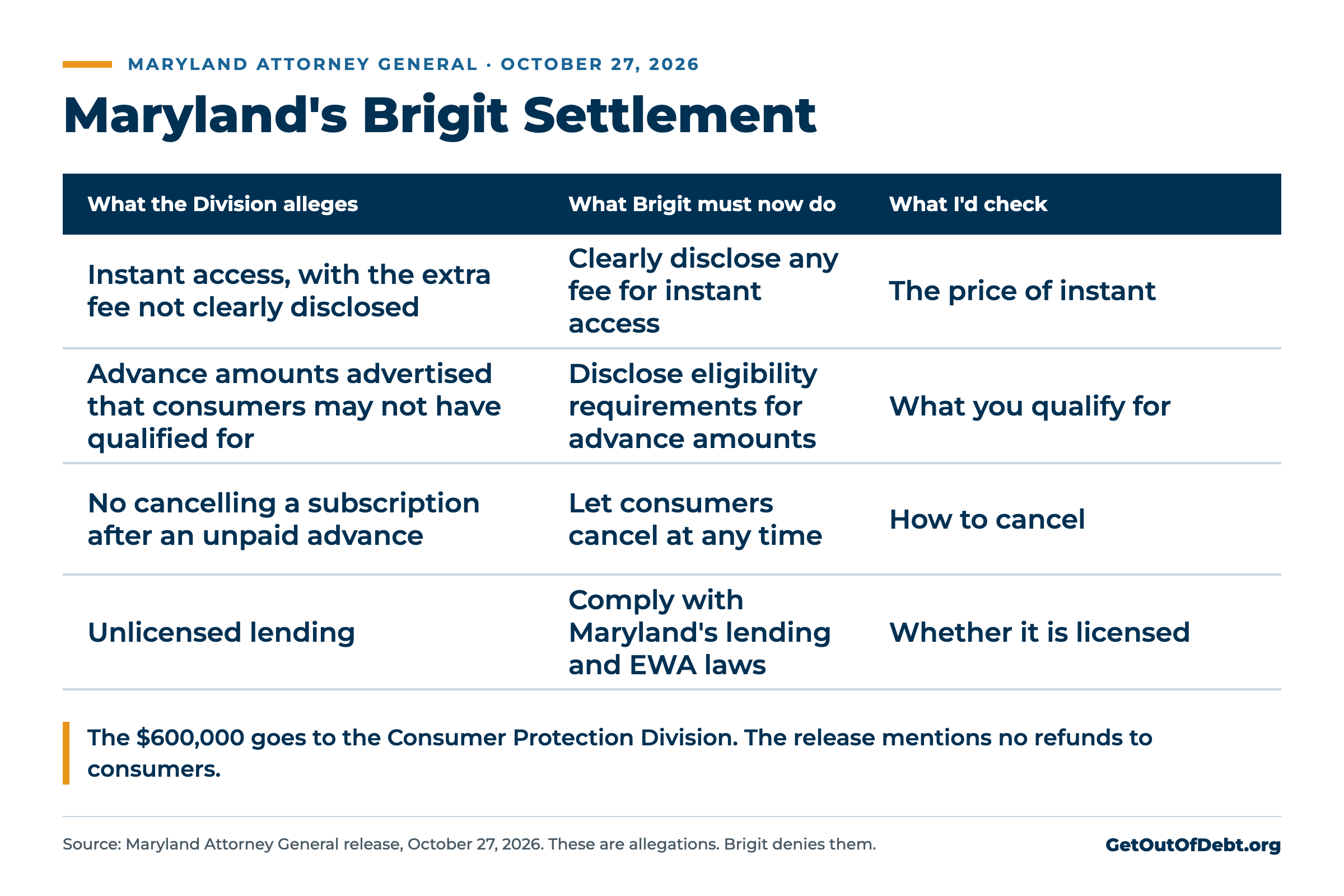
The release says the Division alleged that Brigit engaged in unlicensed lending and that, between December 2019 and October 2023, Brigit misled consumers in how it offered Instant Cash. According to the Division’s allegations in the settlement agreement:
- Alleged: Brigit offered consumers instant access to a cash advance without clearly disclosing that they would have to pay additional fees to get the money instantly.
- Alleged: Brigit represented that consumers could access an advance amount when, in fact, they may not have qualified for the advertised amount.
- Alleged: Brigit would not let consumers cancel a subscription or recurring charge if they had taken an advance and not repaid it, causing consumers to pay continued fees.
Brigit’s side: the release links to the signed agreement, titled an Assurance of Discontinuance. Brigit signed it on October 21, 2026 and the Division signed it on October 26, 2026. In it, Brigit “asserts that its business practices have at all relevant times complied with all applicable laws in Maryland,” and agrees to the terms “without trial of any issue of fact or law.” The agreement also says the Division contends that, before October 1, 2025, Brigit’s EWA products were loans that needed a Maryland lending license. The agreement itself states that Brigit applied for a lending license on April 2, 2024, and that the application was pending when the agreement took effect. You can read the full agreement.
The Attorney General put it this way in the release: “Marylanders living paycheck to paycheck cannot afford surprise charges on a cash advance,” he said. That is his statement about the settlement, and it is the heart of the case as described: a fee for instant access that, the Division alleges, was not clearly disclosed.
What the Settlement Requires, and Who Gets the $600,000
Under the settlement, according to the release, Brigit must:
- Comply with the Maryland Consumer Protection Act, Maryland’s lending laws and Maryland’s EWA law.
- Clearly disclose all material terms and fees of any loans it provides to Maryland consumers, including if an advertised advance amount is subject to eligibility requirements or if instant access to an advance requires an additional fee.
- Let consumers cancel subscription and recurring charges at any time, regardless of whether they have repaid an advance.
- Pay $600,000 to the Consumer Protection Division of the Attorney General’s Office.
Read that last line again. The $600,000 is paid to the Division, and neither the release nor the signed agreement sends any of it to consumers. The release says nothing about refunding fees to Maryland users, nothing about how many Marylanders used Instant Cash, and nothing about a claims process. So based on the release and the agreement, there is nothing to file and nothing to click in this settlement to get money back. The signed agreement has no refund or claims provision either. It says Brigit must make the payment within 30 days of the date of the agreement, and that the money may be used “at the sole discretion of the Attorney General, for consumer protection purposes,” including future enforcement, consumer education, litigation or local consumer aid fund investigation, “or for any other lawful public purpose.” If a text, email or ad tells you that you must pay a fee, or hand over a bank login or Social Security number, to “claim your Brigit settlement money,” it did not come from anything in this release.
The Claim: “A settlement means the company was found guilty.”
The Reality: This settlement resolves the Division’s investigation. The release reports the Division’s allegations and the terms Brigit agreed to. It does not report a court ruling, and in the signed agreement Brigit denies the allegations and agrees to the terms without a trial of any issue of fact or law.
If you used Instant Cash in Maryland and believe you were charged fees you were not clearly told about, the Consumer Protection Division takes consumer complaints (the Division says it helps Maryland consumers resolve disputes with businesses through mediation), and its page on how to file a complaint explains the process. The page notes that complaints become public records subject to disclosure requests under state law, while confidential financial, medical or psychological information remains protected. A complaint is not a claim for a share of this settlement. It is a way to put your own experience in front of the office.
Maryland’s Earned Wage Access Law Was Amended This Year
The release says Brigit must comply with “Maryland’s EWA law,” and that law has just been amended. The agreement says Maryland’s EWA law came into effect on October 1, 2025. Chapter 170 of the 2026 Laws of Maryland (Senate Bill 94), signed April 28, 2026 and effective October 1, 2026, amends it. Reading the chaptered text, among the items below the only new one is the ban on tips. The other items below were already in the statute and Chapter 170 left them in place. As amended, for providers the law covers:
- A provider may not “solicit or charge a tip.” This is the new language.
- When a provider offers a fee-based option, it must offer at least one reasonable option to get the money at no cost.
- A provider must let you cancel at any time without a cancellation fee.
- A provider may not charge a late fee, interest or other penalty for failure to pay, and may not report your failure to pay to a consumer reporting agency.
- If a provider’s attempt to pull repayment from your bank account causes an overdraft or non-sufficient funds fee, it must reimburse the full amount within five business days. That duty does not apply to amounts a consumer received or incurred “through fraudulent or other unlawful means,” in the statute’s words. If it hasn’t paid, I would ask the provider in writing and keep a copy.
I want to be careful here. The release dates the alleged misleading conduct to December 2019 through October 2023, and the agreement says the unlicensed-lending claim concerns the period before October 1, 2025. Both come before Chapter 170 took effect. I am not saying Brigit violated this version of the law. I am pointing out what Maryland’s rulebook says now, because it is a useful checklist for any app.
Where Else Regulators Have Looked at Advance Apps
Maryland is not the first state to look at this business model. Minnesota’s Attorney General sued Brigit in June 2026, alleging it was an unlicensed lender making a modern, online variation of payday loans. I covered that in my post on the Minnesota lawsuit and you can read Minnesota’s announcement. That is a separate matter, the Maryland release does not mention it, and I have not found a report of whether it has been resolved. In Connecticut, I wrote about a consent order that required a different paycheck-advance app to refund fees to its Connecticut users. Different states, different companies, different remedies: Connecticut’s order included refunds, while the Maryland release describes a payment to the state.
For the bigger picture, I laid out why I think these products deserve the same scrutiny as any short-term loan in earned-wage-access apps are payday loans in a costume. I also have a general explainer, Is Brigit Legit in 2026?
What I Would Check Before Your Next Advance, in Any App
You do not need to use Brigit for this to matter. The Maryland allegations point to three things worth checking in any advance app, and I have added two more from my own experience:
- The instant fee. Find the price of “instant” before you tap it. Ask what the free, slower option is and how many days slower it is. The Maryland allegation is that this fee was not clearly disclosed.
- The amount you actually qualify for. An advertised “up to” amount is not an offer. Look at the amount the app shows you after it reviews your account, and decide before you accept.
- The subscription and cancellation. If there is a monthly membership, find out how to cancel it, and whether canceling works while you still owe an advance. The Maryland allegation is that cancellation was refused after an unpaid advance. Brigit denies it, and the signed agreement now requires Brigit to let you cancel whether or not you have repaid.
- Tips and “optional” fees. Count every tip, express fee and membership charge as part of the cost of the advance, whatever the app calls it.
- The cycle. If you borrow again every payday to cover the gap the last advance left, you are not bridging an emergency. You are paying a fee every pay period to rent back your own paycheck.
The math the app screen does not show you: This is my illustration, not Brigit’s pricing. Say you take a $100 advance and pay a $5 instant fee. If you repay in 14 days, that is $5 on $100, or about 130% on an annualized basis. If you repay in 7 days, the same $5 fee works out to about 261%. A fee that feels like pocket change can be a very expensive loan once you run the number. This is a back-of-envelope figure and not the formal APR a lender must disclose, but it is the right way to compare a flat fee with a credit card or a credit union loan.
Key Takeaways
- Maryland’s Attorney General announced a $600,000 settlement with Bridge It, Inc. (Brigit) on October 27, 2026. The money goes to the Consumer Protection Division.
- The Division alleged unlicensed lending and that Brigit misled consumers between December 2019 and October 2023. The release describes allegations, not a court ruling.
- Brigit must clearly disclose fees and terms and let consumers cancel subscriptions and recurring charges at any time.
- Brigit denies the allegations in the signed agreement, and neither the release nor the agreement provides refunds or a claim form.
- Run your own numbers: instant fees, tips and subscriptions all count as the cost of the advance.
The Bottom Line
If you have ever used a cash advance app because the paycheck and the rent did not line up, you were not being careless. You were using a tool that makes the next advance feel easy. What Maryland alleges is a fee for instant access that was not clearly disclosed, and you should not have to feel foolish about missing something the Division says was not clearly shown. Brigit denies the allegations. Nothing in this settlement sends the $600,000 back to you. What you can take from it is the lesson: the number on the button is never the whole price. I filed bankruptcy in 1990 and rebuilt from there, and what changed things for me was looking at the real numbers instead of the feeling. Add up what you have paid in fees, and take the next step knowing your number.
Frequently Asked Questions
What did Maryland’s Attorney General announce about Brigit?
On October 27, 2026, Attorney General Anthony G. Brown announced that his Consumer Protection Division entered into a settlement with Bridge It, Inc. (Brigit) over its “Instant Cash” earned wage access product. The Division alleged unlicensed lending and that, between December 2019 and October 2023, Brigit misled consumers. Brigit must clearly disclose fees and terms, let consumers cancel subscriptions and recurring charges at any time, and pay $600,000 to the Division. The full release is on the Attorney General’s site.
Do I get a refund if I used Brigit in Maryland?
Neither the release nor the signed agreement describes any refund to consumers. The release says Brigit must pay $600,000 to the Consumer Protection Division of the Attorney General’s Office, and the agreement lets the Attorney General use that money for consumer protection purposes or any other lawful public purpose. Neither mentions a claims process or deadline for users. If you believe you were charged fees that were not clearly disclosed, you can file a complaint with the Consumer Protection Division, but a complaint is not a claim for a share of the settlement.
Did Brigit admit it did anything wrong?
No. In the signed agreement, Brigit “asserts that its business practices have at all relevant times complied with all applicable laws in Maryland” and agrees to the terms “without trial of any issue of fact or law.” The release itself reports only the Division’s allegations and the terms. A settlement is not a court finding, and I am not going to convict a company that a judge has not.
How do I figure out what a cash advance app really costs me?
Add every instant fee, tip and subscription charge you paid over the last six months and divide by the total you actually borrowed. That is your cost per dollar borrowed, not an annual rate. Because each advance lasts only days, even a few percent per advance can mean a triple-digit annualized cost, as the example below shows. For a single advance, divide the fee by the amount, multiply by 365, and divide by the number of days until you repaid. In my illustration, a $5 fee on a $100 advance repaid in 14 days works out to about 130% annualized, and about 261% if repaid in 7 days.
Does Maryland’s new law ban tips in earned wage access?
For providers the law covers, yes. Chapter 170 of the 2026 Laws of Maryland (Senate Bill 94), effective October 1, 2026, amends Maryland’s earned wage access law, which the agreement says came into effect on October 1, 2025, to say a provider may not “solicit or charge a tip.” The requirement to offer a no-cost option when a provider offers a fee-based one was already in the statute. You can read the chaptered text. The Brigit release does not say which parts of Maryland’s EWA law the settlement relies on.
One more thing before I go: everything above is what I’m seeing in the release and what I’d tell my own family if they asked me about one of these apps. It’s input, not instruction. You know your paycheck, your bills and your situation better than I ever could, so you do you. Don’t let anyone, including me, tell you what to do with your money.
If this saved you from doing the fee math the hard way, send it to someone who leans on an advance app every payday. Sometimes just seeing the real cost is what changes the decision. If you want to see where an advance habit fits among all your options, the Find Your Path quiz takes a couple of minutes.
Dealing With Debt? Understanding your options is the first step. See how all your debt relief options compare — including ones most sites won’t tell you about. The Find Your Path quiz gives a recommendation based on your actual numbers, and the Scam-O-Meter checks any company’s complaint history before you sign. Federal Reserve Bank of New York research shows bankruptcy filers recover faster than those who don’t file.



