

Quick Answer: Damon Day, my podcast co-host, had two things wrong about Walmart Spark’s top driver tier, Sapphire, and said so on camera. First, he saw the number 120 and assumed it meant 120 deliveries; he says it is 120 points, and the offers he sees carry about two to four points each. Second, he read the 10% Sapphire bonus as 10% more on everything he earns; it applies to eligible incentives, so 10% of a $5 incentive is 50 cents. My arithmetic: 120 points is roughly 30 to 60 deliveries at four to two points each, and the 50-cent bonus has to be weighed against the miles you drive to chase it. This is one driver’s reading of one program, not a promise of anything a driver will earn.
Debt is math wrapped in emotion, and a tier badge works the same way. The shiny word is the emotion. The points, the miles and the 50 cents are the math.
I co-created The Penny Stupid Project with Damon in 2022 as a public experiment in side hustles, and it is our joint channel on YouTube as @pennystupid. Damon is the one who does the driving. I tell you that every time I feature one of these videos, because you deserve to know where I stand before you weigh my opinion. Damon also runs his own debt-coaching practice at damonday.com, the first link in the channel’s own description. He is my podcast co-host, and I receive no payment for featuring this video or for sending you to his site.
There is one more thing to disclose, and it matters more than the rest: I am in this video. It is an episode of the Gigalicious video podcast that Damon and I make together, and I am the other voice in the conversation. The video’s description points viewers to his site and to mine. So treat this as me writing about something I helped make, and read my enthusiasm with an asterisk. The episode also has some salty language, so keep that in mind before you press play at work.
Each weekday I send one short email: one story that caught my attention, why it might matter to you, and one manageable thing you can do with it. A couple of minutes, and a dad joke.
In the latest issue (Nov 6): Owed money on an Amazon return? Check by Dec. 1
Free. I sell nothing. Unsubscribe any time.
The video, Walmart Spark Sapphire: I Got the Perks Wrong, was posted October 28, 2026 and runs 40 minutes and 37 seconds. Damon says in it that it was recorded October 27.
What He Corrected
Everything below is my paraphrase, built from YouTube’s auto-generated captions and the description. Auto-captions get names and numbers wrong, so I note where I couldn’t reconcile something, and the video is the record. Nothing here is a quotation of anyone. Walmart’s program terms are attributed to Damon’s video unless I say Walmart’s own page backs them up. That page is Walmart’s Spark Driver Rewards help page, as I read it on October 28, 2026. It does not list the point thresholds as text, so every number below that sounds like a requirement comes from Damon. Check the tier chart in your own app before you rely on any of them.
Mistake One: 120 Points Is Not 120 Deliveries
Damon says that when Walmart rolled out its new Silver, Gold and Sapphire tiers a couple of months ago, he glanced at Sapphire, saw 120, and decided it meant 120 deliveries in a month. He says that sounded impossible for someone who drives part time, a few orders on some evenings and not every day. Roughly four deliveries a day, every day, is how he works it out. He had written the tier off for months.
Mid-month, he says, he noticed he was about 37 away from the number and realized he had not done anything close to 70 deliveries in two weeks. That made him read the screen properly. The app counts points, and individual offers are worth two, three or four of them. He says shopping orders tend to pay about four, and curbside pickup about two. He says he had been blind to it for months and calls himself dense for missing it. I call it the most ordinary mistake in money: the number in the headline got the attention and the unit next to it got none.
By the time of the recording he says he was at 119 points with about four days left in the month, one point short of Sapphire for the first time. He also repeats a complaint he says drivers make on forums: that a points tier favors people who drive full time. That is his report of what drivers say, and I haven’t checked it.
Mistake Two: The 10% Bonus Is on Incentives, Not on Your Pay
The second one is the one I’d frame and hang on a wall. Damon says he first read the Sapphire perk, a 10% incentive multiplier, as 10% more on everything he makes. He ran a hypothetical month of $1,500 in his head and got a $150 bonus, which he compared to a retirement-plan match. Then he reread the word. In Walmart’s usage, he says, an incentive is the extra a driver sometimes gets when Walmart wants orders picked up in a time block, such as an added $3 or $5 on an order. So the bonus is 10% of that extra, not 10% of the month. His example: 10% of a $5 incentive is 50 cents. The video’s description gives the same example.
Walmart’s help page agrees on the shape of it. It describes the 10% multiplier as a Sapphire perk that applies to eligible incentive earnings and is applied automatically once you unlock the tier. The word eligible matters, and Damon does not claim every incentive qualifies.
The Other Perks, Per Damon
He walks through the list in the app and is candid about what he doesn’t understand. In his telling, three things are available at every tier: a cellular discount, tax-filing assistance and a dash-cam app offer. He says he has no idea what the cellular discount is, asks viewers who use it to comment, and says he can’t tell whether it would apply to his own phone carrier. One month of Walmart+ comes with Gold and Sapphire, he says, though he already has it and wonders whether you get charged if you don’t requalify the next month. He doesn’t know. Walmart’s page, as I read it, doesn’t mention Walmart+ in its text, so treat that one as his reading of the app.
The perk he cares about is the one Walmart’s page does describe: Sapphire drivers may see some offers before Gold, Silver and no-tier drivers. Gold drivers may see some before Silver and no-tier drivers. The wording is may see some offers, not all of them. He plans to test whether it means better orders where he drives, and the video’s description is careful to say so: the Sapphire experiment is still ahead, and the episode does not claim it has already produced better orders.
The Metrics That Can Cost You the Tier
Damon says qualification is monthly, so you have to earn it again each month. Beyond points, he lists four measures. These are his numbers from the video, not Walmart’s text:
- Quantity found, 99%. This is the one he says hurts people. If an item isn’t there and there is no substitute, it counts against you. He says it is based on his most recent 100 eligible shopping deliveries over the past 15 months, so a dip can take a long time to repair.
- On-time arrival at pickup, 96%. He says he sits right at that line because he runs several apps at once.
- Completion rate, 96%. Cancel an accepted order for a better one and it costs you. He says he is at 98%.
- Customer rating, 4.9 out of 5. He says his is about 4.96.
Walmart’s help page does name Customer Rating and Quantity Found among the My Metrics that count toward a tier. The thresholds I couldn’t confirm in text.
His story about the missing-item metric is the part I’d tell a friend. He had a customer who ordered a Halloween candy that is only sold seasonally, and it wasn’t on the shelf. The customer didn’t respond to his messages, and a different candy bar would obviously not be what she wanted. Marking it unavailable counts against his metric. Swapping in anything just to protect the number would mean handing someone a product they didn’t order. He chose to take the hit rather than do that, and says he luckily still held 99%. He adds that a rule like this nudges a driver to force a substitution, which isn’t good for the customer. That is his opinion, and I haven’t tested how Walmart scores it.
Points for Sapphire, per Damon, and he says it is points and not deliveries
10% of a $5 eligible incentive, the video’s own example
Quantity found Damon says Sapphire needs, per his video
These are figures from one driver’s video about one program. They are not earnings and not a forecast. Check the tier chart in your own app.
The Arithmetic Before You Chase a Tier
Here is my math, not Damon’s. Gross means before anything comes out, and for a driver what comes out includes miles, wear, gas and taxes. The IRS’s own standard business mileage rate is 76 cents a mile for July 1 through December 31, 2026. It is the IRS’s stand-in for what gas, tires, maintenance, insurance and depreciation cost per mile. It is a yardstick, not a measurement of anyone’s actual costs.
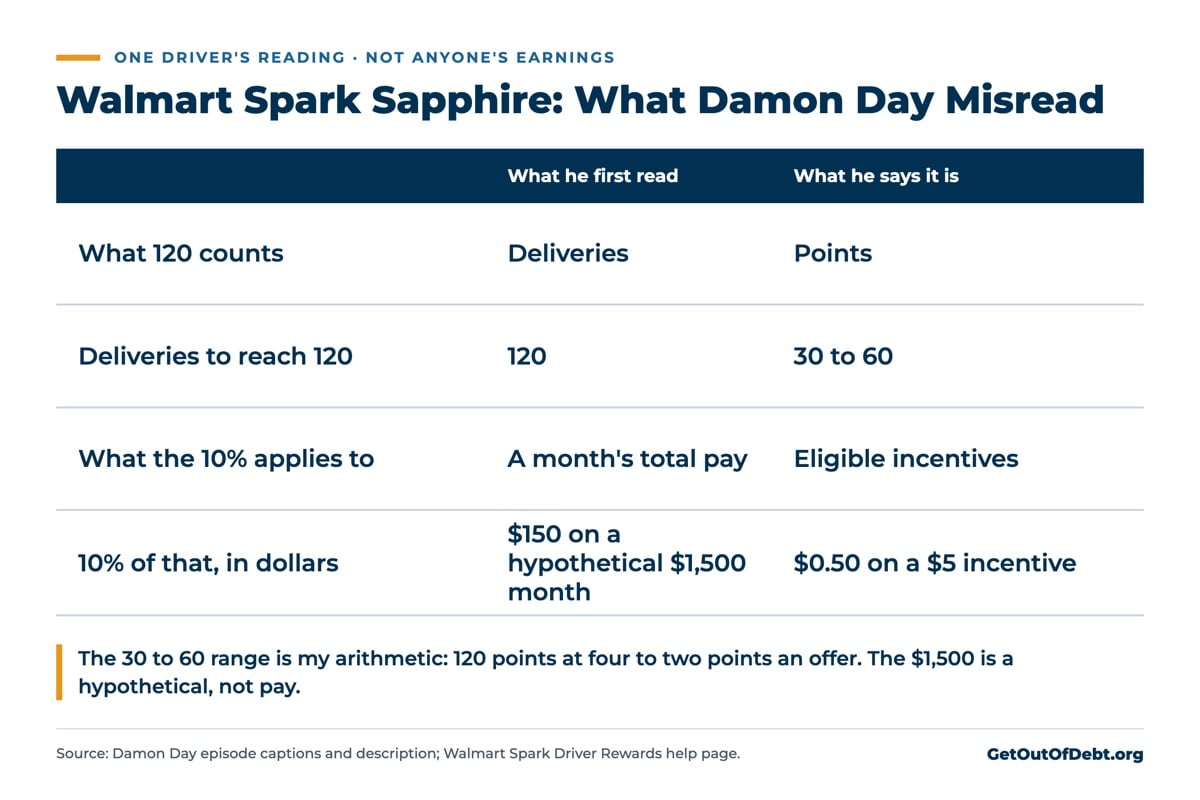
What the Two Corrections Are Worth, Step by Step
The points. At four points an offer, 120 points is 30 offers. At two points an offer, it is 60. So the range is roughly 30 to 60 deliveries, which is a long way from 120 but still a month of steady work for a part-time driver. That range is my arithmetic from the two to four he mentions. It assumes every offer is worth the same, which won’t be true.
The multiplier. 10% of a $5 eligible incentive is $0.50. If the bonus had applied to a hypothetical $1,500 month the way he first read it, it would be $150. That is a 300-to-1 gap between the version he imagined and the one he says is real. The $1,500 is his illustration of the misreading, not a pay figure for any driver.
Put the bonus next to the miles. Suppose, hypothetically, chasing the tier adds 50 extra miles to your month. At 76 cents a mile that is $38.00. At 50 cents per $5 incentive, it would take 76 eligible incentives of that size to earn $38.00 back. If the extra were 10 miles, it is $7.60, or about 15 of them. I’m not saying a chase adds that much. I’m saying the question to ask is how many incentives you actually receive in a month and how many extra miles the chase costs, before you decide the tier is worth it.
Use a real example. In Damon’s 10-stop Walmart Spark delivery, $8 of the order’s $56.05 was incentives. If both incentives were eligible, which I don’t know, 10% of that is 80 cents. The bonus is real money, but it scales with the incentive portion of your pay and not with the headline.
My read: on paper, the perk list works out to less than it first sounds like. The one thing that could change that is the earlier look at offers, and Damon says he hasn’t tested it yet. I’m waiting for that test before I say a tier is worth chasing. Words matter, and so does knowing which numbers you are being asked to chase. No sense wasting a perfectly good mistake, and he made his in public so you can skip it.
A Note on the Numbers I Couldn’t Fully Reconcile
YouTube’s auto-transcript drops decimal points and punctuation, so I read each figure from context.
- The thresholds. The 120 points, 99%, 96% and 96% figures come from Damon’s spoken list. Walmart’s page, as I could read it, doesn’t give them as text, so I can’t confirm them.
- The rating. The captions garble it as 4.9% and later as 4.96 and .04. I read the requirement as 4.9 out of 5 and his own as about 4.96.
- The missing-item count. He says 1,689 items were found or substituted and six were not found with no substitute. That works out to six out of 1,695, about 99.6%, by my arithmetic. He also describes the window as his most recent 100 eligible shops over 15 months. I couldn’t tell from the captions how Walmart rounds or which items the 1,689 covers.
- Dates. He says it was October 27 and that four days remained in the month. I read that as the evening of October 27.
- The cellular discount, tax help, dash-cam offer and Walmart+ month. All are his description of the app. Walmart’s page, as I read it, did not describe them.
What I’d Do Before Chasing Any Tier
This is my checklist, not Damon’s:
- Read the exact words of the perk. Incentive, eligible, points and may see some all mean something narrower than the headline.
- Find the incentive part of your own pay. If the perk is 10% of incentives, your ceiling is 10% of that number, no more.
- Price the chase in miles. Multiply the extra miles by 76 cents before you count any perk as a gain.
- Look at what can knock you out. A metric you can’t control, like an item that isn’t on the shelf, is a risk, not a goal.
- Remember it resets. He says you have to qualify again every month, and Walmart’s page says Points This Month resets on the first of each month.
- Wait for the test. A perk that might show you better offers hasn’t proved it yet, and Damon says as much.
The Rest of the Episode: Lyft Black
The last stretch of the episode is about Lyft Black, Lyft’s premium tier. Damon says he has driven it off and on since he started with Lyft in 2022, that Lyft stopped allowing new Model Ys on the tier, and that his 2020 Model Y was grandfathered but ages out at the end of this year. I haven’t verified Lyft’s vehicle rules, so that is his account. He’s weighing whether a different, more expensive car is justified so he can keep doing it, and describes talking himself in circles between the fun answer and the financial one. As he tells it, my advice was the sensible one, and he says he is leaning toward the practical choice. The description frames it as a question of whether the upgrade is worth the extra work it would require. He gives some income figures for his holiday driving that I’m deliberately leaving out, because they are one driver’s good nights and not a number you should plan around.
If You’re Behind on Bills
I hear some version of this all the time: should I pick up gig work to catch up on my debt? My answer is the same one I give about every option on this site: it depends on your numbers, and most people never run them. Gig work can put money in your account quickly when you don’t have savings, and that speed is real. If you’re closing a short gap, it can help. Quick Cash for Bills: Myth vs Reality is the honest version of that question, and Side Hustles for Debt: When They Help and Hurt is where the Penny Stupid Project started.
Before you count gig work, or a tier perk, as ongoing income, especially income you’re relying on to get out of debt, track what you actually keep over a full week. Count your miles and your minutes, and set money aside for taxes. If the math says delivery work won’t get you where you need to go, that is useful information and not a failure on your part. Sometimes the faster, cleaner answer is a different tool entirely, like a hard look at whether bankruptcy fits. You are not your debt, and you don’t have to drive your way out of it if the numbers say otherwise.
Cleaned Auto-Transcript, Condensed
This is a cleaned and condensed rendering of YouTube’s auto-generated transcript, using the chapter list from the video description for the timestamps. It is not a record of anyone’s exact words. Auto-transcripts get names and numbers wrong, which is why none of it is in quotation marks. Watch the video above for what is actually said.
0:00 – The Sapphire bonus surprise. A cold open on the 10% bonus: it applies to a small incentive, not to a month of earnings.
0:20 – Damon and Steve. The two hosts introduce the show: Walmart Sapphire, the Lyft Black tier, and working more efficiently at gig work.
1:04 – Walmart shopping and the missing-item penalty. A look back at his previous video, a hunt for a seasonal candy, and why a missing item with no good substitute now counts against a driver’s metric.
4:52 – One point away from Sapphire. He is at 119 points with days left in the month, and says he plans a test of whether Sapphire shows better orders.
7:48 – When a Walmart GMD route makes sense. A recap of why a general merchandise delivery paired with grocery drops worked in his last video, why those orders carry no tip, and why a loop route helped.
13:30 – Sapphire perks and the points mistake. The tier perk list as he reads it, and his admission that he took 120 points for 120 deliveries.
18:59 – What the 10% multiplier actually means. Why he first read it as a bonus on a month’s pay, what Walmart means by an incentive, and the 50-cent example.
22:02 – Shopping where other drivers do not. Why he thinks shopping orders are where many drivers leave opportunity, and that shops tend to carry more points than curbside pickup.
23:29 – The metrics that can cost you Sapphire. On-time arrival, completion rate, quantity found and customer rating, with his own standing on each.
26:43 – Why holiday demand complicates the test. A busy season makes it hard to tell whether better offers come from the tier or from higher volume.
27:43 – The end of my Lyft Black era. His history with Lyft Black and why his car is aging out of it.
32:07 – Will Lyft cut me off at midnight? Holiday-night driving stories, and a worry about whether Lyft will drop him from the tier in the middle of a New Year’s Eve shift.
34:53 – Can I justify a Model X? His back-and-forth about a pricier car, the sensible alternative, and a sign-off with a plug to subscribe.
More From the Side Hustle Archive
I’ve been writing about this project since it started in 2022. A few pieces that pair well with this video:
- Damon Day Tried a 10-Stop Walmart Spark Delivery. Here’s the Math After Miles and Tips. — the video he talks about at the start of this episode
- Damon Day Turned Down Low Walmart Spark Offers. Here’s the Math. — the other side of the same decision, saying no to an offer
- Damon Day and I Talk Gig Work: The Math to Run Before You Download an App — an earlier Gigalicious episode
- Why Do You Recommend Damon Day as a Debt Advisor? — where I stand on him, and a reminder that he is my co-host and I receive no payment for linking to him
- Side Hustles: When They Help and When They Hurt — the honest boundaries of what a side hustle can fix
- Side Hustle Success: What It Means and What to Do — the mindset piece behind the math
- Damon Day Asked if Walmart Spark Killed Curbside. Here’s the Math on a 26-Stop Offer. — a later video, on pricing a bundled many-stop offer
Key Takeaway
Damon Day says he misread two things about Walmart Spark’s Sapphire tier: 120 is points and not deliveries, and the 10% bonus applies to eligible incentives, not to a month’s pay, so 10% of a $5 incentive is 50 cents. Before you chase any tier, read the exact words, find the incentive part of your own pay, and price the extra miles at the IRS’s 76 cents. The figures here come from one driver’s video about one program, and the arithmetic is mine. They are not a promise and not a plan.
This is what I’m telling friends like you over coffee. But remember, you do you. Take it as input and make the call that fits your own life.
If someone you know is thinking about gig work to catch up on their bills, send them this before they download an app. Share this with a friend who drives for Walmart Spark, because the terms of a perk are worth reading before you drive extra miles for it.
Common Questions
What did Damon Day get wrong about Walmart Spark Sapphire?
He says he made two mistakes. He took the 120 in the Sapphire tier to mean 120 deliveries, and he says it is 120 points, with individual offers worth about two to four. He also read the 10% Sapphire bonus as 10% more on all his earnings, and he says it applies to eligible incentives instead. Walmart’s Spark Driver Rewards help page describes the multiplier as applying to eligible incentive earnings. The point thresholds are his reading of the app, not something I could confirm in Walmart’s text.
How much is the Walmart Spark Sapphire 10% incentive multiplier worth?
The video’s description gives one example: 10% of a $5 eligible incentive is 50 cents. What it is worth to you depends on how much of your pay arrives as eligible incentives, since it is 10% of that part and not of your whole month. Weigh it against what the extra miles cost, which the IRS yardstick puts at 76 cents a mile for July 1 through December 31, 2026.
Does Sapphire show drivers better Walmart Spark orders?
Walmart’s help page says Sapphire drivers may see some offers before Gold, Silver and no-tier drivers. Whether that means better orders is untested. Damon plans to test it, and the video’s description says the episode does not claim it has produced better orders yet. Until someone measures it in your market, treat it as a possibility and not a benefit.
Who is Damon Day, and what is The Penny Stupid Project?
Damon Day is my podcast co-host, and his own business is Damon Day & Associates at damonday.com, listed first in the channel’s description. The Penny Stupid Project is a public side-hustle experiment I co-created with Damon in 2022, and it lives on YouTube as The Penny Stupid Project. I am in this episode. I receive no payment for featuring the video or for sending you to his site. You can read where I stand on him in Why Do You Recommend Damon Day as a Debt Advisor?
Can gig work help me get out of debt?
It can help close a short-term gap, and some people use it that way. Whether it can take you all the way out depends on what you keep after miles, wear, time and taxes compared with what you owe. If the math says it won’t, other options exist, and I lay all of them out in the debt options comparison, including bankruptcy, which I rate highest across credit, collections, speed and retirement.
Dealing With Debt? Understanding your options is the first step. See how all your debt relief options compare — including ones most sites won’t tell you about. The Find Your Path quiz gives a recommendation based on your actual numbers, and the Scam-O-Meter checks any company’s complaint history before you sign. Federal Reserve Bank of New York research shows bankruptcy filers recover faster than those who don’t file.



