
Written by Steve Rhode, consumer debt expert since 1994 • Last updated October 28, 2026
Quick Answer: A dismissal ends your automatic stay (11 U.S.C. § 362(c) and § 349(b)(3)) but wipes out none of your debts, so garnishment, foreclosure and repossession can resume. Read the order for any refiling restriction and get the reason in writing. A motion to reconsider is due 14 days after entry (Rule 9023) and does not automatically restore the stay. Refile within a year of one dismissal and the stay as to you, on debts, property securing those debts, and leases, generally ends on day 30 unless the court extends it after a hearing finished before day 30, where you must show the new case was filed in good faith; if two or more of your cases were pending and dismissed in the past year, the stay does not start unless a party asks within 30 days after the new filing and the court grants it, and then only from the date of the order (§ 362(c)(4)(C)); the request alone does not create a stay.
Before you read further: this guide covers a dismissed Chapter 7 or Chapter 13 case, and the first thing to find is a date: the day the court entered the dismissal order. Several clocks in this guide run from that date, and some of them are short. The order itself can set shorter or different deadlines than the ones I describe, so treat my numbers as the federal default and check yours against the order. I am not an attorney, and this is information, not legal advice. These deadlines are from the Federal Rules of Bankruptcy Procedure as I read them on October 28, 2026; rules are amended most Decembers, so confirm the current version with your attorney.
Part of the Crisis Guide Series: This is one of my emergency triage guides. See all available Crisis Guides. If your Chapter 13 is still open and you are behind on payments, read I’m Falling Behind on My Chapter 13 Payments first. If a creditor is collecting during a case that is still pending, see I Filed Bankruptcy and a Creditor Is Still Trying to Collect.
What Just Happened to Your Bankruptcy Case
A dismissal means the court ended your case without giving you a discharge. That is different from a discharge, which is the order that releases most debts, and different from a case that is merely “closed” after it is finished. Nothing was wiped out. Dismissal is not a discharge, so unpaid debts are still owed. In Chapter 13, money the trustee already paid to creditors is not returned to you; ask your attorney whether interest or fees were added to what you still owe. A discharge, if you later get one, releases most debts, not all. The automatic stay you had while the case was open ended at dismissal. That is not a bar on a later discharge.
The Bankruptcy Code says the stay of other acts continues until the case is closed, dismissed, or ends in a discharge decision (§ 362(c)(2)), and a dismissal also returns estate property to whoever held it before the case (§ 349(b)(3)), so on the day of dismissal a creditor who was holding back is free to move again. I wrote about what the stay did for me in The Automatic Stay: What Happened the Moment I Filed Bankruptcy in 1990. The Code also says that, unless the court orders otherwise for cause, a dismissal reinstates transfers and liens the case had avoided and vacates certain orders the case had produced (§ 349(b)). So ask your attorney whether anything the case undid has now come back.
You are not alone in this, and it is not a verdict on you. In the Justice Department’s fiscal year 2025 audited reports for Chapter 13 trustees, I added up the national totals myself: 93,646 of 179,727 recorded exits in the six exit categories of the FY2025 Chapter 13 trustee workbook were dismissals (52.1%), and about half of those dismissals (47,077) came before a plan was ever confirmed. That is one year of exits across many filing years in the U.S. Trustee districts only (Alabama and North Carolina are not included), so it is not a true completion rate, but it tells you how common this is. Debt is math wrapped in emotion, and a dismissal is a math problem with a deadline.
“With Prejudice” and “Without Prejudice”: What the Order Actually Controls
Section 349 does not use the phrase “with prejudice,” but the idea is real. The default rule in § 349(a) is that a dismissal does not bar a later discharge of debts that could have been discharged in the dismissed case and does not otherwise prejudice you from filing again, unless the court, for cause, orders otherwise, and except for the waiting rule in § 109(g). So the first thing to do is read the order for the words that change the default.
| Where a restriction comes from | What it does | What to check |
|---|---|---|
| Nothing special in the order (the default) | No bar on a later discharge or a new filing under § 349(a) | That the order contains no refiling bar or conditions |
| § 109(g)(1): dismissal for willful failure to obey court orders or to appear in proper prosecution of the case | You cannot be a debtor again for 180 days after that dismissal | Whether the order or the motion to dismiss says the failure was willful; if unclear, ask an attorney before refiling |
| § 109(g)(2): you asked for a voluntary dismissal after a creditor filed a motion for relief from the stay | The same 180-day bar | Whether a creditor had filed a stay-relief motion at any point before you asked to dismiss |
| A judge’s order “for cause” under § 349(a) | Whatever the order says | Any refiling bar, fee condition or discharge limit written into the order |
Of the rows in this table, only the last three restrict a new filing, and only the last one can go beyond what the statute spells out. If none applies, the dismissal itself does not bar a new filing. Other rules (a current credit-counseling certificate under § 109(h), and waiting periods between discharges under §§ 727(a)(8)/(9) and 1328(f)) can still limit a new case or discharge; ask which rule, order and date anyone relies on.
The Mistake You’re About to Make: The two common ones are opposite. One is assuming the dismissal is final and letting the 14-day clock run out without asking anyone, when a motion might have put the case back. The other is refiling in a panic the same week, with the same missing paperwork or the same unaffordable plan that sank the first case. A repeat filing runs into the stay limits described below, and an unfixed one can run into a presumption that it was filed in bad faith. Do not pay a company to “fix” the dismissal either; only the court can undo a dismissal, usually on a motion filed by you or your attorney; no paid “fixer” can do that for you.
Why Cases Get Dismissed (and the Fix for Each)
| Reason | Where it comes from | The usual fix |
|---|---|---|
| Chapter 13 payments missed, or never started | § 1307(c) lists failure to timely start payments and material default under a confirmed plan | Ask the attorney whether to move to reinstate with a plan to cure, or to refile with a budget that fits. See my guide on falling behind in Chapter 13 |
| Required papers not filed | § 521(i): if the § 521(a)(1) information is not filed within 45 days after filing, the case is dismissed automatically on day 46 | File everything within 45 days of filing, or ask the court in that window for up to 45 more days if justified; after dismissal, ask the attorney whether your court will vacate the dismissal or whether a new case is needed |
| Credit counseling certificate missing | The counseling must come from an approved agency within the 180 days before filing (§ 109(h)), and the certificate must be filed (§ 521(b)) | Take the course from an agency on the U.S. Trustee Program’s approved list and keep the certificate; ask the attorney whether your court will reinstate or whether you need a new case |
| Missed the meeting of creditors | § 343 requires you to attend (the courts’ Chapter 7 basics page says so), and courts can treat not attending as cause to dismiss under § 707(a) or § 1307(c) | Contact the trustee’s office and the attorney right away about a new date and a motion to reinstate |
| Filing fee not paid | Nonpayment of fees is a ground in § 707(a) and § 1307(c)(2); Rule 1017(b) governs dismissal over fee installments | The courts’ Chapter 13 page describes up to four installments with the last due within 120 days (up to 180 with an extension), and the Chapter 7 page describes a fee waiver (Chapter 7 only) if income is under 150% of the poverty line and you cannot pay even in installments |
| Income too high for Chapter 7 (means test) | § 707(b) allows dismissal, or conversion to Chapter 11 or 13 with your consent | Ask the attorney whether conversion to Chapter 13 is on the table instead of a dismissal |
The point of the table is that most of these are fixable once you know which one you have. That is why step 3 below is getting the reason in writing, because the right next move for a missing certificate is different from the right move for six missed plan payments. The fee rules above are as the court system’s pages described them when I read them on October 28, 2026; they change, so check the current numbers before you pay anything.
Free Tool — Bankruptcy Means Test: Wondering if you qualify for Chapter 7 bankruptcy? The free Bankruptcy Means Test checks eligibility based on your state, household size, and income — including state exemptions. Check My Eligibility →
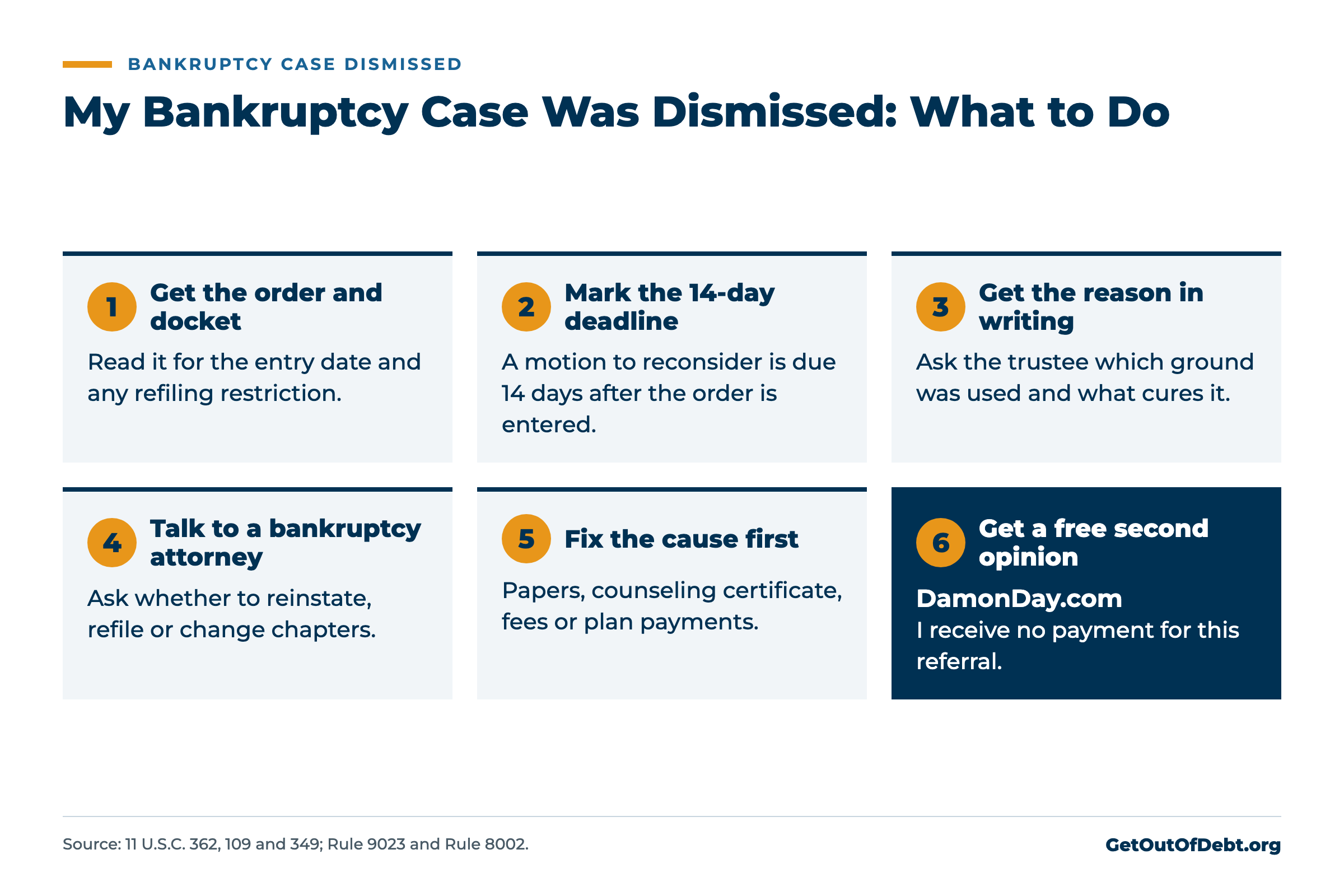
What to Do in the Next 48 Hours: 6 Steps
- Get the dismissal order and the docket. Ask your attorney for both, or look up the case on PACER (the federal courts’ public records system). Read the order for the entry date, any refiling bar, and any conditions. Then look at what was filed just before it: a trustee’s or U.S. Trustee’s motion to dismiss, or a notice from the clerk, usually states the ground.
- Write the deadline on a calendar today. The federal default for a motion asking the judge to reconsider or amend the order is 14 days after the order is entered (Rule 9023(b)), a notice of appeal is also due in 14 days (Rule 8002(a)(1)), and the judge is not allowed to extend the time for the first of those (Rule 9006(b)(2)). The judge can, for cause, shorten the 14-day reconsideration time by order (Rule 9006(c)(1)), though the judge cannot shorten the appeal deadline that way, so read the order for any different date. A timely Rule 9023 motion (or a Rule 9024 motion filed within 14 days) restarts the appeal clock from the order deciding it (Rule 8002(b)); the court can also extend the appeal deadline for some orders, including for excusable neglect if the motion is filed within 21 days after the deadline (Rule 8002(d)(1)). Rule 8002(d)(2) forbids any extension for other orders, including an order granting relief from the stay and an order confirming a plan, so do not assume the extra 21 days exist for your order. Ask a lawyer before relying on either. Count calendar days, weekends included, starting the day after entry; a weekend or holiday deadline moves to the next business day (Rule 9006(a)(1)). Example: an order entered Monday, November 2, 2026 makes day 14 Monday, November 16. For a paper filing, the last day ends when the clerk’s office is scheduled to close, not at midnight (Rule 9006(a)(4)); for electronic filing it ends at midnight in the court’s time zone, unless your court’s rules or the order set a different time. If you miss 14 days, a later motion for relief from the order is still possible under Rule 9024, which brings in Civil Rule 60: it must be made within a reasonable time, and for reasons such as mistake or excusable neglect, no more than a year after the order. Do not count on that door; it is harder than the 14-day one.
- Get the reason in writing. The clerk’s office cannot give you legal advice, but the docket shows what was filed. Ask the trustee’s office to confirm in writing which ground it relied on and, for a Chapter 13, what amount or document would cure it.
- Talk to a bankruptcy attorney today, not next week. Ask five questions: should I move to reinstate or vacate the order, or refile; what is the deadline for each; does my order restrict refiling; what happens to the stay if I refile now; and what do I need to fix first. Find a bankruptcy attorney through NACBA, or start with my free 2-minute bankruptcy quiz so you arrive with your numbers. If you cannot afford an attorney, the free legal aid route in the section below is where to start.
- List every date a creditor has attached to you, and fix the cause before anything is filed. Write down foreclosure sale dates, repossession threats, garnishment notices, lawsuit deadlines and the next payment due. Then work through the fix for your cause: gather the missing documents, take the counseling course, pay or arrange the fee, or rebuild the budget. If you were in Chapter 13 and your plan was never confirmed, ask the trustee in writing about money you already paid in: § 1326(a)(2) says the trustee returns to you payments that were not yet paid and are not yet due to creditors, after deducting unpaid administrative expenses, and after a plan was confirmed the answer depends on what has already gone to creditors.
- Get a free second set of eyes on your whole picture. Schedule a free consultation with Damon Day, an independent debt coach (not an attorney) and my podcast co-host. I receive no payment for this referral. And if someone offers to “reverse” the dismissal for a fee, walk away. Only the court can undo a dismissal, usually on a motion filed by you or your attorney; no paid “fixer” can do that for you.
Your Real Choices: Reinstate, Refile, or Change Course
- Ask the judge to put the case back (reinstate or vacate). Ask the attorney what this route preserves, including your original filing date. It works best when the cause was a mistake you can show and cure: a payment that was made and misapplied, papers you can now file, a notice you never received. The 14-day motion under Rule 9023 is the first window, and the Rule 9024 and Civil Rule 60 route is the later one. The judge has discretion either way, so the motion shows what went wrong and what is different now. Filing the motion does not automatically restore the stay: Civil Rule 60(c)(2) says a Rule 60 motion does not affect finality or suspend the order, and nothing in Rule 9023 suspends the order either, and the stay itself ended by statute when the case was dismissed. A pause has to be asked for, so ask the attorney whether to request one on an emergency basis if a sale date is close, and whether reinstatement would undo anything a creditor did in the meantime.
- Refile a new case. This is a new filing with a new fee and fresh paperwork, and the stay limits below apply. It is often the right call when the cause was eligibility (a missing counseling certificate) or when the old plan was never affordable. A repeat case needs a real change: if you refile within a year of a dismissal and ask the court to keep the stay going, the Code presumes the new case was not filed in good faith when nothing substantial has changed in your finances or personal affairs and there is no other reason to think it will succeed, and you can rebut that only with clear and convincing evidence. I cover the waiting rules in You Can Only File Bankruptcy Once in Your Life? The Law Sets Waiting Periods, Not a Lifetime Limit.
- Switch chapters. If you were in Chapter 13 and could not keep up, Chapter 7 may fit better. Chapter 13 to Chapter 7 conversion is a right the Code gives a Chapter 13 debtor at any time (§ 1307(a)), if you qualify for Chapter 7. Once the case is dismissed, that is a new filing instead. My Chapter 7 guide explains who qualifies.
- Do something else, with your eyes open. Some people are better off dealing with creditors directly after a dismissal, particularly if a single debt was the reason they filed. I put bankruptcy first because, on credit, collections, speed and retirement, it beats the other options I have studied. That is my opinion after 30 years, not a promise about your case, so let the numbers from the attorney’s meeting decide.
- What won’t work: waiting and hoping the stay still protects you. It does not. And asking a creditor to “give you time” is fine, but get it in writing.
What Creditors Can Do Now
Once the stay ends, the actions it paused can resume under state law: collection calls, lawsuits, wage garnishment, bank levies, repossession, and foreclosure sales. If your Chapter 13 was what stopped a foreclosure, check the sale date first, because a date that was postponed may be set again quickly. How fast any of this moves depends on your state and on where each creditor stood when you filed, so I can’t promise you a timeline. If wages are the worry, my complete wage garnishment guide explains the limits, and for a vehicle see keeping your car after a Chapter 13 dismissal. If tax debt was part of your plan, see IRS tax debt in a dismissed Chapter 13, and for the house, keeping your home in bankruptcy.
One warning for homeowners: if a court previously entered an order under § 362(d)(4) finding that a filing was part of a scheme to delay, hinder or defraud creditors (multiple filings is one of the listed grounds), and that order was recorded in your county’s property records, it can bind, as to that property, a case filed within two years of the order, and the debtor can ask for relief for changed circumstances or good cause. Read the dismissal order and the docket for one.
Free Tool — Wage Garnishment Calculator: Worried about your paycheck being seized? The free Wage Garnishment Calculator shows exactly how much creditors can legally take in your state — and some states prohibit garnishment entirely. Calculate My Risk →
If You Refile: How Long the Stay Lasts
The stay on a new filing depends on how many earlier cases of yours were pending in the year before the new filing and were dismissed. Both rules sit in § 362(c).
| Your situation when you refile | What happens to the stay | What to do |
|---|---|---|
| No earlier case of yours was pending in the past year | A new case gets the stay in the ordinary way | Still fix the cause, because the same problem can end the new case too |
| One earlier case pending in the past year was dismissed (§ 362(c)(3)) | The stay, as to debts, property securing debts, and leases, ends as to the debtor on the 30th day after you file, unless the court extends it after a hearing completed before day 30 and you show the new case was filed in good faith | Ask the attorney to file the motion to extend the stay when the case is filed, because the hearing has to be finished inside the 30 days |
| Two or more earlier cases pending in the past year were dismissed (§ 362(c)(4)) | The stay does not go into effect when you file; the court can order it to take effect if a request is made within 30 days after filing and you show good faith, and then only from the date of the order (§ 362(c)(4)(C)); the request alone does not create a stay | The attorney should plan the good-faith showing before the filing, not after |
| Your last case was dismissed more than a year before you refile | These two limits look only at cases pending within the past year | Confirm the dates against the docket, not memory |
Good faith is the heart of both rules, and the Code spells out presumptions against you: a prior dismissal after you failed to file or amend papers without a substantial excuse (mere inadvertence or negligence is not an excuse, with an exception for your attorney’s negligence), a dismissal after you failed to provide the adequate protection the court ordered or to perform a confirmed plan, or no substantial change in your financial or personal affairs and no other reason to expect the new case to succeed. Having more than one earlier case pending in the year is also a presumption. The statute also has an exception for a case refiled under another chapter after a § 707(b) dismissal (the abuse ground that includes the means test). I would not try to read these rules alone. For one earlier dismissal the statute says the stay ends “with respect to the debtor,” and how a court treats other protection is a question for your attorney.
If Your Case Is Not Dismissed Yet
If someone has asked the court to dismiss but the judge has not ruled, you may have more options than a dismissal order leaves you. A Chapter 13 debtor may convert to Chapter 7 at any time (§ 1307(a)) if eligible; after a plan is confirmed, § 1329 lets payments be modified, including longer (up to the five-year limit) or smaller ones; and in limited cases § 1328(b) allows a hardship discharge after confirmation when failure to finish is due to circumstances you should not justly be held accountable for, but only if creditors have received at least what a Chapter 7 would have paid them and modifying the plan is not practicable. Asking for a voluntary dismissal yourself (§ 1307(b)) is an option too, but it ends the case and the stay with it, and if a creditor has already filed a motion for relief from the stay it triggers the 180-day refiling bar in § 109(g)(2), so I would see an attorney first. If this is you, my guide on falling behind on Chapter 13 payments is the place to start.
If something about the dismissal was wrong or no notice reached you, raise it with an attorney or the court inside the 14 days. If you learn of it after 14 days, ask an attorney about the Rule 9024 route in step 2. If a creditor is acting as if the stay never mattered, call a bankruptcy lawyer the same day and ask about an emergency motion. A CFPB or state attorney general complaint can come after; it does not put a stay back. If you need legal help but can’t afford an attorney, find free legal aid through LSC.gov, or find a consumer attorney through NACA. Earlier, I answered readers’ questions on this topic in Chapter 13 Dismissed: What It Means and What to Do and Chapter 13 Dismissal: When Payments Aren’t Enough; this guide goes further on the deadlines, both chapters, and what happens when you refile.
Steve’s Take
I filed bankruptcy in 1990, and I know how a court order can feel like a final grade. A dismissal is a setback, not the end. It does not erase the debt, but it also does not erase your right to try again, and the people I have watched get through it did the unglamorous part: they found out exactly why the case ended, fixed that one thing, and only then filed or asked the judge to put the case back. No sense wasting a perfectly good mistake. Deal with it and look to the future rather than spend 5 years repairing the past. Bankruptcy still beats the other options I have studied on every factor, and a dismissed case just means the first attempt needs a better plan, not that you are the problem. You are not your debt.
Frequently Asked Questions
My bankruptcy case was dismissed. Are my debts gone?
No. A dismissal ends the case without a discharge, so unpaid debts are still owed (in Chapter 13, money the trustee already paid to creditors is not returned to you; ask your attorney whether interest or fees were added to what you still owe), and the automatic stay is over (11 U.S.C. § 362(c)). A discharge is a separate order, and it is the thing that releases most debts.
Can I file bankruptcy again after a dismissal?
In many cases yes. The default rule in § 349(a) is that dismissal does not prejudice a new filing, unless the court orders otherwise for cause, and § 109(g) adds a 180-day wait only in two situations: a dismissal for willful failure to obey court orders or appear, or a voluntary dismissal you requested after a creditor filed a motion for relief from the stay. Read your order and ask an attorney, because a judge can write a longer restriction into the order.
What does “dismissed with prejudice” mean in a bankruptcy?
It means the order restricts what you can do next, such as refiling or discharging the same debts. The Code’s default is that a dismissal does not do that, so a restriction has to come from the order itself or from § 109(g). If your order contains one, the exact wording and the date it started are what an attorney will work from.
How long do I have to ask the judge to reinstate my case?
The federal default for a motion to alter or amend the order is 14 days after it is entered (Rule 9023(b)), and the judge may not extend that time. A motion for relief from the order under Rule 9024 and Civil Rule 60 must be made within a reasonable time and, for mistake or excusable neglect, within a year. Your order can set a shorter date, and local rules control how the motion must be filed, so call an attorney the day you read this.
If I file a motion to reinstate, does the automatic stay come back?
Not automatically. Civil Rule 60(c)(2) says a Rule 60 motion does not affect the finality of the order or suspend its operation, nothing in Rule 9023 suspends the order either, and the stay itself ended by statute when the case was dismissed, so creditors may keep going while the motion is pending. If a foreclosure sale or repossession is close, tell the attorney the date and ask what emergency options your court allows.
What happens to the money I paid my Chapter 13 trustee?
If your plan was never confirmed, § 1326(a)(2) says the trustee returns to you payments that were not yet paid and are not yet due to creditors, after deducting unpaid administrative expenses, and the court’s Chapter 13 page says the court may let the trustee keep some funds for costs. After confirmation, much of what you paid may already have gone to creditors, so ask the trustee in writing for an accounting.
Can creditors garnish my wages or foreclose right after a dismissal?
Once the stay ends, they can resume what state law allows. Timing depends on your state and on how far each action had progressed, so check every notice for a date. If you refile quickly, the stay limits in the table above apply to the new case.
Should I convert my Chapter 13 to Chapter 7 instead of letting it be dismissed?
Sometimes, if you qualify. A Chapter 13 debtor may convert at any time (§ 1307(a)), and conversion keeps you in bankruptcy where dismissal ends it. Whether it fits depends on your income and assets, so take it to the attorney, and see my post on Chapter 13 to Chapter 7 conversion.
One more thing — everything I share here is based on 30-plus years of helping people through exactly this. But my advice is input for your decision, not the decision itself. Only you know your full situation. Talk to an attorney, look at your numbers, and make the choice that serves your future.
Important: This guide is for informational purposes only and is not legal advice. Federal bankruptcy law sets the framework, but local court rules, state law and the exact wording of your dismissal order can change your deadlines and options. For legal advice specific to your case, consult an attorney licensed in your state. NACBA can help you find a bankruptcy attorney, NACA can connect you with a consumer attorney, or schedule a free consultation with Damon Day, an independent debt coach and my podcast co-host — I receive no payment for this referral.
Key Takeaway: A dismissal is not a discharge and not the end of your options, and the first 14 days after the order are the most valuable. Get the order, read it for any refiling restriction, get the reason in writing, and use my bankruptcy quiz before you talk to a bankruptcy attorney today, before the 14 days from the entry date run out. Do not refile the same broken plan if you can avoid it. If a sale, repossession, or garnishment date is close, ask a bankruptcy attorney the same day whether to refile or seek emergency relief before that date.
The Bottom Line
If your case was dismissed, you did not fail at bankruptcy, you ran into a rule you may not have been told about, and most of those rules have a fix if you move before the clocks run out. If someone you know just got a dismissal notice and is staring at it, send them this page — knowing the 14-day window exists is half the fix. For the wider picture, start with my bankruptcy guide, or take my free Find Your Path quiz to see your options side by side.
Dealing With Debt? Understanding your options is the first step. See how all your debt relief options compare — including ones most sites won’t tell you about. The Find Your Path quiz gives a recommendation based on your actual numbers, and the Scam-O-Meter checks any company’s complaint history before you sign. Federal Reserve Bank of New York research shows bankruptcy filers recover faster than those who don’t file.
Right now you are dealing with the thing in front of you, and that is exactly where your attention belongs. When it is handled — and it will be — there is a next stage, and it is the one I most enjoy writing about.
In the latest issue (Nov 12): A 10% cap on your credit card rate? Here's what's real.
Each weekday I send one short email: one story that caught my attention, why it might matter to you, and one manageable thing you can do with it. It is free, I sell nothing, and I take no money from any company I write about.



