

Quick Answer: On October 26, 2026, the Federal Trade Commission and 20 states sued Dollar General in federal court in Tennessee (Case 3:26-cv-01693, Middle District of Tennessee). The complaint alleges that Dollar General routinely charged customers more at the register than the price shown on the shelf, tag or ad. The plaintiffs ask the court for an injunction, monetary relief and civil penalties, but the prayer for relief asks for no specific dollar amount and the complaint describes no refund or claim process. As of October 28, 2026, no court has decided any of it. Dollar General says it aims for “100% accuracy between shelf and register prices” and will “defend this litigation vigorously.” Today, the levers you actually hold are a ten-second look at your receipt and, where your state has one, its price-accuracy law.
Expert Context: I ran a credit counseling organization for years and watched families on tight budgets lose money in small amounts that never show up on a budget worksheet. A few dollars at a register does not feel like a debt problem. For a household counting every dollar, it is part of the same math. I read the complaint itself for this post, not just the headline, because the details tell you what the plaintiffs are actually asking for.
The lawsuit alleges that Dollar General charged more at the register than the advertised price, but it does not hand you a refund, and nothing in the complaint sets up a claim form. The complaint asks a court to order “monetary and other relief within the Court’s power to grant” and to impose civil penalties and restitution, without naming a dollar figure in that request or a process for individual shoppers. These are allegations. A judge has not found that Dollar General did any of it, and the company has said it will defend the lawsuit vigorously. While that plays out, you have your own rights in your own state, and I will walk through the two state laws I read.
Key Terms Defined
Complaint: The document that starts a lawsuit. It states what the plaintiffs allege. It is not a finding.
Claiming money you are owed is one good day. What you do over the following year is what actually changes your position.
In the latest issue (Nov 12): A 10% cap on your credit card rate? Here's what's real.
Each weekday I send one short email: one story that caught my attention, why it might matter to you, and one manageable thing you can do with it.
Free. I sell nothing. Unsubscribe any time.
Injunction: A court order telling a company to do something or stop doing something. Here the plaintiffs ask for a permanent one.
Civil penalties and restitution: Penalties are money a company can be ordered to pay the government for violations. Restitution is money ordered returned to the people who lost it. The prayer for relief lists these among the remedies the states seek.
Scanner law: My shorthand for a state statute that governs what a store must do when the price it charges at an electronic checkout is higher than the price posted. Wisconsin and Michigan have them, and they differ.
What the Complaint Alleges
Everything in this section is what the plaintiffs allege in the filed complaint. I am not telling you any of it is proven.
- Alleged, the pattern: The complaint says Dollar General “has routinely charged customers more at the register than the prices displayed on shelves, price tags, and advertisements,” and that this has persisted for years.
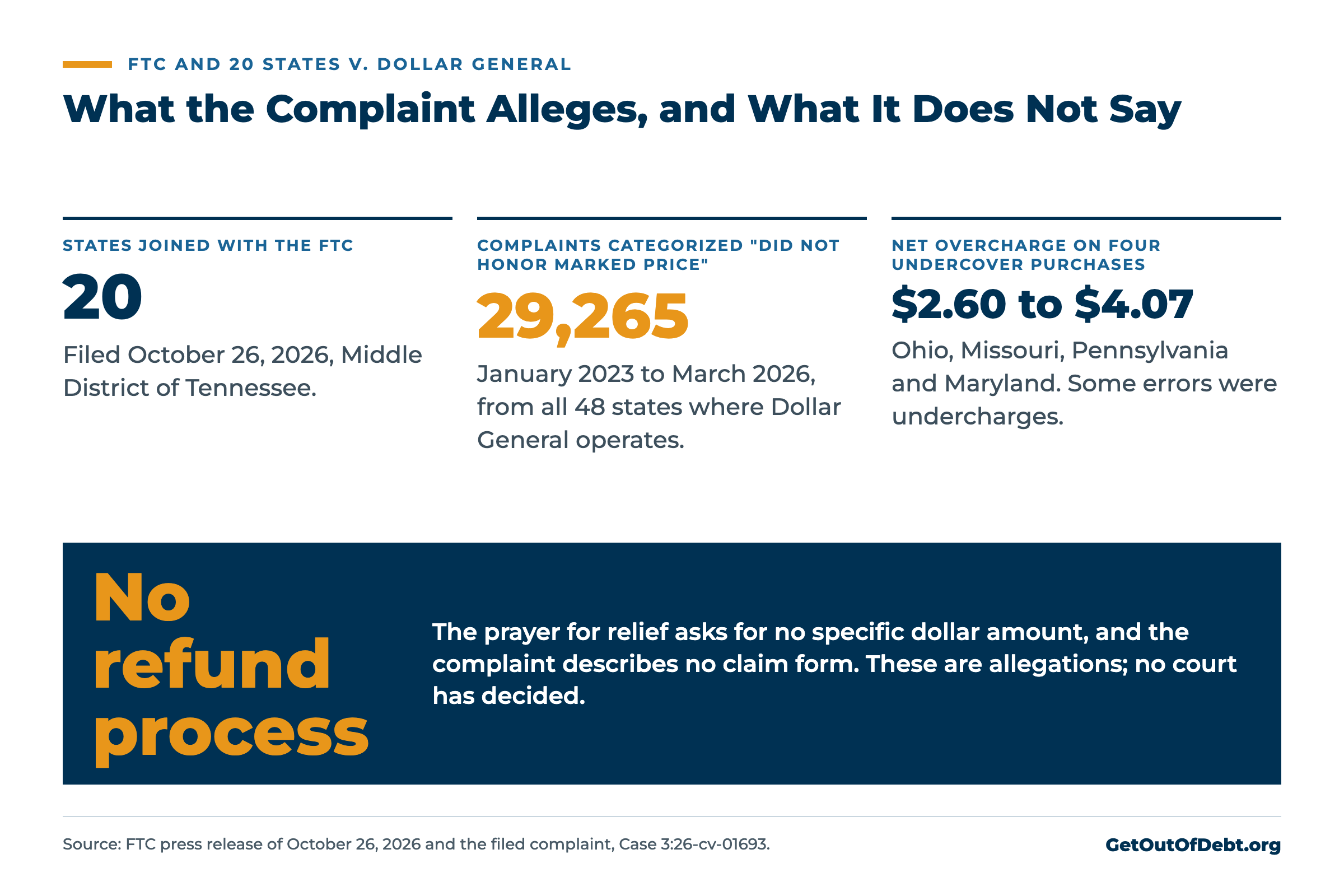
- Alleged, the undercover purchases: Between January 16 and April 1, 2026, FTC investigators paid by credit card at Dollar General stores in Ohio, Missouri, Pennsylvania and Maryland. The complaint says every one of those purchases resulted in Dollar General charging more than the advertised price for multiple products.
- Alleged, the customer complaints: From January 1, 2023 through March 31, 2026, Dollar General received at least 29,265 complaints categorized “Did Not Honor Marked Price,” from all 48 states where it operates.
- Alleged, the inspections: The complaint says state and local inspectors found price-accuracy failures at Dollar General stores. For example, the complaint says Dollar General failed over 39% of pricing inspections in Kansas between January 1, 2023 and March 2, 2026, and that New Mexico conducted 73 inspections of Dollar General stores between January 5 and April 14, 2026, with 53% resulting in failures. The complaint says 33 states follow the National Institute of Standards and Technology inspection procedure (or a past version of it), under which a failed inspection means more than 2% of the items inspected had inaccurate price labels.
- Alleged, the checkout: The complaint says that at the register, prices flash quickly on the screen, and in some stores the screen facing the customer does not clearly show each item’s price; during one FTC undercover buy, the only display the investigator could see was a small screen with an abbreviated description and price. When shoppers notice and ask for the lower price, the complaint says that in many instances employees do not correct it, despite company policies and at least two state settlements requiring them to honor the lowest price.
The four undercover purchases deserve a closer look, because the details matter. According to the complaint, on those trips between 8.5% and 22.4% of the items rang up at a price different from the product label or shelf (13 of 58 items in Cleveland, 6 of 59 in Springfield, Missouri, 6 of 60 in Sharpsburg, Pennsylvania, and 5 of 59 in Baltimore). On three of the four, the complaint says some of the errors were undercharges, in the shopper’s favor. The complaint reports the result as a net overcharge, and the net amounts were small: $3.25, $4.07, $2.60 and $3.65. I am telling you that on purpose. The case the plaintiffs are making is about a pattern across millions of purchases and thousands of failed inspections, not about any one trip costing a fortune.
The complaint also describes earlier trouble. It lists seven settlements since 2019 with six state attorneys general or agencies, totaling more than $6 million, and says Dollar General has been the subject of eight class actions about pricing accuracy since 2022. It says the Colorado and Pennsylvania settlements require signs telling shoppers the store will honor the lowest price.
What the Plaintiffs Ask the Court For
The complaint’s prayer for relief asks for four things:
- A permanent injunction under the FTC Act, the Gramm-Leach-Bliley Act and the listed state laws.
- “Monetary and other relief within the Court’s power to grant.”
- For the plaintiff states, civil fines, restitution, disgorgement, forfeitures or penalties per violation, and attorneys’ fees.
- Costs, fees and other relief the court finds proper.
Read that list again with a shopper’s eyes. There is no dollar figure. There is no claim form, no deadline and no description of how an individual customer would get paid. If this case ends in a settlement or judgment, a refund process is something that would have to be created at that point. I cannot tell you whether it will be, and nobody can yet.
Why a Bank-Privacy Law Is in a Price Case
You may notice that the complaint cites the Gramm-Leach-Bliley Act, a law most people associate with financial privacy notices. I want to explain what the complaint says and stop there. As the complaint describes it, Section 521 of that Act bars anyone from obtaining, or attempting to obtain, a financial institution’s customer information by making a false, fictitious or fraudulent statement to a customer of a financial institution. Count II alleges that Dollar General made false, fictitious or fraudulent statements to obtain or attempt to obtain customer information, namely information from credit and debit cards and checks that contain bank account information, including by representing that consumers will be charged the advertised price. Dollar General says it will defend the case, and I am not going to guess at a motive for the company. The FTC also cites the FTC Act’s Section 19, which, the complaint says, authorizes the court to grant relief including “rescission or reformation of contracts, and the refund of money or return of property.” The complaint ties that Section 19 relief to the alleged GLB Act violations, and the states separately ask for restitution under their own laws. Those are the provisions the complaint cites as authority for a court to order redress or restitution. The complaint does not say shoppers will be paid, and it describes no claim process.
The Claim: “The FTC sued, so Dollar General owes me a refund.”
The Reality: The lawsuit asks a court for relief. It does not create a refund today. No court has found liability; as of October 28, 2026, no settlement has been announced; and the complaint describes no process for individual shoppers. My earlier post on Dollar General’s $8.5 million class settlement covered a different case, and its April 13, 2026 claim deadline has passed.
Is Money Coming Back to Shoppers?
Here is what I know, and what I do not. I know this is a government enforcement lawsuit in its earliest stage, filed October 26, 2026. I know the complaint asks for monetary relief and civil penalties. I do not know what, if anything, would be paid to customers, or when. If a claim process ever opens, I expect it will ask for something to show you shopped there, so keep receipts and take photos of the shelf tag and the receipt line when something rings up wrong. As of today the complaint sets up no claim process, so treat any message asking you to pay a fee or hand over a bank login to “claim your Dollar General refund” as a scam. The FTC’s ReportFraud site is where to report it.
Your Rights at the Register Today: Two State Laws I Read
The complaint alleges inaccurate advertised prices are unlawful in all 50 states, but the remedies may differ from state to state. I read the actual statutes for two of the plaintiff states, Wisconsin and Michigan. I did not read the laws of the other states, so I will not describe them. If you live somewhere else, your state’s weights-and-measures office is the place to ask; the National Institute of Standards and Technology keeps a directory of state weights-and-measures directors.
Wisconsin. Wisconsin Statute 98.08 says a person who uses an electronic scanner to record prices and sells at a price higher than the posted or advertised price “at least shall refund to a person who purchases the commodity or thing the difference between the posted or advertised price” and the price charged. A seller using a scanner has to display a conspicuous sign stating that requirement. As I read the text, there is no bonus and no deadline in that section; the seller must refund the difference; that section names no claim procedure and no office that pays you the difference. Ask at the register. A weights-and-measures complaint is a report, not a refund claim.
Michigan. The Shopping Reform and Modernization Act is more specific. Under MCL 445.319, the section applies when a price is displayed, the sale is recorded by an automatic checkout system, and you get a receipt describing the item and the price charged. Within 30 days of the purchase, you notify the seller in person or in writing, with evidence of your loss; that notice is a precondition to suing under MCL 445.322 over that overcharge. If, within two days of receiving your notice, the seller pays you the difference plus 10 times the difference (that extra amount no less than $1.00 and no more than $5.00), you cannot recover anything further for that loss. If you bought two or more identical items in one transaction, you get the difference on each, but the 10-times bonus is figured on only one of them. If the seller does not pay, you may sue under MCL 445.322, which allows actual damages or $250, whichever is greater, for each day a violation is found, plus attorneys’ fees capped at $300 in an individual action. That is the statute’s list, not a check to expect; ask the store first and ask a Michigan lawyer before filing over a small overcharge. One carve-out: the 30-day notice and two-day payment steps (Section 9, MCL 445.319) do not apply where a seller intentionally charges more than the displayed price. That is not the same as having no claim. MCL 445.318 separately bars knowing overcharges, but only for items subject to section 7; MCL 445.317 lists items outside section 7, and so outside 445.318, including unpackaged food and items sold by weight or volume without a package or container. Do not assume no other law applies.
Here is my arithmetic, not a quote from the statute. If you were overcharged 50 cents on one item, then 10 times the difference is $5.00, so the Section 9 payment that would settle your claim would be $5.50 in total. If you were overcharged 5 cents, the $1.00 minimum applies, so the payment would be $1.05 in total. Whether you ever collect depends on how the store responds and on facts the statute leaves to the particular sale. I am describing what the text says, not promising you an outcome.
Ten Seconds at the Register
You do not have to wait for a court. Here is what I would do:
- Watch the screen while items scan. If a price flashes by too fast, ask the cashier to slow down.
- Check the receipt before you leave the counter. It is easier to fix at the register than from the parking lot.
- Photograph the shelf tag for anything that looks off, with the product visible. A photo helps document the shelf price; Michigan’s notice must include evidence of the loss. I did not read other states’ rules.
- Ask for the lower price right then. The complaint alleges the company has policies requiring employees to honor the lowest price.
- If it is not fixed, complain somewhere that counts. Start with the store, then your state’s weights-and-measures office or attorney general. My state-by-state guide to consumer protection offices can help you find yours. You can also report it to the FTC at ReportFraud.ftc.gov.
This is the same habit I wrote about in my post on catching shrinkflation at the shelf. And if you have wondered whether the shelf labels themselves are the problem, I looked at that in my post on electronic price tags.
What Dollar General Says
CBS News reported Dollar General’s response. The company said: “Our goal is 100% accuracy between shelf and register prices in every store.” It also said, “As with other retailers and despite our policies and procedures, occasional price discrepancies can occur,” that “our store teams are instructed, empowered, and expected to make things right for the customer” when that happens, that it “worked tirelessly and in good faith to resolve this matter without litigation,” including an “alternative, and in our view, more reasonable, manner of calculating potential settlement ranges,” and that “we will defend this litigation vigorously.” You can read the CBS report. The FTC’s press release notes that the FTC files a complaint when it has “reason to believe” the law is being violated, and that “the case will be decided by the court.”
Debt Is Math Wrapped in Emotion
A few dollars at the register does not feel like a debt issue, so here is the math for a budget where every dollar is assigned. This is an illustration, not a claim about what happens to you: if a shopper were hit with a net overcharge of $3 on one trip a week, that is $156 over 52 weeks. For a household on a tight budget, $156 can be a utility bill. The complaint says the FTC’s four undercover trips netted overcharges between $2.60 and $4.07, which is why I use $3 as the round number. You are not careless for missing a few cents on a receipt, and checking is not paranoia. It is the same discipline as tracking where the money goes, which is the first step in any budget I have ever helped someone build.
Key Takeaways
- The FTC and 20 states sued Dollar General on October 26, 2026, alleging it charged more at the register than the advertised price.
- These are allegations. No court has ruled, and Dollar General says it will defend the case vigorously.
- The complaint asks for an injunction, monetary relief and civil penalties, but names no amount and no refund process.
- Wisconsin’s price-accuracy statute says the seller must refund the difference but names no claim procedure, and Michigan’s sets a notice-and-payment process; other states’ rules may differ, so check yours.
- Check the screen, check the receipt and photograph the shelf tag when a price looks wrong.
The Bottom Line
If you have ever walked out of a store and found the receipt did not match the shelf, you were not careless, and you were not imagining it. What the FTC and 20 states allege is a pattern at a company whose customers depend on every dollar being where the sign says it is. Dollar General has said it will defend the lawsuit vigorously, and a judge will decide. What you can do today does not depend on the lawsuit: watch the screen, keep the receipt, take the photo, and use your state’s law. I filed bankruptcy in 1990 and rebuilt from there, and what helped was looking at the real numbers instead of the feeling. Know where your dollars go, and you are already ahead of most people.
Frequently Asked Questions
What is the FTC alleging against Dollar General?
On October 26, 2026, the FTC and 20 states filed a complaint in the Middle District of Tennessee (Case 3:26-cv-01693) alleging Dollar General routinely charged customers more at the register than the price shown on shelves, tags and advertisements. The complaint cites the FTC Act, the Gramm-Leach-Bliley Act and state laws. These are allegations, and the court will decide. Dollar General says it aims for 100% accuracy and will defend the case vigorously. The FTC’s press release has the announcement.
Can I get a refund from Dollar General because of this lawsuit?
Not through anything the complaint sets up today. The prayer for relief asks for an injunction, monetary relief and, for the states, civil fines and restitution, but it asks for no specific dollar amount and describes no claim form or deadline. If the case ends in a settlement or judgment, a refund process would be created then, and I cannot say whether it will be. Keep your receipts and photos, and ignore anything that asks you to pay a fee to claim money.
What if Dollar General charges me more than the shelf price today?
Ask for the lower price at the register and photograph the shelf tag. Then look at your state’s law. In Wisconsin, Statute 98.08 requires a seller using a scanner to refund the difference. In Michigan, if MCL 445.319 applies, notice to the seller within 30 days is a precondition to suing under MCL 445.322 over an ordinary overcharge. If the seller intentionally charged more than the displayed price, those Section 9 steps do not apply, so do not treat a missed 30 days as the end of the claim; ask a Michigan lawyer. If the seller pays within two days, the payment is the difference plus a bonus of $1.00 to $5.00 and ends your claim for that loss. If it does not pay, you may sue under MCL 445.322. Other states’ rules may differ, so contact your state’s weights-and-measures office or attorney general.
Did Dollar General admit to overcharging customers?
Not in the statement CBS News reported; it did not admit the routine overcharging the complaint alleges. CBS News did quote the company saying that despite its policies and procedures “occasional price discrepancies can occur,” that its goal is 100% accuracy, and that it will defend the litigation vigorously. A complaint is not a finding, and I am not going to convict a company that a judge has not.
Where can I report a price problem at a store?
Start with the store manager, then your state’s weights-and-measures office or attorney general; my guide to consumer protection offices lists them by state. You can also report to the FTC at ReportFraud.ftc.gov. Include the store address, date, the item, the shelf price and the price charged, with your photo and receipt.
One more thing before I go: everything above is what I’m seeing in the complaint and what I’d tell my own family if they asked me about it. It’s input, not instruction. You know your budget and your situation better than I ever could, so you do you. Don’t let anyone, including me, tell you what to do with your money.
If this was useful, send this to someone in your life who shops at a dollar store every week and never checks the receipt. Sometimes seeing it laid out is what gets someone to look. If you want to see where everyday money leaks fit among all your options, the Find Your Path quiz takes a couple of minutes.
Dealing With Debt? Understanding your options is the first step. See how all your debt relief options compare — including ones most sites won’t tell you about. The Find Your Path quiz gives a recommendation based on your actual numbers, and the Scam-O-Meter checks any company’s complaint history before you sign. Federal Reserve Bank of New York research shows bankruptcy filers recover faster than those who don’t file.



