

Quick Answer: Damon Day, my podcast co-host, spent a day working Walmart Spark, Instacart, DoorDash and Uber Eats offers from a loaner Tesla Model 3 running Full Self-Driving (Supervised), and filmed it. The video’s description says the day came to $173.02 gross across the four apps, before expenses and taxes, and says in so many words that this is not profit and not a claim that FSD increased his earnings. What I took from it: the car did not make the money decisions, Damon did. He turned down offer after offer that failed his per-mile rule, he counted the miles back to where the next order might be, and he dropped one Instacart batch for a closer Walmart order. My arithmetic: at a hypothetical 100 miles and the IRS’s 76 cents a mile, $76 of that $173.02 goes to the car before any tax, and a $99 monthly FSD price that Carscoops reported in January is a separate cost on top. This is one driver’s day, not a forecast of what anyone will earn.
Debt is math wrapped in emotion, and a self-driving car is a very shiny wrapper. The car can steer. It cannot tell you whether an offer is worth the miles.
I co-created The Penny Stupid Project with Damon in 2022 as a public experiment in side hustles, and it is our joint channel on YouTube as @pennystupid. Damon is the one who does the driving. I tell you that every time I feature one of these videos, because you deserve to know where I stand before you weigh my opinion. Damon also runs his own debt-coaching practice at damonday.com, the first link in the channel’s own description. He is my podcast co-host, and I receive no payment for featuring this video or for sending you to his site.
One more disclosure: as far as the captions and the description show, I am not in this one. It is Damon alone in the car, plus the voice assistant the car carries, which joins the conversation for a minute. The episode has some salty language, so keep that in mind before you press play at work.
Each weekday I send one short email: one story that caught my attention, why it might matter to you, and one manageable thing you can do with it. A couple of minutes, and a dad joke.
In the latest issue (Nov 10): Prices rose again. What's your own number?
Free. I sell nothing. Unsubscribe any time.
The video, I Let Tesla FSD Drive My Walmart Spark & Instacart Shift, was posted October 29, 2026 and runs 32 minutes and 14 seconds.
What the Car Is, and What It Isn’t
Tesla calls the feature Full Self-Driving (Supervised), and the word in parentheses is the whole story. The video’s description says it requires an attentive driver ready to take over, and that the thumbnail is an illustrated joke, not driving guidance. Tesla’s own annual report says the same thing in corporate language: it describes the driver assistance systems it offers and states that, as in the past, the driver is responsible for remaining fully engaged in the driving operation. That comes from Tesla’s 10-K for 2025, filed with the SEC on January 29, 2026. Damon takes the wheel several times in the video, and I’ll point out where. Nothing in this post says a car can work a delivery shift without a person paying attention to it.
I did not research whether any delivery platform’s terms address driver-assist features. If you are thinking about trying this, read your own platform’s terms first, and your insurance policy too.
What Happened on the Shift
Everything below is my paraphrase, built from YouTube’s auto-generated captions and the video’s description. Auto-captions get names and numbers wrong, so I flag the places I couldn’t reconcile, and the video is the record. Nothing here is a quotation of anyone. Where I describe how an app behaves, that is Damon’s account of one day, and I have not tested it.
The Setup: a Loaner, Four Apps and a Tote Problem
Damon says the Model 3 was a loaner that he’d had for four or five days, and that it is a newer car with Tesla’s latest hardware, which is why it came with the current FSD software. He says the plan was to work the whole shift and see whether supervised self-driving makes multi-app delivery work easier. He runs four apps at once: Uber Eats, DoorDash, Instacart and Walmart Spark. That is how he works every shift, and he says it is the only way to stay busy on a slow day, because any one app can go quiet for hours.
The first thing he complains about is the car. He says he’d never buy a Model 3 over a Model Y for delivery work, because the trunk opening is small, he keeps hitting his head getting in and out, and his laundry totes barely fit. That is one driver’s opinion about one vehicle. I’m not recommending a car, and I’ll say this as a debt guy: the vehicle is the biggest line in any gig-work budget, and buying one for delivery work is a decision to run through the numbers before you shop, not after.
Where the Car Helped, and Where He Took Over
He says the car handled long stretches well, including a long dirt driveway that impressed him. He also lists what it doesn’t know. It doesn’t know which parking spot a pickup needs, so he takes over in the lot. It tends to head toward the busiest part of the lot where pedestrians are crossing, and he says it nearly pulled into a spot reserved for law enforcement. It doesn’t stop short of a gate keypad, so he takes over to punch in a code. In one lot he says it parked in the middle of two spaces, and then admits the faded lane lines might be to blame, so he declines to pin that one on the software.
Near the end he raises a bigger question: if a vehicle has no way for a person to take over, who deals with the keypad, the specific parking spot and the gate that is far from the call box? That is his question about Tesla’s Cybercab, and I haven’t verified anything about how it will work. I raise it only because it shows what the shift actually consists of. Much of the job is the last 100 feet, where a human decides what to do.
The Math That Did Not Come From the Car: His Per-Mile Rule
This is the part I’d save from the whole video. Damon describes a rule of thumb for shopping orders: about $2 per mile out, plus about $1 per item. He says the $2 is really a stand-in for $1 a mile once you count the drive back. He also says his rules are more like guidelines and he’ll break them to keep moving. Here is how the offers he talks about land against that rule. The first and third comparisons are Damon’s own arithmetic. The middle one is mine, applying his rule.
- 10 miles out, 13 items, $25 offered. By his rule that needs about $33, so he calls it $8 short. He passes.
- 11 miles out, 7 items, $12 offered. By his rule that is about $29 needed. He describes the trip as 22 miles round trip plus an alcohol scan for $12, and passes. (My application of his rule; he doesn’t state the $29.)
- About 5 miles, 5 items, roughly $18 offered. By his rule that is about $15 needed, so it clears, and he takes it partly because it is close and keeps him moving. He also mentions a minimum of about $20, which the captions garble, so I can’t reconcile the two.
The Return-Mile Lesson
One offer is a catering run: the captions read it as $18.41 for about 17.6 miles. Damon’s point is that the number on the screen leaves out the drive after the drop. If the next likely order is another 10 miles away, he says, that is really about 27 miles for roughly $18. My arithmetic: $18.41 over 27.6 miles is about 67 cents a mile, and that is before the car costs anything. His summary is that a dollar a mile is not enough if you are not already sitting where the next order will find you, and I think that is the most useful idea in the video. He declines.
He does the same thing with a roughly $9 offer that shows 26 minutes: the estimate covers the trip to the restaurant and the drop, not the drive home, so he reads it as about 45 minutes for $9.
Swapping an Instacart Batch for a Closer Walmart Order
The most interesting decision of the day, to me, is when Damon takes a roughly $38 Instacart batch with two customers and about 21 items at a store about 9 miles away. Then a Walmart order appears: $42, 29 items, one customer, about 1.9 miles, and the drop-off is a mile away. He cancels the Instacart batch and takes the Walmart one. His reasoning is that Walmart pays about $4 more, he shops Walmart about twice as fast, one customer means one checkout and one delivery, and he estimates finishing 20 to 30 minutes sooner. He also says the Instacart app warns that canceling batches can affect a driver, that he had canceled one the week before, and that he doesn’t cancel often. That is his account of the app, not Instacart’s terms.
Run his rule on the two: the Instacart batch needs about $38.60 (2 x 8.8 miles + 21 items), against $38 offered, which is roughly even. The Walmart order needs about $32.80 (2 x 1.9 miles + 29 items), against $42 offered, so about $9 over. That is my arithmetic, not something he does on camera, but it lines up with the call he made.
The Accidental Accept and the Support Call
Later, Damon says he hit accept on a DoorDash order by accident while the phone was in his pocket. All he knew was that it paid $23. He says DoorDash doesn’t show the total miles or the item count once you are on the way to the store, so he couldn’t tell whether he’d signed up for 20 miles, and he wasn’t willing to shop for something without knowing that. He finishes a $6 order first, then calls support to ask. The video’s description says that call goes nowhere. By his account he cancels the order. I haven’t checked how DoorDash’s app shows these details today, and I’m not drawing a conclusion about the company from one call on one day.
In the same stretch, he delivers to the wrong house after taking the car off FSD to deal with people walking nearby and then going on from habit. The right address was two houses up the street. He laughs about it on camera, and so will I, but the cost is real: an extra five minutes with an Uber Eats order waiting. I’m not blaming the car or the takeover. It is the kind of thing that happens in a shift with four apps open.
Two Dollars, and Knowing When to Go Home
At one point the app offers him a $2 pickup that is 6.4 miles away, with an estimate of 22 minutes. He declines it with some choice words and says he is ready to quit for the night. He ends up taking a Walmart order that reappears on the board at $25, and later passes on a $13.79 two-pickup offer. Around 9:00 p.m. he decides that, with some grocery stores closing, the evening is probably done. He says he made roughly another $40 on top of the $100 or so from earlier, which is a running estimate. The description’s $173.02 is the number that uses completed payouts, and it is the one I use.
Gross for the day across four apps, per the video’s description. Not profit and not an FSD result.
Monthly FSD (Supervised) price Carscoops reported in January 2026. I could not confirm it on Tesla’s page.
IRS business mileage rate per mile for July 1 through December 31, 2026. A yardstick, not his actual costs.
These are figures from one driver’s video about one day. They are not typical earnings and not a forecast.
The Arithmetic Before You Count a Day Like This
Here is my math, not Damon’s. Gross means before anything comes out, and for a driver, what comes out includes miles, wear, gas, insurance, time and taxes. The IRS publishes a standard business mileage rate of 76 cents a mile for July 1 through December 31, 2026. It is the IRS’s stand-in for what gas, tires, maintenance, insurance and depreciation cost per mile, and a yardstick, not a measurement of anyone’s actual costs. The IRS also says the self-employment tax rate is 15.3%. I use that flat figure below as a simplified illustration, because an actual return works it out differently.
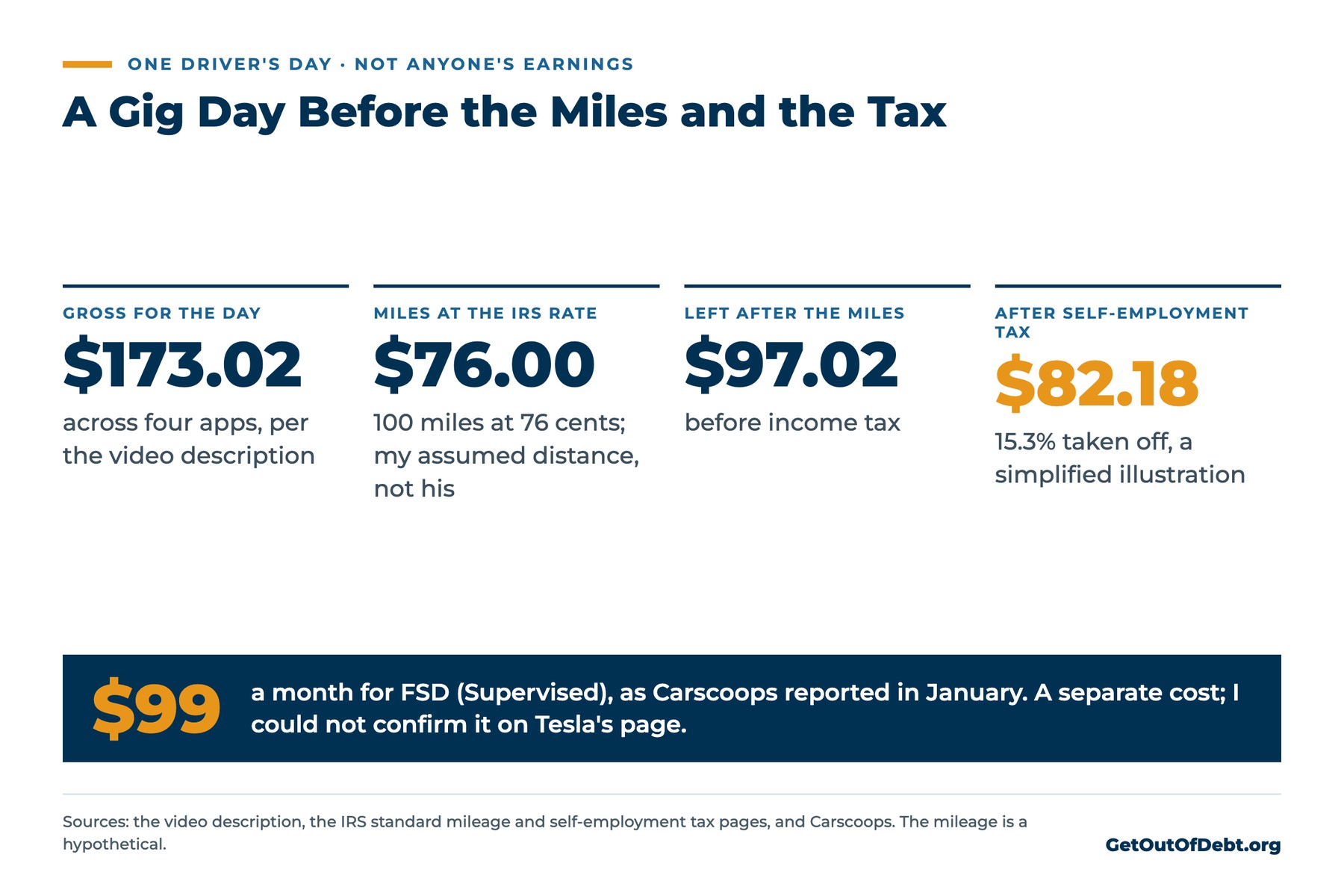
The $173.02 Day, Subtracted Step by Step
The starting point. The description gives $173.02 gross across Walmart Spark, Instacart, DoorDash and Uber Eats. It also says individual running totals and work times are approximate. I don’t know his actual miles, his hours or what any app deducted, so I can’t tell you what he kept, and neither can the video.
The miles, three guesses. I am assuming distances, because he doesn’t give a total. At 50 miles the IRS rate is $38.00, leaving $135.02. At 100 miles it is $76.00, leaving $97.02. At 150 miles it is $114.00, leaving $59.02. Those are my hypotheticals, not his miles.
Then the tax. Taking a flat 15.3% off each remainder for self-employment tax leaves about $114.36, $82.18 and $49.99, before income tax. That is a simplified illustration of the order of operations, not tax advice.
What the car did and did not cost on this day. It was a loaner, so on this shift Damon did not carry a car payment, and the IRS mileage yardstick is a better picture of what a car you own costs per mile. FSD itself is a separate line. Carscoops reported on January 14, 2026 that Tesla’s website showed FSD (Supervised) at $99 a month and that Tesla would stop selling it outright after February 14, 2026. I couldn’t load Tesla’s own page for this post because it blocks automated requests, so check the current price yourself before you rely on that number. If it holds, $99 is about 57% of this one day’s gross. Spread over a month of shifts it shrinks, but it is a real cost that a day’s gross does not subtract.
The bottom line of the math. Whether FSD is worth paying for in this work depends on how many shifts you work, how many miles each one takes and how much of the day goes to the last 100 feet where the car hands control back to you. Nothing in this video measured that, and the description says so itself.
My read: the most valuable thing in this video isn’t the car. It is a driver who says no to most of what he is offered, does the return-mile arithmetic before he accepts, and is willing to cancel a decent order for a better one. A self-driving car doesn’t make that decision for you. No sense wasting a perfectly good mistake: he accidentally accepted an order he couldn’t evaluate, and he shows you how that felt so you don’t have to.
A Note on the Numbers I Couldn’t Fully Reconcile
YouTube’s auto-transcript drops decimal points and punctuation, so I read each figure from context.
- The gross. The $173.02 comes from the description. The totals he says out loud during the shift are running estimates, and the description says so.
- The catering offer. The captions read it as $18.41 and 17.6 miles, and he says roughly 18 dollars, so my 67 cents a mile uses the caption figure.
- The $20 minimum. He mentions a minimum of about $20 in the passage about the roughly $18 offer, but the captions are garbled there. I couldn’t reconcile it with his $2-per-mile-plus-$1-per-item rule, so I report both.
- The Instacart batch. The captions give 21 items, about 9 miles and a $38 total, and later 8.8 miles. I use 8.8 miles in the arithmetic.
- The date. The video was posted October 29, 2026, but he mentions Labor Day weekend in the first part of the shift. The description does not give a recording date, so I don’t know when it was filmed.
- The platform behavior. The accept-and-cancel details for DoorDash and the Instacart warning about canceling are his account of what the apps showed him that day, not terms I checked.
What I’d Do Before Counting a Day Like This
This is my checklist, not Damon’s:
- Add the miles you drive back. An offer that shows 17 miles can really be 27. Count the trip home, or to the next place an order will find you.
- Write your own rule before you open the app. Damon’s is a couple of dollars a mile plus a dollar an item. Yours will differ. The point is that an offer gets measured against a rule, not against a feeling.
- Price the car. Multiply the miles by the IRS rate before you call a day good, and add any subscription on top.
- Take the tax off. Self-employment tax comes out of net earnings, so set money aside for it.
- Stay responsible for the car. If you use any driver-assist feature, the car is still yours to watch. Tesla says so in its own annual report.
- Read the offer before you tap. An accidental accept with no distance shown is a lesson in why. If your app hides the distance after you accept, slow down on the button.
If You’re Behind on Bills
I hear some version of this all the time: should I pick up gig work to catch up on my debt? My answer is the same one I give about every option on this site: it depends on your numbers, and most people never run them. Gig work can put money in your account quickly when you don’t have savings, and that speed is real. If you’re closing a short gap, it can help. Quick Cash for Bills: Myth vs Reality is the honest version of that question, and Side Hustles for Debt: When They Help and Hurt is where the Penny Stupid Project started.
Before you count gig work as ongoing income, especially income you’re relying on to get out of debt, track what you actually keep over a full week. Count your miles and your minutes, and set money aside for taxes. If the math says delivery work won’t get you where you need to go, that is useful information and not a failure on your part. Sometimes the faster, cleaner answer is a different tool entirely, like a hard look at whether bankruptcy fits. You are not your debt, and you don’t have to drive your way out of it if the numbers say otherwise.
Cleaned Auto-Transcript, Condensed
This is a cleaned and condensed rendering of YouTube’s auto-generated transcript, using the chapter list from the video description for the timestamps. It is not a record of anyone’s exact words. Auto-transcripts get names and numbers wrong, which is why none of it is in quotation marks. Watch the video above for what is actually said.
0:00 – This is why I need FSD. A run of offers on screen, including a pharmacy pickup and an Uber offer that goes 20 miles, and a joke about why the car should drive.
0:28 – Model 3 vs. Model Y: the tote problem. His view of the loaner Model 3 for grocery work, the small trunk opening and the totes that barely fit.
1:55 – Walmart Spark and the four-app plan. A curbside Walmart offer he calls a no-brainer, and the plan to work all four apps and take over the wheel when the lot gets specific.
4:39 – Why I pass on these offers. A borderline Target shop, his per-mile rule for shopping orders, and the offers that fail it.
9:36 – A better Walmart offer changes the plan. He cancels an Instacart batch at a different store for a closer Walmart order and explains why.
13:11 – The return-mile lesson. A catering offer and a long pickup that look better on screen than they are once the drive back is counted.
15:58 – Grok takes a shot at Uber pay. The car’s voice assistant weighs in on a slow DoorDash afternoon and his four-app strategy.
18:27 – Wrong house, wrong customer. A delivery to the wrong house after he takes the wheel, and a stacked Uber Eats order that runs late.
21:08 – The order STILL wasn’t ready. Waiting on a slow restaurant while a second pickup is stacked, and an accidental DoorDash accept.
24:17 – DoorDash support frustration. A call to find out what he accepted and how far it goes.
26:01 – Did that say two dollars? A very low offer, and the temptation to quit.
26:35 – Back out for the evening shift. A Walmart order that returns to the board, a long driveway the car handles well, a gate keypad it can’t, and a parking job in the middle of two spaces.
29:26 – Cybercab: the unusual use cases. His questions about what happens when a vehicle has no way for a person to take over at a gate, a garage or a specific spot.
30:58 – Knowing when to go home. Passing on a couple more offers as stores close, and heading home.
More From the Side Hustle Archive
I’ve been writing about this project since it started in 2022. A few pieces that pair well with this video:
- Damon Day Tried a 10-Stop Walmart Spark Delivery. Here’s the Math After Miles and Tips. — another look at the miles-first rule, on a single Spark run
- Damon Day Misread Walmart Spark’s Sapphire Tier. Here’s What He Corrected. — reading the exact words of a perk before you chase it
- Damon Day and I Talk Gig Work: The Math to Run Before You Download an App — an earlier Gigalicious episode
- Why Do You Recommend Damon Day as a Debt Advisor? — where I stand on him, and a reminder that he is my co-host and I receive no payment for linking to him
- Side Hustles: When They Help and When They Hurt — the honest boundaries of what a side hustle can fix
- Side Hustle Success: What It Means and What to Do — the mindset piece behind the math
Key Takeaway
Damon Day worked a day of delivery offers from a loaner Tesla on Full Self-Driving (Supervised), and the video’s description reports $173.02 gross across four apps, before expenses and taxes, and not as a claim that FSD increased his earnings. The money lesson is his per-mile rule, the return miles and the willingness to say no. Before you count a day like this, subtract the miles at the IRS’s 76 cents, take out self-employment tax, and add any FSD subscription on top. The driver stays responsible for the car. The figures here come from one driver’s video, and the arithmetic is mine. They are not a promise and not a plan.
This is what I’m telling friends like you over coffee. But remember, you do you. Take it as input and make the call that fits your own life.
If someone you know is thinking about gig work to catch up on their bills, send them this before they download an app. Share this with a friend who delivers for Walmart Spark, Instacart or DoorDash, because the math on the miles is worth running before the first tap.
Common Questions
Does Tesla Full Self-Driving drive itself on a delivery shift?
No. Tesla’s feature is named Full Self-Driving (Supervised), and the video’s description says it requires an attentive driver ready to take over. Tesla’s 2025 annual report says the driver is responsible for remaining fully engaged in the driving operation. In the video, Damon takes the wheel for parking spots, gate keypads and pedestrians.
How much did Damon Day earn using Tesla FSD for gig work?
The video’s description reports $173.02 gross across Walmart Spark, Instacart, DoorDash and Uber Eats for the day, before expenses and taxes, and says plainly that this is not profit and not a claim that FSD increased his earnings. It is one driver’s day and not typical. I don’t know his miles or hours, so I can’t tell you what he kept.
What rule does Damon use to decide whether to take a shopping order?
By his description, about $2 per mile out plus about $1 per item, because he has to come back. He says it is a guideline he’ll break to keep moving. Under that rule, a 10-mile, 13-item order needs about $33, so a $25 offer is about $8 short.
What does Tesla FSD (Supervised) cost?
I could not load Tesla’s own pricing page for this post. Carscoops reported on January 14, 2026 that Tesla’s website showed a subscription at $99 a month and that Tesla would stop selling FSD outright after February 14, 2026. Check Tesla’s page for the current price. Tesla’s annual report confirms that customers may purchase FSD (Supervised) as a subscription.
Who is Damon Day, and what is The Penny Stupid Project?
Damon Day is my podcast co-host, and his own business is Damon Day & Associates at damonday.com, listed first in the channel’s description. The Penny Stupid Project is a public side-hustle experiment I co-created with Damon in 2022, and it lives on YouTube as The Penny Stupid Project. I receive no payment for featuring the video or for sending you to his site. You can read where I stand on him in Why Do You Recommend Damon Day as a Debt Advisor?
Can gig work help me get out of debt?
It can help close a short-term gap, and some people use it that way. Whether it can take you all the way out depends on what you keep after miles, wear, time and taxes compared with what you owe. If the math says it won’t, other options exist, and I lay all of them out in the debt options comparison, including bankruptcy, which I rate highest across credit, collections, speed and retirement.
Dealing With Debt? Understanding your options is the first step. See how all your debt relief options compare — including ones most sites won’t tell you about. The Find Your Path quiz gives a recommendation based on your actual numbers, and the Scam-O-Meter checks any company’s complaint history before you sign. Federal Reserve Bank of New York research shows bankruptcy filers recover faster than those who don’t file.



