

Quick Answer: Medicare Part D stand-alone drug plan premiums for 2027 are projected to rise by less than $1 a month on average, from $35.09 to $36 (CMS), but KFF found that some plans will cost $50 or more extra per month if you simply keep them (KFF). Social Security’s 2027 raise is 3.6%, which averages $75 a month for retirees (SSA), so how much of the raise you keep depends on your specific plan and on the 2027 Part B premium, not on the average. Medicare Open Enrollment runs from October 15 to December 7, 2026, and the plan must receive your request by December 7 for a change to start January 1 (Medicare.gov). Running your own drug list through Plan Finder is the best defense I know, and I’d plan on roughly 20 minutes for it.
Expert Context: I started Debt Counselors of America in 1994, and what I learned from the budgets that crossed my desk is that a fixed income rarely breaks on one big expense. It breaks on a recurring charge that quietly grew $30 or $50 a month while the raise went to groceries. Debt is math wrapped in emotion, and a drug plan letter is both. So when I saw headlines warning that Part D changes could eat the raise, I went to the federal numbers to see who is actually at risk.
The 3.6% raise is the headline. For many people, how much of it you keep depends on a number on a letter from your drug plan, and on a 2027 Part B premium that isn’t out yet, and the average of the drug plan number tells you almost nothing about yours.
Key Terms Defined
Annual Notice of Change (ANOC): The letter your plan sends before Open Enrollment listing what is changing in your coverage and costs for next year. CMS tells people to review it, along with the plan’s Evidence of Coverage, and says that if you are satisfied your plan will meet your needs and it is still offered, you don’t need to do anything (CMS).
Each weekday I send one short email: one story that caught my attention, why it might matter to you, and one manageable thing you can do with it. A couple of minutes, and a dad joke.
In the latest issue (Nov 12): A 10% cap on your credit card rate? Here's what's real.
Free. I sell nothing. Unsubscribe any time.
Formulary and tier: The formulary is your plan’s list of covered drugs. Plans sort the drugs on it into tiers, and the tier is a big part of what you pay at the counter, so a drug can stay covered and still cost you more.
Out-of-pocket threshold: The yearly amount of your out-of-pocket spending on covered Part D drugs after which you pay nothing more for covered drugs for the rest of the calendar year. It is $2,400 in 2027 (Medicare.gov).
Extra Help: A Medicare program for people with limited income and resources that helps pay Part D premiums, deductibles, coinsurance and other costs (Medicare.gov).
Medicare Prescription Payment Plan: A payment option that spreads your out-of-pocket drug costs across the calendar year. It is not a discount (Medicare.gov).
What You Need to Know: Three Numbers the Headlines Mix Together
The Social Security Administration announced on October 14, 2026 that benefits rise 3.6% for 2027, and that on average retirement benefits go up $75 a month. SSA says the 3.6% cost-of-living adjustment begins in January 2027 (SSA press release, SSA, Latest COLA). That is the number everyone is quoting. Here are the other three, and I’d rather you saw them side by side.
1. The average Part D premium is nearly flat. CMS projects the average stand-alone prescription drug plan premium rises from $35.09 in 2026 to $36 in 2027, and the average Part D premium inside a Medicare Advantage plan with drug coverage falls from $11.32 to $7 (CMS, September 28, 2026). So the claim that Part D changes will swallow everyone’s raise is not what the federal averages show.
2. The average hides wide differences between plans. KFF analyzed the CMS plan files and found that many people will see their premium fall or rise only a little if they keep their plan, while others face large increases. KFF’s findings, in my paraphrase:
- There will be no $0-premium stand-alone drug plans for people who don’t get Extra Help, and KFF says all 4 million stand-alone plan enrollees without Extra Help who paid no monthly premium in 2026 will face a higher premium in 2027 whether they keep their plan or switch to another stand-alone plan. Extra Help, if you qualify, or a Medicare Advantage plan with drug coverage can come out differently, and Plan Finder is the check.
- Enrollees in United’s AARP-branded stand-alone plans will pay more in many states if they keep their plan. For AARP Medicare Rx Preferred, KFF found increases of $50 or more in all 50 states and D.C., and for AARP Medicare Rx Saver, increases of $50 or more in 33 states. Preferred and Saver together enrolled more than 2 million people without Extra Help in 2026.
- The number of stand-alone plans available to the average person falls from 11 to 9, and the total number nationwide falls from 360 plans in 2026 to 316 in 2027.
- KFF notes that many people don’t compare plans or switch during Open Enrollment.
Those are KFF’s reading of CMS’s plan files for stand-alone plans (KFF, October 2, 2026), and what you pay depends on your state, so look up your own plan instead of trusting my sentence or anyone’s headline. KFF also reports that 56% of Part D enrollees were in Medicare Advantage drug plans in 2026, so a majority of people may not feel stand-alone premium changes. If that’s you, your Medicare Advantage plan’s own notice is what matters, and I covered that in my posts on getting the Medigap answer in writing before dropping Medicare Advantage and on why a star rating won’t tell you what you’ll pay.
3. The ceilings move up too. For 2027 the Part D out-of-pocket threshold rises from $2,100 to $2,400 and the largest deductible any plan may charge rises from $615 to $700 (CMS 2027 Rate Announcement, Attachment V; Medicare.gov says the same). CMS also announced that it is ending the Part D Premium Stabilization Demonstration, a voluntary program for stand-alone plans, at the end of 2026 (CMS). KFF says the disappearance of $0-premium stand-alone plans for people without Extra Help, and some of the larger increases, are “possibly related to the termination of extra subsidies that were provided to PDP plan sponsors under the demonstration” (KFF).
One number you can’t have yet is the 2027 Part B premium. As of October 29, 2026 I could not find a 2027 Part B announcement from CMS. The 2026 premium was $202.90, up $17.90 from $185.00 (CMS), and CMS announced it on November 14, 2025. SSA says Medicare enrollees’ 2027 premium amount will be in their my Social Security message center starting in late November (SSA). I’d treat any 2027 Part B figure you see before CMS announces it as unofficial.
Why You Need to Know It: “Stay Put” Is a Decision With a Price
CMS says people who are satisfied with their coverage generally don’t need to re-enroll, and that is true. But “satisfied” means you checked, and KFF’s analysis shows many enrollees don’t compare plans or switch during Open Enrollment. The raise arrives as a bigger number in your bank account in January, the plan’s new premium arrives as a smaller one, and the two never appear on the same page. Medicare.gov lists having your plan premium withheld from your Social Security payment as one way to pay it (Medicare.gov). If you pay that way, a premium jump comes straight out of the raise before you see it.
Federal hold-harmless protection is about the Part B premium. The statute limits an increase in the monthly premium under that section, which is the Part B premium. It applies only to people whose Part B premium is deducted from their Social Security benefits, and only when the increase would shrink their net benefit, among other conditions (42 U.S.C. § 1395r(f)). It does not cap a Part D premium. As I walked through in my post on the COLA and Medicare’s hold-harmless law, a drug plan increase is yours to catch.
Things to Consider: The Math Nobody Prints Next to the Raise
Here is my own arithmetic, not a forecast. The average raise is $75 a month, which is $900 a year. A $50 monthly premium increase is $600 a year, or two-thirds of that average raise. If someone in that plan also has drug costs high enough to reach the out-of-pocket threshold, that threshold is $300 higher than in 2026, and the extra $600 plus $300 would equal the whole $900. That is a bad-case illustration, not a typical one and not the worst. KFF’s $50 is a minimum, and some increases are bigger. It also takes drug costs high enough to hit the threshold, and your own raise depends on your own benefit. Use the average only to see the shape of the problem.
The cheapest premium is not always the cheapest year. Here’s a made-up example, not a quote. A plan with a $10 premium and a $700 deductible costs $120 in premiums plus up to $700 in drugs before the plan starts paying. A plan with a $40 premium and no deductible costs $480 in premiums. On just these numbers (ignoring copays), the two plans cost the same at about $360 of drug costs, because $480 minus $120 is $360. If you’d pay more than that for drugs before the first plan starts covering them, the second plan may be cheaper for the year. Medicare.gov says some plans have no deductible, and KFF adds that premium is only one feature to weigh, along with which drugs are covered, what tier they’re on and the cost-sharing rules. That’s why the comparison has to use your drugs.
Extra Help may fit more people than they think, and the raise can change it. You get Extra Help automatically if you have full Medicaid coverage, help from a Medicare Savings Program or Supplemental Security Income. Otherwise you can apply. Medicare.gov lists the 2026 limits as income of $23,940 and resources of $18,090 for an individual, and $32,460 and $36,100 for a married couple, and says the limits may go up each year (Medicare.gov). I only have the 2026 limits, so check the current ones before you decide you’re over. For 2027, Medicare.gov lists Extra Help costs as a $0 deductible and copays of up to $5.80 per generic and $14.40 per brand-name drug. A raise can also cost you help you already get, which I walked through in what the 3.6% COLA can quietly cost you in SNAP, rent and Extra Help.
The Medicare Prescription Payment Plan changes when you pay, not what you pay. Medicare.gov says it “might help you manage your monthly expenses, but it doesn’t save you money or lower your drug costs.” It is most likely to help if you have high drug costs early in the year, and it may not be the best choice if your yearly costs are low, your costs are the same every month, you sign up late in the year, or you get or qualify for Extra Help (Medicare.gov). In my read, it matters most for someone who faces a big January bill at the counter while still paying down a deductible.
Don’t drop drug coverage to dodge a premium. Medicare.gov says a Part D late enrollment penalty can apply if there is any stretch of 63 or more days in a row after your initial enrollment period without Medicare drug coverage or other creditable coverage, and that the penalty is added to your premium, generally for as long as you have drug coverage. Medicare.gov also says you don’t pay the penalty while you get Extra Help.
The debt side. A pharmacy bill nobody planned for is one of the ways medical debt starts in retirement. If a drug costs more than you budgeted, ask your plan, your doctor and your pharmacist about alternatives before you put it on a credit card. Medicare.gov lists generic options, manufacturer assistance programs and state programs among the ways to lower drug costs. If a bill has already gone to collections, start with my guide for retirees on a fixed income whose debt collectors won’t stop calling.
What to Think About Doing: A Roughly 20-Minute Check Before December 7
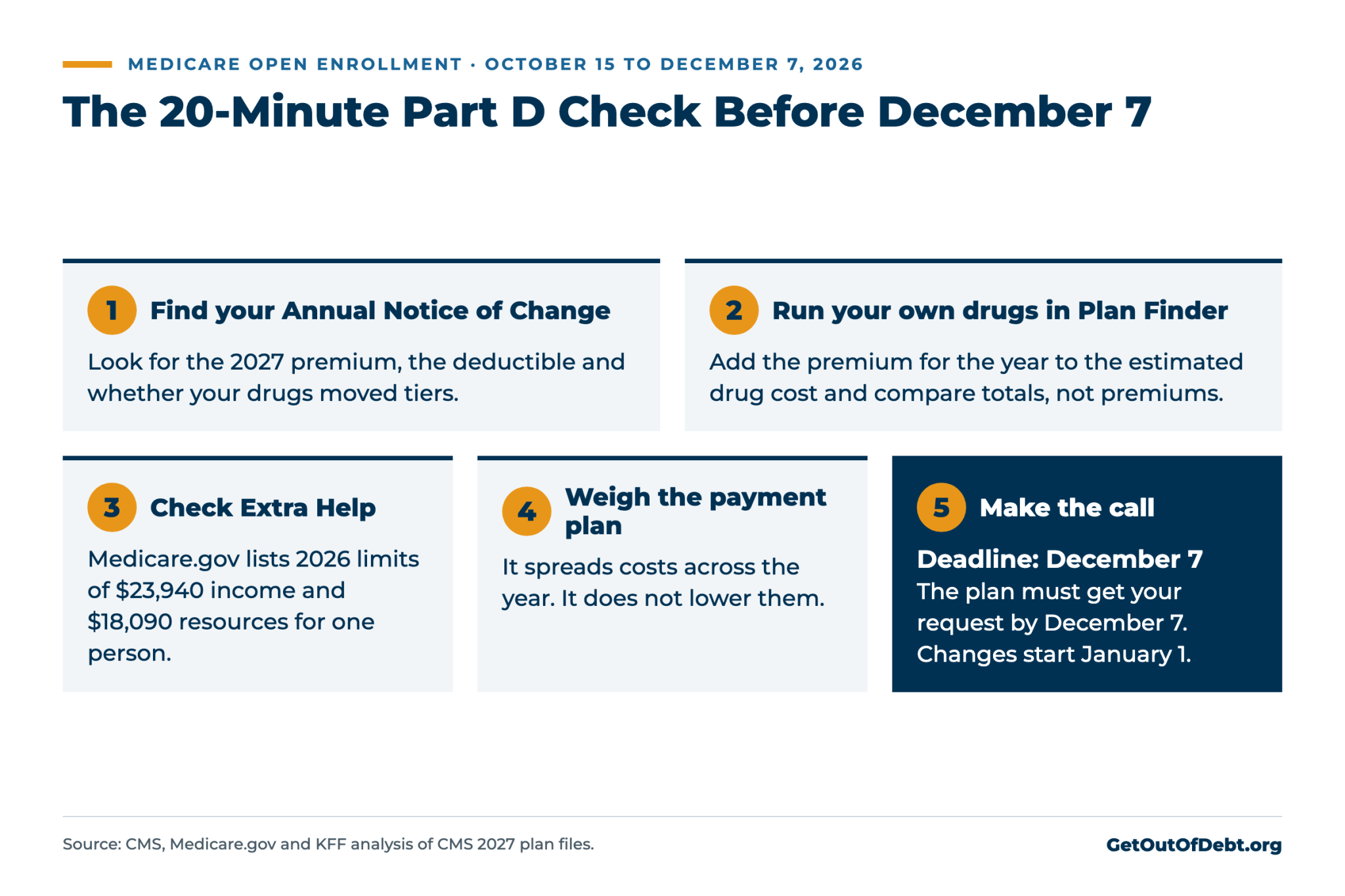
- Find your Annual Notice of Change. Look for the 2027 premium, the deductible and whether your drugs moved to a different tier or off the drug list. If you can’t find it, your plan’s website or the number on your member card will get you the same information.
- Run your own drugs in Medicare Plan Finder. CMS built the tool so people can compare Medicare health and drug plans, including premiums and costs. Enter every drug you take and your pharmacy, then add the plan’s premium for the year to the estimated drug cost and compare the totals, not just the premiums. Do it for your current plan too, since that’s the one most people keep by default.
- Check Extra Help. If you might qualify, apply through Social Security, or get free help from your State Health Insurance Assistance Program at shiphelp.org. You can also call 1-800-MEDICARE, which Medicare.gov says you can reach 24 hours a day, 7 days a week, except some federal holidays (Medicare.gov).
- Weigh the payment plan. If you fill expensive drugs early in the year, call your plan about the Medicare Prescription Payment Plan. Treat it as cash-flow help, not a discount.
- Decide by December 7. The plan must get your request by December 7 for a change to take effect January 1. If you switch, write down the date and what you chose.
Two things you can’t have yet are your COLA notice and your 2027 Medicare premium amount. SSA says people with a my Social Security account can view their COLA notice online starting in late November. If you don’t have an account, SSA says you need to create one and enroll in paperless notices by November 18 to see the notice online, and anyone who hasn’t enrolled in paperless notices gets the COLA notice by mail in December (SSA). Don’t wait on either one to make your December 7 decision; your plan’s notice and Plan Finder are what that decision runs on. When the COLA notice arrives with the Part B premium, rebuild your 2027 monthly budget from the net amount that actually lands in your account, after Medicare premiums, not from 3.6%. That budget is the real raise, and a pencil and a few minutes will work it out.
I’d rather you spend roughly 20 minutes now than spend a year paying a premium you could have avoided. Deal with it and look to the future rather than spend months repairing the past.
Key Takeaways
- SSA’s 2027 COLA is 3.6%, an average of $75 a month, and SSA says it begins in January 2027.
- CMS projects the average stand-alone Part D premium rises less than $1, from $35.09 to $36 a month, so the claim that Part D will swallow everyone’s raise isn’t what the averages show.
- KFF found some stand-alone plans going up $50 or more a month if you keep them, and no $0-premium stand-alone plans for people without Extra Help.
- The 2027 Part D out-of-pocket threshold is $2,400 (up from $2,100) and the maximum deductible is $700 (up from $615).
- As of October 29, 2026 I could not find a 2027 Part B premium announcement from CMS.
- Open Enrollment runs October 15 to December 7, 2026, and changes start January 1, 2027.
The Bottom Line
If a stack of plan letters makes your stomach tighten, that’s normal, and it doesn’t mean you’re bad with money. The average Part D premium is barely moving, but the average isn’t the plan you have, and the plan you have is one of the things that decides how much of this raise you keep. A little time with your own drug list is a small price for knowing. You are not your bills, and you have until December 7 to make sure the raise you earned over a lifetime of work stays yours.
Frequently Asked Questions
When is Medicare Open Enrollment for 2027 coverage, and when do changes start?
Open Enrollment runs from October 15 to December 7, 2026. Changes you make are effective January 1, 2027, and the plan must receive your enrollment request by December 7. CMS says people who want to keep their current coverage generally do not need to re-enroll.
Will my Part D premium go up in 2027?
It depends on your plan. CMS projects the average stand-alone Part D premium will rise from $35.09 to $36 a month, but KFF found some stand-alone plans will cost $50 or more extra per month if you keep them, and no $0-premium stand-alone plans for people who don’t get Extra Help. If you’re in a Medicare Advantage plan with drug coverage, CMS projects the average Part D premium falls from $11.32 to $7, so your plan’s own notice is what matters.
What are the Part D deductible and out-of-pocket limit in 2027?
No Part D plan may have a deductible above $700 in 2027, up from $615 in 2026, and some plans have none. The out-of-pocket threshold is $2,400, up from $2,100. After you reach it, Medicare.gov says you won’t pay out of pocket for covered Part D drugs for the rest of the calendar year.
Who qualifies for Extra Help with Part D costs?
You qualify automatically if you have full Medicaid coverage, help from a Medicare Savings Program or SSI. Otherwise you can apply if your income and resources are below the limits. Medicare.gov lists the 2026 limits as income of $23,940 and resources of $18,090 for an individual, and $32,460 and $36,100 for a married couple, and says they may go up each year.
Does the Medicare Prescription Payment Plan lower my drug costs?
No. Medicare.gov says it might help you manage monthly expenses but it doesn’t save you money or lower your drug costs. It spreads your out-of-pocket costs across the calendar year, and it tends to help most when your costs are high early in the year.
This is what I’m telling friends over coffee. Take it as input, not instruction, because you know your numbers and I don’t. Only you can decide what fits your health, your budget and your drugs, and nobody, including me, gets to tell you what to do with your money. But remember, you do you.
If you know someone who has a stack of plan letters on the kitchen counter and hasn’t opened them, send them this post. It’s easier to start when you know you’re not the only one.
Dealing With Debt? Understanding your options is the first step. See how all your debt relief options compare — including ones most sites won’t tell you about. The Find Your Path quiz gives a recommendation based on your actual numbers, and the Scam-O-Meter checks any company’s complaint history before you sign. Federal Reserve Bank of New York research shows bankruptcy filers recover faster than those who don’t file.



