

Quick Answer: The Federal Reserve held its target range for the federal funds rate at 3-3/4 to 4 percent on Oct. 28, 2026, in a 10–2 vote, and both dissents were votes to raise the rate, not to cut it. A hold is not relief for anyone carrying a card balance: the average credit card APR was 21.19% across all accounts in August 2026 (Federal Reserve G.19), which is before the Sept. 16 hike, so variable-rate cards may be a bit higher now, and a quarter-point move in either direction changes the interest on a $6,000 balance by about $15 a year. What moves your payoff date is your monthly payment. If you’re a saver, the FDIC’s national average savings rate is 0.38% while the overnight rate banks charge each other was 3.88% on Oct. 27, so it’s worth checking what your cash is actually earning.
Part of the Credit Cards Hub: This post is one piece of my complete Credit Cards: The Complete Guide — how credit cards actually work, what they cost, how they affect your score, and every option when the debt gets out of hand.
Expert Context: I’ve spent more than 30 years helping people with debt, starting with Debt Counselors of America in 1994, and I filed bankruptcy myself in 1990. “I’ll deal with the card when rates come down” is a sentence I’ve heard many times over those years, and it’s a plan that depends on something you don’t control. So when the Fed meets, I look at what the decision changes in dollars, not what it changes in headlines.
Debt is math wrapped in emotion, and a Fed meeting is mostly emotion. Here is the math on what a hold means for your credit card and your savings, and what I’d do about it this week.
Each weekday I send one short email: one story that caught my attention, why it might matter to you, and one manageable thing you can do with it. A couple of minutes, and a dad joke.
In the latest issue (Nov 6): Owed money on an Amazon return? Check by Dec. 1
Free. I sell nothing. Unsubscribe any time.
What You Need to Know
The decision. The Federal Open Market Committee’s statement, released at 2:00 p.m. EDT on Oct. 28, 2026, says: “The Committee decided to maintain the target range for the federal funds rate at 3-3/4 to 4 percent, in support of the Federal Reserve’s dual mandate.” The vote was 10–2. The statement names the two members who voted against: “Lisa D. Cook and Beth M. Hammack, who preferred to raise the target range for the federal funds rate by 1/4 percentage point at this meeting.” So when you see “split vote” in a headline, the split was between holding and raising. No member dissented in favor of a cut.
How the Fed got here. The target range was 3-1/2 to 3-3/4 percent at the Fed’s July 29 meeting, which ended in a 9–3 vote to hold, with Beth M. Hammack, Neel Kashkari and Lorie K. Logan preferring to raise. On Sept. 16 the Committee raised the range by a quarter point to 3-3/4 to 4 percent, 12–0. Wednesday’s hold kept it there.
What the statement says about inflation. It says: “Inflation remains elevated. The accumulation of more information will help the Committee determine the policy stance appropriate to ensure a timely return of inflation to the Committee’s 2 percent goal.” It also describes economic activity as “expanding at a strong pace.” The statement does not mention a rate cut.
What the Chairman said. Kevin Warsh is Chairman of the Board of Governors. In his press conference, asked whether the midterm elections factored into the decision, he said “politics played no role in the decision.” Asked whether he still sees widespread support for another hike this year, he said he doesn’t “believe in forward guidance absent exigent circumstances, absent a crisis,” and doesn’t “believe in prejudging meetings.” (That transcript is marked “preliminary” by the Fed.) I have no opinion on the politics; what matters for your bills is that the person running the meeting wouldn’t say what comes next, and neither can I.
What the Fed’s own projections showed in September. In the Sept. 16 Summary of Economic Projections, 18 participants gave a year-end 2026 rate. Twelve pointed to a midpoint of 4.125 percent (one more quarter-point increase from the current 3.875 midpoint), four to 4.375 percent (two more), and two to 3.875 percent (no change). None projected a lower rate by the end of 2026. Those are projections, not decisions or promises, and they were made before this week’s data.
The data that came out the next morning. The Bureau of Economic Analysis released two reports at 8:30 a.m. on Oct. 29, the morning after the Fed met. Its Personal Income and Outlays report says the PCE price index (the measure the Fed’s 2 percent inflation goal is defined in terms of) rose 0.5 percent in September from August, after 0.3 percent in August, and was up 3.6 percent from a year earlier; excluding food and energy it rose 0.3 percent for the month and 3.1 percent from a year earlier. Its GDP advance estimate says real GDP increased at an annual rate of 3.4 percent in the third quarter, after 2.2 percent in the second. One piece cuts the other way: the same GDP report puts the third-quarter PCE price index at a 2.1 percent annual rate, down from 5.0 percent in the second quarter. The monthly and yearly numbers are hot and the quarterly number cooled. That’s a mixed picture, and I’d rather show you both than pick the half that makes a cleaner story.
Key Terms Defined
Target range: The range the Fed sets for the federal funds rate, the overnight rate banks charge each other. It is now 3-3/4 to 4 percent. The effective rate was 3.88 percent on Oct. 27 (Federal Reserve H.15).
Dissent: A formal vote against the Committee’s decision. On Oct. 28 there were two, both for a hike.
Prime rate: A benchmark rate set by banks. The Fed’s H.15 table shows it at 7.00 percent on Oct. 27, which is three points above the top of the Fed’s range (my arithmetic).
Variable APR: The CFPB explains that a “variable-rate APR, or variable APR, changes with the index interest rate.”
Why You Need to Know It
The headline version of this story is “the Fed didn’t cut,” and a lot of people are reading that as bad news for anyone with debt. After more than 30 years of watching people make wait-or-act decisions off a Fed headline, my read is different, and it’s my opinion, not a forecast: the question in that room was whether to hold or to raise, so “no cut” is the wrong thing to be disappointed about.
The Claim: “The Fed held rates instead of cutting them, so relief on my credit card interest got pushed back.”
The Reality: The only dissents on Oct. 28 were votes to raise rates, the statement doesn’t mention a cut, and none of the 18 September projections had the rate ending 2026 lower than it is now. That doesn’t mean a hike is coming; the Chairman wouldn’t say, and neither will I. It means nothing in the Fed’s Oct. 28 statement or its September projections points to a cut, so “I’ll deal with it when rates drop” isn’t a plan I’d lean on.
And here’s the part the “cut or no cut” argument leaves out: even a cut wouldn’t have done much for your card. In January I wrote about credit card rates staying near record highs despite Fed cuts: I wrote then that card rates stayed high after the 2025 cuts, and the number I’ll stand on here is this week’s math, not that earlier figure. I covered how a hike hits a variable card APR, and why your issuer doesn’t have to warn you first, in my post after the Sept. 16 hike.
Things to Consider
The Fed’s move is small next to the rate you already carry. The Fed’s G.19 report (released Oct. 7, 2026) puts the average card rate at 21.19% for all accounts in August (before the Sept. 16 hike, so variable-rate cards may be a bit higher now), and at 22.36% for accounts that were actually charged interest. G.19 defines that second number as “the annualized ratio of total finance charges at all reporting banks to the total average daily balances against which the finance charges were assessed.” On a $6,000 balance, a quarter point is $6,000 × 0.25% = $15 a year, in either direction. Carrying that balance at 21.19% is about $1,271 a year, or about $1,342 at 22.36% (my arithmetic).
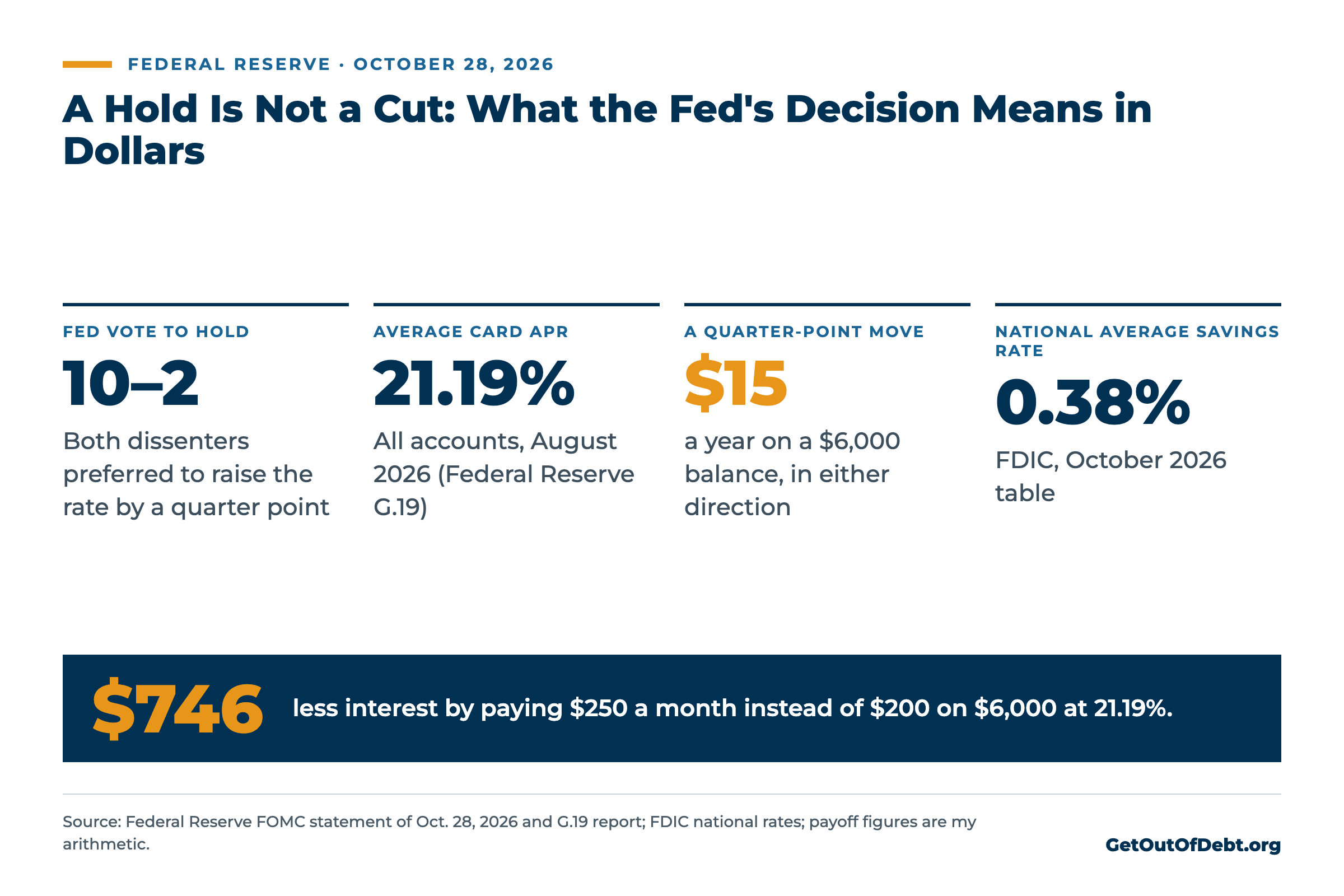
Your payment is the bigger lever. Here’s the math on that same $6,000 at 21.19%, assuming no new charges and a fixed rate (my arithmetic): paying $200 a month takes 44 months and about $2,621 in interest; paying $250 takes 32 months and about $1,874. That extra $50 a month saves about $746 and a full year of payments. A quarter-point increase at $250 a month adds roughly $32 over the whole payoff. The payment choice is more than twenty times the size of the Fed’s move.
Your card may move with prime, and it may not. The CFPB lists a rise in a variable rate’s index, such as the prime rate, among the situations in which an issuer can raise your interest rate. A hold gives a variable APR no new Fed move to follow, but it does not freeze your rate: that same CFPB page also lists a temporary rate expiring and a minimum payment not received within 60 days after the due date, among other situations in which an issuer can raise a rate, and neither is a Fed decision. Your account agreement says whether your card is variable or fixed, and what its margin is.
Savers: the bank sets your rate, not the Fed. The FDIC’s October 2026 table puts the national average savings rate at 0.38%, the 6-month CD at 1.39% and the 12-month CD at 1.76% (FDIC national rates, based on data from the last business day of September; the savings figure is for the $2,500 product tier). Against an effective federal funds rate of 3.88%, an account paying the national average on $10,000 earns $38 a year, and each extra full percentage point on the same $10,000 is $100 a year (my arithmetic). That gap is where the shopping happens. I can’t tell you rates won’t fall, and a bank can lower the rate on a variable-rate savings account without advance notice (12 CFR 1030.5(a)(2)(i)), so the only way to know what you’re earning is to look.
Your mortgage doesn’t move in step with the Fed’s rate. I explained that in my post on mortgage rates rising for a sixth straight week after cooler inflation data.
What to Think About Doing
None of this is one-size-fits-all. Here is how I’d think about it depending on which side of the ledger you’re on.
If you’re a saver:
- Look up your current rate today. Your app or statement shows the APY. If it’s near the national average of 0.38%, you’re leaving money on the table.
- Compare accounts, and check that they’re insured. The FDIC insures deposits up to $250,000 per depositor, per FDIC-insured bank, for each account ownership category. I won’t quote any bank’s rate here because they change constantly; get today’s number from the bank itself.
- Keep emergency money liquid. A CD usually charges a penalty if you take the money out early, so only lock up money you won’t need for the whole term, and read the early-withdrawal terms first. I’d also keep a cushion of at least three months of expenses in savings rather than draining it to pay down debt, though that’s my rule of thumb, not a law.
- I wrote more on the CD question after Treasury yields plunged: what that does and doesn’t mean for your CD and savings rate.
If you’re carrying a card balance:
- Find your actual APR on your statement and run the payoff math at that number. The debt calculator will do it for you.
- After the minimums are paid and your cash cushion is still there, put extra dollars on the card with the highest rate. That’s the avalanche method, and it costs the least in total interest. If you’re being sued, answer the lawsuit and get advice before deciding what to pay. And if a car or housing payment is what keeps you from losing the asset, keep that current before any extra card payments.
- Call your card issuer and ask for a lower rate or a hardship program. It’s free and it sometimes works, but it isn’t guaranteed. Before you say yes to anything, ask what it does to your account and to your credit report.
- If the payments don’t work at any rate, look at every option, and look at the costs. A consolidation loan only helps if its rate after fees is lower than what your cards charge — and you still owe every dollar of principal, which can crowd out retirement saving while you pay it. A credit counseling debt management plan can lower your interest, but it comes with monthly fees — and years of full-balance payments that can crowd out retirement saving. In my own ratings, bankruptcy rates well on credit, collections, speed and retirement. That’s my opinion, formed from running a credit counseling organization and from my own 1990 bankruptcy, and it has costs too, including filing fees and a public record, and it isn’t right for everyone. The Find Your Path quiz compares them using your numbers.
One more thing I’d do: write down the date of the next Fed meeting, Dec. 8–9 on the Fed’s calendar, and then not plan around it. If the plan only works if the Fed does something, it isn’t a plan yet. The next BEA Personal Income and Outlays report, the one with the PCE inflation numbers, is scheduled for Nov. 25, 2026 on BEA’s release schedule. I’d treat both as information, not instructions. My own 1990 bankruptcy taught me the same thing: deal with it and look to the future rather than spend five years repairing the past.
Key Takeaways
- The Fed held at 3-3/4 to 4 percent on Oct. 28, 2026, 10–2, and both dissents were for a quarter-point hike.
- The Fed’s statement doesn’t mention a cut, and none of the 18 September projections had the rate lower at year-end.
- Average card APR was 21.19% in August, before the Sept. 16 hike (G.19); a quarter-point move is about $15 a year on $6,000, while an extra $50 a month saves about $746.
- The FDIC’s national average savings rate is 0.38%, so check what your cash earns, keep emergency money liquid and insured, and never plan around a Fed meeting.
The Bottom Line: If you read “the Fed held” and felt either let down or relieved, that’s normal; a Fed meeting is built to feel like it’s about you. It mostly isn’t. The decision that changes your month is the one you make about your own balance and your own savings account, and the math says your payment and your account shopping matter more than a quarter point. I filed bankruptcy in 1990 and rebuilt from there, so I know how heavy a balance can feel, and I know it gets lighter once you stop waiting on things you can’t control. You don’t need the Fed’s permission to start paying less interest. You need a number, a payment and a day.
Frequently Asked Questions
Did the Fed raise or cut interest rates on October 28, 2026?
Neither. The Federal Open Market Committee voted 10–2 to keep the target range for the federal funds rate at 3-3/4 to 4 percent. The two members who voted against, Lisa D. Cook and Beth M. Hammack, preferred to raise it by a quarter point, according to the Fed’s Oct. 28 statement.
Will my credit card interest rate go down now that the Fed held rates?
Not because of this meeting. A hold means the Fed’s target hasn’t changed, so there’s no new rate move for a variable APR to follow, though a hold doesn’t freeze your rate: the CFPB lists a temporary rate expiring or a minimum payment not received within 60 days after the due date, among other situations in which a rate can rise. The average card APR was 21.19% across all accounts in August 2026, before the Sept. 16 hike (Federal Reserve G.19), and even a quarter-point change would move the interest on a $6,000 balance by only about $15 a year. Check your own card’s APR and how it’s set.
Why did two Fed members vote against holding rates?
According to the Fed’s statement, Lisa D. Cook and Beth M. Hammack preferred to raise the target range by 1/4 percentage point. The statement says inflation “remains elevated,” and the Bureau of Economic Analysis reported the PCE price index up 3.6% from a year earlier in September, against the Fed’s 2 percent goal. The statement doesn’t give the dissenters’ reasoning, and I’m not going to guess at it.
Is now a good time to move my savings to a higher-rate account?
I can’t say what’s right for you or where rates are heading, but it’s worth checking. The FDIC’s October 2026 table puts the national average savings rate at 0.38% and the 12-month CD at 1.76%, while the effective federal funds rate was 3.88% on Oct. 27. Banks set their own deposit rates, so compare FDIC-insured accounts (coverage is $250,000 per depositor, per insured bank, per ownership category), keep money you may need soon liquid, and read the early-withdrawal terms before locking anything into a CD.
Should I wait for the Fed to cut rates before paying off my credit card?
I wouldn’t build a plan on it. The Fed’s Oct. 28 statement doesn’t mention a cut and both dissents were for a hike, and in my January post on card rates I wrote that card rates stayed high after the 2025 cuts. On $6,000 at 21.19%, raising your payment from $200 to $250 a month saves about $746 and a year of payments, while a quarter-point change moves the cost about $15 a year. If the payments don’t work at any rate, compare all your options, including bankruptcy.
This is what I see in the numbers right now and what I’d tell my own family. Take it as one informed perspective, not a directive: you know your paycheck, your budget and your timeline better than any article or news cycle does, and only you can decide what’s right for your situation. Nobody gets to tell you what to do with your money. Not me, not anyone.
If this helped you see what a Fed headline does and doesn’t change, send it to someone who’s waiting for rates to come down before dealing with their card, or who’s leaving cash in a savings account that barely pays. A calm look at the real numbers is worth passing along.
Dealing With Debt? Understanding your options is the first step. See how all your debt relief options compare — including ones most sites won’t tell you about. The Find Your Path quiz gives a recommendation based on your actual numbers, and the Scam-O-Meter checks any company’s complaint history before you sign. Federal Reserve Bank of New York research shows bankruptcy filers recover faster than those who don’t file.



