

Fact-checked by Steve Rhode, consumer debt expert since 1994 • Last reviewed October 29, 2026 • Every legal claim below links to the court order, the Federal Register, the regulation or the agency page it comes from.
The verdict: Myth. There is no federal rule that caps credit card late fees at $8. The CFPB’s 2024 rule would have set an $8 safe harbor for the largest card issuers, but a federal judge in Texas blocked it before it took effect, and on April 15, 2025 the same court vacated it. The CFPB’s own credit card penalty fees page says the rule “was vacated pursuant to a court order.” A late fee still has limits, but not that one — the hard ceiling is the full minimum payment that was due right before the fee, not just the part you failed to pay, and a fee under that ceiling is not automatically legal.
Well, Actually…
This is a belief I keep running into, and I understand exactly where it comes from. I’ve used the “$8 cap” shorthand myself in earlier posts, including my look at Synchrony’s 10-Q and what Synchrony told the SEC. Those older posts used the cap shorthand; on the rule’s status, this page is the current one. Debt is math wrapped in emotion, and a number like $8 sticks in your head because it feels like someone finally took your side. So let me give you the math, in order.
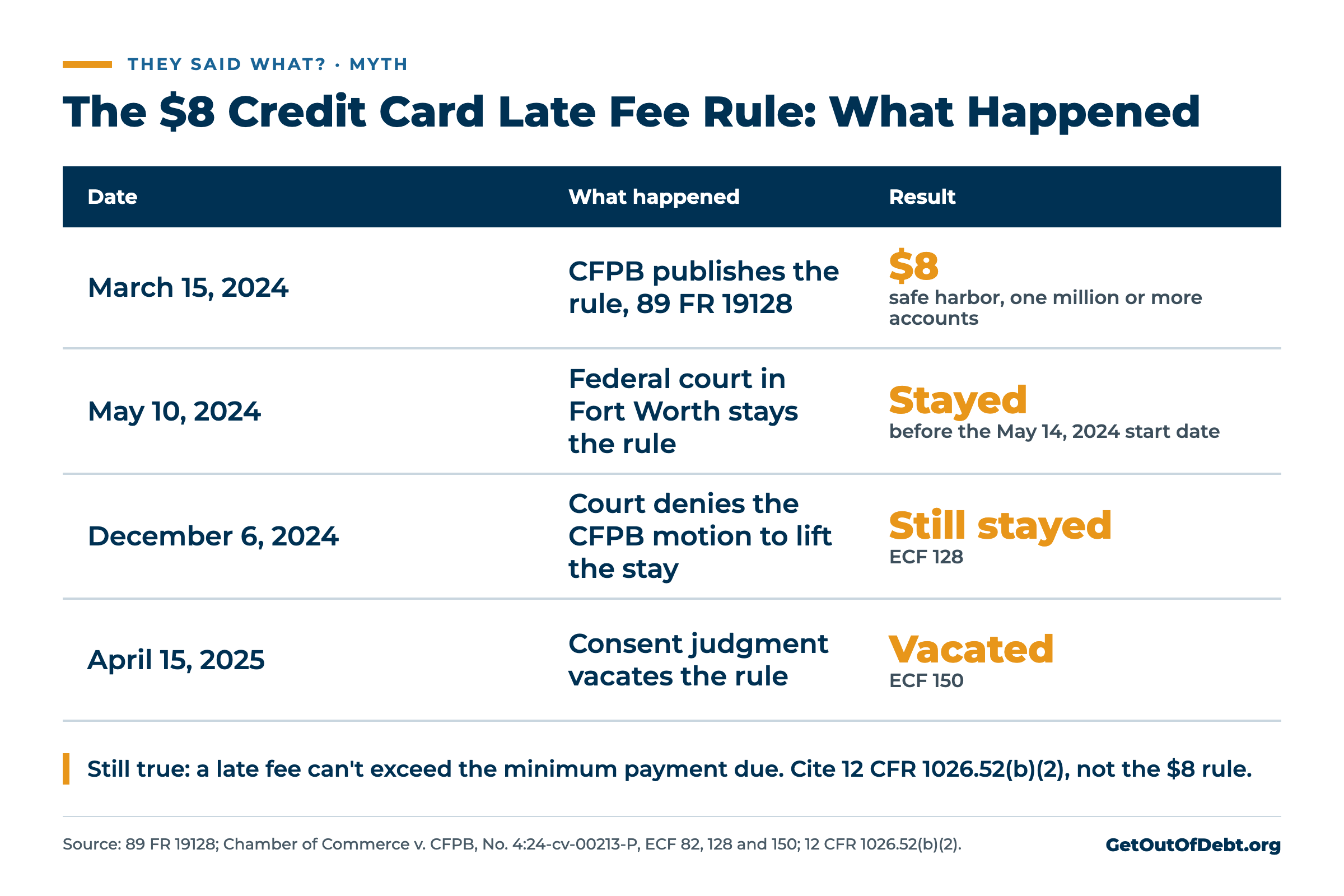
What the rule actually was. On March 15, 2024 the CFPB published its Credit Card Penalty Fees rule in the Federal Register (89 FR 19128). The summary says the rule “adopts a late fee safe harbor threshold of $8” for card issuers that, together with their affiliates, have one million or more open credit card accounts. A safe harbor is a number an issuer can charge without having to justify it (it still can’t exceed the minimum payment that was due, covered below). It is not a flat ban on anything higher, and the rule left the separate cost-based route in Regulation Z in place (though it narrowed which costs count), where an issuer that has done its own cost analysis can justify a different fee (12 CFR 1026.52(b)(1)(i)). Smaller issuers were never covered by the $8 threshold at all, because the Federal Register notice says the final rule “does not adopt” that change for them.
What happened to it. The rule was due to take effect on May 14, 2024. On May 10, 2024, a federal judge in Fort Worth granted a preliminary injunction and stayed it (Chamber of Commerce v. CFPB, No. 4:24-cv-00213-P, ECF 82). On December 6, 2024 the same judge denied the CFPB’s motion to dissolve that injunction and lift the stay (ECF 128). Then, on April 15, 2025, the court granted the parties’ joint motion for a consent judgment and wrote that it “VACATES the rule entitled, Credit Card Penalty Fees (Regulation Z), 89 Fed. Reg. 19128 (Mar. 15, 2024),” because it failed to allow card issuers to “charge penalty fees reasonable and proportional to violations” as the CARD Act (15 U.S.C. § 1665d(a)) requires (Order and Final Judgment, ECF 150). Read in order, those three orders mean the rule was stayed before its effective date and never took effect.
The trap that catches people who check. If you go to the regulation itself, you will see the number. As I write this, the eCFR says the text is up to date through October 27, 2026, and 12 CFR 1026.52(b)(1)(ii) still reads: “a card issuer may impose a fee for a late payment on an account if the dollar amount of the fee does not exceed $8.” That is the vacated rule’s language. The section’s last amendment on the eCFR is dated May 14, 2024, so the code book hasn’t been updated for the court’s order, and the CFPB’s page says the rule was vacated. Notice, too, that even the stale text says an issuer “may impose” a fee up to $8, which is permission, not a ceiling. The same eCFR paragraph also prints $32 and $43 for other kinds of penalty fees (and, in that stale text, for a smaller issuer’s late fee), figures the 2024 rule itself inserted through its inflation adjustment (89 FR 19128). The Federal Register described the safe harbor in force before the 2024 rule as $30 for a first violation and $41 for each later violation, but whether either pair is the operative late-fee number for a smaller issuer today is something I could not confirm from any primary source issued after the vacatur.
Federal law caps credit card late fees at $8, so any card charging more is breaking the rule.
The CFPB’s 2024 rule set an $8 late fee safe harbor threshold for issuers with one million or more open accounts. A federal court stayed it on May 10, 2024 before it took effect, kept the stay in place on December 6, 2024, and vacated the rule on April 15, 2025. No federal $8 rule is in force today, and even the vacated rule was a safe harbor rather than a flat ban on higher fees. What does still limit a late fee: it can’t exceed the full minimum payment that was due immediately before the fee, though a fee under that is not automatically legal, and a card can’t charge more than one penalty fee for a single event.
CFPB, Credit card penalty fees (page modified July 1, 2025) • Order and Final Judgment, April 15, 2025 • 89 FR 19128
What Still Limits a Late Fee
Here is the part the $8 shorthand hides: the vacated rule was an add-on to protections that were already there, and those protections were not vacated. Three of them matter when you are staring at a statement.
- A late fee can’t be more than your minimum payment. Regulation Z says a card issuer “must not impose a fee for violating the terms or other requirements of a credit card account under an open-end (not home-secured) consumer credit plan that exceeds the dollar amount associated with the violation” (12 CFR 1026.52(b)(2)(i)(A)). For a late payment, the official interpretation says the dollar amount associated with it “is the amount of the required minimum periodic payment due immediately prior to assessment of the late payment fee.” The CFPB’s own example is a $15 minimum payment: the fee “cannot exceed $15” (comment 52(b)(2)(i)-1). The same comment works the case where you paid part of it (example ii): you paid $10 of that $15 minimum, and the dollar amount associated with the late payment is “the full amount of the required minimum periodic payment … ($15), rather than the unpaid portion of that payment ($5).” So the ceiling is still the full $15, not the $5 left unpaid. And being under the ceiling does not make a fee automatically legal, because it also has to meet the “reasonable and proportional” standard in the third item below.
- One missed payment, one fee. The same regulation says a card issuer “must not impose more than one fee for violating the terms or other requirements of a credit card account” based on a single event or transaction (12 CFR 1026.52(b)(2)(ii)). The commentary’s own example is a check that bounces: the issuer may charge a late fee or a returned-payment fee, but not both.
- The fee has to be “reasonable and proportional.” That is the statute itself: the amount of any penalty fee, “including any late payment fee,” “shall be reasonable and proportional to such omission or violation” (15 U.S.C. § 1665d(a)). It is the same standard the court said the $8 rule violated, because it didn’t let issuers charge fees reasonable and proportional to the violation. Issuers meet it either through a cost analysis or by staying inside a safe harbor.
What I Can’t Hand You: A Clean Dollar Figure
The natural next question is “fine, then what is the number?” I looked, and I’m not going to pretend there is a tidy answer. The Federal Register described the safe harbor in force before the 2024 rule as $30 for a first violation and $41 for each later violation of the same type in the same billing cycle or one of the next six. But I could not find a CFPB or Federal Register document restating the operative amounts after the April 2025 vacatur. The eCFR prints the vacated rule’s figures, and the CFPB’s own copy of Regulation Z prints $27 and $38 for the same paragraph, as of the day I looked, which are figures from an older version of the regulation (its commentary history stops at 2017), even though the Federal Register itself says $30 and $41 were in force by 2024. So I won’t call any of those today’s legal number. What I can tell you is what governs your bill: your cardholder agreement and your statement show the late fee your issuer actually charges, and, whatever that fee is, it can’t exceed the full minimum payment that was due immediately before it.
And will the $8 idea come back? Maybe, but nothing has been proposed. As of October 29, 2026, reginfo.gov lists a CFPB “Request for Information Regarding Credit Card Late Fees and Late Payments” (RIN 3170-ZA54) as “Pending Review,” received July 6, 2026. A request for information asks questions. It is not a rule, and it changes nothing about the fee on your statement today.
Why You Were Told This
I don’t see a villain here. “Cap” is short and sticky, and I’ve used it myself. The Federal Register notice says “safe harbor threshold,” which is a much less catchy phrase, and the shorthand outlived the rule. The CFPB’s notice that the rule was vacated sits on a compliance page written for industry, so most cardholders never see it. If you were told your card was breaking a rule by charging more than $8, the person telling you meant well and was working from an old headline. The cost of the myth is that you spend a phone call citing a rule that is no longer in force, which hands the representative an easy reason to say no.
What to Actually Do
- Compare the fee to the minimum payment that was due. Find the late fee on your statement and the minimum payment from the statement before it. If the fee is larger than that minimum payment, it is above the Regulation Z ceiling in 12 CFR 1026.52(b)(2)(i). Use the full minimum that was due, even if you paid part of it. A fee at or below that minimum is not automatically legal, but this is the test you can run from your own statements. Ask the issuer in writing to reverse it and cite that section and comment 52(b)(2)(i)-1, not the $8 rule.
- Check for a double charge. A late fee and a returned-payment fee for the same bounced payment (say, a check returned for insufficient funds) run into 12 CFR 1026.52(b)(2)(ii). Point to it and ask for one of them back.
- Ask for a waiver anyway. No federal rule requires an issuer to waive a late fee, but asking costs nothing, and a fee is a decision your issuer makes, not a law of nature. Ask, say what happened, and ask what it would take to keep it from happening again.
- If the issuer won’t fix an overcharge, file a complaint. You can submit one at the CFPB’s complaint page and say exactly which section you think the fee violates.
- Fix the cause, not just the fee. No sense wasting a perfectly good mistake. One late fee is information. If the minimum will actually be in your account on the due date, automatic payment for at least that amount can stop a repeat. If it might not be, read what to do when you can’t make your minimum payments before the fees and interest stack up.
Steve’s Take
I understand why the $8 number felt like a win. People who miss a payment are usually people who are already stretched, and a late fee on top of interest can feel like being kicked while you’re down. You are not your debt, and one late payment doesn’t make you careless. But a rule that isn’t in force can’t protect you, and acting like it does costs you the real protections you still have: the minimum-payment ceiling, the one-fee-per-event rule, and a complaint process you can use. If late fees keep showing up, treat that as the math talking. Deal with it and look to the future rather than spend five years repairing the past. That might mean autopay if the minimum will be there on the due date, it might mean a hard look at the budget, and for some people it means finding out whether a bigger reset such as bankruptcy would serve them better. Run your own numbers before you decide.
Frequently Asked Questions
Is there a federal cap on credit card late fees?
Not a flat dollar cap. The CFPB’s $8 rule was vacated on April 15, 2025 (ECF 150). A late fee still can’t exceed the full minimum payment that was due (12 CFR 1026.52(b)(2)(i)), a card can’t charge more than one penalty fee for a single event, and any penalty fee, including one under the minimum payment, has to be “reasonable and proportional” under 15 U.S.C. § 1665d(a).
Did the $8 late fee rule ever go into effect?
No. It was scheduled to take effect on May 14, 2024, and a federal court stayed it on May 10, 2024 (ECF 82). The court denied the CFPB’s motion to lift that stay on December 6, 2024 (ECF 128) and vacated the rule on April 15, 2025.
Why does the eCFR still show $8 in the late fee rule?
The eCFR text of 12 CFR 1026.52(b)(1)(ii), which, as of October 29, 2026, the site said was current through October 27, 2026, still reads “does not exceed $8,” and the section’s last amendment is dated May 14, 2024. That is the vacated rule’s wording. The CFPB’s penalty fees page says the rule was vacated, so read the page and the court order, not the code book alone.
Can my card charge a late fee bigger than my minimum payment?
No. The official interpretation of Regulation Z says the dollar amount associated with a late payment is the required minimum periodic payment due immediately before the fee, and the fee can’t exceed it (comment 52(b)(2)(i)-1). If your minimum payment was $15, the late fee can’t be more than $15, even if you paid $10 of it and only $5 was left unpaid. A fee under the ceiling is not automatically legal, because any penalty fee also has to be “reasonable and proportional” under 15 U.S.C. § 1665d(a).
Can they charge a late fee and a returned payment fee for the same missed payment?
Not both, if they come from a single event or transaction. Regulation Z says a card issuer “must not impose more than one fee” for violating the account terms based on a single event or transaction (12 CFR 1026.52(b)(2)(ii)). Fees based on two different events are a different question, and the official interpretation gives examples of fees that are allowed because they rest on different events (comment 52(b)(2)(ii)-1).
What is the most my card can charge for a late fee right now?
I can’t give you one verified number. The full minimum payment that was due sets a hard ceiling, though a fee under it is not automatically legal, and your cardholder agreement shows what your issuer actually charges. The safe-harbor figures are unclear after the vacatur: the Federal Register put the pre-2024 amounts at $30 and $41, but I found no CFPB or Federal Register document restating the operative figures since April 2025.
Will the CFPB bring back a late fee cap?
I can’t predict that. As of October 29, 2026, reginfo.gov lists a CFPB request for information on credit card late fees and late payments as pending review. A request for information is a request for input, not a proposed rule, and nothing about your fee changes until a rule is final.
Where can I read more about what card issuers charge in fees?
For one issuer’s numbers, see what Synchrony’s 10-Q shows about late fees. Some older posts on this site used the “cap” shorthand; this page is current on the rule’s status. For the other cap people argue about, see the 10% credit card interest rate cap, which is about interest rates, not fees.
This is one informed perspective from someone who has watched how this plays out since 1994 — not legal or financial advice for your case. Only you can decide what’s right for your situation, and an attorney who has read your cardholder agreement can tell you where you actually stand. Take this as input, not instruction, and make the call that serves your future.
The bottom line: No federal rule caps credit card late fees at $8 — the CFPB’s 2024 rule was stayed before it took effect and vacated on April 15, 2025 — but a late fee still can’t exceed the full minimum payment that was due, a fee under that isn’t automatically legal, and it can’t be stacked twice for one event. If someone you know still believes the $8 cap is law, send them this page.
Dealing With Debt? Understanding your options is the first step. See how all your debt relief options compare — including ones most sites won’t tell you about. The Find Your Path quiz gives a recommendation based on your actual numbers, and the Scam-O-Meter checks any company’s complaint history before you sign. Federal Reserve Bank of New York research shows bankruptcy filers recover faster than those who don’t file.



