

Quick Answer: Working part time on SSDI splits your income into two pieces that the law treats very differently. The SSDI payment is protected from ordinary creditors by 42 U.S.C. § 407, but your paycheck is plain earnings that most creditors can garnish once they sue you and win a court judgment (government debts and support orders are exceptions) — and then only up to the lesser of 25% of your disposable earnings or the amount by which your weekly disposable earnings exceed 30 times the federal minimum wage (15 U.S.C. § 1673), a ceiling your state may set lower. On a small part-time check that ceiling can be tiny, or zero, which is why I would think hard before paying a debt settlement company and would compare it with bankruptcy using your own numbers — in my ratings of the debt options, bankruptcy comes out ahead on credit, collections, speed and retirement, and debt settlement is only “meh” on the first three and bad for retirement.
Where this topic came from: Conversations in my free Ask Steve chat keep raising situations like this. I’m not giving away any personal information here — I never do — but when real questions show me a gap worth covering, I write the answer for everyone. If you’re facing something like this yourself, ask me about it in the chat. It’s free, it’s private, and I’m not selling anything.
Expert Context: I filed my own bankruptcy in 1990, and from 1994 to 2006 I ran a nonprofit credit counseling organization, so I have watched the debt settlement pitch from the inside. My earlier post on disability and debt covers what happens when benefits are your only income. This post covers the case it leaves out: you went back to work, even part time, and now there is a paycheck in the picture.
If your SSDI check is safe from collectors but your paycheck is not, the debt settlement pitch you are about to hear was built for a problem you only half have — and the half you do have has a ceiling written into federal law.
Each weekday I send one short email: one story that caught my attention, why it might matter to you, and one manageable thing you can do with it. A couple of minutes, and a dad joke.
In the latest issue (Nov 13): The shelf price isn't always what you pay
Free. I sell nothing. Unsubscribe any time.
I hear from people in this spot: back to work part time, medical bills still stacked up, collectors calling, trying to decide whether to settle or file, and with retirement somewhere in the back of their mind. Debt is math wrapped in emotion, and this is a case where the math is friendlier than the emotion lets you believe. Let me take the pieces one at a time.
Key Terms Defined
Disposable earnings: your pay after legally required deductions are taken out, the number the garnishment limit is built on (Department of Labor Fact Sheet #30).
Garnishment: a legal procedure through which your earnings are required to be withheld for payment of a debt (15 U.S.C. § 1672).
Judgment-proof: a creditor can win a judgment against you but has nothing it is legally allowed to collect.
Trial work period: a stretch in which you can test your ability to work and still be considered disabled, counted in months where your earnings are more than a set amount (20 CFR § 404.1592).
Substantial gainful activity (SGA): the level of countable monthly earnings above which Social Security ordinarily considers you to be engaging in substantial gainful activity, which a person has to be unable to do to be found disabled (Social Security’s 2026 notice).
The Check Is Protected. The Paycheck Is Not.
The Social Security Act says it in one sentence: “none of the moneys paid or payable or rights existing under this subchapter shall be subject to execution, levy, attachment, garnishment, or other legal process, or to the operation of any bankruptcy or insolvency law.” That is 42 U.S.C. § 407(a), and it is why a credit card company or a medical collector cannot take your SSDI. Notice the last clause too, because it matters later: SSDI is generally kept out of a bankruptcy case as well, which is a protection and not a bar on filing.
Your wages have no such shield. Federal law defines “earnings” as compensation paid for personal services, and a part-time job is exactly that (15 U.S.C. § 1672(a)). Most creditors still have to go through the court first: the Consumer Financial Protection Bureau says most creditors can only garnish wages or benefits after a court issues a judgment. The exceptions are mainly government debts and support: the CFPB says federal and state agencies can sometimes garnish without a court order, and states can generally garnish wages for child support. So when the creditor is an ordinary consumer creditor, a garnishment is the end of a legal process you can see coming, not a surprise that shows up in your paycheck one Friday.
The Claim: “I’m on disability, so collectors can’t touch anything I have.”
The Reality: They can’t touch the SSDI itself for an ordinary debt. Most creditors can go after the paycheck once they hold a judgment, subject to the federal limit below and whatever your state adds. Collectors can also still call you, sue you and pile judgments up, which is why the SSDI protection is a shield and not a reason to ignore a lawsuit.
How Much of a Part-Time Paycheck Can They Take?
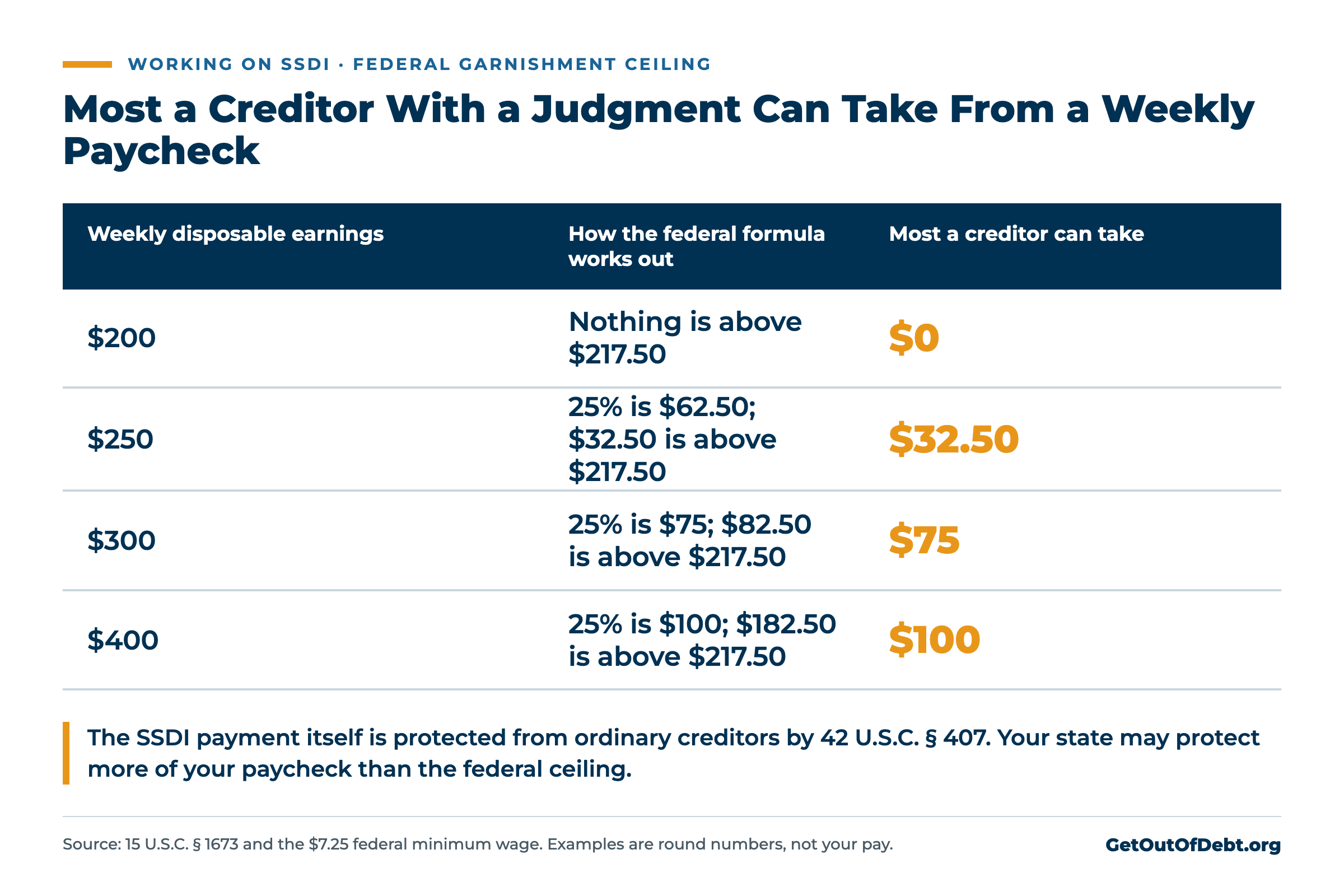
The weekly rule in 15 U.S.C. § 1673(a) and the Labor Department’s Fact Sheet #30 works like this: the weekly amount may not exceed the lesser of two figures, 25% of your disposable earnings, or the amount by which your disposable earnings are greater than 30 times the federal minimum wage. The federal minimum wage is $7.25 an hour, so 30 times it is $217.50 a week. If your weekly disposable earnings are $217.50 or less, the second test comes out to nothing, and the Labor Department’s regulation says it plainly: if disposable earnings for the period are equal to or less than 30 times the minimum wage, “the individual’s earnings may not be garnished in any amount” (29 CFR § 870.10). That formula is for ordinary consumer debts. Under § 1673(b) the § 1673(a) ceiling does not apply to a debt for state or federal taxes, and support orders have their own higher federal cap, so do not use the $217.50 line for taxes or support; ask a local attorney or the child-support agency what applies. Here are four examples with round numbers, which are illustrations and not your paycheck:
- $200 a week: nothing is above $217.50, so the most a creditor can take is $0.
- $250 a week: 25% would be $62.50, but only $32.50 is above $217.50, so the most is $32.50.
- $300 a week: 25% is $75 and $82.50 is above the line, so the most is $75.
- $400 a week: 25% is $100 and $182.50 is above the line, so the most is $100.
If you are paid every two weeks, the same regulation multiplies the weekly figure by the number of workweeks, so the $217.50 line doubles to $435 for a two-week check. Two more things that matter for someone working part time. First, that is a ceiling and not a bill: the same fact sheet says that when a state wage garnishment law differs from the federal one, the law that results in the lower amount of earnings being garnished must be followed. Some states protect more than the federal ceiling, and I am not restating those rules here. Start with my state-by-state wage garnishment table, note that the CFPB says state exemptions may also protect some wages or property, and ask a local attorney before you rely on any state protection. Second, your employer can’t fire you because your pay is garnished for any one debt: 15 U.S.C. § 1674(a) says no employer may discharge any employee by reason of the fact that his earnings have been subjected to garnishment for any one indebtedness. Run your own pay stub through the wage garnishment calculator to see where you sit.
Free Tool — Wage Garnishment Calculator: Worried about your paycheck being seized? The free Wage Garnishment Calculator shows exactly how much creditors can legally take in your state — and some states prohibit garnishment entirely. Calculate My Risk →
Your Bank Account Is Where the Two Pieces Get Tangled
If your SSDI is direct deposited, the bank has to look back two months for federal benefit deposits when a garnishment order arrives, and it has to leave a protected amount alone without you asking: the lesser of the benefits deposited in that two-month lookback or the balance in the account (31 CFR Part 212). The same rule says that for funds above the protected amount the bank follows its ordinary procedures, including freezing them. In the CFPB’s words, the debt collector is permitted to garnish money in your account that is over two months’ worth of benefits, and if you deposit a benefit check instead of using direct deposit, the bank does not have to protect two months and your whole balance could be frozen. Money above the protected amount can be frozen under the bank’s usual procedures, so if you get a notice from your bank or a court, contact a legal aid office or a consumer attorney quickly.
The wrinkle for a working person: the federal protected amount is built from your benefit deposits, so paycheck money in the same account only gets whatever protection your state gives it. I would keep SSDI on direct deposit so the automatic protection applies, and I would ask a local consumer attorney or legal aid office how your state treats paycheck money once it is sitting in a bank account, because that is a state-by-state question I am not going to guess at for you.
The Job Has Its Own Limits
Everything above is about collectors. SSDI has its own rules about work, and they change the picture, because a paycheck that grows makes the garnishable slice grow too. For 2026, Social Security’s annual notice in the Federal Register says a month counts as a trial work month when your earnings are more than $1,210, and sets the monthly amount of earnings treated as substantial gainful activity at $1,690 for non-blind people with a disability ($2,830 for people who are statutorily blind). For an employee, Social Security ordinarily treats countable earnings of more than $1,690 a month as SGA, and countable earnings are your gross pay after it subtracts things like the reasonable cost of impairment-related work expenses (20 CFR § 404.1574(b)). During a trial work period of 9 months in a rolling 60-month period, you can test your ability to work and still receive your monthly benefit, so your benefit generally keeps being paid during those 9 months and Social Security does not treat that work as showing your disability has ended (20 CFR § 404.1592(a)). That protects the work itself, not you from a medical review: Social Security may find that your disability has ended at any time during the trial work period if the medical or other evidence shows you are no longer disabled (20 CFR § 404.1592(e)).
After those 9 months comes a reentitlement period of up to 36 months. If your countable earnings are more than $1,690 in a month in that stretch, Social Security pays you for the first such month and the two after it whether or not you earn that much in those two, and then stops your benefit for each later month in which you do, and if you drop back below it the benefit can start again without a new application (20 CFR § 404.1592a). Once the reentitlement period is over, the rule changes: SGA-level work can end your entitlement to disability benefits rather than stopping them one month at a time (20 CFR § 404.1592a(a)(3)), so ask Social Security about your own dates before the 36 months run out. For an employee the trial work test is about monthly earnings and not hours, and the SGA test looks at countable earnings under Social Security’s rules, so a month with overtime or a bonus can matter more than your hours-per-week number. Hours do still matter for people who are self-employed. You are also expected to tell Social Security promptly when you return to work, get a new employer, increase your work or your earnings go up (20 CFR § 404.1588), so report your work in writing, whether you are below or above those lines, and keep your pay stubs and the receipt Social Security says it will issue when you report. If work goes unreported, Social Security can later decide it paid you too much and demand repayment, because the rules count any payment in excess of the amount due as an overpayment (20 CFR § 404.501).
None of this is a reason to stop working. It is a reason to know where the lines are before a raise or an extra shift surprises you, and it is why I ask people to see the whole income picture before they sign anything with anyone. If you receive SSI as well as SSDI, the SSI asset limit trap applies to you too, because paying off debt the wrong way can cost you that benefit.
Why I Would Not Buy Debt Settlement Here
Debt settlement is the option I warn people on benefits about most, and I have a whole post on it: if Social Security is your only income, you may be paying thousands of dollars to solve a problem you do not have. Adding a paycheck changes the facts, not my conclusion. Here is what the Federal Trade Commission says in its guide on how to get out of debt: “Debt settlement programs often ask — or encourage — you to stop sending payments directly to your creditors.” and “That means late fees and penalties may grow, put you further in the hole, and hurt your credit.” It also says “You could even be sued while you’re waiting for a settlement.” A lawsuit can lead to a judgment, and a judgment is the thing that makes your paycheck reachable. For a person whose main income is protected, a program that works by getting you sued is a strange way to buy peace.
Look at the fees too. Under the FTC’s Telemarketing Sales Rule, 16 CFR § 310.4(a)(5)(i), a debt relief company selling by phone cannot request or receive payment until it has settled or otherwise altered at least one of your debts under an agreement you signed and you have made at least one payment under that agreement. And forgiven debt carries a tax question: the IRS says that if your debt is canceled for less than you owe, the amount of the canceled debt is generally taxable, with exclusions for insolvency and for debt canceled in a bankruptcy case.
Here is how I rate the two options people in this spot usually weigh, from my published comparison of every debt option, and the full list is in my options comparison:
- Debt settlement: meh on credit, meh on collections, meh on speed, and bad for retirement.
- Bankruptcy: good on credit, good on collections, good on speed, and good for retirement.
Where Bankruptcy Fits When SSDI Is Your Main Income
Bankruptcy has a few features that matter a lot to someone in your spot, and I want you to have all of them, including the ones that argue for not filing.
SSDI does not count against you in the means test. The bankruptcy law’s definition of “current monthly income” excludes “benefits received under the Social Security Act” (11 U.S.C. § 101(10A)), so the income that gets measured is your wages. And § 407(a), quoted above, keeps SSDI outside the operation of bankruptcy law, though an attorney should tell you how benefits already sitting in your bank account are handled.
Medical bills are ordinarily dischargeable. The list of debts a Chapter 7 discharge does not cover is in 11 U.S.C. § 523(a), and ordinary medical bills are not among the categories it names, though a lien on your property or a fraud claim can change that. The federal courts’ own overview says an individual Chapter 7 case usually results in a discharge of debts, though the right to a discharge is not absolute and a discharge does not extinguish a lien on property.
Retirement accounts are protected in bankruptcy. Retirement funds held in accounts that are tax-exempt under sections 401, 403, 408, 408A, 414, 457 or 501(a) of the tax code are exempt under 11 U.S.C. § 522(b)(3)(C). That is the legal reason I tell people never to cash out a 401(k) or IRA to pay a collector: you would be spending money that bankruptcy law protects to pay a debt you may be able to discharge.
Chapter 7 filers’ scores tend to climb in the first few years. The CFPB’s 2019 study of bankruptcy and credit scores found that median credit scores rise steeply for Chapter 7 filers in the first few years after filing, in contrast to scores for Chapter 13 filers. The report says this could be because debt in a Chapter 7 case is discharged in about four months, while Chapter 13 filers keep their debt through a three- or five-year repayment plan (page 10 of the PDF). I filed in 1990. I would rather you deal with it and look to the future than spend five years repairing the past.
Now the case against filing. It is not for everyone. If your debts are small, if your pay and your state’s rules put you below what any creditor can reach, nobody has sued you, and a local attorney confirms a judgment could not reach anything else you own, such as home equity or a paid-off car, doing nothing but protecting the SSDI deposit can be a legitimate answer for now. A raise, a better job or a bigger paycheck changes that, so it is a position to revisit and not a permanent shield. The right answer comes from your numbers, and a bankruptcy attorney in your state can tell you what your state exempts. The Find Your Path quiz will run your numbers through the options for you.
Medical Debt and Your Credit Report
The three credit bureaus changed how they handle medical collections on their own, not because a law made them. As of July 1, 2022, paid medical collection debt no longer appears on U.S. credit reports, and the wait before unpaid medical collection debt appears went from six months to one year, and as of April 11, 2023, medical collection debt with an initial reported balance of under $500 was removed. The CFPB points out that this does not include credit card collections, even if you used your credit card to pay for a medical expense under $500.
Do not count on a federal law behind those policies. The CFPB’s 2025 medical debt rule, 90 Fed. Reg. 3276, was set aside and vacated by a federal court on July 11, 2025 in Cornerstone Credit Union League v. CFPB in the Eastern District of Texas, so it is not in force as of this writing. The bureau policies were announced in 2022 and 2023, they are voluntary and can change, so check your three reports at AnnualCreditReport.com and dispute anything that should already be gone.
What I Would Do This Week
- Pay nothing to anyone on a phone call. Especially not a settlement company that asks you to stop paying your creditors first.
- Pull your last pay stub and find your disposable earnings. That is your pay after only the deductions the law requires, such as taxes, so it can be more than your take-home pay. Compare a weekly check with $217.50 and a two-week check with $435; for a longer pay period the regulation multiplies $217.50 by the number of workweeks (29 CFR § 870.10(c)). Then check your state’s rules.
- Keep SSDI on direct deposit and ask a local consumer attorney how your state treats paycheck money in the same account.
- Tell Social Security about your work in writing, whether you are below or above the lines, and keep a month-by-month record of your earnings against the 2026 trial work and SGA numbers.
- If you are sued, answer the lawsuit. The SSDI protection does not make a default judgment go away.
- Talk to a bankruptcy attorney before you sign with a settlement firm. NACBA can help you find one. If you want to talk it through with a debt coach first, you can schedule a free consultation with Damon Day, an independent debt coach, not an attorney. Damon is my podcast co-host, and I receive no payment for this referral.
Key Takeaways
- Your SSDI deposit is protected from ordinary creditors by 42 U.S.C. § 407. Your paycheck is not, but most creditors need a court judgment first (government debts and support orders are exceptions).
- The federal ceiling on a garnishment is the lesser of 25% of disposable earnings or the amount over 30 times $7.25, which is $217.50 a week, and your state may protect more.
- For 2026, a month with earnings of more than $1,210 counts toward the 9-month trial work period, during which your benefit generally keeps being paid, and countable earnings of more than $1,690 a month are ordinarily SGA for non-blind people. Once, during the reentitlement period of up to 36 months, the first such month and the two after it are still paid. Report your work to Social Security in writing either way.
- Settlement programs ask you to stop paying creditors and the FTC says you could be sued while waiting. In my ratings bankruptcy wins on credit, collections, speed and retirement.
- Medical collections under $500 and paid medical collections are kept off your credit reports by voluntary bureau policies announced in 2022 and 2023, not by a federal rule.
The Bottom Line
If you are on SSDI, working part time and buried in medical bills, you did not fail at something. You tried to get back on your feet and the system sent you a bill for it. Your SSDI check is already safe from ordinary creditors, your paycheck has a ceiling that can be small or zero, and bankruptcy is a tool that can ordinarily wipe out medical debt (a lien on your property can survive it) without touching your SSDI or your retirement accounts. No sense wasting a perfectly good mistake: the mistake to avoid is paying someone to solve a problem you only partly have. Look at the real numbers first, then choose. You are not your debt.
Free Tool — I'm Being Sued for Debt Guide: Being sued by a creditor or debt collector? The free I'm Being Sued Guide gives you a personalized action plan — deadlines, defenses, and options based on your state. Most states require a response within 20–30 days. Get My Action Plan →
Frequently Asked Questions
Can a debt collector garnish my SSDI if I’m also working?
Not for an ordinary consumer debt like a credit card or medical bill. 42 U.S.C. § 407 protects SSDI from garnishment and legal process, and working does not change that. Your wages are a separate matter, and most creditors can garnish them only after winning a judgment. The CFPB notes that Social Security and SSDI can sometimes be garnished for government debts and for child or spousal support, which follow different rules.
How much of a part-time paycheck can be garnished?
The federal ceiling is the lesser of 25% of your disposable earnings or the amount by which your weekly disposable earnings exceed 30 times the federal minimum wage. With the minimum wage at $7.25 that line is $217.50 a week, so, for an ordinary consumer debt, a creditor cannot garnish a paycheck at or below it, and at $250 of weekly disposable earnings the most is $32.50. Tax debts and support orders are outside this ceiling. Your state can protect more than the federal limit, and where state and federal limits differ, the one that takes less from you applies.
Will working part time make me lose my SSDI?
Not by itself. During the 9 trial work months your benefit generally keeps being paid, and in 2026 a month counts toward those 9 when your earnings are more than $1,210. After that, in the reentitlement period of up to 36 months, countable earnings of more than $1,690 a month (the 2026 non-blind SGA level) can stop the benefit for a month, but Social Security still pays the first such month and the two after it. Report your work in writing either way. Hours matter less than monthly earnings for an employee, and you should keep your pay stubs.
Is debt settlement worth it if collectors can’t touch my SSDI?
In my ratings, debt settlement is meh on credit, collections and speed and bad for retirement, while bankruptcy is good on all four. The FTC says settlement programs often encourage you to stop paying creditors and that you could be sued while you wait, and a lawsuit is what puts a paycheck within reach. Under the FTC’s Telemarketing Sales Rule, a debt relief company that sells by phone also cannot collect a fee before it settles at least one of your debts and you have made a payment under that settlement.
Can I file bankruptcy while on SSDI with a part-time job, and what happens to my retirement savings?
Yes, you can file. Social Security Act benefits are excluded from the bankruptcy means test’s definition of current monthly income, so your wages are the income measured, and SSDI itself is protected from the operation of bankruptcy law under 42 U.S.C. § 407, though an attorney should tell you how benefits already in your bank account are handled. Retirement funds in accounts that are tax-exempt under sections 401, 403, 408, 408A, 414, 457 or 501(a) are exempt under 11 U.S.C. § 522(b)(3)(C), but an attorney in your state should confirm how your accounts and your exemptions apply.
This is what I’m telling friends like you over coffee. But remember, you do you: take my advice as input, not instruction, because only you can decide what is right for your situation.
If this made sense to you, share it with someone who needs to hear it. Plenty of people on disability go back to work and assume they just handed collectors a way in. Send this to the one you know, so they see the numbers before they pay anybody.
Facing a Similar Situation? You’re not alone — and you have more options than you think. Start with the all your debt relief options page to see what’s realistic, or take the 2-minute bankruptcy quiz if the debt feels unmanageable. Federal Reserve Bank of New York research shows filers recover faster than those who don’t file. If a company is involved, run them through the Scam-O-Meter first.



