

Quick Answer: A “ghost student” loan is a federal student loan taken out in a real person’s name, with stolen identity information, to pay for an enrollment that person never made. If one is in your name, the Education Department’s own regulation, 34 CFR 685.215, lets you apply to have it discharged, and a discharge relieves you of the loan plus accrued charges and collection costs, qualifies you for reimbursement of what you paid or what was taken from you by enforced collection, and has the credit bureaus’ negative history for that loan deleted. 34 CFR 685.215 is the Direct Loan rule; the Department’s identity-theft form also covers FFEL loans. Don’t wait for the Department to find it for you. Check your StudentAid.gov record and all three credit reports, file a report at IdentityTheft.gov, freeze your credit, and send the Department’s identity theft discharge application with more than one kind of evidence, signed under penalty of perjury. Mailing the form does not by itself stop collection: the regulation’s pause starts if the Department determines the loan may be eligible, so ask your servicer in writing to hold collection, and until the Department decides, open every letter and don’t ignore a collector.
Expert Context: I’ve been helping people with debt since 1994, and readers have been writing me for years about student loans taken out in their names by a parent, an ex-spouse or a stranger (two of those letters are linked below). The pattern never changes: nobody tells you the loan exists until somebody wants it paid. The headlines about this Justice Department case are about the money. I’m interested in the person whose name is on the paperwork.
On Thursday, October 29, 2026, the Justice Department announced the first results of “Operation Ghostbusters,” which its release calls a nationwide investigation into a large-scale student-loan fraud scheme in which “ghost students” were enrolled using stolen identities. If a real person’s name was used, a federal student loan could be sitting in it right now with nobody paying. Here is how to check, and the exact federal rule that lets you apply to have it discharged.
Key Terms Defined
Ghost student: DOJ’s term for a fake enrollee created from a stolen identity. DOJ says the “ghost students” “never actually attend the college classes for which those funds were awarded.”
Each weekday I send one short email: one story that caught my attention, why it might matter to you, and one manageable thing you can do with it. A couple of minutes, and a dad joke.
In the latest issue (Nov 12): A 10% cap on your credit card rate? Here's what's real.
Free. I sell nothing. Unsubscribe any time.
FSA ID: the login that identifies a person to Federal Student Aid. DOJ counts “potentially fraudulent FSAIDs” in its release.
False certification discharge (identity theft): the Direct Loan discharge in 34 CFR 685.215(a)(1)(v) for a loan certified as a result of identity theft committed against the borrower.
What the Justice Department Actually Announced
I read the release itself (number 26-1278) instead of the coverage of it. DOJ describes a scheme in which criminal actors created fraudulent Federal Student Aid (FAFSA) accounts using stolen U.S. citizen identities to enroll “ghost students” in educational institutions. After “loan and grant disbursements,” the release says, the refunds “were diverted to bank accounts controlled by foreign actors and facilitated by U.S.-based money mules, including Kenyan nationals.”
The three cases it highlights: a criminal complaint in New Jersey against three people, arrested, alleged to have used U.S. bank accounts to receive student aid funds and, after taking their cut, to have transferred the funds overseas to co-conspirators in Kenya; a Virginia grand jury indictment on October 21 of one Kenyan national for conspiracy to commit wire fraud and student aid fraud, alleging more than 700 refund deposits totaling about $1,439,548; and a Nebraska grand jury indictment on October 19 of one Kenyan citizen on five counts of theft of government money and five counts of aggravated identity theft. DOJ’s own caution applies to all of it: an indictment, information or complaint “is merely an allegation,” and every defendant is presumed innocent.
The FBI says it has identified more than $32 million in losses in similar ghost student schemes, with millions more suspected, and DOJ says there are now more than 40 open cases across 26 FBI field offices and more than 20 U.S. Attorneys’ Offices. One line in the release is the reason I wrote this post:
“Many known victims have reported attaining only high school diplomas — and are shocked by their faked attendance at an institution hundreds of miles away.”
If you got a letter from the FBI about this: DOJ says the FBI “has sent letters to many identified victims.” Before following any letter’s instructions, confirm it’s real by calling your local FBI field office at a number you look up yourself on fbi.gov, not one printed in the letter. That step is my advice, not something the release says. DOJ also points anyone who believes they are a victim to the Department of Education’s Office of Inspector General hotline complaint form, whose general form lists identity theft as a reason to use it.
The Part the Headlines Skipped
When a story like this breaks, the coverage is about the criminals, the seizure and the schools that lost aid money. The person who did nothing wrong is a footnote, and that person is the one who has to clean it up. On the Department’s books, a loan certified in your name is your loan, and the way out is a specific process you have to start.
My earlier post on ghost student scams covers how the scam works and why open-enrollment schools get targeted. This post is the other half: you looked, or you want to be sure you never need to. What now? Debt is math wrapped in emotion, and the emotion here is a very specific kind of dread. The math is better than the dread. There is a written federal process for exactly this, and it’s free.
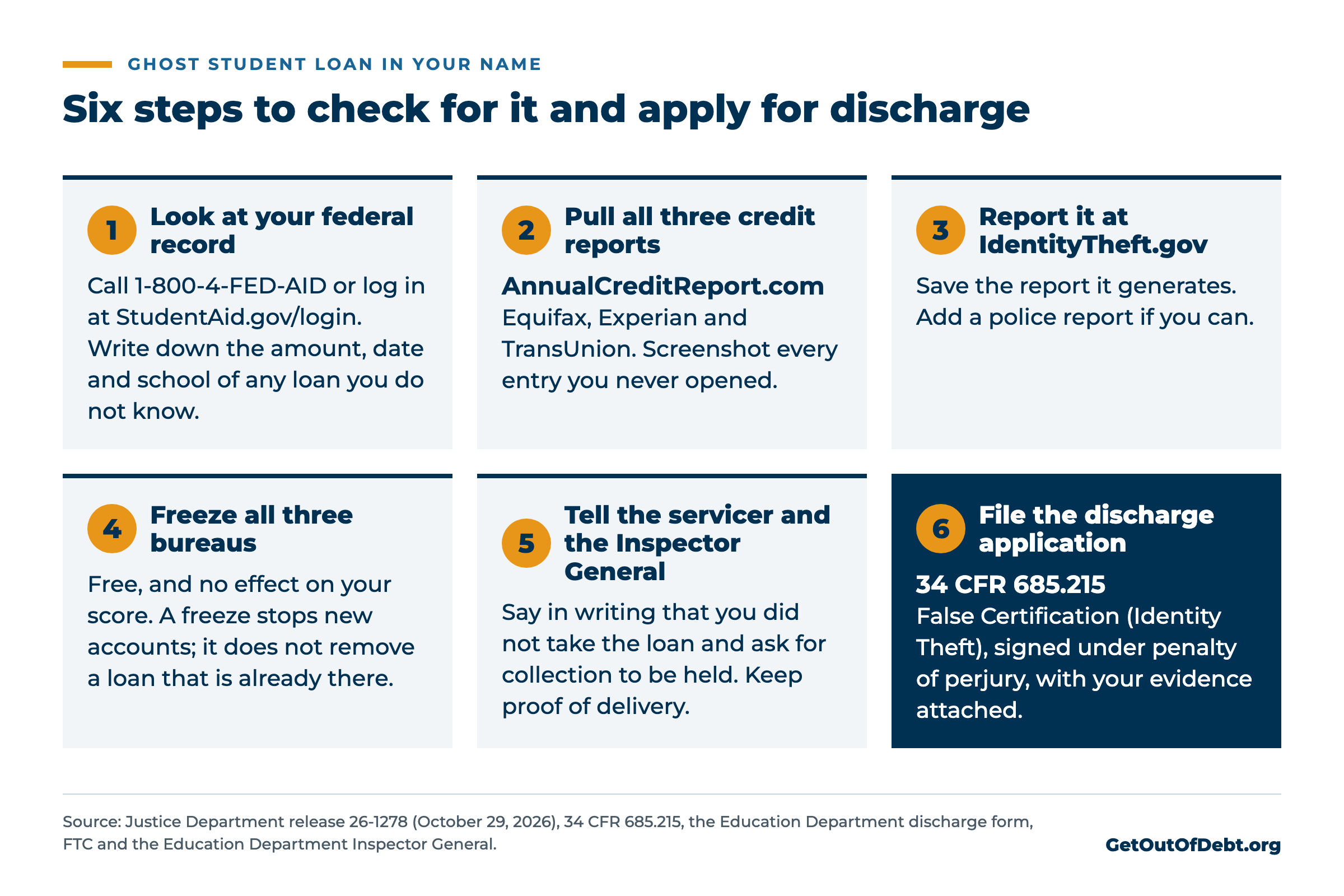
Step 1: Look at Your Federal Student Aid Record
The Department’s discharge form says to find information about loans in your name at StudentAid.gov/login or by calling 1-800-4-FED-AID. If you have never had an account, call and ask what federal loans are on file under your name. For every loan you don’t recognize, write down exactly what the discharge form will ask for later: the loan amount, the loan date, and the school’s name and address. Help a parent or older relative check their own record.
If StudentAid.gov shows no loan, that doesn’t mean you can skip the FTC report and the freeze in Steps 3 and 4. DOJ describes “loan and grant disbursements,” so aid can be taken in a stolen name without a loan showing up.
Step 2: Pull All Three Credit Reports
Go to AnnualCreditReport.com for your free reports, one from each of Equifax, Experian and TransUnion. Look for student loan accounts and collection accounts you never opened. Screenshot each one before you do anything else. The StudentAid.gov record covers federal loans only, so a private loan may show up on your credit report and nowhere in your federal account.
Step 3: File at IdentityTheft.gov
Report it at IdentityTheft.gov. The FTC says you get a free personal recovery plan, and the site can print pre-filled letters for credit bureaus, businesses and debt collectors (FTC). Save the report it generates. Here’s a wrinkle I want you to know about: the federal regulation and the Department’s form both list an “FTC identity theft affidavit” as evidence, while the FTC says its newer Identity Theft Report replaces the FTC Identity Theft Affidavit. I found no Department statement saying in so many words that one counts as the other, which is a good reason to attach more than one kind of evidence. A police report is also on the list.
Step 4: Freeze Your Credit at All Three Bureaus
The FTC says a freeze is free to place or lift and doesn’t affect your credit score, and that you contact all three bureaus to do it. The Education Department’s Inspector General describes the point of it as stopping anyone from opening new credit accounts in your name. A freeze is a lock, not a dispute, so it won’t remove a loan that’s already there. If three calls is too much tonight, the FTC says an initial fraud alert takes one call to one bureau, which must tell the other two, and it’s free and lasts a year. Unlike a freeze, it doesn’t stop businesses from seeing your report, so treat it as a stopgap, not a replacement. For children under 16, the FTC says there is a separate process for a minor, and my earlier ghost student post covers why parents should do it.
Step 5: Tell the Servicer and the Inspector General
The Inspector General’s identity theft page lists four steps: contact your loan servicer, freeze your credit, share the information with the OIG, and report to the FTC. Do the servicer contact in writing, by a method that gives you a delivery record, and say plainly that you did not take out the loan, that you are a victim of identity theft, and that you are requesting the identity theft discharge. Keep a copy. I’d also ask in that letter that collection be held while the discharge is reviewed, and I’ll explain below why I’m asking instead of assuming.
Step 6: File the Identity Theft Discharge Application
This is the step nobody mentions. The regulation says the Secretary discharges a borrower’s obligation on a Direct Loan if a school certified the borrower’s eligibility “as a result of the crime of identity theft committed against the individual” (34 CFR 685.215(a)(1)(v), in the eCFR text current through its October 28, 2026 update, which is the version I read). The Department’s form, “Loan Discharge Application: False Certification (Identity Theft),” covers both Direct Loans and Federal Family Education Loans. If a parent borrowed on a student’s behalf, the form has a Parent PLUS path too. Download the current version from StudentAid.gov, because forms get replaced.
What the regulation requires of you, in its own words, is that you:
“(i) Certify that the individual did not sign the promissory note, or that any other means of identification used to obtain the loan was used without the authorization of the individual claiming relief;
(ii) Certify that the individual did not receive or benefit from the proceeds of the loan with knowledge that the loan had been made without the authorization of the individual; and
(iii) Provide a statement of facts and supporting evidence that demonstrate, to the satisfaction of the Secretary, that eligibility for the loan in question was falsely certified as a result of identity theft committed against that individual.”
Supporting evidence “may include” a judicial determination of identity theft, an FTC identity theft affidavit, a police report alleging identity theft, documentation of a dispute of the loan’s validity filed with at least three major credit bureaus, and “other evidence acceptable to the Secretary.” The form tells you to check every type you are providing and attach a copy of each. Its examples of other evidence fit a ghost student case well: documents showing your actual signature (cancelled checks, signed tax returns, a driver’s license) or proof of where you lived when the loan was made (a lease or utility bill). DOJ’s release describes known victims shocked by attendance at a school hundreds of miles away, so in a case like that a lease or utility bill from the year of the loan is exactly the kind of proof I’d attach.
This is signed under penalty of perjury. The regulation says the application “need not be notarized but must be made by the borrower under penalty of perjury,” and an early question on the form (Item 5) asks whether you applied for the loans you want discharged (“Yes – You are not eligible for this discharge”). Other items ask whether you received a refund or benefited in any other way (Item 7), whether you signed a promissory note (Item 8), whether you ever attended a postsecondary school (Item 9) and where you lived when the loans were originated or certified (Item 14). This process is for people who really did not take the loan. If a relative used your name and some of the money reached you, read the questions with a student loan attorney before you sign, because the regulation’s definition has no family exception that I could find and the decision is the Secretary’s.
What Happens After You File
The regulation sets the clocks, so here they are. First, the point the Quick Answer made: mailing the form does not by itself stop collection. The regulation ties the pause to the Department’s own determination. If the Department determines a loan may be eligible, it provides you an application and “promptly suspends any efforts to collect,” though it may keep accepting payments. You then have 60 days to submit the application and supporting information, or collection resumes with forbearance for the paused period. That 60-day clock starts only if the Department sends you an application after it decides the loan may qualify; it doesn’t start the day you mail your own form. If you already mailed a complete form, keep the proof and don’t wait for a second copy. Under the current rule, if your application is incomplete, you get a notice and 30 more days to fix it. If the Secretary decides against you, the regulation says the decision must explain the reasons, describe the evidence, and give you copies of that evidence on request, and you can re-apply with more supporting evidence (685.215(d)). Nothing in that text promises a pause the day you mail the form, which is why I ask the servicer for a hold in writing and keep the answer.
If it’s granted, the regulation says the discharge relieves you of “any past or present obligation to repay the loan and any accrued charges and collection costs,” qualifies you for reimbursement of amounts paid “voluntarily or through enforced collection,” and means a borrower who had defaulted is not treated as in default after the discharge and is eligible for federal student aid again. The Department also reports the discharge to the credit bureaus it reported the loan to, “so as to delete all adverse credit history assigned to the loan” (685.215(b)). The form lists wage garnishment and Treasury offset among the payments a granted discharge can reimburse. Filing does not stop either one. Until the Department decides the loan may be eligible and suspends collection, open every letter and do not ignore a collector.
Two more provisions are worth knowing. The Secretary can discharge a loan without an application if the information in the Secretary’s possession shows you qualify (685.215(c)(9)). Under the current rule, a State Attorney General or a nonprofit legal services representative may submit an application for a group discharge (685.215(c)(10)). Only they can file that kind of application, not individual victims, so it’s worth reporting the loan to your state attorney general as well.
Free Tool — Wage Garnishment Calculator: Worried about your paycheck being seized? The free Wage Garnishment Calculator shows exactly how much creditors can legally take in your state — and some states prohibit garnishment entirely. Calculate My Risk →
Make the Credit Bureaus Block It, Too
A discharge takes time, and the loan may be on your credit report the whole while. Federal law has a separate lever. Under 15 U.S.C. 1681c-2, a credit bureau “shall block the reporting” of information you identify as resulting from identity theft “not later than 4 business days” after it receives proof of your identity, a copy of an identity theft report, your identification of the information, and your statement that it doesn’t relate to any transaction by you. A bureau may decline or rescind a block if it reasonably determines, among other things, that you “obtained possession of goods, services, or money as a result of the blocked transaction or transactions.” Send each bureau a dispute saying the loan is the result of identity theft, ask for the block, and keep each confirmation. The regulation lists a dispute filed with at least three bureaus as evidence. My guide to what to do when a wrong debt is on your credit report walks through the dispute mechanics in more detail.
If the Loan Turns Out to Be Private
The Department’s discharge form covers Direct Loans and FFEL loans. I did not find an equivalent federal form for a private student loan, so if the loan on your credit report is private, your tools are the identity theft report, a written dispute with the lender, the bureau block above and a consumer attorney. Don’t spend weeks on a federal form for a loan that isn’t federal.
The Claim: “I never went to college, so there can’t be a loan in my name.”
The Reality: The Justice Department release says many known victims have reported attaining only high school diplomas and are shocked by their faked attendance at an institution hundreds of miles away. Your own history is not a shield. Looking is.
Nobody Needs to Be Paid to File This: The discharge application is a free form on StudentAid.gov, and I saw no fee on it. News like this is a good moment to remember that student loan “relief” companies and fake help outfits exist. I’ve written about an FTC action against a student loan relief operation, and the free Contract Decoder will read anything someone asks you to sign before you do.
How I’d Think About It
If I found a loan I never took on my report, I’d give myself one evening to be angry about it, and then I’d do the six steps in order, in one sitting, with a folder open on the desk. I’d deal with it and look to the future rather than spend five years repairing the past. The paperwork is annoying, and it’s also the only thing that works. Until the Department accepts your evidence, the loan stays on the books in your name, but it is somebody else’s crime with your name on it, and the regulation was written for exactly that.
If you have been through other school-related loan problems, two of my reader letters show how these cases show up in real life: a daughter whose mother took out loans in her name and a man whose ex-wife did the same. Those are family cases, and the discharge question in them is the one I described above. Separately, if your problem is that a school falsely certified you for other reasons, such as admitting you without a diploma, that is a different path under the same regulation, and I cover it in my false certification post. If a collector calls about a loan that was never yours, see what to do when a collector calls about someone else’s debt.
Not sure what else is going on with your debts? The free Find Your Path quiz gives a recommendation based on your actual numbers, and it will not try to sell you anything.
Key Takeaways
- Justice Department release 26-1278 (October 29, 2026) says “ghost student” fraud used stolen U.S. citizen identities, with five defendants charged and 830,840 potentially fraudulent FSA IDs identified.
- Check StudentAid.gov and all three reports at AnnualCreditReport.com, then file at IdentityTheft.gov and freeze all three bureaus.
- 34 CFR 685.215 provides a discharge for a Direct Loan certified through identity theft, on an application signed under penalty of perjury, with evidence the Secretary finds satisfactory.
- A discharge relieves the loan and charges, qualifies you for reimbursement of what was collected, and the Department reports the discharge to delete the loan’s adverse credit history.
- Private loans are a different fight. Keep copies of everything and never pay anyone to file the form.
The Bottom Line
If you read this and felt a little sick, that is a normal reaction, and it does not mean anything is wrong. Looking is free. People who find a loan they never took are not careless, and they didn’t do anything to cause it. A federal regulation lets you apply to have that loan discharged, with a refund of what was collected and the credit damage deleted, if the Department accepts your evidence. You can start that paperwork in one afternoon, but the loan is not discharged until the Department says so. Until then, open every letter and don’t ignore a collector. You don’t have to spend five years repairing the past when you can start dealing with it now.
Frequently Asked Questions
How do I find out if someone took out a student loan in my name?
Log in at StudentAid.gov/login or call 1-800-4-FED-AID to see the federal loans on file under your name (the Department’s own discharge form gives those two routes), then pull your free credit reports at AnnualCreditReport.com. A private loan can show only on your credit reports, so check both.
Can a federal student loan taken out through identity theft be canceled?
Yes, under 34 CFR 685.215(a)(1)(v) the Secretary discharges a Direct Loan if a school certified the borrower’s eligibility as a result of identity theft committed against that person. You apply on a form signed under penalty of perjury with a statement of facts and evidence, and the Secretary decides whether the evidence is satisfactory.
Do I need a police report to get a fraudulent student loan discharged?
The regulation lists a police report as one kind of evidence and does not make it the only kind: it also lists an FTC identity theft affidavit, a court determination, documentation of a dispute filed with at least three major credit bureaus, and other evidence acceptable to the Secretary. The Department’s form says to check each type you provide and attach a copy of each.
What if a relative took out the loan in my name?
The regulation defines identity theft as the unauthorized use of the identifying information of another individual that is punishable under 18 U.S.C. 1028, 1028A, 1029 or 1030, or substantially comparable state or local law, and I found no family exception in the text. But you must certify that you didn’t receive or benefit from the loan with knowledge it was taken without your authorization, so talk to a student loan attorney before signing a statement under penalty of perjury.
Does a credit freeze remove a student loan I never took?
No. The FTC says a freeze is free and doesn’t affect your credit score, and the Education Department’s Inspector General describes its purpose as stopping new accounts from being opened in your name. To remove an entry that is already there, use the identity theft discharge, a bureau block under 15 U.S.C. 1681c-2, and a written dispute.
This is what I’d tell my own family if they called me tonight, but I’m not a lawyer and I don’t know your full situation. Take it as input, not instruction. Only you can decide what is right for you, and nobody gets to tell you what to do with your money, me included.
Know someone who never went to college, or a parent who never borrowed a dime? Send them this page and ask them to spend an hour on it. Finding out now is much cheaper than finding out from a collector later.
Dealing With Debt? Understanding your options is the first step. See how all your debt relief options compare — including ones most sites won’t tell you about. The Find Your Path quiz gives a recommendation based on your actual numbers, and the Scam-O-Meter checks any company’s complaint history before you sign. Federal Reserve Bank of New York research shows bankruptcy filers recover faster than those who don’t file.



