

Fact-checked by Steve Rhode, consumer debt expert since 1994 • Last reviewed November 3, 2026 • Every material legal claim below links to its source.
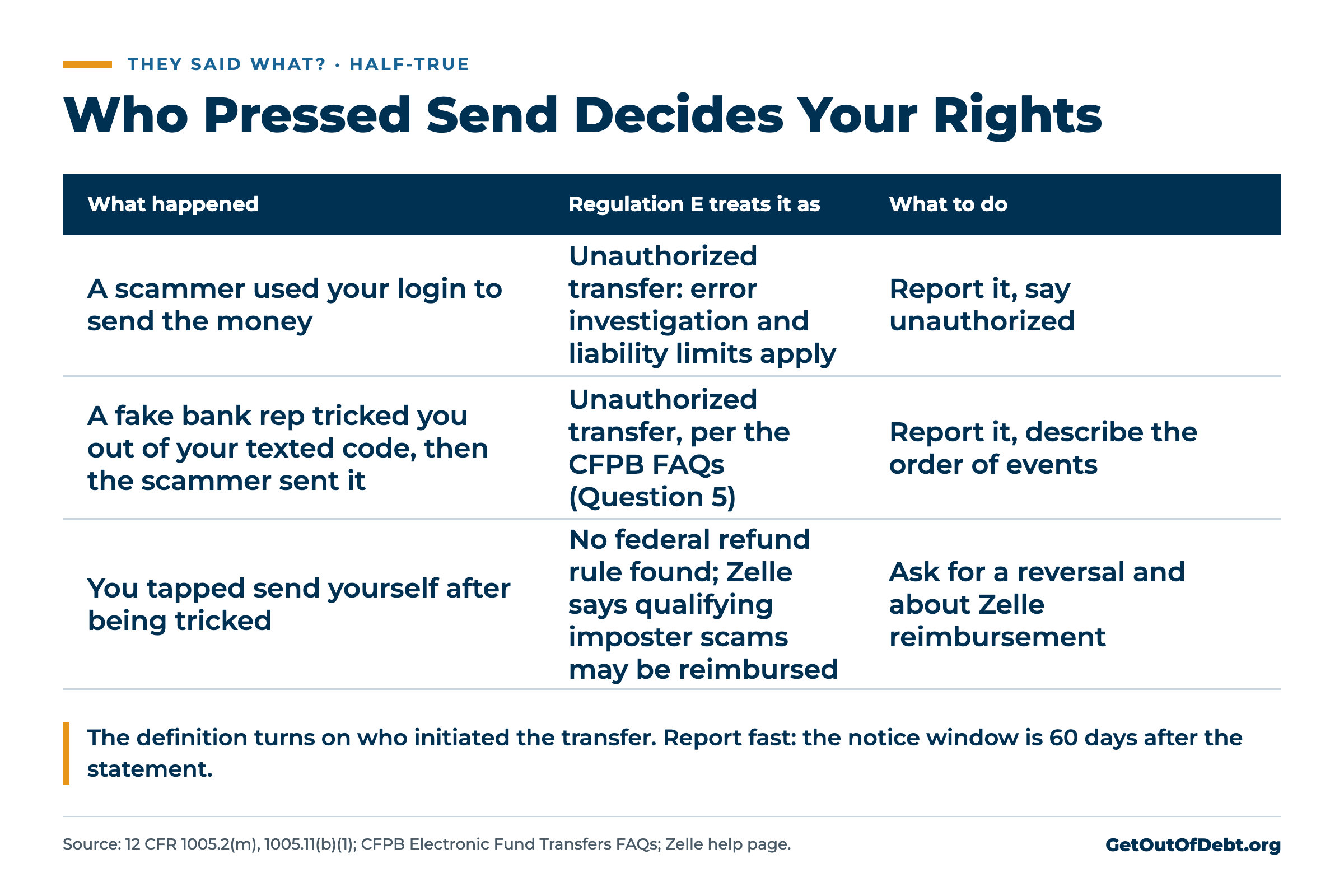
The verdict: Half-true. If a scammer, not you, starts the transfer — with your stolen login or a texted code they tricked out of you — the CFPB’s staff FAQs treat it as an “unauthorized” transfer under Regulation E. If a transfer is unauthorized under that definition, the bank must investigate and your liability is limited; a bank can disagree that yours was. If you sent the money yourself to a scammer, I found no federal rule that makes your bank pay it back — a 2024 Federal Reserve Bank of Atlanta staff blog post (not a Federal Reserve regulation or legal opinion) says the same about current regulations. The definition in 12 CFR 1005.2(m) turns on who initiated the transfer.
If it just happened, do this first: call your bank (or the app) now, tell them exactly what happened, and ask them to reverse the payment — the FTC’s own advice is “Report it to your bank or credit union immediately. Ask them to reverse the payment and refund your money.” If a scammer used your login or a code you were tricked into sharing to send the money themselves, say the transfer was unauthorized. If you tapped send yourself, describe exactly what happened instead. The details of why that word matters are below.
Claiming money you are owed is one good day. What you do over the following year is what actually changes your position.
In the latest issue (Nov 12): A 10% cap on your credit card rate? Here's what's real.
Each weekday I send one short email: one story that caught my attention, why it might matter to you, and one manageable thing you can do with it.
Free. I sell nothing. Unsubscribe any time.
Well, Actually…
A belief I keep running into goes like this: Zelle and the other payment apps work like a credit card, so if I get scammed, the law makes my bank give the money back. I understand why people think that. It is only half right, and the half that is wrong is the half that catches many people out.
The federal law is the Electronic Fund Transfer Act, and its rulebook is Regulation E. Its fraud protections attach to one specific thing: an “unauthorized electronic fund transfer.” 12 CFR 1005.2(m) defines that as a transfer “initiated by a person other than the consumer without actual authority to initiate the transfer and from which the consumer receives no benefit.” The statute says nearly the same thing at 15 U.S.C. 1693a(12). Read that definition slowly, because everything turns on the word “initiated.” The question the law asks is not “were you fooled?” It is “who started the transfer?”
When the scammer starts it. The CFPB’s Electronic Fund Transfers FAQs are staff guidance, not law, but they are the agency’s published reading, and they are direct. A transfer a fraudster initiates through a peer-to-peer payment provider is an unauthorized transfer (Question 3). So is one a fraudster makes with account information the consumer was “fraudulently induced” into sharing — the FAQs give the example of a caller pretending to be from your financial institution who tricks you into giving up your login, a texted confirmation code or your debit card number (Question 5). And handing a fraudster that information does not mean you “furnished an access device” to them, which is the exception banks might otherwise reach for (Question 6).
When you start it. If you open your banking app, type in the recipient and tap send — even because someone lied to you convincingly — you initiated that transfer. The FAQs do not address that situation, and the Federal Reserve Bank of Atlanta put it this way in a September 2024 staff blog post (not a regulation or a legal opinion): “current regulations under the Electronic Fund Transfer Act do not require banks to reimburse consumers for APP fraud since the payments are technically authorized—even if they are obtained through deception.” (“APP” stands for authorized push payment.) I looked for a federal rule that says otherwise and found none. I did not search every state’s law books, and your own account agreement or a state rule could give you more, so ask.
The blurry middle. Real scams do not always sort neatly. A call that says “your account is under attack, move your money to a safe account” has you doing the sending. A “me-to-me” trick can involve both a code you gave up and a payment you tapped; the CFPB’s December 2024 complaint described that scheme. The FAQs do not resolve those mixed cases, so do not diagnose yourself. Describe exactly what happened, in order, and let the bank put its answer in writing.
If I get scammed through Zelle or another payment app, federal law makes my bank refund me.
Regulation E protects you when the transfer was unauthorized, meaning someone other than you initiated it without actual authority and you received no benefit (12 CFR 1005.2(m)) — it does not, as far as I could find, reach a payment you knowingly sent yourself to a scammer, however you were deceived. Which side of that line your scam falls on decides your rights.
12 CFR 1005.2(m), eCFR • CFPB Electronic Fund Transfers FAQs • Federal Reserve Bank of Atlanta, Sept. 23, 2024
A scammer used my login, or a code I was tricked into reading out, to send money from my account — so Regulation E covers it.
That is the CFPB’s published reading (FAQ Questions 3 through 6). Your bank also cannot count your carelessness against you to raise your liability above what Regulation E allows (Question 7), and a clause in your account agreement cannot waive these protections (Question 8). The statute itself says that, except as it provides, “a consumer incurs no liability from an unauthorized electronic fund transfer” (15 U.S.C. 1693g(e)), and in a lawsuit over your liability for an unauthorized transfer, the statute puts the burden of proof on the bank (1693g(b)); that burden is about a lawsuit, not the bank’s own review, and it does not excuse written confirmation the bank asks for. Staff FAQs are not binding the way a regulation is — so expect to quote them back to your bank and not assume the first answer is right.
CFPB Electronic Fund Transfers FAQs, Error Resolution: Unauthorized EFTs, Questions 3–8 • 15 U.S.C. 1693g
I was tricked into sending the money myself — to a fake “fraud department,” a fake seller, a fake collector — but federal law still forces my bank to pay it back.
The regulation’s definition turns on who initiated the transfer, the CFPB’s FAQs do not address a payment you send yourself, and I found no federal rule requiring a bank to refund one — the Atlanta Fed staff blog post above says the same. What you may still have is Zelle’s own network policy: its help page says “Qualifying imposter scams may be eligible for reimbursement,” but it does not spell out which scams qualify, so ask your bank directly. That is a company policy, not a federal right.
12 CFR 1005.2(m) • Federal Reserve Bank of Atlanta • Zelle help page
Why You Were Told This
Some of the confusion is honest. Credit cards come with strong dispute rights, a debit-card or bank-account payment app feels like a card, and Regulation E really does protect you in the fraudster-initiated cases. Some of it is marketing: New York’s attorney general alleges that Zelle’s advertisements “misleadingly promised safe and secure money transfers.” That is the attorney general’s allegation in a lawsuit, not a finding.
And some of it is the legal fight itself, which is worth knowing the status of, because headlines overstate it in both directions:
- The CFPB case is over, and it decided nothing on the merits. On December 20, 2024 the CFPB sued Early Warning Services (which operates Zelle) and three banks, alleging that the defendants committed unfair acts or practices and that the banks violated the Electronic Fund Transfer Act and Regulation E. On March 4, 2025 the CFPB filed a notice voluntarily dismissing the case against all defendants with prejudice, and the court dismissed it on March 5, 2025 (CFPB case page, order of dismissal). No court ruled on the CFPB’s claims. Among them, the complaint alleged that the banks, when customers said they were tricked into giving a fraudster a one-time passcode, often deemed the transfers authorized and denied the claims (complaint, paragraph 298). That is an allegation that was never tested, but it tells you what pushback to expect.
- New York’s case is still alive. On August 13, 2025 Attorney General Letitia James sued Early Warning Services, alleging that Early Warning Services designed Zelle without critical safety features and that scammers stole more than $1 billion between 2017 and 2023. Reuters reported that a New York judge rejected Zelle’s bid to dismiss the case in a decision it said came “late Monday.” The Reuters article is dated Friday, July 24, 2026, so that points to Monday, July 20, 2026; that date is my inference, because Reuters did not print it and I have not seen the order. Reuters also reported that Zelle said it intends to appeal and disputes the claims. A motion to dismiss is not a verdict; the allegations are unproven, and nothing in that lawsuit changes what Regulation E says today.
What to Actually Do
- Call the bank or app today, and say what happened in the order it happened. If a scammer used your login or a code you were tricked into sharing to send the money themselves, tell them the transfer was unauthorized and ask for a Regulation E error investigation. If you tapped send yourself, describe exactly what happened instead. The FTC’s advice for Zelle and bank transfers is to report it to your bank or credit union immediately and ask them to reverse the payment; for apps like Venmo, Cash App and PayPal, report it to the app. Zelle’s own help site says Zelle payments cannot be reversed once sent, so your bank’s error process is where the leverage is.
- Watch the clocks. A bank has to treat a notice of error as timely if it arrives within 60 days after it sends the statement that first shows the problem (12 CFR 1005.11(b)(1)). And under 12 CFR 1005.6(b), if a card or other access device is lost or stolen and you report it within two business days of learning of it, your liability is capped at $50; wait longer and that cap rises to as much as $500. That two-business-day tier is for loss or theft of the access device, not for a scam in which you gave someone a code; describe who started the transfer and let the bank answer in writing. Separately, if you do not report an unauthorized transfer that appears on a statement within 60 days of the bank sending it, you can be held responsible for later transfers the bank shows would not have happened had you reported on time. Do not wait to see if the money comes back.
- Expect the bank’s own clock. The bank generally has 10 business days to decide whether an error occurred. If it needs longer, it can take up to 45 days, but it has to credit the amount to your account provisionally within those 10 business days (12 CFR 1005.11(c)); longer periods apply to new accounts and certain other transfers. Send written confirmation the same day, even if the bank does not ask, and keep a record of the date you reported it and who you talked to. The bank may require written confirmation within 10 business days of an oral notice (1005.11(b)(2)); if the bank requires that writing, it must tell you so when you call, and only if the writing then does not arrive within 10 business days can it skip the provisional credit. Send the writing the same day anyway.
- If the bank says no, ask for the reason in writing. When a bank finds no error, it must give you a written explanation and tell you that you can request the documents it relied on (12 CFR 1005.11(d)). Then report the scam at ReportFraud.ftc.gov and file a complaint with the CFPB and your state attorney general. New York’s attorney general is specifically asking New Yorkers who lost money to Zelle scams to report it to the Office of the Attorney General’s Consumer Frauds Bureau.
- If you sent it yourself, still ask. Ask for a reversal, and ask whether Zelle’s impostor-scam reimbursement applies to what happened to you. If it was a fake debt collector, my guide on what to do after paying one covers the other payment methods. Do not pay anyone who contacts you offering to get the money back for a fee.
Steve’s Take
What bothers me is not the legal line. Lawyers can argue about where it sits. It’s that the people who land on the wrong side of it are so often the ones who were scared into acting fast. Someone calls and says your account is being drained and the “safe” thing to do is move your money — so you do, and now the law may call it a payment you made. If that happened to you, it isn’t a character flaw; a stranger built a crisis designed to beat your good judgment. Report it fast, press the unauthorized question if the facts fit, and then watch out for the second scam: someone offering to “recover” the money for a fee. The same pressure tactics show up in the FBI’s bank impersonation scam warning and the gift card scam myth I wrote about, and the best defense in all of them is the same: slow down, hang up, and call the bank back on a number you look up yourself.
Frequently Asked Questions
Does Regulation E apply to Zelle, Venmo and Cash App?
Regulation E covers electronic fund transfers from a consumer’s account, and the CFPB’s FAQs say a transfer a fraudster initiates through a non-bank peer-to-peer provider is still an unauthorized transfer, and that the bank holding your account must handle the error resolution even if you have no relationship with the app (FAQ Questions 3 and 11). Whether it protects a particular scam depends on who initiated the transfer.
I was tricked into sending money to a scammer on Zelle. Is my bank required to refund me?
I found no federal rule that requires it when you initiated the payment yourself; a 2024 Federal Reserve Bank of Atlanta staff blog post (not a Federal Reserve regulation or legal opinion) says current Electronic Fund Transfer Act regulations do not require banks to reimburse that kind of fraud. Zelle’s help page says qualifying imposter scams may be eligible for reimbursement, so ask your bank about it. Report it right away either way.
A scammer pretending to be my bank got my texted code. Is that covered?
The CFPB’s FAQ (Question 5) says yes when a third party calls pretending to be from your financial institution and tricks you into giving login information, a texted confirmation code or debit card number that is then used to initiate the transfer. Your bank may still push back, so describe the sequence precisely: what they asked for, what you gave, and who tapped send.
How long do I have to report a Zelle scam?
Report it today, whichever kind of scam it was. If the transfer was unauthorized, the regulation sets clocks that matter: a notice of error is timely if it reaches the bank within 60 days after it sends the statement that first shows the problem (12 CFR 1005.11(b)(1)), and liability limits can rise the longer you wait (1005.6(b)). Those clocks apply to an unauthorized transfer or a Regulation E error notice; they do not cap your loss on a payment you sent yourself. Call the same day either way, because money moved by a scammer is often gone quickly.
Will the bank give me the money back while it investigates?
Sometimes. If the bank cannot finish within 10 business days, it can take up to 45 days only if it provisionally credits your account within those 10 business days, though it may withhold up to $50 if it has a reasonable basis to believe the transfer was unauthorized and it has met the conditions in 12 CFR 1005.6(a) (12 CFR 1005.11(c)). If it decides no error occurred, it can debit the provisional credit, and when it does, it must tell you the date and amount (12 CFR 1005.11(d)(2)). Treat a provisional credit as money you may have to give back until the bank confirms the error.
Did the CFPB or the New York attorney general win anything against Zelle?
Neither case has produced a finding that Zelle or the banks broke the law that I could find. The CFPB’s case against Zelle’s operator and three banks was voluntarily dismissed with prejudice in March 2025, and New York’s suit survived a motion to dismiss, per Reuters, in a decision it said came “late Monday” (its article is dated Friday, July 24, 2026, which points to Monday, July 20, my inference), with Zelle saying it intends to appeal. I have not seen a settlement or a claims process for victims, so be wary of any site offering one.
What if I paid with a credit card linked to the app, or paid a fake debt collector?
Different rules can apply to credit cards, and I cover the payment-method differences in my guide on paying a fake debt collector. For the specific Cash App angle, see my post on the 46-state Cash App settlement.
This is one informed perspective based on my own experience and the primary sources linked above. Your situation may have details I can’t see from here — take this as input, not instruction, and verify anything urgent by calling your bank or the app using a number you look up yourself, never one a caller gave you.
The bottom line: Federal law protects you when a transfer from your account is unauthorized under Regulation E (the CFPB’s staff FAQs treat a transfer a scammer initiates that way, though a bank can disagree). As far as I could find, it does not force your bank to refund a payment you sent yourself, even if you were lied to. Either way, report it fast. If someone you know uses Zelle or another payment app, send them this before they need it.
Dealing With Debt? Understanding your options is the first step. See how all your debt relief options compare — including ones most sites won’t tell you about. The Find Your Path quiz gives a recommendation based on your actual numbers, and the Scam-O-Meter checks any company’s complaint history before you sign. Federal Reserve Bank of New York research shows bankruptcy filers recover faster than those who don’t file.



