
Written by Steve Rhode, consumer debt expert since 1994 • Last updated November 3, 2026
Quick Answer: If you’re on active duty (a regular member, or a Guard or Reserve member on a call or order of more than 180 days when DFAS receives the application), a private creditor can’t take your pay with a garnishment order alone. Under 5 U.S.C. § 5520a(k) it needs a final court judgment and an involuntary allotment through DFAS, capped at the lesser of 25% of your pay subject to allotment or your state’s garnishment limit. You get notice, and 15 days after your commander hands it to you to answer. You can contest it, or stop enforcement by filing bankruptcy and sending DFAS a copy of the filing. Don’t ignore the notice: if DFAS gets nothing by its due date, it may start automatic processing 15 calendar days after that date. A civilian job’s paycheck is a different process, covered in the table below.
What Just Happened to Your Military Pay
Military pay doesn’t work like a civilian paycheck. When Congress set the rules for garnishing federal pay in 5 U.S.C. § 5520a, it handled members of the uniformed services separately, in subsection (k): the money comes out as an involuntary allotment, and only for a debt “determined by the final judgment of a court of competent jurisdiction.” A creditor has to win in court first.
Here is the sequence the Defense Department’s own rules lay out in 32 CFR § 113.6, DoD Instruction 1344.09 and DoD Financial Management Regulation, Volume 7A, Chapter 41:
- The creditor sends the Defense Finance and Accounting Service (DFAS) in Cleveland an Involuntary Allotment Application (DD Form 2653) with a certified copy of the final judgment. A garnishment summons or order does not satisfy the judgment requirement, and DFAS says on its own page that applications for involuntary allotments cannot be based on garnishments. For the Coast Guard, the application goes to the Coast Guard Pay and Personnel Center in Topeka instead. DFAS told creditors, on a page last updated November 17, 2020, that payments typically start 90 to 120 days after it receives a complete application. That is the creditor’s timeline, not your deadline: yours is 15 calendar days after your commander’s notice, unless your commander extends it (get that in writing).
- DFAS reviews the package, then mails a copy to you and to your commander with a DD Form 2654. It sets a response date 90 days from the mailing, and it sends the notice to your unit address of record in the military pay system. If you have moved units or deployed since, that is where a notice can get lost.
- Your commander has 5 days after receiving the package to give you a copy and counsel you. You then have 15 calendar days from receiving that notice to complete Section IV of the form, where you either consent or contest.
- If DFAS gets no response by the due date, it can process the allotment automatically starting on the 15th calendar day after that date. Deductions begin within 30 days after the notice process ends.
So there are really two situations. If a DFAS package landed on your desk, you are inside the notice window and the clock is running. If money is already leaving your pay and you never saw a notice, the process has run its course, and you are asking DFAS to cancel or suspend an allotment that already exists. The rules let you do that at any time if you can give DFAS legally sufficient proof, by affidavit or otherwise, that one of the defenses below applies.
Your commander does not decide whether you owe the money. The commander decides two narrow things: whether “exigencies of military duty” kept you from showing up in the lawsuit, and whether to extend your 15 days. DoD defines that as a military assignment or mission-essential duty that, because of its urgency, importance, duration, location, or isolation, kept you from appearing in court or from responding to the allotment notice, and it is normally presumed during war, national emergency, or deployment. Because that definition also covers being unable to respond to the allotment notice, if your duty kept you from answering this notice, say so and ask for the extension in writing.
Two things this guide does not cover. If the creditor is the federal government itself (a military pay overpayment or a federal student loan), none of this applies, because DoD’s instruction excludes debts to the Federal Government. If your debt is an Exchange Military Star card, do not assume this process is off; read my post on it and ask legal assistance before your 15 days run. See my posts on the Military Star card and student loan wage garnishment. And if you have been told a collector is “about to garnish” your pay but nothing has arrived in writing, there may be no judgment yet, and without a judgment the allotment process cannot start. But a default judgment can be entered without you seeing the papers, so have legal assistance check the court records now.
The Mistake You’re About to Make: Treating the DD Form 2654 as command paperwork and letting the clock run, or signing the “consent” block just to make it go away. Section IV is where you either acknowledge the judgment is valid and consent, or contest it with evidence. If you do not respond by the due date, DFAS may start the allotment on the 15th calendar day after it (32 CFR § 113.6). The Defense Department’s financial regulation says DFAS “will honor the application and implement deductions” where the member refused to complete Section IV. Not receiving the notice is not the same as refusing, so if the notice never reached you, tell DFAS and your commander right away. If you consent, you have told DFAS the judgment is valid. Get the package in front of a free military legal assistance attorney first, and tell your commander in writing that you have booked the appointment, because an extension to see a lawyer is denied to members who don’t act with due diligence.
Free Tool — Wage Garnishment Calculator: Worried about your paycheck being seized? The free Wage Garnishment Calculator shows exactly how much creditors can legally take in your state — and some states prohibit garnishment entirely. Calculate My Risk →
Your Options Right Now
Free Tool — I'm Being Sued for Debt Guide: Being sued by a creditor or debt collector? The free I'm Being Sued Guide gives you a personalized action plan — deadlines, defenses, and options based on your state. Most states require a response within 20–30 days. Get My Action Plan →
What to Do in the Next 48 Hours
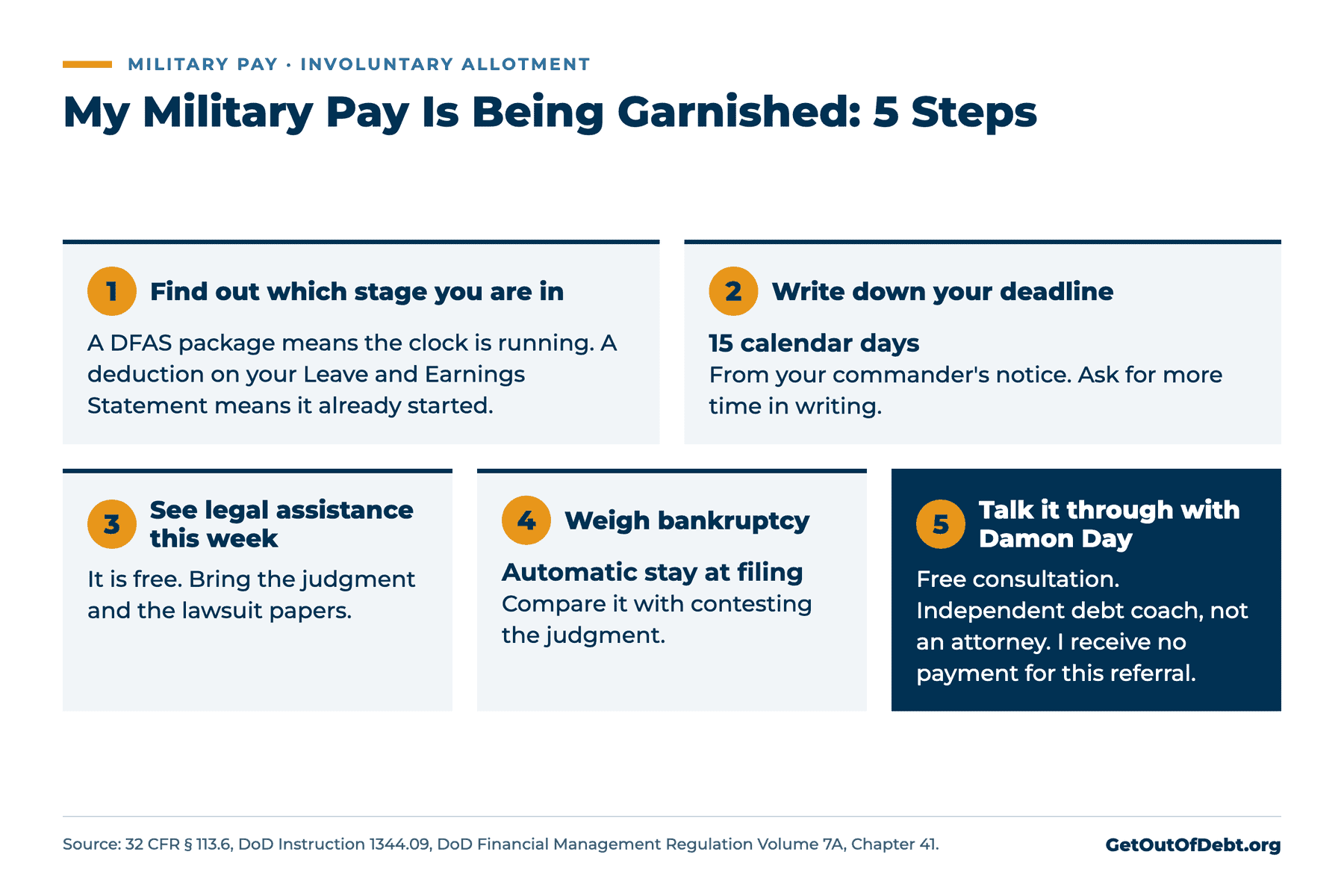
- Find out which stage you are in. Pull your latest Leave and Earnings Statement and gather every piece of paper: the DD Form 2654 package, the judgment, the lawsuit papers. A DFAS package means you are in the notice window, so go straight to step 2. A deduction you didn’t set up means the allotment is already running, so steps 3 and 4 are your road, and you ask DFAS to cancel or suspend it. A phone call with nothing in writing may mean there is no judgment yet, but a default judgment can be entered without you seeing the papers, so have legal assistance check the court records now.
- Write down your deadline and ask for more time, in writing, if you need it. You have 15 calendar days from receiving your commander’s notice to complete Section IV. For good cause the commander may extend that, normally by up to 30 calendar days, and longer during deployment, war, national emergency, assignment outside the United States, or hospitalization. DFAS’s own due date is 90 days from its mailing, and automatic processing can begin 15 calendar days after the due date or the approved extension.
- See a legal assistance attorney this week. It’s free. Military legal assistance offices advise servicemembers at no charge; use the Air Force-run legal services locator, which lists stateside offices. If you are not Air Force or you are overseas, ask your unit, ask your installation legal office, or call Military OneSource at 800-342-9647. Bring the judgment, the lawsuit papers (summons, complaint, proof of service), and the allotment package. Ask three questions: Did the court follow the Servicemembers Civil Relief Act before it entered the judgment? Was I deployed or otherwise unable to appear? Is the amount and the creditor right? Those map straight onto the defenses below, and you must back each one with evidence.
- Weigh bankruptcy if this is one debt among many. The automatic stay takes effect the moment you file. Not weeks later. Send DFAS and your commander a copy of the filing right away, and if you have had a bankruptcy case dismissed before, tell the attorney, because that can limit the stay. DoD’s own regulation lists a bankruptcy discharge, or the stay that comes with a filing, as a reason DFAS must deny or stop an allotment. NACBA can help you find a bankruptcy attorney, and the 2-minute bankruptcy quiz shows whether the math points that way. If one small judgment is the whole problem and you have a real defense, fighting it may beat filing. I would run both numbers before deciding.
- Talk the whole picture through with Damon Day. Schedule a free consultation with Damon Day, an independent debt coach (not an attorney) and my podcast co-host. I receive no payment for this referral.
How to Actually Stop It — Your 4 Paths
- Bankruptcy (the fastest option when this is one of several debts). The stay under 11 U.S.C. § 362(a) bars enforcing a judgment and collecting a pre-filing claim, and DFAS is told to treat it as a legal impediment. Send DFAS proof of the filing, the same way you would prove any other defense, and check your next Leave and Earnings Statement to confirm the deduction stopped. There is military-specific relief too: under 11 U.S.C. § 707(b)(2)(D) the court may not dismiss or convert a case based on the means test for a “disabled veteran” as federal law defines it (not every VA rating qualifies) whose debts arose primarily during active duty, or for a Guard or Reserve member called after September 11, 2001, to active duty of at least 90 days, while on that duty and for 540 days after release. That Guard and Reserve exemption is temporary and Congress has extended it more than once, so the attorney needs to confirm it still applies on the day you file. That limits dismissal on means-test grounds; it does not guarantee you any particular bankruptcy outcome. A bankruptcy attorney has to check whether you qualify.
- Contest the allotment on the grounds DoD recognizes. The regulation lists these: the court didn’t follow the Servicemembers Civil Relief Act; exigencies of military duty kept you from appearing; the application is false or wrong in a material way; the judgment was satisfied, superseded or set aside; the judgment was materially amended or partly paid; or a legal impediment exists, such as a bankruptcy discharge or stay, or a creditor who isn’t the real judgment holder. The CFR also allows other appropriate reasons if you clearly explain them. If your defense is exigencies, your commander makes that call, and the creditor then has 60 days from the date DFAS mails its notice of that decision to appeal. Behind all of this sit the court tools: 50 U.S.C. § 3931(g) lets you reopen a default judgment if military service materially affected your defense and you have a real defense, and § 3934 lets a court stay execution of a judgment and stay or vacate a garnishment when military service materially affects your ability to comply. Whether a § 3934 order reaches a DFAS allotment is a question for your attorney, and this guide does not say that it does, so file the DFAS defense too. If a court reopens and sets aside the judgment, send DFAS the order, because a judgment that was set aside is a listed ground for stopping the allotment.
- Negotiate, and get it in writing. A creditor who applies for an allotment certifies that it will promptly tell DFAS to stop once the judgment is satisfied and will refund any overpayment within 30 days. When you settle or pay off a judgment, ask for a written satisfaction before you rely on a verbal “we’ll take care of it,” and check your Leave and Earnings Statement the next pay period.
- What WON’T work: ignoring it, or leaving it to your commander. Doing nothing hands DFAS the green light. Your commander counsels you and forwards the form; the commander does not dispute the debt for you. And a company that tells you to stop paying while it “settles” the debt has no power over the court judgment, which is what DFAS acts on, so the allotment can start while you wait.
What You Need to Know About the Limits on Taking Military Pay
Most that can be taken: the lesser of 25% of your pay subject to allotment or your state’s garnishment maximum (32 CFR § 113.4)
To complete Section IV of the DD Form 2654 after your commander’s notice, unless the commander extends it
DFAS’s due date for the completed form to come back, counted from the date it mails the notice. Your own deadline is the 15 days above.
Retired pay and your allowances, such as the housing allowance, are not subject to involuntary allotment
The 25% is not 25% of everything you take home. It is 25% of “pay subject to involuntary allotment,” which the regulation defines as basic pay, special pay (including enlistment and reenlistment bonuses), incentive pay, the basic-pay part of accrued leave, readjustment pay and severance pay, minus income tax withholding, FICA, Servicemembers’ Group Life Insurance and a few other mandatory deductions (32 CFR § 113.3(c)). Allowances paid under titles 10 and 37 of the U.S. Code are left out. Child support and alimony get priority: if they are already being taken, the combined total can’t exceed the cap, and the commercial allotment gets reduced or stopped. DFAS processes competing applications first come, first served.
One thing to watch once it starts: the regulation says an involuntary allotment is enforced ahead of voluntary ones when your net pay can’t cover everything. DFAS cancels voluntary allotments in a set order, and you are allowed to choose which discretionary ones to cancel. Check what is still being paid out, such as payments to family, rent or a home loan, so one allotment doesn’t quietly cause a missed bill somewhere else.
| Your situation | What a private judgment creditor can do | Notes |
|---|---|---|
| Active duty, or Guard/Reserve on orders over 180 days | Apply to DFAS for an involuntary allotment after a final judgment | Lesser of 25% or the state limit; notice, defenses and commander review apply. DoDI 1344.09 defines who counts. |
| Guard/Reserve on shorter orders, with a civilian job | The allotment process is written for the 180-day-plus group; your civilian paycheck is garnished like anyone’s | Federal civilian cap: the lesser of 25% of disposable earnings or the amount above 30 times the federal minimum wage (15 U.S.C. § 1673). Ask legal assistance how your specific orders count. |
| Retired military | No involuntary allotment of retired pay; the DoD manual says a retired member may not be deprived of pay by civil process of garnishment | Exceptions are child support/alimony and federal tax levies. Money in your bank account is a different question: see below. |
| VA disability or other VA benefits | Nothing: they are “exempt from the claim of creditors” (38 U.S.C. § 5301) | A Treasury rule also protects up to two months of directly deposited VA benefits from an account freeze. Exceptions: VA’s own claims under its benefit laws, and IRS levies. See my VA disability post. |
| Debt owed to the federal government | Collected through different federal rules, not this process | DoDI 1344.09 excludes it. DFAS overpayments, federal student loans. |
If you live in a state with special protections — the allotment formula uses “the maximum percentage of pay subject to garnishment proceedings under the applicable State law.” This guide does not say which states limit that percentage, so ask legal assistance before you rely on a state rule. How that plays out for a servicemember whose home state, duty station and court are in different places is a question for your legal assistance attorney, and it is worth raising. My state-by-state garnishment table shows each state’s rules, and the complete guide on wage garnishment covers the civilian version.
What This Means for Your Command and Your Clearance
I’ll be straight with you about the part that scares servicemembers most. DoD’s policy is that members are expected to pay their “just financial obligations in a proper and timely manner,” and its instruction says that a failure to pay one “may result in a claim or an appropriate disciplinary action.” DoD defines a just obligation as a debt you acknowledge with no reasonable dispute, or a judgment that conforms to the SCRA, so I won’t tell you your command has no interest in a judgment. But “may result” is not “will result,” and the regulation also tells commanders to counsel you and point you to financial and legal help. Responding on time, with a defense or a documented plan, is how you show you aren’t ignoring it.
Clearances work from a separate list. An older federal guideline on finances for clearance decisions, still printed in 32 CFR § 147.8, names “a history of not meeting financial obligations” and “inability or unwillingness to satisfy debts” as concerns. It also lists what can mitigate them: conditions largely beyond your control (job loss, a medical emergency, divorce), receiving counseling with clear signs the problem is under control, and a good-faith effort to repay creditors or otherwise resolve the debts. That guideline has since been replaced (2017) by a newer one, SEAD 4, whose text I did not check, so treat this as a guide to what adjudicators weigh, not the current text. A judgment you are visibly dealing with reads very differently from one that sat there for a year. Ask your security manager how your case would be viewed, because I can’t know that.
One more protection worth knowing. If a collector, rather than the original creditor, has been calling your chain of command, that is a problem: the Fair Debt Collection Practices Act bars a debt collector from discussing your debt with anyone but you, your attorney, a credit bureau, the creditor or the creditor’s attorney without your consent or a court’s permission, and DoD’s instruction tells commanders the same thing. There is one carve-out: contact “reasonably necessary to effectuate a postjudgment judicial remedy,” which is why a DFAS filing after a judgment is not itself a violation. See what to do when a collector calls your job.
If a collector is contacting your command, threatening you with a garnishment that doesn’t exist, or lying about what it can take, file a complaint with the CFPB and your state attorney general. The CFPB also keeps a page of resources for servicemembers, veterans and military families, and the Justice Department’s Servicemembers and Veterans Initiative is a guidance resource on your rights. If you need legal help but can’t afford an attorney, find free legal aid through LSC.gov, or start with your installation legal assistance office, which costs you nothing.
Steve’s Take
I filed bankruptcy in 1990. I won’t pretend to know what it is like to have your commander handed a copy of your debts. What I do know is the shame: the sense that you did something wrong and the whole unit can see it. You didn’t. A judgment is a piece of paper, and this system has a notice period, a list of defenses, and free lawyers built into it. Debt is math wrapped in emotion. Read the paperwork, hit the deadline, and put the numbers on the table before the fear decides for you. Whether that means contesting it, settling it, or filing bankruptcy, deal with it and look to the future rather than spend five years repairing the past. The people who responded on time had options. The ones who ignored the envelope got what the regulation says happens when there is no response.
Frequently Asked Questions
A creditor is garnishing my military pay — can I stop it?
Often, yes, and the options depend on the stage you are in. If you are still in the notice window, you can contest on the grounds the regulation recognizes (32 CFR § 113.6), backed with evidence. If the allotment is already running, you can ask DFAS to cancel or suspend it by giving it legally sufficient proof that one of those grounds applies. Filing bankruptcy also stops enforcement through the automatic stay. A free legal assistance attorney can tell you which one fits.
How much of my military pay can a creditor take, and does my state’s law change that?
The most a commercial allotment can take is the lesser of 25% of your pay subject to involuntary allotment or the maximum percentage of pay that could be garnished under the applicable state law (32 CFR § 113.4). DFAS describes it as 25 percent of disposable pay. This guide does not say which states limit wage garnishment for consumer debts. The applicant must certify that your pay could be garnished under state law if you were a civilian employee, so ask your legal assistance attorney how your state’s rule applies to you before you rely on a state rule.
Can a debt collector call my commander or my chain of command about my debt?
Not without your consent or a court’s permission, if it is a debt collector covered by the FDCPA, and DoD Instruction 1344.09 says the same about third-party contact. The exception for contact “reasonably necessary to effectuate a postjudgment judicial remedy” means DFAS paperwork after a judgment is not a violation. A creditor collecting its own debt is generally not covered by the FDCPA, which is why the state attorney general and the CFPB are worth contacting too.
I’m a military retiree — can a creditor garnish my retirement pay?
Not through the involuntary allotment process: DoD’s regulation excludes retired pay (32 CFR § 113.3(c)), and the DoD Financial Management Regulation says a retired member may not be deprived of pay by the civil process of garnishment, except for child support and alimony and federal tax levies. That protects the pay at DFAS. Once it lands in your bank account, state account-exemption rules decide what a judgment creditor can reach, and the Treasury’s automatic protection for benefit deposits covers payments from only four agencies (Social Security, VA, Office of Personnel Management and the Railroad Retirement Board) (31 CFR § 212.3), not DFAS pay. See what to do when a bank account is frozen.
Can a creditor take my VA disability pay?
Generally no. VA benefits are “exempt from the claim of creditors” and not subject to attachment or levy “by or under any legal or equitable process whatever” (38 U.S.C. § 5301), with exceptions for the government’s own claims under those benefit laws and for IRS levies. Keep VA money in its own account if you can, because mixing it with other deposits makes a freeze harder to untangle. My post on VA disability and collectors has the details.
I filed bankruptcy — how fast does it stop the allotment?
The automatic stay takes effect the moment you file, but DFAS acts on proof, so send it the filing information and keep the confirmation. DoD’s regulation lets DFAS cancel or suspend an allotment at any time if the member shows it shouldn’t continue, and it lists a bankruptcy filing as a legal impediment. Check your next Leave and Earnings Statement, and if a deduction shows up after you filed, have your bankruptcy attorney call DFAS the same day. I cover creditors who won’t quit in a creditor is still collecting after I filed.
I was deployed and never knew about the lawsuit — can I undo the judgment?
Possibly. Before a court enters a default judgment the plaintiff must file an affidavit about your military status, and if you were in service the court may not enter judgment until it appoints an attorney to represent you (50 U.S.C. § 3931). If a default judgment was entered during your service, or within 60 days after, the court must reopen it on your application if your service materially affected your defense and you have a meritorious defense, and the application is due no later than 90 days after your service ends. If you got the allotment notice instead of the lawsuit, that is one of the defenses on the DD Form 2654. Also see a creditor violated my rights while I was deployed.
Does the 36% military loan cap or the 6% rate cap help me here?
Neither appears by name on DoD’s list of allotment defenses, but either may matter to what you owe. For covered borrowers and covered loans, the Military Lending Act caps the APR at 36% and voids a prohibited agreement from the start, and it makes it unlawful for a creditor to require you to set up an allotment as a condition of the loan. The SCRA’s 6% cap applies to debts you took on before service, and during your military service (for a mortgage, the statute can run longer; ask legal assistance). To get it you must give the creditor written notice and a copy of your orders no later than 180 days after you leave service. If either applies, ask legal assistance whether it changes what you owe. My posts on the 36% cap and the 6% cap letter explain each.
One more thing — everything I share here is based on 30 years of helping people through exactly this. But my advice is input for your decision, not the decision itself. Only you know your full situation. Talk to an attorney, look at your numbers, and make the choice that serves your future.
Important: This guide is for informational purposes only and is not legal advice. Laws vary by state, and your situation may have details that change what options are available to you. For legal advice specific to your case, consult an attorney licensed in your state, your installation’s legal assistance office, or a free Military OneSource legal consultation. NACBA can help you find a bankruptcy attorney, NACA can connect you with a consumer attorney, or schedule a free consultation with Damon Day, an independent debt coach and my podcast co-host — I receive no payment for this referral.
Key Takeaway: Military pay garnishment is serious but not permanent, and it comes with a notice period, a short list of defenses and free legal help. Write down your deadline today, get the package to a legal assistance attorney this week, and use the Find Your Path quiz to see the whole picture. If you are still in the notice window, waiting moves you toward the automatic-processing date. If money is already coming out, ask legal assistance today about contesting it; waiting costs you pay.
The Bottom Line
You are not bad with money because a creditor won a judgment. Moves, deployments and pay surprises are part of service life, and the process you are in has notice and defenses built into it. The servicemembers who answered the notice on time had choices; the ones who let it sit gave those choices away. If someone you know is serving and a letter from DFAS just arrived, send them this page — the clock on that letter is shorter than most people think. See the complete set of crisis guides and take the Find Your Path quiz if the judgment is only part of the problem.
Dealing With Debt? Understanding your options is the first step. See how all your debt relief options compare — including ones most sites won’t tell you about. The Find Your Path quiz gives a recommendation based on your actual numbers, and the Scam-O-Meter checks any company’s complaint history before you sign. Federal Reserve Bank of New York research shows bankruptcy filers recover faster than those who don’t file.
Right now you are dealing with the thing in front of you, and that is exactly where your attention belongs. When it is handled — and it will be — there is a next stage, and it is the one I most enjoy writing about.
In the latest issue (Nov 13): The shelf price isn't always what you pay
Each weekday I send one short email: one story that caught my attention, why it might matter to you, and one manageable thing you can do with it. It is free, I sell nothing, and I take no money from any company I write about.



