

Quick Answer: In a new Penny Stupid Project video, Damon Day asks whether Walmart Spark has changed its curbside offers after he kept seeing general merchandise deliveries bundled with grocery pickups at his local stores over Halloween weekend. The offer he highlights bundles 26 stops and 51.6 miles. Here is the part I care about: an offer like that is a gross number. At the IRS mileage rate, the 51.6 miles alone take about $39 off the offer, and my estimate of self-employment tax takes about $5 more, which leaves roughly $31 before income tax and before a single minute of time is counted. That is a hypothetical subtraction I ran, not anything Damon said, and the figures in his video are one driver’s local offers, not what anyone should expect to earn.
No sense wasting a perfectly good mistake, and no sense accepting a big number before you know what it costs to earn it. Debt is math wrapped in emotion, and a delivery offer with 26 stops on it is the same thing wearing a gig-app badge.
I co-founded The Penny Stupid Project with Damon in 2022 as a public experiment in side hustles, and Damon runs it now. It lives on YouTube as @pennystupid, and Damon is the one who does the driving in these videos. I tell you that every time I feature one, because you deserve to know where I stand before you weigh my opinion. Damon is also my podcast co-host, and he runs his own debt-coaching practice at damonday.com, the first link in the channel’s own description. I receive no payment for featuring this video or for sending you to his site. One more thing in the interest of full disclosure: the description of this video points viewers to his site and to this one, listed as independent debt education. Nobody paid for that placement either, and it doesn’t change what I’m about to tell you.
The video, Did Walmart Spark Just Kill Curbside Delivery?, was posted November 3, 2026 and runs 10 minutes and 59 seconds.
Each weekday I send one short email: one story that caught my attention, why it might matter to you, and one manageable thing you can do with it. A couple of minutes, and a dad joke.
In the latest issue (Nov 6): Owed money on an Amazon return? Check by Dec. 1
Free. I sell nothing. Unsubscribe any time.
What the Video Covers
One thing you should know about how I built this one. YouTube would not give me the video’s captions the day it was posted, so I could not read a transcript. Everything below comes from the title, the description Damon wrote, and the chapter list he published with it. I have not described anything beyond what those say, and there is no transcript section on this page. Watch the video above for what is actually said in it, because the video is the record. Nothing here is a quotation of anyone.
The Pattern He Says He Saw
By his description, Damon spent Halloween weekend noticing general merchandise deliveries bundled together with curbside grocery pickups at the stores near him. Curbside grocery work is the kind of Spark order where you shop or collect groceries and bring them to a customer. A general merchandise delivery is a different kind of order: non-grocery items, not a basket of food. His question, which is also the title, is whether Spark changed how it handles curbside.
He is careful about the limits of that question, and I want to repeat them. The description says this is what he observed locally and is not confirmation of a nationwide change or of what Walmart intends. I have not checked this against anything from Walmart or from drivers in other cities. It is one driver’s reading of the offers on his own screen.
His Theory About the Incentives
Two chapters in the list are about why, in his view, these offers look the way they do. One is titled “My theory about the bonuses,” and the description says he explains a theory about stacked incentives. I am not going to guess at what the theory is, because the description does not spell it out and I could not read the captions. If you want his reasoning, that is a reason to watch the video.
The Offers, and Why Shopping Still Looks Different
The description says he walks through the actual offers he saw and compares them with a shopping order he would have taken. The offer it names is $75.44 for 26 stops and 51.6 miles. A later chapter is titled “Shopping still looks different,” and the one after it is “Why I stopped chasing the bonus.” The video closes by asking viewers whether they are seeing the same thing in their area and whether their curbside offers have changed.
Stops in the bundled offer the description names, offered and not an earnings result
Miles in that same offer, per the description
The posted offer for those 26 stops, a gross figure shown on a screen before miles, time or taxes
These are one driver’s local numbers from one video’s title and description. They are not typical pay, an average, or a projection. Check them against the video before you rely on any of them.
The Arithmetic That Comes Out First
Gross means before anything is subtracted. For delivery drivers, what comes out includes the miles you drive, the wear on the car, gas, and taxes. An offer is also not a payout: the final amount can change with tips and with what the app actually pays.
The IRS’s own standard business mileage rate is 76 cents a mile for July 1 through December 31, 2026. It is the IRS’s stand-in for what gas, tires, maintenance, insurance and depreciation cost per mile. It is not a measurement of anyone’s actual costs, but it is a fair yardstick for a driver who hasn’t tracked their own.
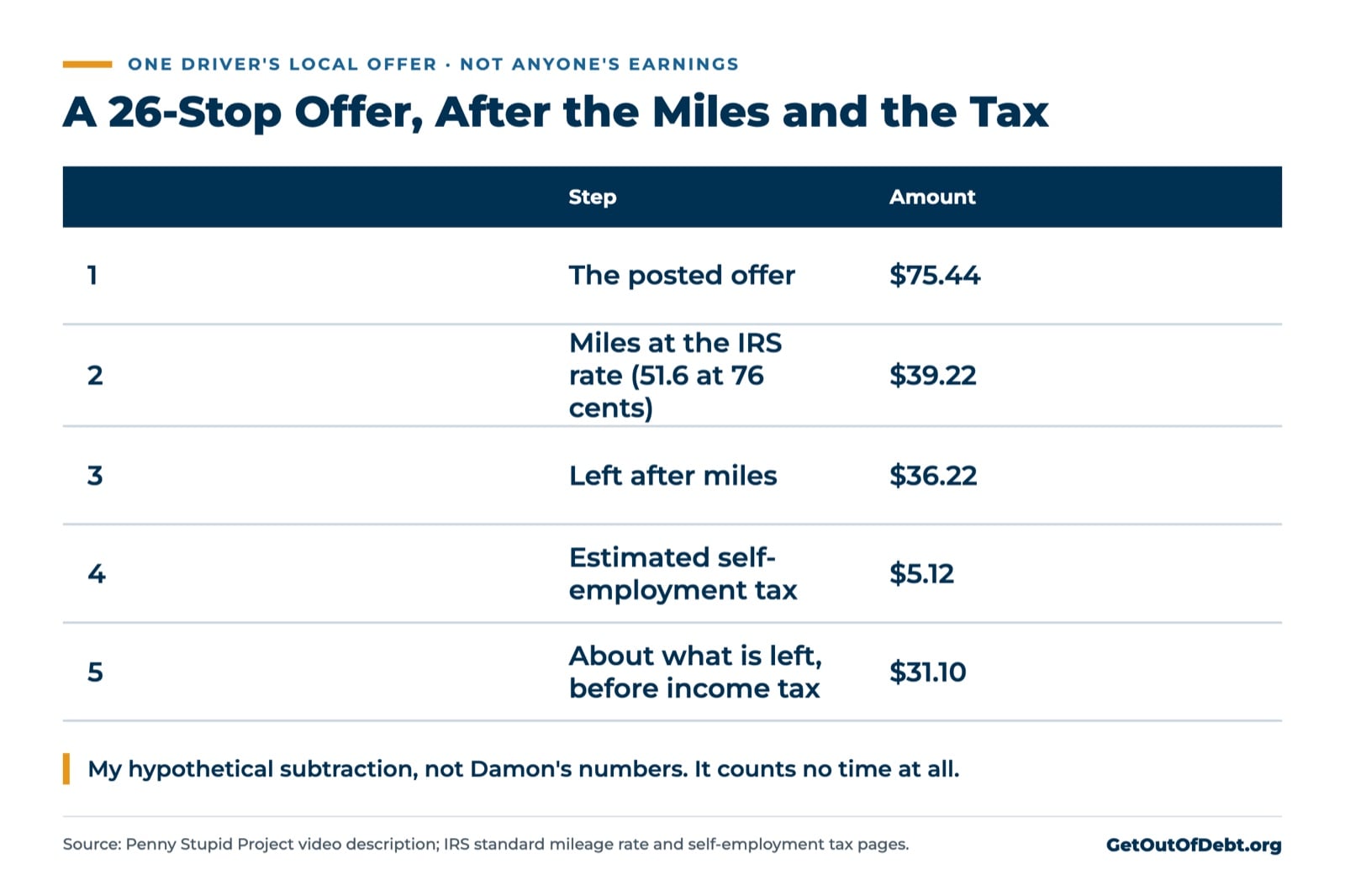
The 26-Stop Offer, Subtracted One Step at a Time
The gross. $75.44 for what the description calls 26 stops and 51.6 miles.
Take out the miles. At 76 cents a mile, 51.6 miles is $39.22. That leaves $36.22. If the 51.6 miles does not include the drive back to where you started, or to your next job, the real number of miles is higher and the leftover is lower, so check what your own offer counts.
Take out self-employment tax. The IRS says the self-employment tax rate is 15.3%, and that the amount subject to it is generally 92.35% of your net earnings. Applied to what is left after the miles, that is about $5.12. This is a simplified illustration that assumes you deduct miles at the standard rate, and I’m not a tax professional, so your own figure will differ.
What is left. About $31.10. That is before federal and state income tax, before the phone and the data plan, and before counting any time at all. Spread over 26 stops, the gross offer is about $2.90 a stop. Spread over 51.6 miles, it is about $1.46 a mile gross, which is the number to hold up against that 76 cent yardstick. And 26 stops take real minutes, so the offer has to be worth that stretch of your day and not just the dollars.
This is the same reason I tell people to price an offer by what it costs to earn it. A big total can hide a small per-mile or per-stop number, and a bonus layered on top of a long route can make the screen look better than the arithmetic does.
What the Video Teaches, in My Words
This part is my commentary, not Damon’s, and I’m not putting words in his mouth.
- Divide before you accept. A total is only half the story. Divide it by the stops and by the miles, then compare the per-mile number with a yardstick like the IRS rate.
- An offer is not income. $75.44 on a screen is a gross offer until it is paid, and bonuses layered on top can make a long route look better than it is.
- Local is local. Damon is careful to say he is describing what he saw at his own stores. A pattern in one metro area is a prompt to look at your own offers, not a rule about the whole company.
- Time is a cost you do not see on the screen. A route with 26 stops uses up an evening or an afternoon. What else could that stretch have done for you?
- Tax money is not your money. If you do this as self-employment, a slice of every gross payout belongs to the IRS, so set it aside as you earn it instead of finding out in April.
When Gig Work Meets Debt
The video’s description says that making extra income only helps when the numbers work, and it points people to his site for the debt side. I agree with the framing. Extra income can help close a short gap, and some people use gig work exactly that way. But it only gets you out of debt if the amount you keep, after miles, wear, time and taxes, is larger than what you owe, and delivery work is a slow way to move that number. Quick Cash for Bills: Myth vs Reality is the honest version of that question, and Side Hustles for Debt: When They Help and Hurt is where the Penny Stupid Project started.
Before you count gig work as ongoing income, especially income you’re relying on to get out of debt, track what you actually keep over a full week, not the best offer you saw one weekend and not one bundle in a video. Count your miles and your minutes, and set money aside for taxes. If the math says delivery work won’t get you where you need to go, that is useful information and not a failure on your part. Sometimes the faster, cleaner answer is a different tool entirely, like a hard look at whether bankruptcy fits. You are not your debt, and you don’t have to drive your way out of it if the numbers say otherwise.
The Chapter List From the Description
This is the chapter list Damon published in the video’s description, reproduced as titles only. I could not pull the captions, so I am not summarizing what is said under each one. The timestamps are his; watch the video for the content.
- 0:00 – Did Spark change curbside?
- 0:18 – My theory about the bonuses
- 1:58 – The offers I saw
- 4:18 – A three-hour tour
- 4:34 – $52 and the return drive
- 6:14 – More miles, more stops
- 7:06 – $75.44 for 26 stops
- 8:07 – Shopping still looks different
- 8:42 – Why I stopped chasing the bonus
- 10:37 – Are you seeing this too?
More From the Side Hustle Archive
I’ve been writing about this project since it started in 2022. A few pieces that pair well with this video:
- Damon Day Passed on a $41 Walmart Spark Order for a $28 One. Here’s the Per-Mile Math. — what a per-mile floor looks like in practice
- Damon Day Tried a 10-Stop Walmart Spark Delivery. Here’s the Math After Miles and Tips. — what a many-stop Spark route does to the numbers
- Damon Day Misread Walmart Spark’s Sapphire Tier. Here’s What He Corrected. — how the Spark rewards tiers are counted
- Why Do You Recommend Damon Day as a Debt Advisor? — where I stand on my podcast co-host, and a reminder that I receive no payment for linking to it
- Side Hustles: When They Help and When They Hurt — the honest boundaries of what a side hustle can fix
- Side Hustle Success: What It Means and What to Do — the mindset piece behind the math
Key Takeaway
Damon Day’s video asks whether Walmart Spark changed its curbside offers, based on what he saw locally over Halloween weekend. The useful part for you is how to price any bundled offer: the miles at the IRS rate, the self-employment tax, and the time it takes, all taken out of a gross number before you decide it was worth it. My own hypothetical subtraction puts a $75.44 offer for 51.6 miles near $31 before income tax. The figures here are one driver’s local offers and my own arithmetic. They are not a promise and not a plan.
This is what I’m telling friends like you over coffee. But remember, you do you. Take it as input and make the call that fits your own life.
If someone you know is thinking about gig work to catch up on their bills, send them this before they accept their next bundled offer. Share this with a friend who drives for an app, because the math on a long route is worth running before you tap accept.
Common Questions
Who is Damon Day, and what is The Penny Stupid Project?
Damon Day is my podcast co-host and an independent debt coach, and his own site is damonday.com, listed first in the channel’s description. The Penny Stupid Project is a public side-hustle experiment I co-founded with Damon in 2022, and Damon runs it now. It lives on YouTube as The Penny Stupid Project. I tell you I helped start it so you know where I stand. You can read why I recommend Damon in Why Do You Recommend Damon Day as a Debt Advisor? I receive no payment for featuring his video or for recommending him.
Did Walmart Spark kill curbside delivery?
I can’t tell you that, and neither does the video claim to. Damon’s description says what he describes is what he observed locally, not confirmation of a nationwide change or of Walmart’s intentions. I have not verified anything from Walmart. If you drive for Spark, compare your own curbside and general merchandise offers over a few weeks before drawing a conclusion.
Is a 26-stop, 51.6-mile offer worth taking?
It depends on what it actually costs you to earn it. Take the offer and subtract the miles at the IRS rate of 76 cents a mile, then the self-employment tax, and then ask what the time is worth to you. On my hypothetical numbers a $75.44 offer for 51.6 miles leaves about $31.10 before income tax, and fewer dollars if the drive back is not counted in those miles. Whether that is worth it depends on the hours it takes and what else you could have done with them.
What does it mean that an offer is gross?
Gross means before anything is taken out. For a delivery driver that leaves out the miles you drive, the wear on the car, gas, the phone and data plan, and the self-employment tax you owe on what you keep. An offer is also not a payout, since the final amount can differ from what first appears on the screen.
Can gig work help me get out of debt?
It can help close a short-term gap, and some people use it that way. Whether it can take you all the way out depends on what you keep after miles, wear, time and taxes compared with what you owe. If the math says it won’t, other options exist, and I lay all of them out in the debt options comparison, including bankruptcy, which I rate highest across credit, collections, speed and retirement.
Dealing With Debt? Understanding your options is the first step. See how all your debt relief options compare — including ones most sites won’t tell you about. The Find Your Path quiz gives a recommendation based on your actual numbers, and the Scam-O-Meter checks any company’s complaint history before you sign. Federal Reserve Bank of New York research shows bankruptcy filers recover faster than those who don’t file.



