

Quick Answer: A class-action lawsuit filed in late October 2026 in Barton County District Court in Kansas alleges that U.S. Sen. Roger Marshall and his former practice, Heartland Regional OBGYN, charged patients an 18% annual interest rate on unpaid medical bills, above the 15% limit the lawsuit cites under Kansas law. Those are allegations, not findings, and no court has ruled. The consumer lesson holds no matter how the case ends: most people never look at the interest line on a medical statement, and if you owe a doctor or hospital, you can find it, ask for it in writing, and in some cases get it removed.
Expert Context: When I ran a credit counseling organization, medical bills showed up in client files all the time, and the line people had read least was often the small one: interest, a finance charge, a “service fee.” People knew the balance. They didn’t always know why it wasn’t going down. I’m not a lawyer, and I haven’t seen the complaint in this case, so I’ll stick to what the reports say, what the law says, and what you can do with your own bills.
A former patient has sued a sitting U.S. senator and his old medical practice, alleging that patients were charged 18% interest on unpaid bills. Nothing has been proven. But the number on the front page is not the point. The point is the small line on your own statement, and you can check it in about ten minutes.
Key Terms Defined
Usury: Charging more interest than the law allows. The lawsuit’s first claim is common-law usury, citing Kansas statute K.S.A. 16-207, which sets a 15% cap on written interest agreements unless the law authorizes more.
Each weekday I send one short email: one story that caught my attention, why it might matter to you, and one manageable thing you can do with it. A couple of minutes, and a dad joke.
In the latest issue (Nov 6): Owed money on an Amazon return? Check by Dec. 1
Free. I sell nothing. Unsubscribe any time.
Financial Assistance Policy (FAP): The written free-or-discounted-care policy that a tax-exempt (nonprofit) hospital must have under 26 CFR 1.501(r)-4.
Extraordinary Collection Action (ECA): The heavy tools, including lawsuits, arrests, wage garnishment, liens and credit reporting, that a nonprofit hospital facility may not use until it has made “reasonable efforts” to find out whether you qualify for assistance. The list is in 26 CFR 1.501(r)-6(b).
Free Tool — Wage Garnishment Calculator: Worried about your paycheck being seized? The free Wage Garnishment Calculator shows exactly how much creditors can legally take in your state — and some states prohibit garnishment entirely. Calculate My Risk →
Here’s What You Need to Know: What the Lawsuit Alleges
According to the Kansas Reflector, as carried by KCUR, a class-action usury lawsuit was filed on Thursday in Barton County District Court. The report is dated October 30, 2026, so I read that Thursday as October 29; the article does not print the date, and I have not seen the complaint. It accuses U.S. Sen. Roger Marshall and his former Great Bend practice, Heartland Regional OBGYN, of routinely charging patients illegal interest rates on unpaid medical debt. The lawsuit calls the alleged practice a “callous and predatory” debt-collection scheme and alleges that he frequently assessed 18% annual interest, above Kansas’ 15% statutory limit. The lead plaintiff, Meischa Zimmerman, was an obstetrics patient in 2009. She says the practice sued her over a $3,596 bill for the delivery of her child, plus 18% annual interest. The Times reported that she was arrested three times for missing court dates in that case.
The Kansas Reflector report lists four claims: common-law usury under K.S.A. 16-207, unjust enrichment, breach of the implied covenant of good faith and fair dealing, and breach of fiduciary duty. The plaintiffs ask the court to certify a class, and they seek restitution, damages and pre- and post-judgment interest at a jury trial. Marshall declined to comment to the Kansas Reflector and referred questions to his communications team.
Here is the background, as The New York Times reported it. The Times found in September that Marshall, over a 25-year career as an obstetrician-gynecologist, sued more than 700 patients over unpaid bills, and that in at least 81 of those cases patients were arrested after missing court dates. It also reported that Steven Johnson, a lawyer who filed Marshall’s debt cases, told the paper the 18% rate was set by the doctor’s office. In a text message Johnson wrote: “Generally, at the time of services for all our clients if they were not paid up front, the Debtor agreed to an 18 percent interest rate.” He called it “common practice” and “pretty much the way it works in the state of Kansas.” The Times said it had not been able to review the original patient contracts, which are decades old.
I care about the question this lawsuit raises for everyone else: is there a rate on your medical bill that you never noticed?
What I could not confirm: I could not locate the complaint itself, so everything above about its contents comes from news reports. No court has ruled on whether any rate was unlawful, and the defendants’ formal response isn’t in the reports I found.
Here’s Why You Need to Know It: Interest on Medical Bills Is Easy to Miss
Nobody sets out to sign up for interest on a doctor bill. You sign a stack of intake papers while you’re worried about something else, you get a bill later, and you start paying what you can. If a rate was written into one of those papers, it can run quietly for years, and small monthly payments can end up covering mostly interest. You can check your own bills for that in two minutes.
The Claim: “If the interest rate was in something I signed, it must be legal.”
The Reality: Signing a paper does not by itself make a rate lawful. Kansas’ own statute says anyone who contracts for a rate above the limit “shall forfeit all interest so contracted for in excess of the amount authorized under this section,” and that this “may be set up as a defense or counterclaim in any action to enforce the collection of such obligation” (K.S.A. 16-207(d)). That is one state’s statute, and the same text carves out several kinds of transactions, including consumer credit transactions governed by Kansas’s consumer credit code. The Times noted that Kansas has exceptions that can allow a higher rate when a contract spells it out. Whether the 15% cap, or one of its exceptions, governs a patient’s medical bill is exactly the kind of question the court in this case will have to answer. I’m not going to guess, and you shouldn’t either: ask for the document and the legal basis.
One more point matters if you’re reading this about a hospital bill. Everything I’m about to say about the financial-assistance application window (at least 240 days) and refunds comes from federal rules for tax-exempt hospital facilities. A hospital facility, in those rules, is a facility a state requires to be licensed, registered, or similarly recognized as a hospital (26 CFR 1.501(r)-1(b)(17)). A private doctor’s practice isn’t licensed as a hospital, so I am not saying those rules governed the practice in this lawsuit. They do govern a bill from a nonprofit hospital, and a hospital’s assistance policy must list which doctors and other providers working in the hospital it covers and which it does not (26 CFR 1.501(r)-4(b)(1)(iii)(F)). A doctor’s separate bill may or may not be covered. Read that list.
Here Are Some Things to Consider
- Interest isn’t automatically illegal. Some bills carry agreed-upon interest, and some states allow it up to a cap. What matters is the rate, the paper that created it, and the law in your state.
- Rates vary a lot by place. Kansas’ statute sets 15% for written interest agreements, with exceptions. The District of Columbia passed a law this year that, per Orrick’s summary, caps interest on medical debt at 3% a year, although, per that September 2026 summary, its operative requirements don’t start until six months after D.C. includes its fiscal effect in an approved budget (I covered it in this post on D.C. and hospital financial assistance). I haven’t verified a rule for your state, so look it up or ask a legal aid office.
- Nonprofit hospitals have a different set of rules. If the bill is from a tax-exempt hospital, the assistance application window runs, at the least, until the 240th day after the first post-discharge billing statement (26 CFR 1.501(r)-1(b)(3)), and a hospital may accept an application after that. The hospital also has to hold off on lawsuits, arrests, garnishment, liens and credit reporting until it has made reasonable efforts to check your eligibility, which includes waiting at least 120 days from the first post-discharge statement (26 CFR 1.501(r)-6).
- If you paid and later qualify, there can be a refund. The federal regulation gives a hospital a safe harbor for charging an eligible patient more than the allowed amount before the patient applied, but one condition is that, if the patient later applies and is found eligible, the hospital refunds what the patient paid above what they owe under the policy, unless that excess is under $5 (26 CFR 1.501(r)-5(d)). I’m not claiming that rule automatically wipes out interest. That is a request you make, and you should make it.
- A court date is not optional. The Times reported patients arrested after missing court dates in at least 81 of Marshall’s collection cases. Whatever you think of the bill, don’t let a missed hearing turn it into something worse.
Here Are Some Things You Might Want to Think About Doing
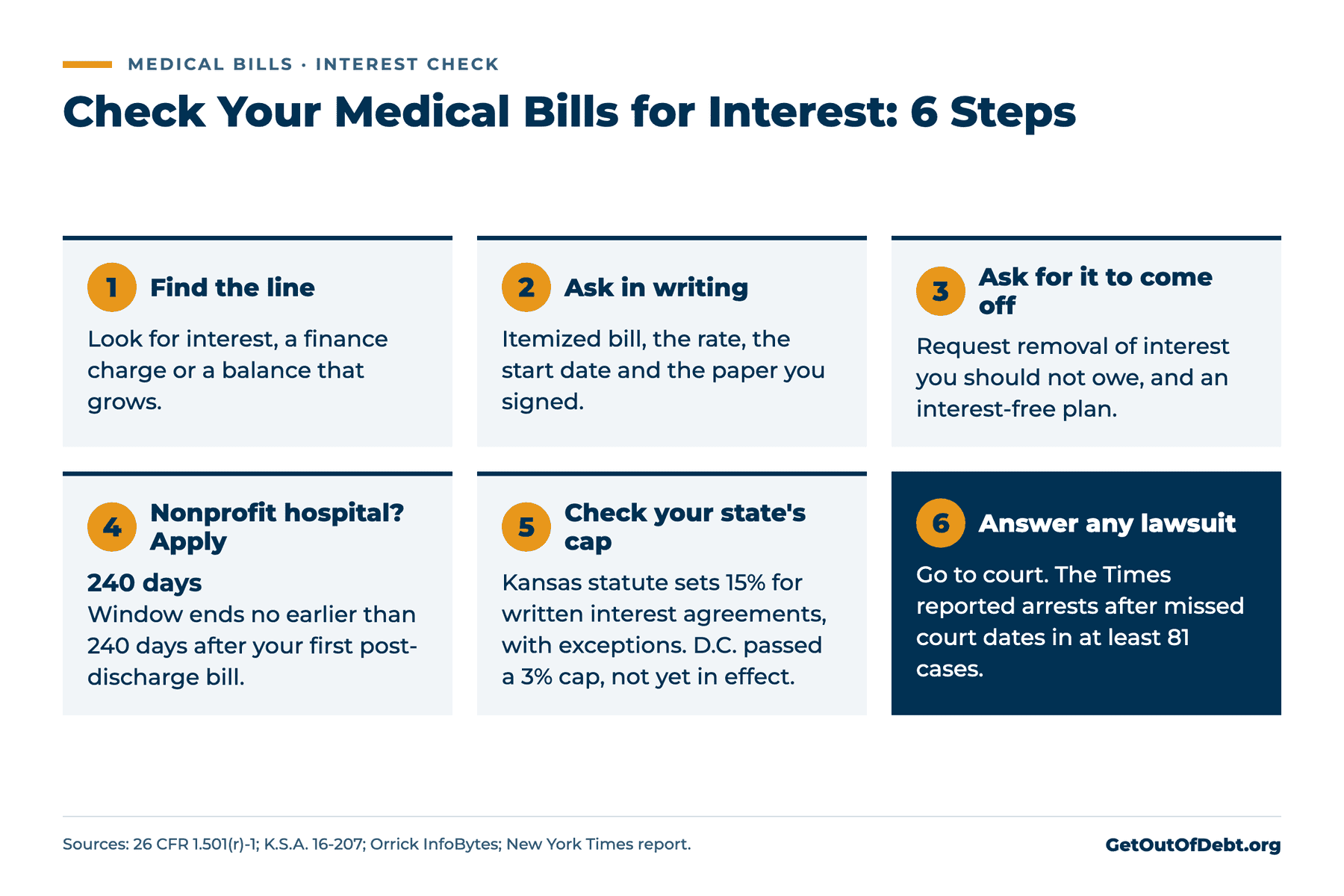
- Pull every medical statement you have from doctors, hospitals, labs and collection agencies. Look for the words “interest,” “finance charge,” “late fee,” “service charge,” or a balance that goes up when you haven’t had any new care.
- Find what you signed. Ask the billing office for a copy of the financial responsibility or payment agreement you signed at intake. If there is a rate in it, you’ll see it there.
- Ask in writing, and keep a copy. Request an itemized bill, the interest rate and the date interest began, the document that says you agreed to it, and the legal basis for the rate. Ask them to remove interest you shouldn’t owe. Send it in a way you can prove, such as certified mail or the portal with a screenshot.
- If it’s a nonprofit hospital, apply for financial assistance now. Don’t wait for them to offer. The application window ends no earlier than 240 days after your first post-discharge billing statement, and every month you wait shrinks the cushion. If you are already past that point, apply anyway: the rule lets a hospital accept an application later (26 CFR 1.501(r)-1(b)(3)). My step-by-step is in the D.C. hospital financial assistance post, and if you were already denied, read what to do when the hospital denies your charity care.
- Ask in writing for an interest-free payment plan before your next payment is due. Do not skip a payment you already owe, or a court date, while you wait for an answer. The worst answer is “no,” and then you know where you stand.
- Look up your state’s rules. Search your state’s medical debt interest limits or ask your state attorney general’s consumer office or a legal aid office. If there’s a cap and your rate is above it, put that in your letter.
- If you’re sued, answer the court papers and go to the hearing. If the lawsuit includes interest, ask a legal aid lawyer whether your state’s usury law gives you a defense. My guide is I’m Being Sued for Medical Debt: What to Do.
- If several medical bills are piling up on top of everything else, Damon Day is an independent debt coach and my co-host on the Get Out of Debt Guy podcast. I want you to know that before you decide anything, and I receive no payment for this referral. The consultation is free, and the only time money changes hands is if you decide to hire him as a consultant. Go to DamonDay.com and schedule; he doesn’t cold-call anybody, and neither do I.
Key Takeaways
- A class action filed in late October 2026 in Barton County, Kansas alleges that Sen. Roger Marshall’s former practice, Heartland Regional OBGYN, often charged patients 18% interest, above the 15% limit the lawsuit cites. These are allegations. No court has ruled.
- Whatever the outcome, check every medical statement for an interest or finance charge line, and ask in writing for the rate, the start date and the paper you signed.
- The financial-assistance application window (at least 240 days) and the refund rule apply to tax-exempt hospital facilities, not to a private doctor’s office, and a hospital’s policy lists which doctors it covers.
- If you are sued, answer and go to court. A missed hearing can make things worse.
The Bottom Line
If you’ve been paying a medical bill for months and the balance barely moves, that doesn’t mean you’re bad with money. It may mean the bill came with a number nobody walked you through. Debt is math wrapped in emotion, and the math on a medical statement is easy to avoid looking at because the emotion is so loud. Look anyway. Ask for the rate, ask for the paper, and ask for relief in writing. I filed bankruptcy in 1990 and rebuilt, and I know that looking at the numbers honestly is where the way forward starts. You are not your debt, and you’re allowed to ask what you were really charged.
Frequently Asked Questions
Is 18% interest on a medical bill legal?
It depends on your state’s law and on what you agreed to in writing. The lawsuit against Sen. Roger Marshall and Heartland Regional OBGYN alleges that 18% exceeds Kansas’ 15% limit under K.S.A. 16-207, but no court has ruled, and whether that statute covers a patient’s medical bill is a question for the court. Other places set different limits, such as the District of Columbia’s new 3% cap on medical debt interest, which became law, though, per a September 4, 2026 summary, its operative requirements don’t start until six months after D.C. includes its fiscal effect in an approved budget. I have not checked whether a later budget did that.
Can a doctor or hospital charge interest on what I owe?
Sometimes. Whether interest can be charged, and how much, depends on your state’s law and on any agreement you signed. That is why I tell you to ask for the signed document, the rate, the date interest started and the legal basis for it, in writing.
How long do I have to apply for financial assistance at a nonprofit hospital?
Under federal regulation, a tax-exempt hospital facility must accept and process an application until at least the 240th day after it sends your first post-discharge billing statement, and it may accept one later (26 CFR 1.501(r)-1(b)(3)). Ask the billing office for the exact deadline in your hospital’s policy.
If I already paid a hospital bill and later qualify for assistance, can I get money back?
Possibly. The federal regulation gives a hospital a safe harbor for charging an eligible patient more than the allowed amount before the patient applied, on the condition that it refunds payments above what the patient owes under the policy once the patient applies and is found eligible, unless the excess is under $5 (26 CFR 1.501(r)-5(d)). You have to apply and be found eligible first, and the rule covers nonprofit hospital facilities, not private doctor’s offices.
What happens if I ignore a lawsuit over a medical bill?
Ignoring it can let the other side win by default. The Times reported that patients were arrested after missing court dates in at least 81 of Marshall’s collection cases. Answer the papers, go to the hearing, and call a legal aid office if you can’t afford a lawyer.
This is what I’m seeing after 30 years of helping people with debt, and it’s what I’d tell my own family. I’m not a lawyer, and the lawsuit I described is still just allegations. Take this as one informed perspective, because only you know your whole situation. Use it as input for your decision, not as instructions. Nobody gets to tell you what to do with your money. Not me, not anyone.
If you know someone who keeps paying on a doctor or hospital bill that never seems to shrink, send them this. A balance that grows while you pay it deserves a second look, and sometimes one question to the billing office is all it takes.
Dealing With Debt? Understanding your options is the first step. See how all your debt relief options compare, including ones most sites won’t tell you about. The Find Your Path quiz gives a recommendation based on your actual numbers, and the Scam-O-Meter checks any company’s complaint history before you sign. Federal Reserve Bank of New York research shows bankruptcy filers recover faster than those who don’t file.



