

Quick Answer: High school financial education may not be worth it, as students who take full money management courses actually score worse on financial exams than those who don’t take personal finance classes. The lack of effectiveness likely stems from teaching financial concepts when they aren’t relevant to students’ current lives.
In what feels like a never-ending series of debunking articles about financial topics, like why a 15-year mortgage is less safe than a 30-year mortgage, here is another installment, this time about financial education.
Typically financial education classes are touted as some sort of inoculation that can be given to high school students to prepare them for the real world. The secret is that financial education does not prove to be effective for high school students.
In fact, students that have to take a full money management course have scored worse on financial exams than students that did not take a personal finance class. And I’m not alone in this observation, even the academics that study this issue have observed the same problem.
Each weekday I send one short email: one story that caught my attention, why it might matter to you, and one manageable thing you can do with it. A couple of minutes, and a dad joke.
In the latest issue (Nov 9): Check your power bank and your French press
Free. I sell nothing. Unsubscribe any time.
We have long noted with dismay that students who take a high school course in personal finance tend to do no better on our exam than those who do not. This finding has been a great disappointment to consumer educators and to those who support efforts to make courses in personal finance a requirement for high school graduation, and it points to the need for better materials and teacher training. Source: The Financial Literacy of Young American Adults – 2008
My theory is that financial education is shoved down the throats of students when it is not relevant and not at the optimum teachable moment. It is hard to grasp the concepts and realities of the elements of financial education when it has no relevance in your life. It’s a lot like making kids take driver’s education classes years before they can get in a car and drive.
Quite frankly, high school students that had access to a stored value Visa or MasterCard and were shown how to use it properly would be much further ahead than those that only book facts thrown at them.
Even according to the results of students that took a full semester of money management class. the failure rate among high school students of all grades was about the same, except for freshmen that excelled at failing the financial literacy tests.
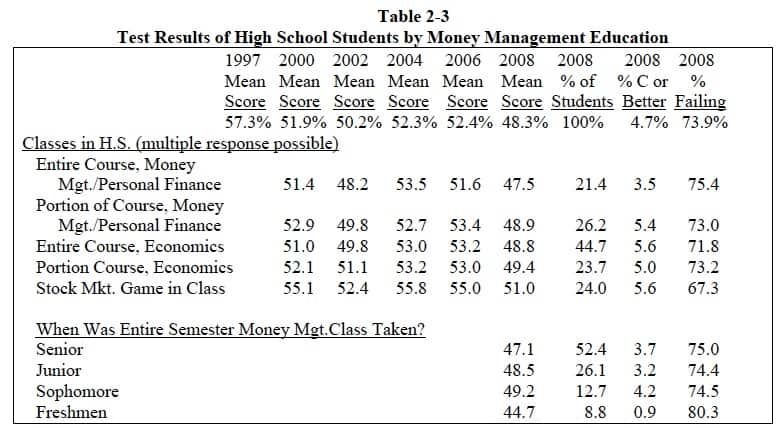
Rather than continue to encourage states to invest in money management education programs that do not prove to be effective, better use could be made of the millions of dollars each year spent on financial education and the number of teacher and student hours that are invested in order to achieve a 75% failure rate.
Financial education for young adults needs to be re-examined to determine what, if anything, is going to provide basic financial education in a cost-effective way with much better results. What is being delivered now, isn’t working.
Get Out of Debt Guy – Twitter, G+, Facebook
Dealing With Debt? Understanding your options is the first step. See how all your debt relief options compare — including ones most sites won’t tell you about. The Find Your Path quiz gives a recommendation based on your actual numbers, and the Scam-O-Meter checks any company’s complaint history before you sign. Federal Reserve research shows bankruptcy filers recover faster than those who don’t file.



Financial Education For High School Students Does Not Work and Could be a Waste of Time and Money http://tinyurl.com/mwmy3c